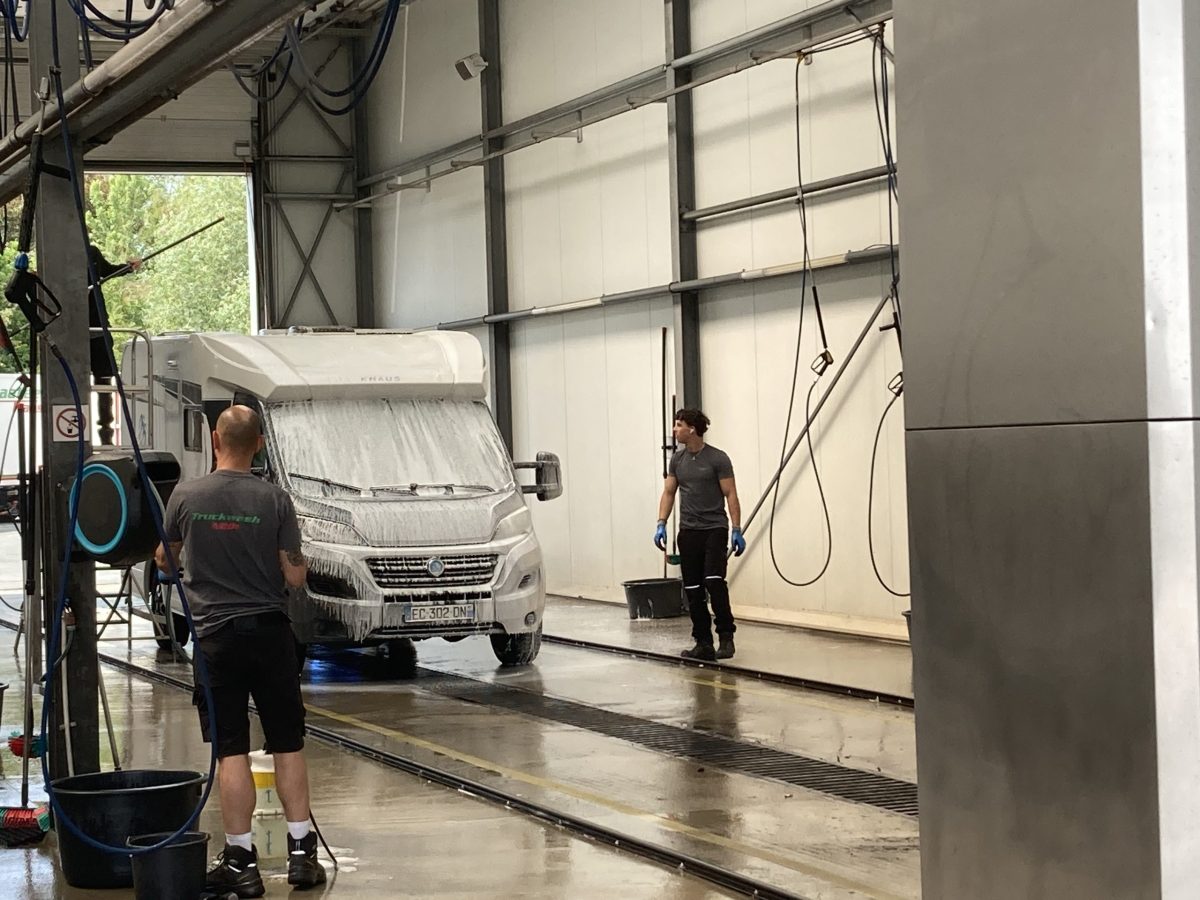
Another trip is in the books. It is one of our shortest since we began touring Europe by RV. Our end of the trip routine is pretty set now, a couple of days to clean up the inside and packing followed by a trip to the truck wash for a good cleaning before putting François in storage for the summer.
This trip we visited two new countries for us in Slovakia and Hungary. Slovakia was a country we knew little about and we thoroughly enjoyed our visit. Hungary we had higher expectations and we were very happy. Ton had visited Budapest before, but it was a first for me and I now see why it is on everyone hot list for tours. It was a fantastic city and one of the most beautiful in Europe. The rest of Hungary was scenic and we really enjoyed ourselves. We also spent more time in Czechia and found the countryside and smaller cities to be charming. Vienna was also new to me, and it is an impressive wealth of culture.
We discovered good wine in Slovakia that we had never heard of, and confirmed what we had heard about the good wine in Hungary. The beer in Czechia also didn’t let us down. The food in central Europe is hearty and plentiful, but we still prefer southern European food.
It was a cold trip until the last week but also one of the driest. Spring traveling is always a roll of the dice, but in this case we came out pretty positive.
We haven’t locked onto a location for our fall trip, though Ton seems to have Spain on her mind. Stay tuned.
Today is our last day of fun on the trip. Tomorrows agenda is packing up, getting François an overdue bath, and heading to storage. But since we got most of the work done yesterday to prepare for storage, Ton agreed that we could go into the center for a last day of fun.
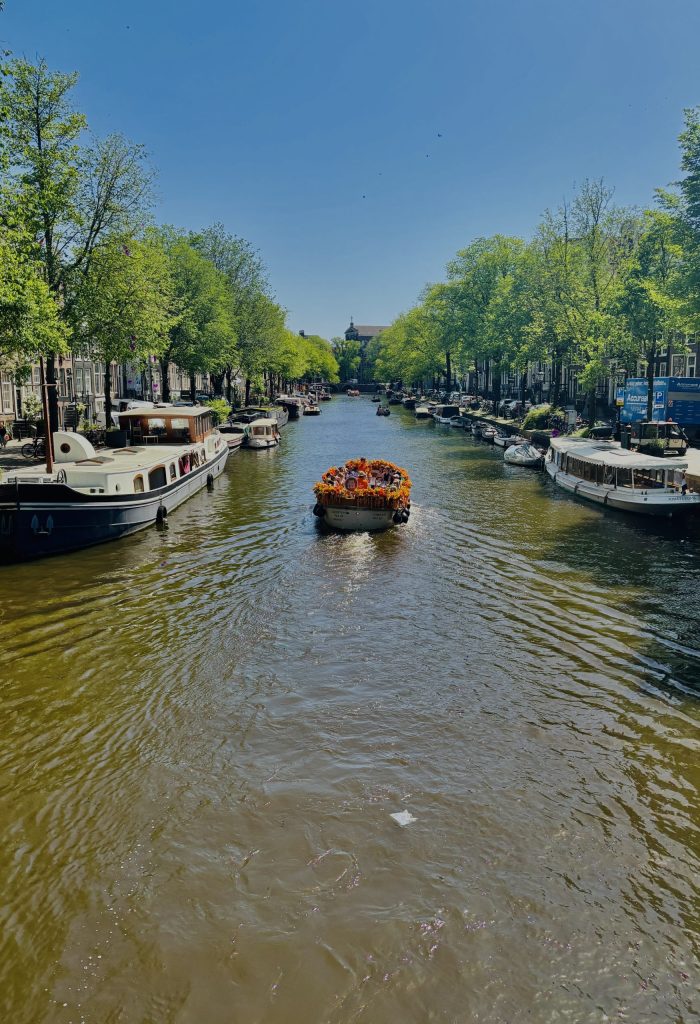
The canal boats were out decked out in Tulips. I guess it is the season.
The reason we base out of the campsite in Gaasperplas is it is a 10 minute walk from the metro station. Plus it is the first/last stop of the M53 line so it makes navigating easy. Today we got off at the Nieumarket stop to head for a pastry shop Ton had picked out.
A Thai restaurant well decked out.
The city looked a little worst for wear after the long weekend. City workers were out in force cleaning up the debris from the party that must have been Whitsunday weekend. The first place was about 20 minutes from the metro stop but was not what we were expecting. Ton had a back up which was about 20 minutes from that place, but it was also not what she was expecting. I was hoping for some of the famous apple pie the Netherlands is famous for. I mentioned a place that looked promising, it was about 25 minutes from where we were. When we got there it didn’t look good either. So after over an hour of walking on the hottest day of the year, (part of the reason we headed into the city was to find some cool air) we hadn’t found anything.
Our new favorite bar in Amsterdam.
We decided to give up on pastries and apple pies and head to a bar we like for a cold beer. After a short 10 minute walk we arrived at the bar, and it was closed. At this point we were close to giving up but Ton saw a bar that looked promising across the street and we went in. We were met with an empty bar, but a blast of cold air-conditioned air so we were hoping for the best. The bartender came in and asked what we wanted so we had found our place.
Beer, bitterballen, and apple pie. The healthy persons lunch! Ank in the background went above and beyond to get the apple pie.
Our bartender was named Ank which couldn’t be more Dutch, but she was a treat. The bar was everything we expected from Amsterdam 6 good beers and lots of wood and old curiosities. Ank told us her clientele was still 80% Dutch with just enough foreigners mixed in to make it interesting. She asked about our day and Ton told her about our failed quest to find apple pie. A couple of minutes later she said I have an idea, and left us alone in the bar. About 5 minutes later she returned with an apple pie, she said her friends mother in law made it. Now that is service beyond the call of duty. The apple pie was delicious and the atmosphere and company made this the most memorable meal of the trip. A good end to the day.
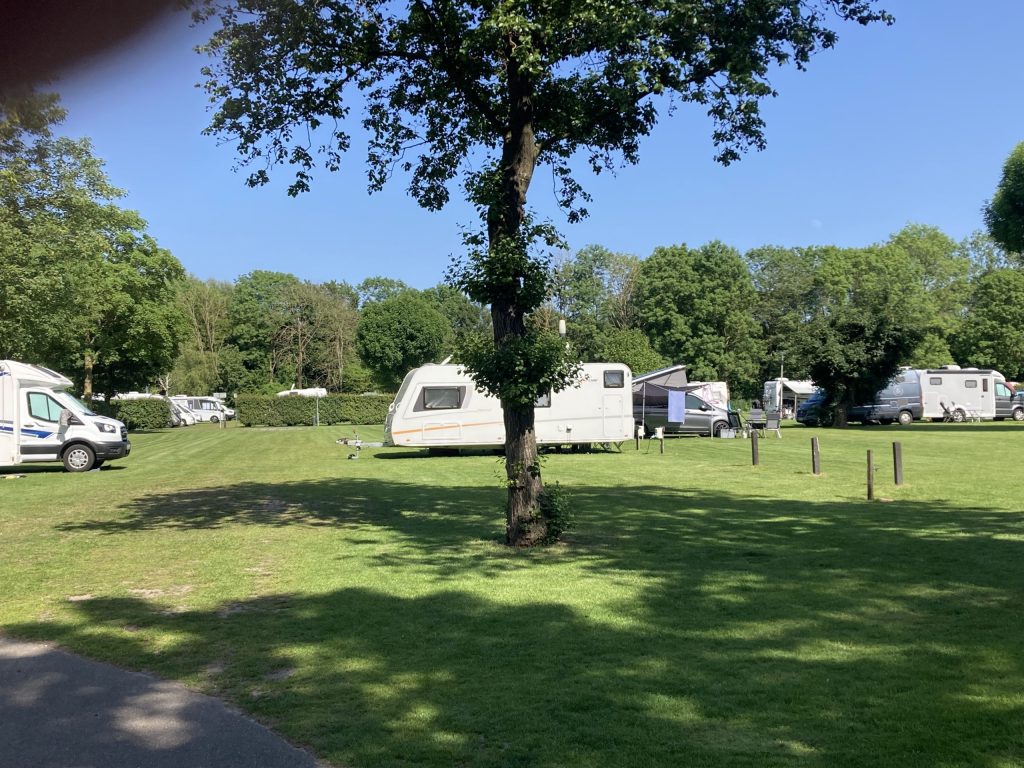
Today we spent the morning watching the Witsunday exodus from the park. There was a steady stream of motorhomes and caravans going by our spot by the entrance in the park. Yesterday all 496 places in this large park were occupied. This evening there are maybe 125 places occupied.
What a difference a day makes. If you compare these two pictures you can see the difference.
Our experience in the last week convinced us that we could never enjoy Europe in the summer. Having to book each and every stay would take all of the joy and spontaneity out of traveling. Plus campgrounds teeming with people are not relaxing for us.
We spent most of the day packing for our trip home on Thursday. As usual Ton packed and I stood by to occasionally help hand her things or move heavy bags once they were packed. We are about 90% there and still have a day and a half to go so I have proposed a sojourn to downtown Amsterdam tomorrow. Ton is thinking on it.
Well Whitsunday weekend beat us. We like to travel in François so we have flexibility in where we go. This weekend our ability to just show up was taken from us. Our original plan of traveling slowly across Germany from Friday to Sunday was overcome by events and we ended up in a hotel on Saturday night. The first time this has happened in 8 years of traveling here.
We woke up in the morning and started looking for a place we could stay in ever increasing arcs from where we were. We didn’t trust stellplatz’s as we expected they would be full. After checking about 10 different places we checked the place we end our trips at in Amsterdam and already had a place booked for tomorrow and they showed a spot available today so we booked it and relaxed until check out time in the hotel.
A completely full campground.
The drive was busy and at one point Ton said I don’t think anyone in Germany or the Netherlands is staying home. We arrived at the large campground near Amsterdam and were assigned spot number 469. There are 470 spots in this campground and they are all full.
As we were driving Ton looked up Whitsunday and it is a minor Catholic holiday but it falls in May and appears to be the beginning of summer holiday much like Memorial day in the US. In our previous 7 years of traveling it had never bothered us which is why we were caught so off guard. But, I do remember last May we were surprised when our off the beaten path campground in the Ardennes in Belgium suddenly turned into Woodstock. It was Whitsunday. So from now on we have a new planning point for our travels in the spring. Book a place for Whitsunday weekend in advance if we are in western Europe!
In our 8 years of travel we have been pretty lucky, today not so much. As I said yesterday we learned that it is a long weekend for Germany, Netherlands, and Belgium. We were lucky yesterday that our campground in Erfurt let us stay, but we had to move on this morning.
Our plan was to drive to Aachen and head to a large Stellplatz there. Stellplatz’s are first come first served. We were up bright and early and on the road at 8am. It was supposed to take 4 hours to Aachen, but traffic was heavy and about 25% of the route today was under construction. So we didn’t make great time.
We rolled up to the Stellplatz at about 1:15 and saw the dreaded sign out on the road-full. A quick look at our camping act showed a cluster of 5 campgrounds just over the border in the Netherlands so we thought we have 5 chances. The first one was full, the second one was also full but the nice lady there than called 4 other campgrounds for me to see if she could find us a place but failed.
The Germans, Dutch, and Belgians have begun cracking down on what the Europeans call wild camping, or just parking somewhere discreetly for the night. In the past the police would just move you on, but now they move you on after they fine you. So while we were tempted we decided to splurge on a hotel.
That proved harder to accomplish than we expected. Part of the issue is François doesn’t fit in underground garages so we have to look carefully at the parking situation before we book a place. We spent about an hour in a parking lot looking at hotel options in the Netherlands, Germany, and Belgium before finding the place we are at tonight in Germany. Tomorrow we are going to take another crack at Aachen, but have a valid backup plan if the Stellplatz falls thru.
Our day was going to go one of two ways. At the end of the night last night we decided that if we could stay here in the campground we would for today. If we could not we were going to pick a place and hope we could get in, but be prepared to wild camp somewhere.
I was waiting at the office when they opened at 8am. While I was waiting I began to mentally decide where we would go today as taped to the door was a notice that they were completely booked today and would not be accepting any unreserved arrivals.
When the door opened I went in and said I know you are full, but is there any chance we can stay today? The lady said we are full but asked my name. She typed in her computer and said M8 (our spot in the campground), after a couple more key strokes she said today, but not tomorrow.
Our plans for the day then became doing laundry, and relaxing. Early in the afternoon we walked to the nearby mall to look for a stool to replace the one I had run over Ceske Krumlov. We hadn’t eaten lunch and instead of a stool we ended up with a bag full of food all of which looked delicious at the grocery. As they always say, don’t shop for food when you are hungry.
The rest of the day was spent lounging around François and watching the campground fill up. The plans for tomorrow are an early departure and a 4 house drive to Aachen Germany near the Dutch border.
Ton picked Erfurt because it had a medieval bridge that has homes and stores still built on it and in use. This used to be a common thing in Europe. A few cities most notably Milan still have bridges with businesses on them, but apparently Erfurt is the last place that still has people living on the homes on the bridge.
From the surface of the bridge it looks like a typical medieval street. The apartments above the stores are still residences.
I knew we were walking on the bridge, but it is difficult to tell you are on a bridge when you are crossing it. It feels like any medieval street. You have to go around back to see that it is indeed a bridge.
The bridge from behind shows the buildings that line either side of the roadway over the river.
It is not a large bridge, but during the middle ages when most cities were fortified real estate was at a premium within the walls. This caused many towns to build stores and housing on bridges. Over time this practice faded because of maintenance cost and other reasons, think about how much stuff that makes your house a home is buried in the ground. So today there are only a handful of bridges like the one we saw today.
This puppet shop specializing in recreating medieval puppets is one of the businesses located on the bridge.
We were both surprised by the size of Erfurt. The population density is much lower in Central Europe than Germany and it showed up today when Erfurt which is at best a regional city felt much more bustling and crowded than Bratislava or Brno.
A nice restaurant doing good business mid-afternoon.
We headed out to check the Cathedral and walked by one of the icons of the town Bernd das Brot. He is a character on a children tv show and is characterized by chronic depression. Ton called him the Grumpy Breadman until we learned his real name.
Posing with Bernd.
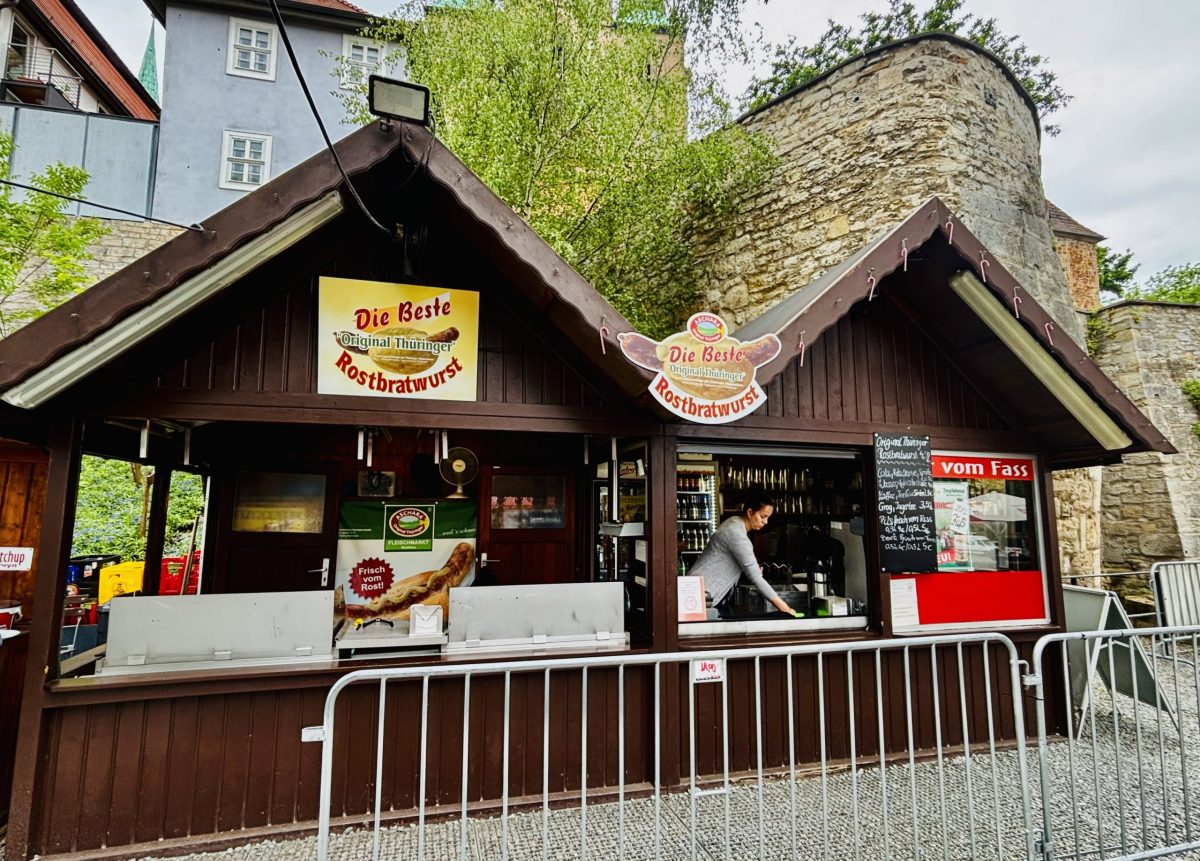
After posing with Bernd I decided to do another must do thing here which was to have a Thuringen Bratwurst. The Brats here are lower in fat than normal Brats. It was good washed down with a beer which interestingly was the Bud from Czechia and not a German beer.
The entrance to the old main department store which has been converted into a mall.
Erfurt is located in the old East Germany and despite that appears to be quite prosperous and on par with the cities further west to our eyes. There are a few reminders of the communist past including the main avenue being called Yuri Gagarin Strasse.
An image of Yuri Gagarin painted on an old Lego style apartment building.
Yuri Gagarin was a Soviet cosmonaut and the first man in space. He visited Erfurt after his flight and they named the main road after him. After the fall of communism they retained the name for the road. Ironically Gagarin never returned to space because after a fatal accident involving another cosmonaut they government decided it would be bad for the first man in space to die in a rocket accident so they sent him back to the Air Force. While retraining as a fighter pilot Gagarins Mig 15 crashed and he was killed.
Not a Soyuz capsule, but a BMW from 1962. You enter the car from the front.
We enjoyed Erfurt but decided to head back to the campground. It turned out to be a misadventure as I had us get on the right bus, but heading in the wrong direction. After a couple of stops we got off and crossed the road to get on the one going in the right direction, but the next bus didn’t come for 30 minutes it was the same bus we had got off so we might as well have gone on a city tour, the bus driver gave me a knowing nod when I waived our tickets at him. Not my best day.
We got to enjoy a bit more of Erfurt while we waited for the right bus.
When we returned to the campground I noticed that it was very full. Erfurt is not the kind of place that should fill up a campground on a Thursday in May. We had decided to move on to Frankfurt tomorrow, but I decided to check availability at the one campground in Frankfurt and found there was no room. While I looked at a couple of other places I asked Ton to see if this is a holiday weekend and it turns out it is Whitsunday and Whitmonday. So it is a long weekend both here and the Netherlands.
We may have a chance to see more of Erfurt tomorrow, if we are allowed to stay.
I tried several campgrounds on our route to Amsterdam and all of them were fully booked for the weekend. Our hope now is that they will let us extend here but we don’t even know if that is possible as we didn’t realize the problem until the office was closed.
Lots of trams in Erfurt. Not as many busses.
So tomorrow is very much up in the air. The good news if worst comes to worst we can dry camp somewhere safe for a day or two on the way to Amsterdam.
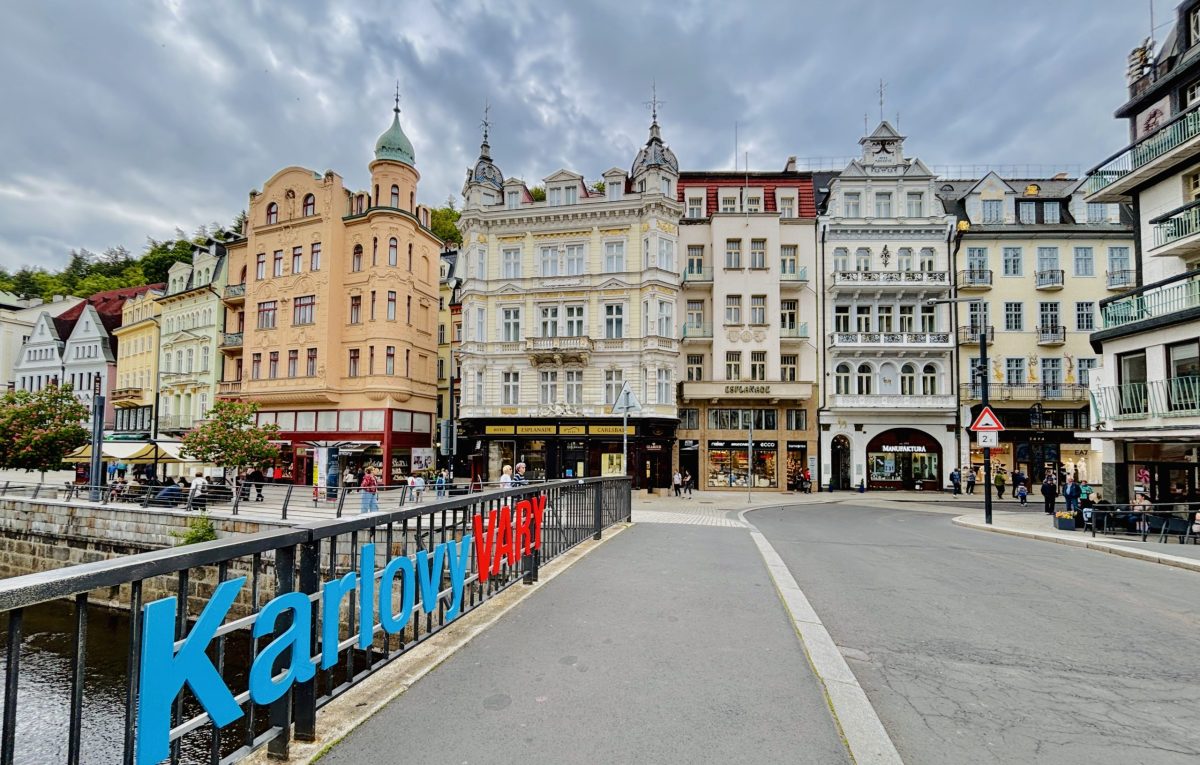
We are not spa people but decided to visit Karlovy Vary as Ton’s research indicated that it had a great number of 19th century hotels and villas that had survived both wars intact. Despite not being spa people we visited Vichy a couple of years ago and had really enjoyed it, so we wondered if our second spa visit here would be as fun.
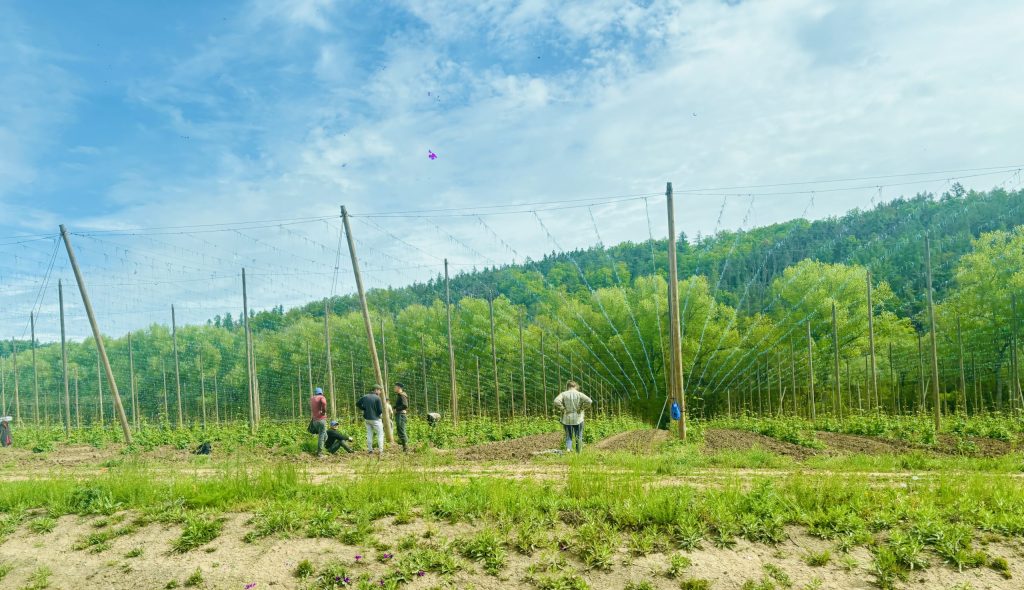
Driving over from Melnik we passed thru the main hop growing region in Czechia. So we got to see a lot of our second favorite plant.
The hot springs at Karlovy Vary got their start in the 1400’s when King Charles IV soaked his injured leg in a hot spring here and was pleased with how it healed. He then built a lodge near the spring so he could enjoy the soaks on a regular basis.
A small royal lodge eventually spawned a giant resort in the 1800’s.
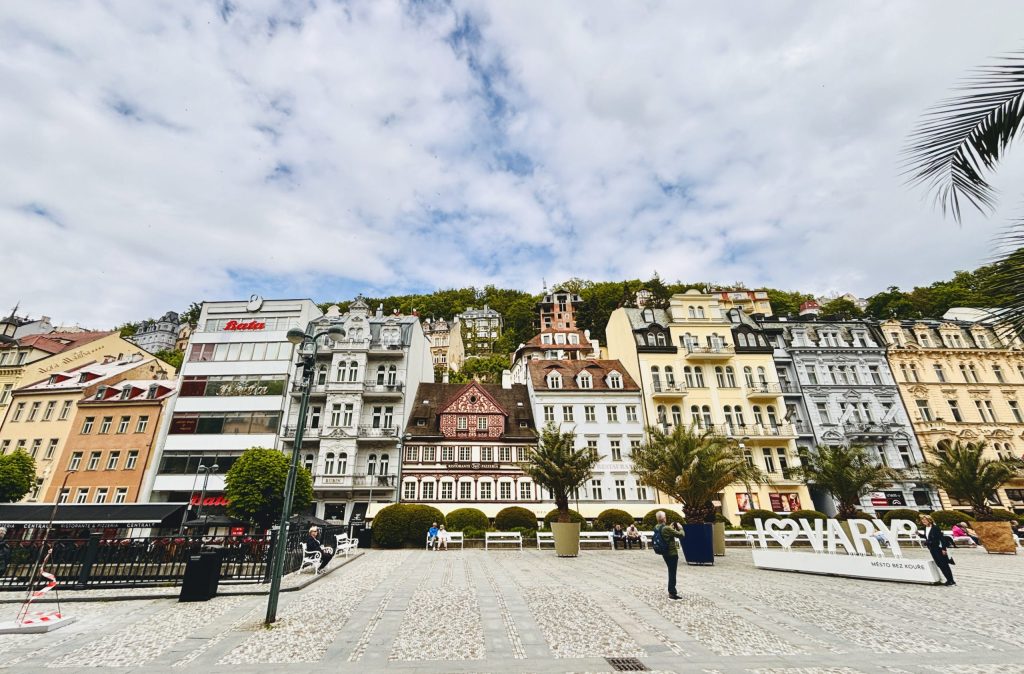
In the 1800’s spa treatments were the rage among the beautiful people of Europe and Karlovy Vary (then known as Karlsbad) went thru a boom period as one of the hot places to visit. As a result hundreds of hotels and pensions sprung up to pamper the rich and famous of that time, and they are spectacular buildings.
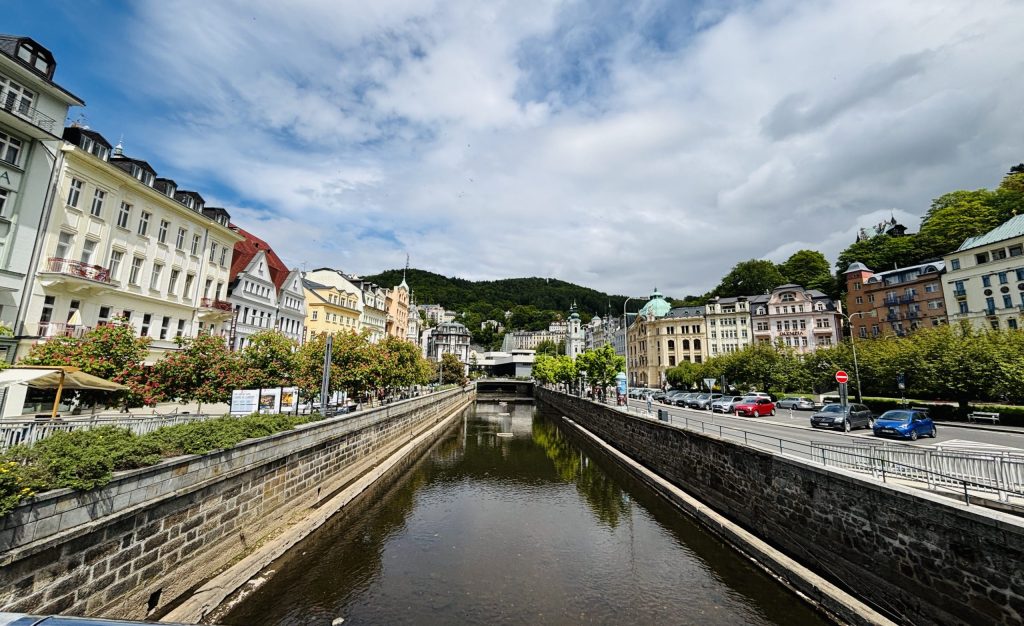
In the 1800’s hotels and villas sprung up on both sides of the Tepia River.
If you like 19th century architecture then you will be in heaven in Karlovy Vary. The promenade along the Tepia River, and the hills surrounding the town are full of gorgeous and large 19th century buildings.
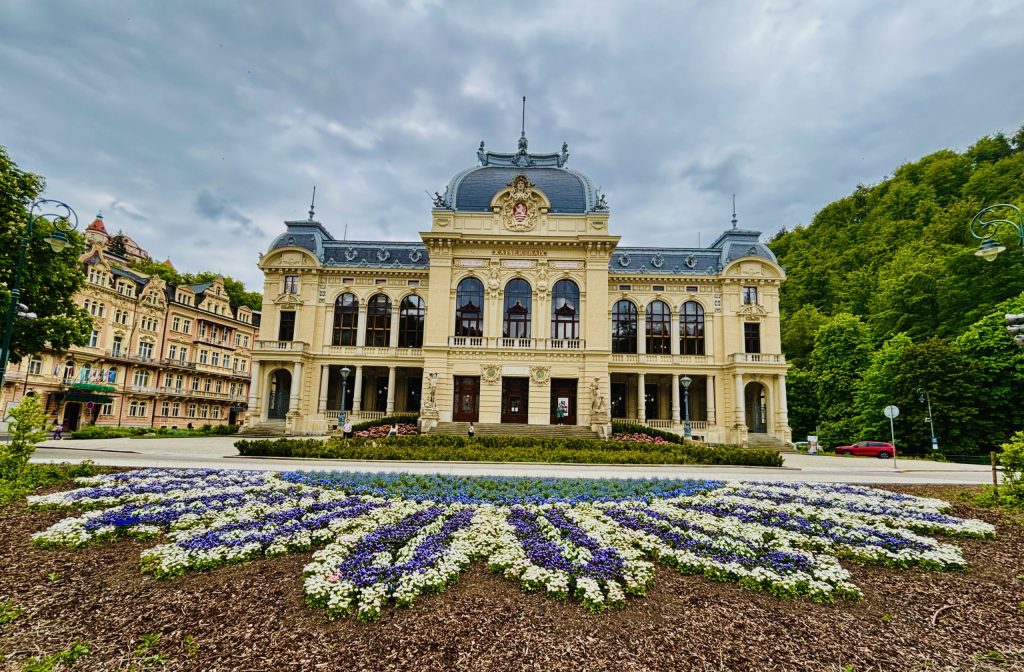
The Opera House.
After the fall of communism there has been a great deal of investment in the town and the buildings have been wonderfully restored to their original grandeur.
The coffee house at the Grand Hotel Pupp.
We decided to punch above our weight socially and dropped into the coffee shop at the Grand Hotel Pupp which is a gigantic complex at the end of the promenade. It has always been the grandest place in town since its founding. They have a walk of fame of previous guests and we got a kick out of two names side by side on the walk, John Malkovich who stayed there in 2009, and Sigmund Freud who stayed there in 1912. There was a brick available between the two of them and we wondered if we got a room whether we could claim the brick.
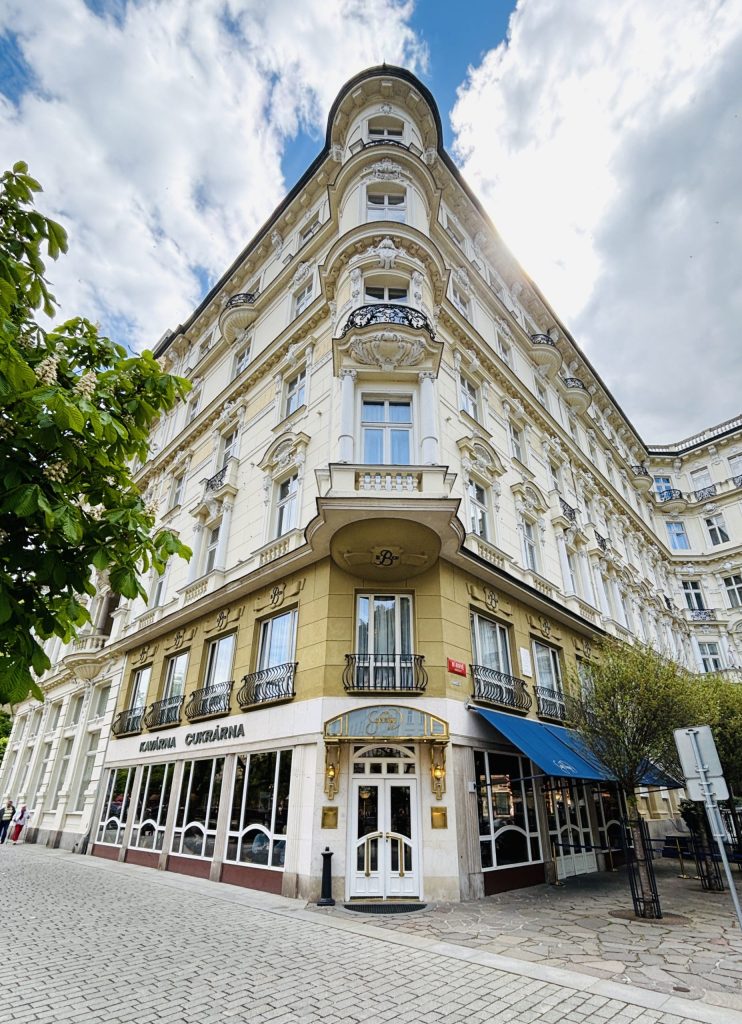
Another stunning building along the boardwalk.
Ton was very interested in sampling the waters. There are 15 springs that are located in cool buildings that you can drink from as you walk along. To make it easier you can purchase a decorated ceramic mug whose handle acts as a straw. After some careful shopping and much discussion about the size, shape, and decoration on our mug we were on our way.
Some examples of the mineral water cups.
In our walk we found about 10 of the springs without trying too hard. The temperature and the strength of the minerals varied quite a bit from spring to spring.
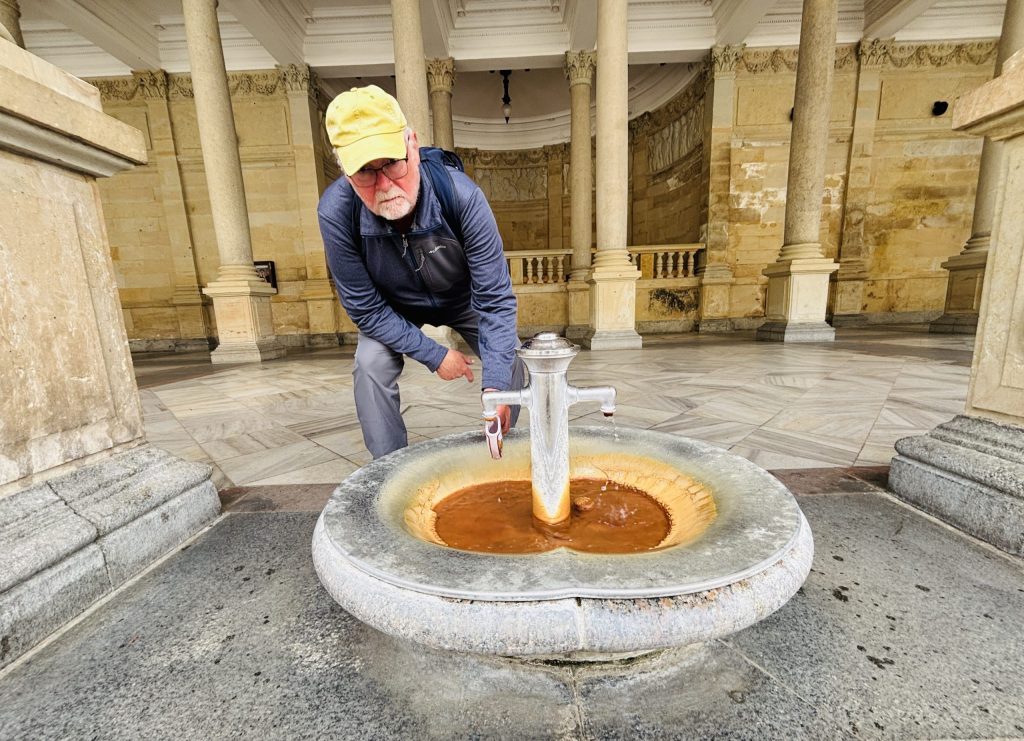
Procuring my water from one of the springs.
Most of the springs were nondescript pipes in the middle of large buildings, and we were a little surprised more people weren’t trying it. We enjoyed it, though after a while we were getting a little waterlogged.
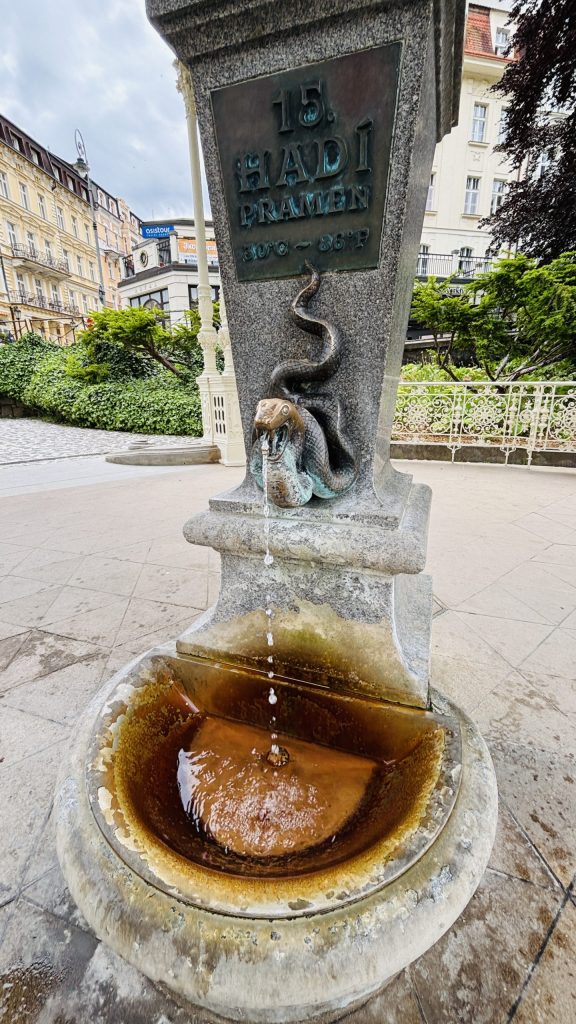
This one was the snake spring and the water is 96 degrees Fahrenheit. .
The promenade is over a mile long and with all of the buildings and springs it was great fun to walk. If you like 19th century architecture with a small dose of communist brutalist buildings mixed in for contrast you will be in heaven as we were.
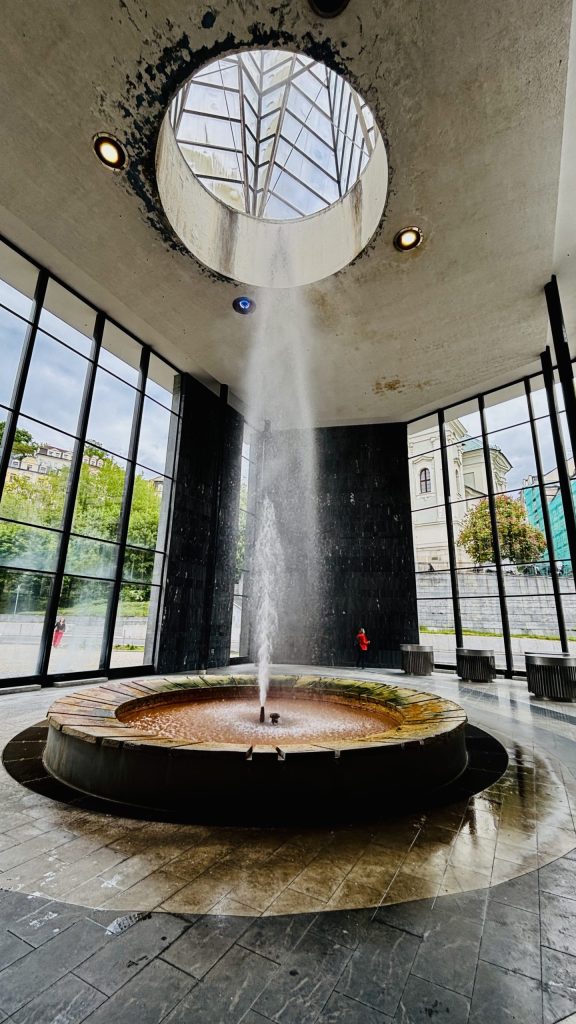
This geyser of spring water was located in one of the few communist era buildings on the promenade.
We took a couple of turns up and down the promenade. There were enough people to make it interesting, but not enough that you felt crowded. Plus Ton was entranced, she said to me at one point, everywhere you point the camera there is a beautiful building.
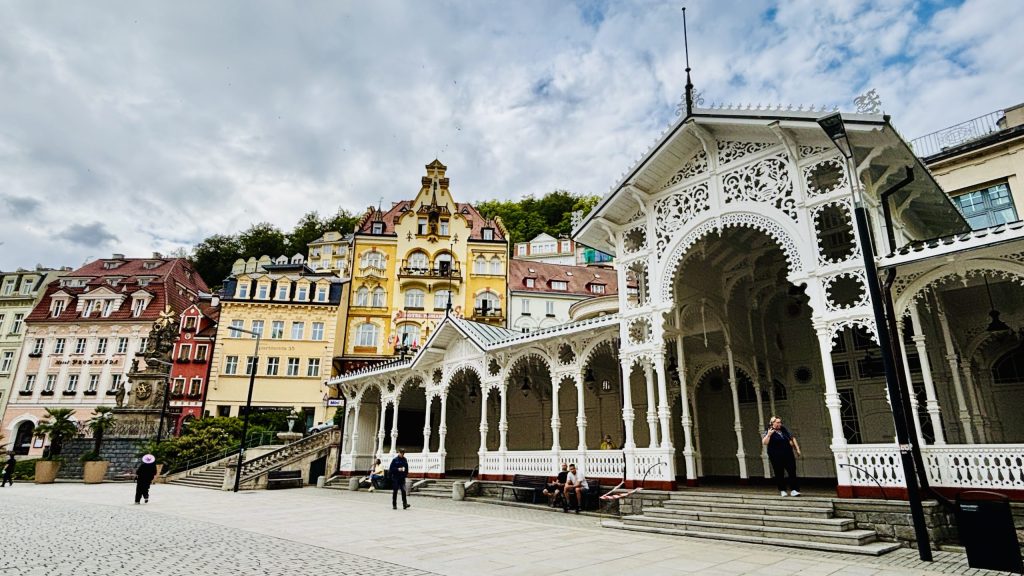
One of the colonnade buildings holding the hot springs.
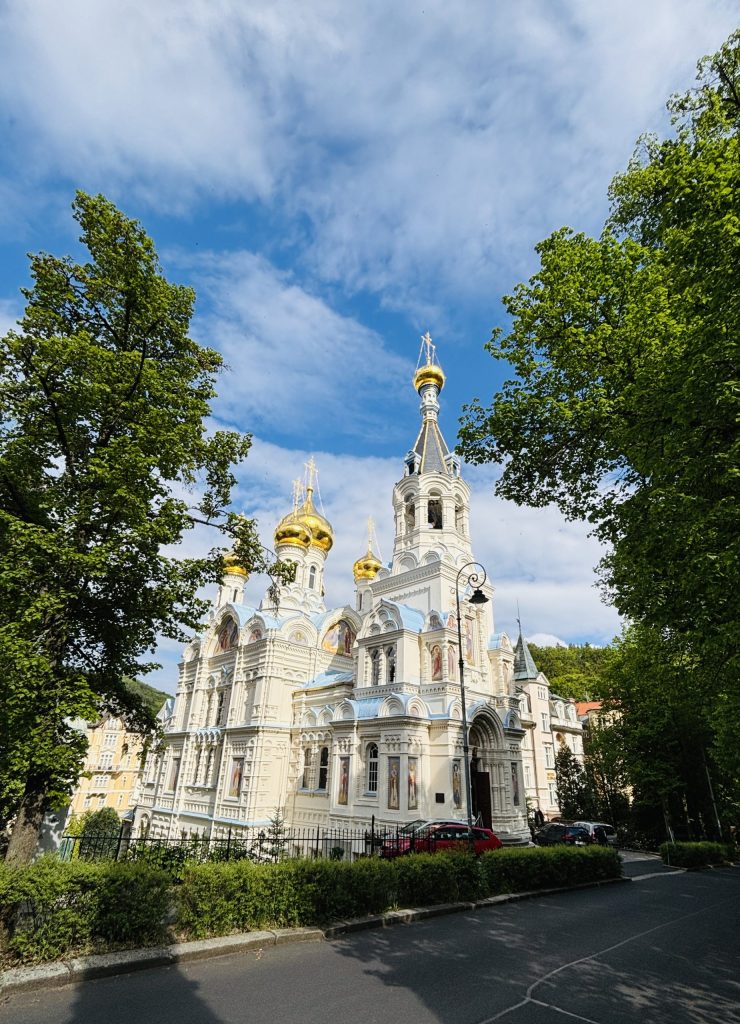
We weren’t done walking after the colonnade. Ton wanted to check out the Orthodox Church here (a lot of the investment in Karlovy Vary after communism was Russian money) that is modeled on a famous cathedral in Moscow.
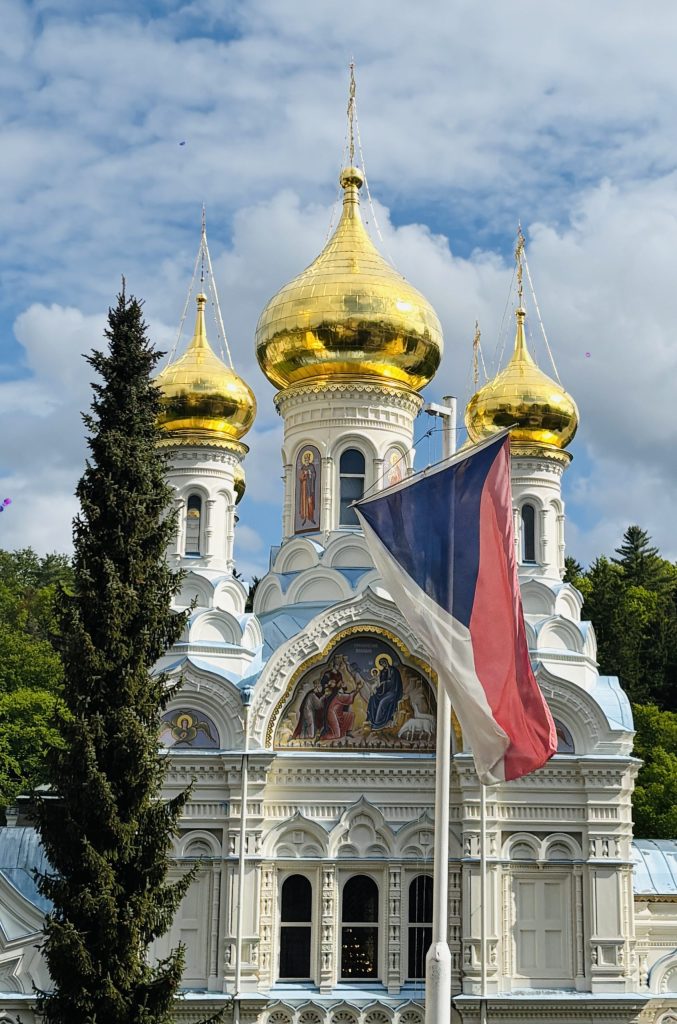
The beautiful Orthodox Church in Karlovy Vary.
When I put it into google maps I asked Ton if she really wanted to go. Once again it was not how far it was, but how much we would have to climb. Karlovy Vary is built in a valley, and while the promenade follows the river, the town quickly climbs the hills.
Once we arrived Ton was happy.
The climb began by scaling about 120 steep steps, half way up Ton was questioning my routing. After the steps it was a steady climb for another 10 minutes. But when the church came into site Ton took off and left me in the dust. So in the end the climb was worth it.
Getting some more spring water.
In the last three days we have visited two of the prettiest cities I have seen. Both Ceske Krumlov, and Karlovy Vary were spectacular. The fact that I didn’t know either one of them existed even made it better for me. As we have traveled the last 6 weeks I have been thrilled to be exposed to several towns that were either vague places on the map, or places I didn’t know existed that have been wonderful.
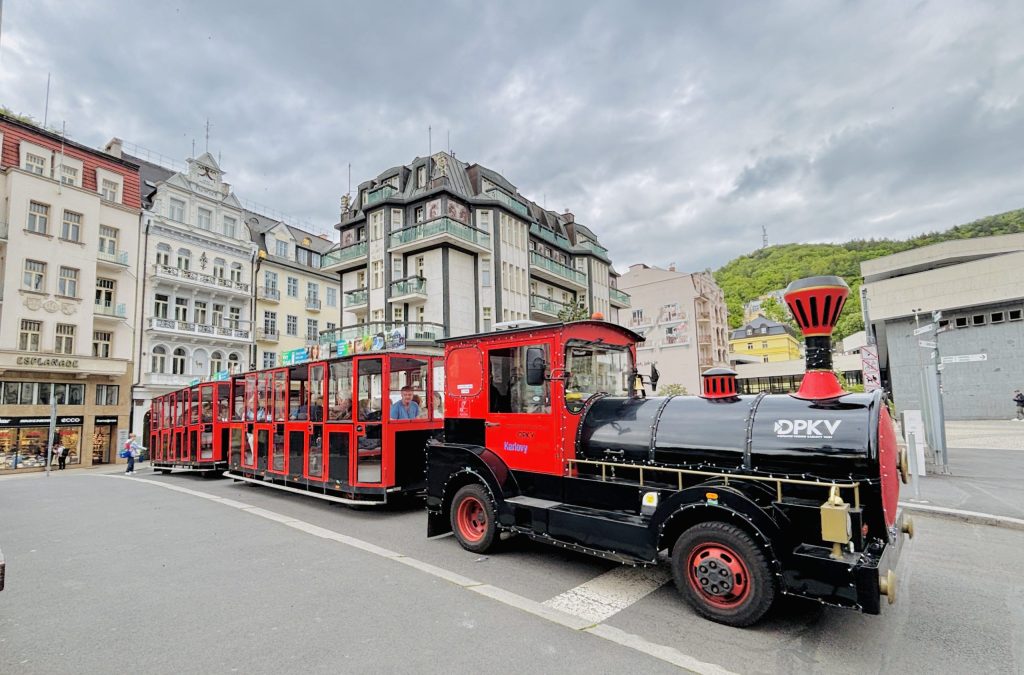
The tourist train in front of one of my favorite buildiings.
Tomorrow we are going to leave Czechia behind as an airplane is now calling us. But I have to say that it has been a fantastic visit.
A cool building I guess is from the early 20th century.
When we woke up this morning I proposed Prague to Ton, but she pointed out that we are running out of time. She had two more places she wants to visit so Prague was struck from the list.
Holasovice is one of the smallest UNESCO sites, and one of the least visited.
Our first stop for the day was only about 40 minutes from Krumov and is another UNESCO site. Holasovice is a small farm village of about 30 homes and businesses built in the Gothic style that was common in the late 1800’s. The original villagers were German speaking, but today the village is Czech.
The May Pole and a small chapel on the village green.
Driving to Holasovice had us mostly on small country roads that are impeccable . While the roads are not wide, the condition of the surface is the best we have seen anywhere. The first time we visited Czechia we swooped into Prague on a freeway from Germany, and swept out of Prague on a freeway to Wroclaw Poland so we did not experience Czech national and secondary roads.
An advertisement for a local ceramic shop.
This time we have spent quite a lot of time on national and secondary roads and Czech roads are the best we have driven on in Europe. They are not particularly wide, on par with Germany and Austria, but the condition and quality of the surface of the roads is exceptional, it makes driving very relaxing.
About half the roofs had triangular facades, and half had rounded facades like the one above. We both decided we liked the rounded one better for looks, but expected it cost more.
After spending about 45 minutes walking thru Holasovice we set off for our final destination of the day. Melnik is located about 30 kilometers north of Prague so I was dreading driving thru Prague. It turned out to be not that bad. Part of the reason is in the 2010’s the Czechs completed a 3 mile tunnel under the center of Prague. As a result thru traffic is kept off the surface freeways. It worked really well today for us.
The Prague gate in Melnik.
When we arrived at the campground in Melnik there was no one in the reception, just a phone number to call. This is becoming more common. You call a phone number and they tell you what to do, and give you a window in the morning when you can go pay them. We debated whether to move on from Melnik, but our next destination was too far to tackle so we decided to stay.
The town hall in Melnik.
After setting up we decided to walk to the center of the city. I checked google and it said it was about 1400 meters which we usually cover in about 20 minutes. I noticed that google also called out a 120 meter change in altitude which is steep. What google didn’t make clear is that 110 meters of that climb were in the last 800 meters, it was very steep and had Ton asking me why we didn’t call a taxi.
The church in the center of town.
Our first stop once we successfully scaled the hill to the town center was the city museum which featured a wine shop serving local wines. The person serving us didn’t speak English, only Czech and German. She decided to speak to us in German. Instead I asked her to speak to us in Czech since we weren’t German and it would be a good chance to learn Czech. I could see she appreciated that, and while I didn’t learn much Czech (one word) it made for a fun experience.
Melnik is a pretty city, but tonight it was largely empty in the old town.
We enjoyed the wine and one of them impressed Ton so much that we bought a bottle of it. But we had come here to see the place where the Vltava River enters the Elbe River. Melnik was originally established as a Castle to guard that critical point.
The confluence of the Elbe and Vltava Rivers. The river barge is turning into the Vltava. Note the vines in the foreground.
We walked around Melnik for nearly an hour and Ton was enjoying taking a lot of pictures which is a sign she is enjoying herself. At the end she said she was glad we stayed in Melnik and that the climb was not that bad.
We woke up to blue skies but cold temperatures. Once again I got up and turned on the heat at about 4am as the temperatures inside François had gotten uncomfortable.
Cesky Krulov from the castle gardens. It is a beautiful compact city in the shape of an Omega.
We weren’t in a hurry to get going as the weather was supposed to be good all day and we didn’t have any particular plans. After a while we set out for the town along the river.
Cesky Krulov is located on a horseshoe bend of the Vltava River.
We began by heading to the castle gardens which are located on the same bluff as the castle. The gardens are actually higher than the castle so it involved a good climb to get up to them.
The most interesting thing in the gardens was this communist era panoramic theater.
The gardens were nice but nothing special as castle gardens go. But on one end of the gardens was a modern theater built in the 1960’s and 1970’s. The theater can rotate 360 degrees. What this means is when they stage a play there; instead of changing sets they build multiple sets and rotate the crowd to the new set. It is an interesting if complicated concept. Cesky Krumlov is a well deserved UNESCO site, but they are butting heads with the World Heritage People who want them to take out the theater because it is not congruent with the rest of the city. It seems like a weird request to us as it is part of the cultural heritage of Cesky Krumlov even if more recent than other things.
Looking down on the roofs of the city as we descended from the gardens.
We took a route off the beaten path to return to the city so had a quiet walk for about 30 minutes past rows of “Pensions” which is what the Czechs (and French) call bed and breakfasts. There are a lot of them and most of them looked quite charming.
The palace from the city side. The arched columns are called the Cloak Bridge. The bridge connects two parts of the castle.
We spent a lot of time looking up as many of the buildings are decorated with paintings or art on the facade of the building. There was a fascinating array of different decorations.
This paining of a bear in a window was on one of the hotels in the city center.
I kept losing track of Ton because another detail on a building caught her attention and needed to be studied and photographed. I could tell she was once again enjoying Cesky Krulov after her twenty year gap.
They were selling funnel cakes in this beautiful courtyard.
Unfortunately almost all of the museums were closed today as there were several we wanted to visit. We are considering if we want to extend another day to visit museums or move on for a second visit in François to Prague.
An aluminum sculpture outside the art museum.
The town wasn’t as busy as yesterday, but for a Monday in May there were still a lot of tours from Asia walking around. Today we heard Mandarin, Cantonese, Korean, Japanese, and Thai being spoken by different groups of people.
Another example of building art. The figures in the windows were interesting. In the last several cities we have noticed that many buildings have painted rectangular patterns that can be quite intricate and colorful. It is a form of decoration we have not seen anywhere but in this region.
It is not a large city so after a couple of hours you start to see the same people over again. We had run into our neighbors in the campground a couple of times, and in the church we struck up a conversation about traveling. After a few minutes we decided we needed to exit the church as we were getting a bit loud.
The facades of the buildings are varied and interesting we were intrigued from street to street.
They had traveled by RV in Canada a couple of times and we exchanged stories about the Alaska Highway. They had done the Canadian part but ran out of time to do the US part. They asked us about our visit to Morocco, and in the end they remarked that they were learning about traveling in their region from Americans. Ton was proud as they were the second couple to make the same observation on this trip.
Some more interesting buildings. We had lunch in the one on the far left.
After another typical central European lunch we decided to take a couple of days off from eating out. The meals are hearty, but we need a break from pork and potatoes. Ton in particular needs some rice and vegetables.
This building was the fire department in the middle ages. It is now a hotel but maintains the symbol of the firefighter on it.
After 5 or 6 thoroughly enjoyable hours we decided to head back to François for the evening. It is a much quieter and non-smokey campground than last night.
Heading home through one of the city gates.
Cesky Krulov is one of the best preserved and maintained medieval walled cities we have seen. I think Ton was not let down by Cesky Krulov which is always a chance when you revisit a place that you have very fond memories of. For me it was a charming and interesting place and I understand why it is on all of the central Europe travel lists. We have been to many UNESCO sites now, but Cesky Krulov may be the best one for me as you really do feel the “culture” of the place.
Cesky Krumlov is a favorite place of Ton’s. She has told me about it many times over the years. She visited it about 20 years ago with some of her old friends from Thailand and it was a memorable three day visit for her.
Cesky Krumlov is a beautiful city, everything you think of when you think of an European town.
We had waited to visit until we had a good weather window as we wanted the city to be able to dazzle us. The weather was supposed to be sunny today so we were up early for the 45 minute drive to Krumlov. We pulled into the campground and quickly set up François. Just as we finished setting up I noticed a van getting ready to leave from a better spot down by the river. I told Ton lets move to that spot. So I quickly unhooked our electric and got ready to move. I normally do a walk around François before moving, but since we were only moving about 50 yards I didn’t. I forgot I had set out our two folding plastic stools on the passenger side. One stool we use to help step into François, and the other is a utility stool that is handy. As I was backing up I heard a crunch and knew I had hit something-it was the two stools and somehow I had managed to crush both of them. It will only cost about €15 to replace them and they are commonly available, but my stupid haste put me into a bad mood.
Part of the castle at Cesky Krumlov. It is quite a climb to the building on top.
I was stewing over my stupidity when we arrived at Krumlov. Ton really wanted to tour the castle and unfortunately it is closed tomorrow so we needed to get the tour in today. The castle tours are guided and scheduled. I tried to schedule it on line but could not. So we headed to the ticket office. When I went to the ticket office the lady quite clearly said that she did not sell the guided tickets. Ton and I both heard it. So we were confused and went out to look for another ticket office that did sell them.
The square by the information office.
We didn’t see one in the castle so we headed to the tourist information office but it was closed when we got there for lunch. After a 30 minute wait for lunch to end the nice young guy at the tourist info office told us that they didn’t sell tickets that we would have to go to the ticket office in the castle. My day was getting worst and my bad mood was getting to Ton. We trudged back to the same ticket office, saw the same lady who said she did not sell tickets and bought two tickets for the 1:40 tour from her. I have no idea what the miscommunication was the first time.
The chapel in the castle.
The castle was very beautiful and having a guide added to the interest. The site has been a castle for about 800 years and passed thru several “owners” over the centuries. It has some wings in Gothic style, some in Baroque and one in Rococo.
A painting from the 1500’s showing the castle with the town under it.
When Ton visited 20 years ago the castle was open to the public and there was no guide. We guessed that as Cesky Krumlov has become more popular they have gone to the guided tours to keep the crowds down.
A dining room from the Gothic wing of the castle.
I appreciated being guided and since we are early in the season there were only about 15 of us on the tour so we had time to linger and enjoy the rooms. The castle was never fought over so it served primarily as a residence for very rich people of different eras.
A dining table from one of the Rococo rooms. There is a simulation of a wedding cake on the table given to one of the owners by the Austrian Emperor.
The highlight of the tour was the ball room which was elaborately decorated with paintings of over 130 human figures from the late 1700’s. They varied from nobles to street urchins. The paintings were done by an artist and his assistant in 6 months and they included their self portraits.
The ball room with the painted figures occupying nearly every inch of wall. The figures represent the people you would typically see at a ball that would be held in the room.
The paintings were done based on real people from the era. The paintings strike me as being more humorous than serious. It is not high art and probably is not being studied by any serious art students.
A detail of one section of the wall.
The art is very well preserved and because it has not been damaged over time it has not had to undergo any major restoration. At the end of the tour I thought it was one of the more interesting palace tours because it was not the home of an Emperor, but a well preserved palace of a mid to high ranking noble. Rich but not luxurious.
The exterior of the palace.
After the bad start to the day, Cesky Krumlov had charmed me and gotten me out of my funk. We walked around the town for a while doing some recon work for tomorrow as well as people watching.
Ton found this art display on an alley way off of the main street.
Cesky Krumlov is a day trip destination from Prague, so by 4 pm the streets were starting to thin out. With the lighter crowds we could take in the beauty of the town in a more relaxed way.
One of the city gates.
The other thing that makes Cesky Krumlov special is that there is almost no vehicle traffic. There are a very few taxi’s that deliver people to the hotels in the city, but other wise the streets are pedestrian only.
The most picturesque of the many watchtowers we have seen in Czechia.
We ended our first day in Cesky Krumlov at the brewery. The beer was a smoked beer which we have not seen since Germany. We both really enjoyed it along with the pickled sausages we had as a snack. I can see more pickled appetizers in my future included pickled cheese which was on the menu.
The gate heading back to the campground.
When we got back to the campground it had gone from sleepy to hopping. A couple of groups had built campfires, and unfortunately one of the campfires is closer to François than I would like. Hopefully, they will be respectful of our sleep.
It poured rain all day so today ended up being a day of rest. Luckily the campground here has exceptional Wi-Fi so we spent the day relaxing and streaming movies on the internet. The only problem is it was quite cold so I fired up the heater a couple of times to make it bearable inside François.
Ton’s fish dinner of Zander.
We headed into the restaurant at the campground for dinner. I had carp and Ton had another fish called Zander that is similar to Walleye. Ton said the carp reminded her of catfish but not as good. I agree with her carp is adequate but now that I have had it I will not be seeking it out.
The local beer on the left and the Anheuser Busch beer that is the distant relative of Budweis brewery.
The weather is going to break tomorrow and we will be off to a place that Ton has been looking forward to since we began the trip.
We had a debate about what to do today. We were still discussing it in the morning with three possible course of actions. It was supposed to rain today and the rain is supposed to be worst tomorrow. It is also supposed to be cold with lows in the low 40’s. So our debate was go to Ceske Krumlov the next place on our list and wait for the weather to get better. Go to Prague and get a hotel room for a couple of days. Or, move to a town about 20 kilometers away that is supposed to be pretty and wait out the weather.
The town center in Trebon. Note the winter fashions on display.
The winner was going to be decided on where we could get our laundry done. Czech campgrounds don’t feature washers and dryers like we are used to. Also, it appears for some reason Czechs have not embraced laundromats so they are rare even in larger cities. We are getting low on clothes and in another couple of days we would be getting desperate. None of the three campgrounds at Ceske Krumlov had washers and dryers. All of the hotels in Prague were really expensive so it didn’t matter if they had washers and dryers. The campground in Trebon didn’t have a washer and dryer, but when I googled laundromats near me one came up in a shopping center on the way out of town.
I never saw what this store was selling, must have been antiques.
So the decision was swing by and check out the laundromat and then head to the campground in Trebon which was about 30 minutes away. We pulled into a small shopping mall and sure enough in the mall they had a slightly expensive laundromat. An hour later with enough clothes to get us to the end of the trip we headed out to Trebon.
The gate to Trebon with an interesting decoration on top and tiled walls on the side.
It had rained overnight but as we were driving we noticed that the weather today was better than yesterday. After we set up in a nice campground by a lake I checked the weather, and it looked like we had a few hour break in the rain so we headed into Trebon.
Trebon is a pretty little town with the same long rectangular square common in this part of Europe.
Trebon is a center for aquaculture in Czech. As we walked into town we walked by a large pond, and a commercial fish farm. They have been producing fish in this area since the middle ages. Interestingly the fresh water fish of choice in central Europe is Carp.
A fish restaurant featuring fresh Carp.
Ton and I have noticed that Carp is the most common fish featured in menus since we arrived in Central Europe. Neither of us have ever tasted Carp as Americans don’t eat it, and neither do the Thai. But in Central Europe it is a staple and part of the Christmas Eve meal. The campground has it on its menu so we decided we would give it a chance tomorrow.
The town features a brewery from the 1300’s, but unfortunately we couldn’t get in to sample their product as they were only doing Czech tours today.
After an hour walking thru the town we saw the skies darkening and decided to head back to the campground. We tried to hitch a ride on the tourist train which stops at our campground, but we didn’t have a ticket, and they didn’t offer one stop prices even for old people.
The tourist train passing us on the walking path to the campground.
We got back just as the rain started again. We had a light supper and then sat back and watched the lake and the other campers from inside François as the temperatures fell into the 40’s.
The man made lake that is the source of the carp industry.
For the first time on this trip we are having to plan on dealing with wet weather. Today wasn’t supposed to rain, but we ended up with some spotty rain. On top of being wet the temperatures have fallen into the 50’s again during the day, and into the high 30’s at night.
The city hall in Ceske Budojovic is pretty and has a nice glockenspiel.
We started the day by heading into the city to check out the town square. It was another nice town square with a good representation of Baroque and Renaissance buildings that are well preserved.
The fountain was a little more “normal” than the ones in Brno.
We gave the square a look from all 4 quarters, and since this is not a town focused on tourism did some real shopping in the stores lining the square. Instead of the normal tourism stores and restaurants the stores here were clothes and shoe stores. Ton has been casually looking for a jacket and a pair of shoes to take home. She didn’t find anything, but enjoyed looking.
How do you tell if a square is for locals or tourists? If the town allows parking in the square it means that the square is being used mostly by the locals for shopping. Ton was impressed that the tulips were still blooming.
While she was shopping I popped into a bank and got a couple thousand Czech Crowns, just in case we need to pay for something in cash. Most of central Europe has not joined the Euro and having to deal with Crowns, Forints, and Zloty’s every time you change countries is a pain.
The Black Tower. Most Czech cities have preserved the watchtower that was part of the city walls.
But we didn’t come to Ceske Budojovic to shop or because of its beautiful town center. We came to visit Budvar Brewery which produces a beer called Budvar Budweiser and they claim they are the true Budweiser, but a little American company called Anheuser-Busch disputes that.
Enjoying our Budvar Budweiser.
Like all of these kind of things it is complicated. Ceske Budojovic has been a beer brewing town since the 1200’s, and brewing has been a mainstay of the economy here since then. The town always had a mix of Czech and German inhabitants, the Germans called the town Budweis.
Standing in the visitors center.
In 1795 a group of German residents formed a brewery called Budweiser Burgerbrau and were successful. In a trip to Europe in the mid 1800’s Augie Busch discovered it and decided to brew a beer of a similar style in St. Louis calling it Budweiser. That business worked out well for him as all of us Americans know.
A cool wood carving representing the process of brewing beer.
In 1897 a group of Czechs got together and formed a competitor to Budweiser Burgerbrau called Budweiser Budvar Brewery. Since then there has been a great deal of jousting in courts around the world, and in the court of public opinion over the use of the name Budweiser. To make things even more fun Anheuser-Busch acquired the former Budweiser Burgerbrau brewery in 2012 and produces a beer there called Samson. Budweiser Budvar cannot use that name in North and South America and is marketed as Czechvar in the Americas. But in Europe you will see both the American Budweiser and the Czech Budweiser Budvar on the same shelf.
Beer delivery truck from the 1930’s.
While the story was complicated, the beer tour was fun and the beer is very good. We took the English language tour with a couple from Poland, Austria, the Netherlands, and a daughter and father from Hungary. So of the 10 people on the English language tour I was the only native English speaker!
Standing by my dream bottle of beer.
When we came out of the brewery it was raining steadily so we splurged and took a Bolt (Uber equivalent) back to François to settle in for the night. Tomorrow and Saturday are supposed to rain all day so we will see how hardy we are feeling.
Our original plan was to give Brno another day so we could visit the castle that dominates the town. When we woke this morning Ton told me she had done some research on the castle. From the 1700’s on it had been turned into a prison by the different governments that ran Brno. So when the prison was closed and the castle was returned to Brno they decided to embrace its ugly history. So today it is a museum of torture. There are whole wings devoted to torture devices, and executioner axes. There is a display of cells showing how people were put into various uncomfortable positions using tools and rocks. Since we are not interested in this kind of thing we agreed that we didn’t need to visit the castle. So after some thought and faced with a deteriorating weather forecast the next few days we decided to move on.
Telc is a UNESCO site because of its well preserved town center.
Our next stop was Telc which was a nice 2 hour drive through rolling hills and farms. The canola fields were at their brightest yellow and Ton was entranced.
There were miles and miles of beautiful yellow canola fields on the way to Telc.
We parked up at a municipal parking lot that had a little food cart. While I was getting organized Ton had bolted out of the car and run to the cart. She had noticed that the cart was selling rotisserie chicken and she wanted to make sure they would still be open when we returned. Once we knew their closing time we moved on to the town square.
The large square is full of these beautiful renaissance facades on three sides.
The square is about 300 yards long and 100 yards across and lined with buildings that all have 3 colonnades on one side and larger buildings with 2 colonnades on the other. They are painted in various pastel colors. It makes for a striking picture.
The town is flanked by two large ponds that used to contain fish farms.
One of the towns main source of income in the past were fish farms from the two large man made lakes that flank the town center. The water in the ponds is remarkably clear but today the lakes go unfarmed.
A close up of one of the buildings showing the original facade from the 1700’s.
The town had a fairy tale like feeling, and its main business is now tourism. There appears to be room to grow as a lot of the spaces facing the square were still vacant, but there were plenty of places to eat, and a couple of interesting shops.
The center was pretty quiet.
In addition to the scattering of tourists there were a couple of student groups doing some sort of scavenger hunt assignment. Telc was a pretty stop with almost a movie set feeling. It is the kind of place that feels like it is one “break” away from being the new must see place.
Mary overlooking Telc.
Most importantly we got our chicken and a pork knuckle from the food cart so our next couple of dinners are set. We didn’t finish our day in Telc but decided to move on to Ceske Budojovice for the night. Tomorrow we will be visiting the most important business in Ceske Budojovice or to use towns German name Budweis.
It was time to move on from Hungary so today we shifted north to the Czech Republic, or as it is now officially called Czechia. It seems that many Czech’s are still calling it the Czech Republic, so it appears that both names are acceptable.
Ton calls this the ugly fountain, there is a dude in what appears to be a cave with an emaciated dog and a religious figure on top.
Our last chore in Hungary was to spend our last Hungarian Forints. We thought we had 21,000 forints which is about $70 so the plan was to put it in the gas tank. But when I pulled the money out of my wallet at the gas station there were two 20,000 notes instead of one so we had 41,000. François could only hold a little over 37,000 so we went inside, luckily they had a bottle of wine that took most of the remainder and the cashier got to keep the change.
The streets of Brno.
Brno is the second largest city in Czechia and continuing our new quest to visit second largest cities in countries-we added it to our list of places to visit here. I was feeling bad about my lack of knowledge about second cities and was confessing this to a Dutch couple referencing Brno, Plovdiv, and Kosice (Czechia, Bulgaria, and Slovakia), when they both laughed and said they had never heard of any of them either, so Ton and I felt better.
A stall in the cabbage market selling flowers.
The first thing we needed to figure out was how to say Brno as there appears to be at least one vowel missing for an English speaker. Ton went online and said it was Bur-NO with the emphasis on the No. That mystery solved we headed to the center to check it out.
A large crocodile hanging from the roof of a passageway. There are multiple stories about why it is there according to Ton’s research. This probably means someone just thought it would look cool.
Brno is a University town with 10 Universities and over 100,000 students. We were struck with how busy the center was, but it felt like a working city not a pretty city. An active city center with people who look like they are going to meetings or classes feels different than an active city center full of tourists looking at things. There is a different flow to the pace that we enjoy.
This is a statue dedicated to Mozart. It is a weird depiction and Ton hates it.
We decided that the difference reflected in the statues. The statues are not made to be photographed by tourists, but to reflect something about the character of Brno. It is winning the award for unusual works of art that you may have to be from Brno to appreciate or even understand.
The interior of the Cathedral again is functional not beautiful.
I decided to embrace that practicality with our choice for lunch. After weeks of sampling various central European meals I told Ton I wanted something familiar, I was leaning towards a hamburger, but Ton wanted something warm so we went for Italian pasta.
Another quirky art piece. If you look carefully you can see the center spire on the iron is bent and twisted. The story is the guy who made it thought they shorted him on the final payment so he mounted it, but bent the center spire in protest. A couple of hundred years it is still there.
Brno does have a good beer scene so we popped into a quirky pub that made us feel at home. The place had a nice after work vibe full of co-workers and friends having a beer before heading home. We were the only tourists in the place.
One of the most normal statues of the day, modern but mostly conventional. We think it represents Saints Peter and Paul who the Cathedral is named after.
I thought the cold weather was over but the low tonight is supposed to be in the high 30’s again, worst after tomorrow we are supposed to get 4 or 5 days of rain in the region. Bummer for us, but they have had a dry spring and probably need the rain.
We headed into Sopron early as the weather forecast had rain arriving in the afternoon. When we arrived downtown the streets were very empty.
We had the streets in the center of the city almost to ourselves.
It is a nice town with a well preserved medieval core. Sopron is known as the most loyal city in Hungary. It is located about 80 kilometers from Vienna, and if you drive 10 kilometers North, East, or West you are in Austria. When the Austro-Hungarian empire was being divided after WWI the people of Sopron were offered the choice of joining Austria or Hungary. Despite the economic incentive to join Austria, the people here decided to stay with their Hungarian heritage and opted to stay in Hungary.
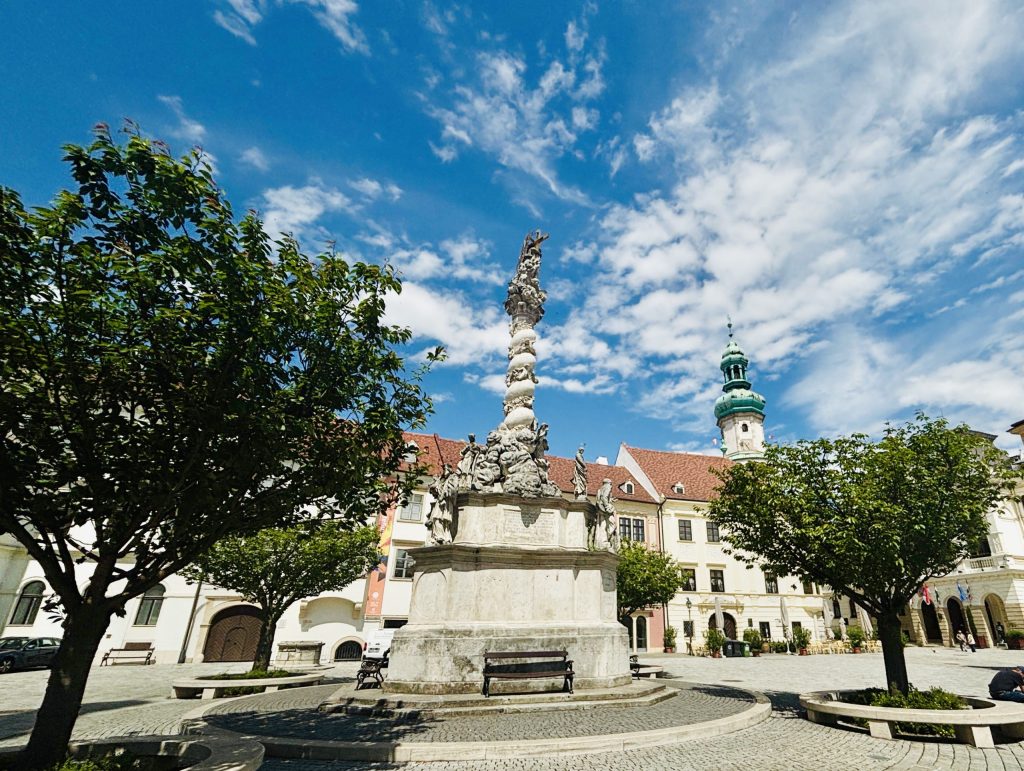
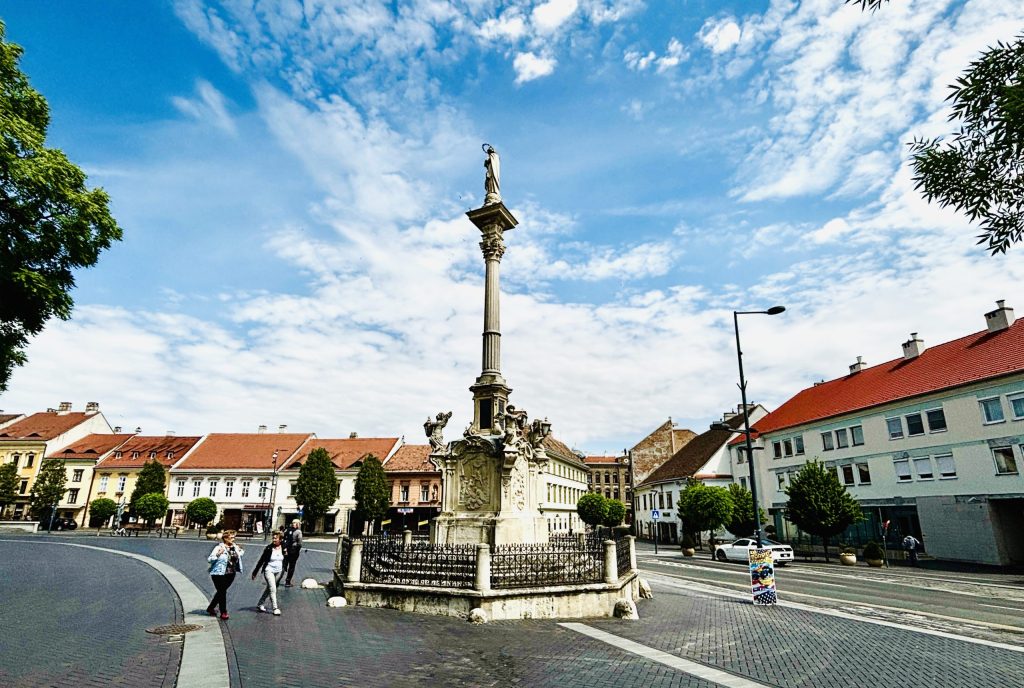
The Holy Trinity memorial in the main square of Sopron.
Ton had read that they had a Holocaust memorial that was moving so we headed there. The memorial was in the modern town, but located in what became the Jewish Ghetto during WWII. The memorial was small but very well done. It was similar to the one in Budapest highlighting the shoes and winter coats the Jewish residents had to leave behind before they were executed. It also had a Hebrew inscription that faded away into the sky. I really liked the symbolism.
Another beautiful and touching Holocaust memorial.
The Hungarians have the most moving Holocaust memorials we have seen in Europe. Other countries have them, but they are often small and hidden away. In Hungary they are more in the forefront. They also seem to be making more of an effort to maintain the synagogues though the one in Sopron needs to be restored.
The Synagogue in what was the ghetto of Sopron is still waiting for restoration.
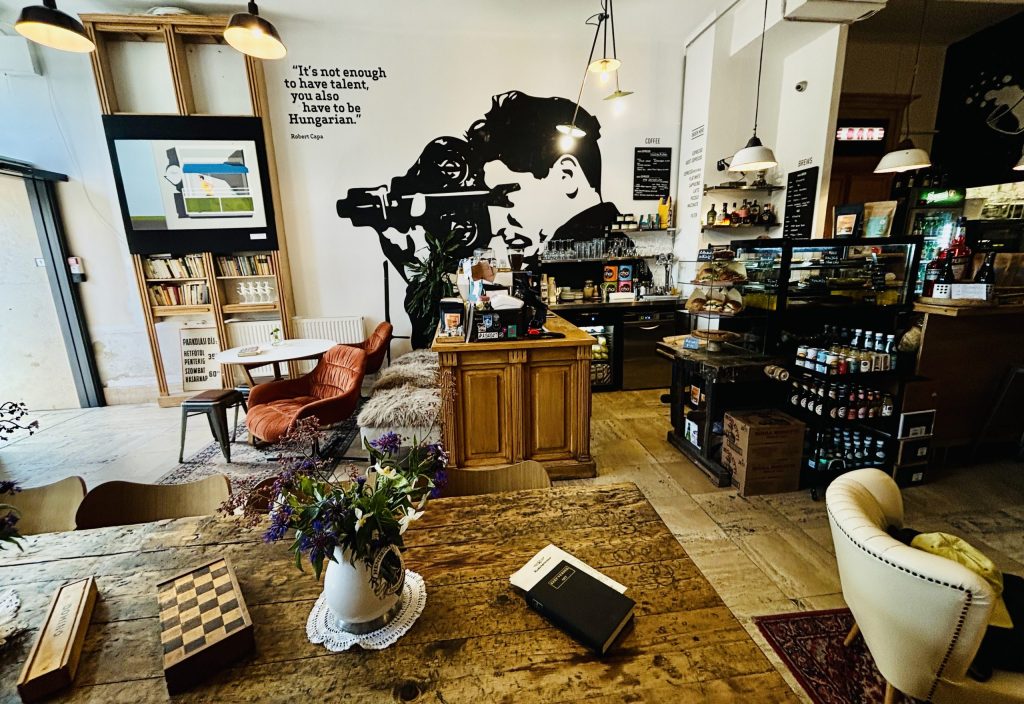
On the way back to the old town we stopped in a nice coffee shop on the main street. They had a quote from Frank Capra on the wall, he was a famous combat photographer of the Spanish Civil War, WWII and Vietnam where he was killed while photographing the French. In WWII he traveled with the US Army landing on Omaha Beach, but had to have special dispensation as he was still a Hungarian citizen and thus technically an “enemy alien”.
A quote from Frank Capra who was a proud Hungarian.
The main street is not part of the old town and was much more active than the old town. It seems the locals prefer to do their shopping and dining in modern buildings rather than medieval ones.
A monument in the modern center of Sopron.
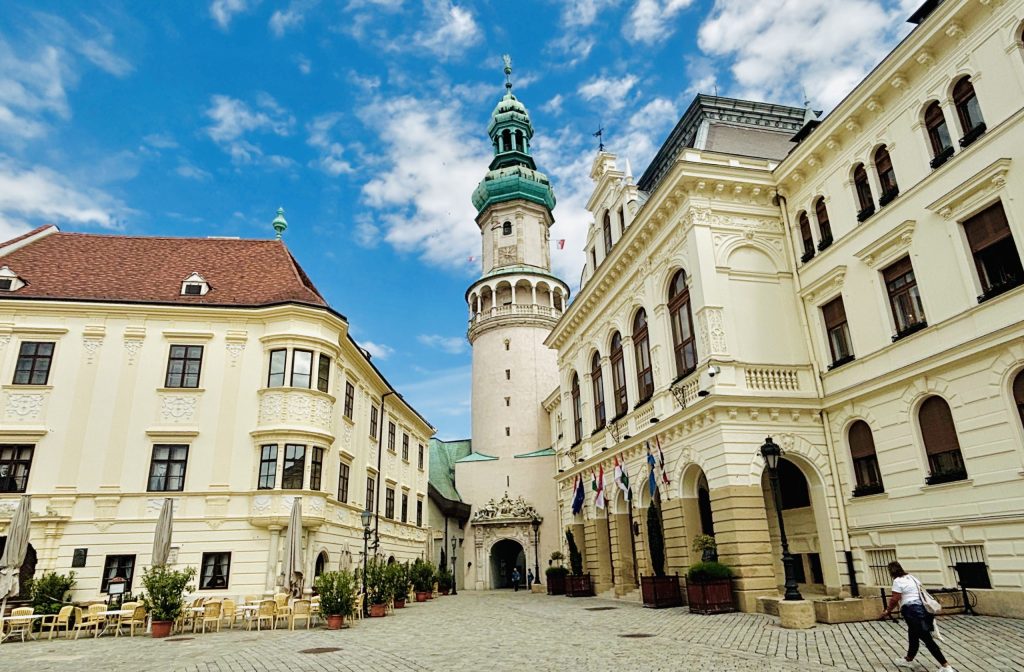
The big attraction of Sopron is its fire tower. It is a tall tower located on what was the main gate to the walled city. It served three purposes, the first is a place to watch for fires in the city, the second was for broadcasting information, and lastly to watch for wine merchants from other regions trying to bring their inferior wine to Sopron.
The fire tower of Sopron.
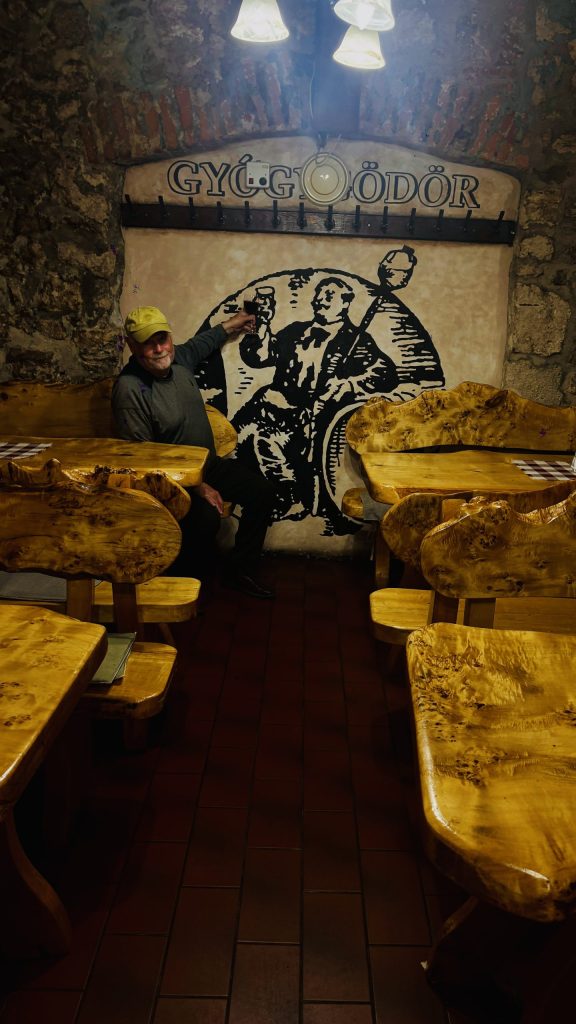
Since Sopron is famous for its wine we decided we should give it a taste and headed to a cool place for lunch. The restaurant was in a cave under the main square and featured Hungarian food and wine. When we entered we were handed the Hungarian/German menu and then our waiter disappeared. We began taking a stab at what things might be by trying to decipher two languages that we have almost no knowledge of . A lady at the next table heard our discussion and offered to help us. She was Hungarian but taught German in school. Her English was pretty good which she said she learned from Duolingo. We had fun working with her and her translations were good because the waiter returned and fetched us the English menu and we could confirm them. We thanked her and she recommended a particular local wine which also turned out to be delicious.
Toasting the local wine in our restaurant in the cave.
We settled on two different forms of goulash and enjoyed them both. It took until our last day to find some goulash but it was worth the wait.
Some Roman ruins, as like most towns in Europe Sopron started as a Roman outpost.
It was getting towards the time the rain was supposed to begin so we headed back to François to settle in for the day. Later we found out our Austrian neighbors dental work had gone well so we were happy for her though she looked like she needed to rest.
We reluctantly decided we needed to put Hungary behind us. Today we had our longest driving day of the trip at 400 kilometers as once again we had to back track northeast to Budapest to head northwest to Sopron. Luckily it was Sunday and all of the commercial trucks are restricted so we were the slowest vehicle on the toll way.
This building reminded us of the wooden churches we saw in Romania. It was built in the mid-90’s.
We were driving thru a small village called Kakasd when Ton asked that I find a way to stop near what appeared to be a wooden church. François is agile by RV standards but not by car standards, but I found a place to turn around and we found a parking lot near the building which turned out to be the community center for the village.
It is built in the style of a church but is used for festivals and weddings.
Besides having a cool building Kakasd is a typical small village you pass thru on the highway. But because we stopped I checked the history of the village posted next to the community center. Prior to WWII the village population was split between Swabian Germans and Hungarians. After WWII the Germans were sent to Germany even though many of the families had been there for centuries. This left the city lacking people, but at the same time Hungarian minorities were being kicked out of Romania and the Ukraine and the lost Germans were replaced by these Hungarian families who had lived for centuries in Romania and the Ukraine. The wooden churches are common in Romania and Ukraine, so after the fall of communism the communities wanted to recognize their heritage by building a replica of the wooden churches from their ancestral homeland.
An accidental lesson in the complex interactions of European people.
This little village of 1500 people was a poignant reminder of the complexity of history in Europe. I knew intellectually about the mass displacement of minorities after WWII, but reading about the impact on this little village really drove it home to me.
Our Aire/Stellplatz tonight is owned by a RV dealer who also collects Trabants. Trabants are an infamous East German car that was in its time considered the worst car in the world. Now they have a cult following.
Tomorrow we are going to visit our last Hungarian town located in a little isthmus of Hungary that sticks into Austria. Our Austrian neighbors told us that in addition to being a cute town Sopron has the highest density of dentists in Hungary as dental work is much cheaper in Hungary than Austria and Sopron is the center of dental tourism from Austria.
Time is against us now otherwise I think we would have extended our stay in Szeged. But we reluctantly decided we had to move on to our next destination. Pecs is a similar sized city to Szeged and also has a prestigious university so we were excited to see what it offered.
The synagogue in Pecs, not open to the public on Saturday. due to the sabbath.
It was only about 170 kilometers but we were traveling on secondary roads so google said it would take 2 1/2 hours. We add about 15 minutes an hour to googles estimates as we do not often travel at the speed limit so I was planning on a little over 3 hours. We needed fuel so I planned to get some on the way out of Szeged, but the first two we saw were on the wrong side of the road so I told Ton we would stop at the next one. Next thing I knew we had popped out of Szeged into the countryside, but I told Ton not to worry as one of the towns ahead would have a gas station and I would turn left if I had to. 45 kilometers later the idiot light came on, and I was beginning to feel like one; as we were in the middle of vast farms with only the occasional very small village. I finally pulled over and googled how far the next gas station was, and initially google told me the nearest one was in Szeged (one of the ones I had driven past). I tried it one more time with a little different search and now it said there was one 4 kilometers ahead of us. Sure enough it was there, and while it was the most expensive tank of gas I have ever put into François, I was happy.
This statue is dedicated to the holy trinity.
The rest of the drive was much more relaxed and I could enjoy the quiet country roads, and look at the massive farms. We arrived in Pecs about noon, and as soon as we were settled headed into the city. We were assured the bus system was free no matter where we were from, so we hopped on the bus and were deposited in the center in 10 minutes.
The exterior of the church/mosque of Pecs.
The building we were looking forward to was the Church of the Blessed Mary. It is a converted mosque. My favorite Cathedral is the converted Mosque of the Cathedral of Cordoba in Spain. The converted Mosque here was left over from the Ottoman rule, and is much smaller.
The interior of the church has the altar in the center of the circular room under the dome.
The building was nice, and you could see the influence of Islamic design in the layout of the church. It also retained the balcony which was where women prayed when it was a Mosque.
The artwork in the cupola of the dome was remarkably similar to that of the Synagogue in Szeged.
The church was nice and we enjoyed walking thru it. It was unusual to convert an Islamic building to a Christian building as the Mosques were usually razed and a new church was built on the site.
The Basilica of Pecs.
Our ticket to the Mosque/Church also included a visit to the Basilica of Pec so we headed over to check it out. As we were walking the streets we noticed the energy level in Pecs was much lower than in Szeged. The weather was just as good, and it was a Saturday, but the city seemed much quieter. There were a lot of cafes’s on the main street and people were in them, but they also seemed to be much quieter than yesterday.
The interior of the Basilica.
We did not see any of the happy end of the year celebrations we saw yesterday in Szeged. We kept looking for a spark in Pecs and didn’t find it.
The interior of the Basilica was interesting to us.
The Basilica was interesting as it had a very unique design. The first thing we noticed was that the roof was flat. It didn’t have the arches and cupolas we expect in major churches. Also, a lot of the art on the walls, ceilings, and floors was geometric patterns-something we associate with Mosques.
The crypt had the rounded roofs and columns that we have seen in the purification rooms of Mosques.
After walking thru it for a few minutes we began to wonder if this building was also a converted Mosque. I googled the history of the Basilica and it had never been a Mosque or converted to a Mosque. We decided that maybe the Ottoman influence of 200 years had crept into the artwork and some of the design of the Basilica.
An aerial view of Pecs from one of the bell towers on the Basilica.
I was surprised when Ton decided to climb the 130 steps to the top of the bell tower. She is afraid of heights and usually avoids long climbs. Today she was up for it so we headed up there where we had a good view of the area around Pecs.
Lovers locks on a street in Pecs.
We spent another 30 minutes exploring Pecs and hoping to capture some of the spirit we left behind in Szeged. But it did not happen, so we headed back to the campground where Ton prepared a nice dinner for me.
The tower Ton climbed.
Different towns have different personalities. Pecs has beautiful architecture, an interesting story. The squares are nice, and the city is extremely clean. I suspect we caught it on a quiet day. We enjoyed our walk, but after a couple of hours we were ready to move on.
If you are interested in Art Nouveau architecture than Szeged Hungary should be on your list of places to visit. It is the kind of place we love because there is a lot to see, but it far enough off of the beaten path that the tour busses and cruise boats don’t make it here. In fact neither of us had ever heard of it until we began researching our trip to Hungary and were not sure what to expect when we headed over in the morning.
The city hall is heavily influenced by Art Nouveau.
In 1879 Szeged was struck by a catastrophic flood that destroyed over 90% of the buildings in town. The Austro-Hungarian government was determined to rebuild the town and did so to a new plan rather than trying to reconstruct the old town. As a result Szeged has wide avenues and since Art Nouveau was the fashionable style of architecture in that time it is full of striking Art Nouveau buildings.
All of the buildings aren’t Art Nouveau, the Natural History Museum is neo-classical. The wooly mammoth is mechanical and periodically moves.
Our first stop was the New Synagogue. The exterior is heavily influenced by Art Nouveau and is striking. It is much larger than we expected and reflects the strength of the Jewish population of the city at the turn of the 20th century.
The exterior of the New Synagogue.
We went inside and the interior was even more beautiful than the outside. We know very little about the architecture and the art of Synagogues but this one was as ornate as any Christian Cathedral, and prettier than most.
The interior of the synagogue.
While we were inside a high school class was getting a guided tour in Hungarian. While we could not understand the tour we could access the front of the Synagogue where the Torah is kept which is normally roped off by tagging along.
A beautiful menorah.
We also provided a bit of comic relief for some of the students as I had lost sight of Ton, she was quietly trying to signal me, but I was oblivious. Finally a couple of the kids got my attention and pointed at Ton with big smiles.
The cupola of the Synagogue has 24 arches representing the hours of the day and the 24 parts of the Jewish bible. In the center of the cupola is a Star of David surrounded by stars representing the universe.
We spent quite a while exploring the building as there was interesting art work around every corner. Over 50% of the Jewish residents were killed in the holocaust, and after WWII a large number of the survivors immigrated to Israel. For a long time after the war the building was used as storage, but restoration began in 2000 and they have done a wonderful job.
The ceiling and the upper gallery is quite beautiful.
After the Synagogue we struck out to find one of the most famous of the Art Nouveau buildings called Reok Palace. The architect was influenced by the Spanish architect Gaudi who built the famous cathedral in Barcelona. Like Gaudi’s architecture it avoids geometric angles trying to mimic nature.
The Reok Palace now sports a very good coffee house.
As we were walking the 20 minutes from the Synagogue to the Reok palace we were struck by what a beautiful city Szeged was. It was another city we had never heard of that was blowing us away.
The Grof Palace with it’s distinctive cupola.
When we arrived at the Reok palace we decided to enjoy a coffee and share a pastry. To continue to build on a special day the pastry was delicious. Ton decided to try another Melange coffee which is famous from Vienna. She declared it far superior to the Vienna one. We were falling for Szeged.
We really enjoyed this apartment building and suspect the architect was also influenced by Gaudi.
Our next stop was the Votive Church of Szeged. Three sides of the square the Church is built on house classrooms of the University of Szeged with the fourth side being the Church. The square is supposed to be the exact same size as St. Marks square in Venice but we are not sure why.
The Church is as large as many Cathedrals we have seen.
By this time we were just enjoying walking around Szeged. The weather was perfect. The architecture was to a very high standard and we were constantly pointing at not only government and religious buildings that were interesting, but ordinary apartments and office buildings.
The cupola in the church.
Szeged is also home to a large and prestigious university. It was near the end of the semester and the kids were enjoying their Friday. In particular we kept running into students from the medical school who must be done for the year as they were having a great time heading to a party. At one point 4 horse drawn wagons full of future Doctors went by blowing off steam after finishing their exams by riding thru town accompanied by dance tunes and alcohol.
Szeged was capturing our heart.
Just when we thought Szeged couldn’t get any more charming the fountains in front of the natural history museum started dancing in synchronicity to Beethoven’s 5th symphony. We were just walking by and were utterly charmed. We just sat down and enjoyed the music and the accompanying dance for 30 minutes.
The fountains were moving to Beethoven’s 5th Symphony.
We decided to take a break and headed back to François for some water and rest. We really appreciated that our weird campground was just across the bridge from downtown, and now we found it part of the charm of this town.
Better coffee and desert than Vienna.
We headed back over to town for dinner and spent more time enjoying the architecture and the energy of the students. Today is the kind of day that makes any hassle we go thru while traveling worthwhile. It was a special day in a special place that we would never have known existed if we did not travel like we do.
Sunset looking across at Szeged from in front of François.