Today was a long day of driving. We planned on six hours, and it turned into 8. We knew that this trip was going to have a couple of days of long driving because we could not come up with a loop. The excursion into northern Romania was worth it though.
The early morning fog was still in place when we were leaving Sighisoara. The fog made a kind of rainbow, I guess a fogbow.
The early part of the trip went very well, and we were making better time than I thought we would. I was optimistic that the day would not be the slog we thought it would be and then we hit Bucharest. Bucharest is now our European city with the worst traffic having surpassed Antwerp. The ring road is a single lane with periodic strangely designed intersections that have no visible control system, no roundabout, no lights, basically a free for all, right of way goes to the biggest, fastest, and most aggressive vehicles. For a short while it is kind of entertaining, but the fun factor fades fast.
Some countryside from the side window of François.
On top of that Greta Garmin for the third time on the trip decided to direct us to a road that does not yet exist. Whoever did the programing for Garmin 18 months ago when we bought our European card decided that freeways under construction could be used. Three times she has directed us to freeways that were under construction when she was programmed, and from the looks of things will still be under construction for several more years. As a result of the bad traffic, and the bad direction from Greta we had to put her in timeout, and break out Google maps on the phone. My guess is that Greta cost us an extra 90 minutes of very stressful driving in Bucharest. The result is that it took us about 2 1/2 hours to navigate 30 miles around Bucharest.
After Bucharest a sign we were very happy to see.
We did eventually escape Bucharest and ended the day at one of our favorite campsites of the trip, overlooking a beautiful gorge in a national park. Our neighbors are an Australian couple who also bought their van from Eurocampingcars in France. It is a small world.
Sighisoara is another Saxon city in Romania. It is one of the most well preserved medieval cities in Europe as war mostly has missed it over time. Also its modest size and relative remoteness means that industrialization and communism did not change the city much either.
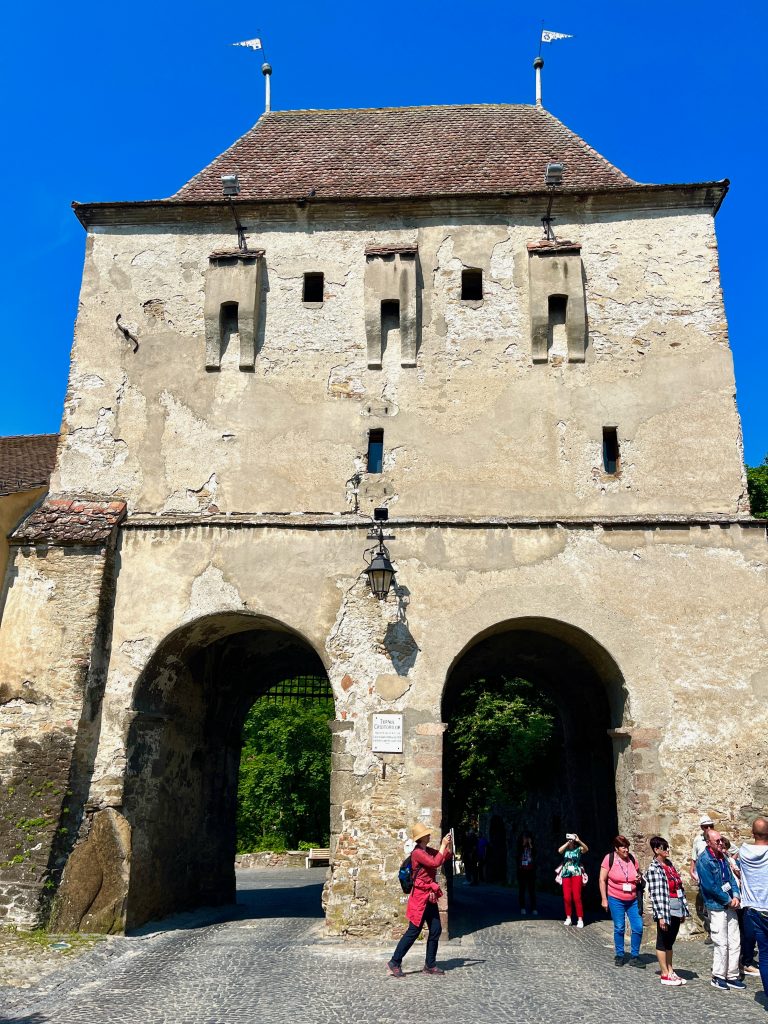
One of the gates of the city dating back to the 1600’s.
It is now very much on the tourism trail for Romania as it is very nicely preserved and a good size to visit in one day. But of all of the places that we have visited on this trip it felt the most touristy. There were more souvenir shops than we have seen in other places. Today the tourists though were mostly Romanian.
A cute flower display based on bicycles.
The old city is built on a prominent hill and most of the wall is still intact. There are 9 towers remaining of the original 12, and they are all in good shape. So you get a good sense of the city during its heyday in the middle ages.
The clock tower with the first glockenspiel we have seen in the Balkans.
They also are capitalizing on Dracula. Many people believe that the author of Dracula, based the character on a historical figure from the 1400’s known as Vlad the Impaler. Vlad was actually born in Sighisoara but only lived here until he was about 4 years old, so he did most of his impaling elsewhere. Nonetheless their are several restaurants, and museums devoted to Vlad and Dracula.
Vlad the Impaler as he appeared well after leaving Sighisoara when he was 4 years old.
The city historically has been a mix of Germans, Romanians, and Hungarians and has passed back and forth between the Austro-Hungarian empire and Romania. That mixed heritage is reflected in the three churches in the city, one Lutheran for the Germans, one Orthodox for the Romanians, and one Catholic for the Hungarians ( and a few of the Germans.)
The Lutheran church had the best real estate at the highest point in the city.
There were several weddings going on today and we saw wedding parties at both the Orthodox and Catholic churches.
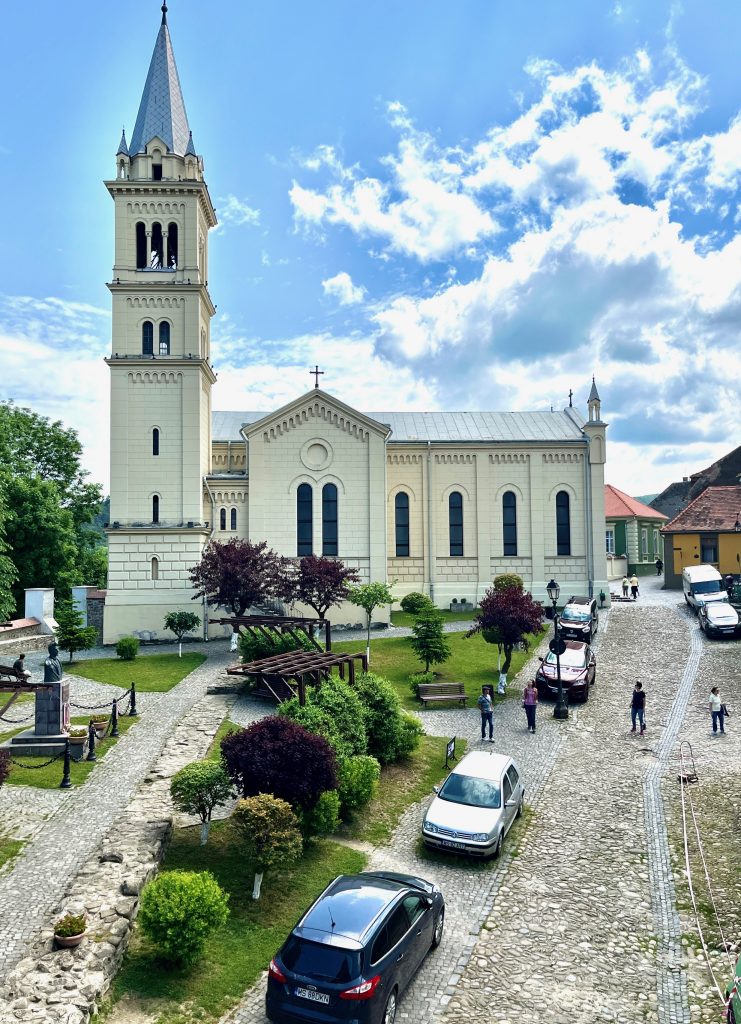
The Catholic Church next to a park with a statue of a hero of the Hungarian Revolution of 1848 against the Hapsburg empire.The large Orthodox Church near the river.
Climbing down from the top of the town we came upon a long covered staircase. The Lutheran Church used to also have the main school in town next to it. The covered stairway allowed the students to quickly climb the hill to the top of the town no matter the weather.
The covered stairway has over 150 steps in it.
Having come down the stairs from the top of the town we were both looking for a little break. We spotted a sign for a wine shop that looked like it had an interesting cave, and we stuck our head in. The shop was beautiful and the owner asked us if we wanted to try a tasting of the local liquor called Pilinka. We both said sure without asking the price. The Pilinka was excellent but the cost shocked us both. He did tell us the cost after we had agreed and before he served it, but neither one of us wanted to lose face so we sat down. For what we paid for 5 shots of Pilinka each, we could have had a nice 3 course meal with a glass of wine.
Our samples of Pilinka. We should have asked the price first. But they were quite good.
When we came out of the wine cellar we noticed that the afternoon thundershowers were starting to build again. We figured we had about an hour before they would hit so we decided to head back to François.
A nice window.
We weren’t in a hurry and Ton had heard there was a Lidl near the campground so we headed there. Just as we returned to François there was some spattering of rain. We sat inside and listened to thunder all around us, but as often happens with thunderstorms it was probably raining heavily all around us, but we only got a few drops where we were.
One of the watch towers from the city walls. Each of the towers was funded by one of the trade guilds in town. This one was the shoemakers tower.
Our plan was to head back into town in the evening after the rain blew thru. But once we got back into François we both got comfortable and the walk back into town never happened.
Looking over the lower town and the valley from the top of Sighisoara.
Today was a driving day. We had one more site on our tour of Romania we wanted to get to. When I punched Sighisoara into Google Maps to look at options it said 250 km’s which is not bad, but then I noticed it also said 4.5 hours, which is not good. The majority of the trip was thru mountains, and villages so Google was predicting an average speed of just over 50 kph, which meant for us it was going to take about 6 hours given we never hit Googles average speed.
Ton always provides me with way more pictures than I can use, since today was a driving day, here are some beautiful pictures from Romania.
We were up early for us and noticed that the Spanish Motorhome Tour we have been sharing the campground with was already gone. They had left about 7:30 am. This was the second time we had shared a campground with them and the second time they had departed before 8 am. Ton and I decided that we are not cut out for group touring of motorhomes!
A house in one of the villages we drove thru.
The drive over was thru truly beautiful mountains, and probably 150 kilometers of villages. The roads in Romania, even the major ones do not by pass the villages like in many parts of Europe, and since the speed limit in villages no matter how small is 50 kph it makes for a slow drive. The Romanians deal with this problem by ignoring the speed limit. We are frequently passed in the villages by cars going about 90kph, and today we were passed twice by semi-trucks in villages, despite the fact that I was right on 50 kph.
The church of the late noon bells.
It was a long drive, but we had set our minds to it and we ended up enjoying the day. We saw a lot of interesting things happening in villages. Two of the mountain passes were absolutely stunning, and even the thunderstorm we navigated for about 20 minutes broke up the monotony.
A home that appears to host artists painting scenes from the countryside in Maramures.
We arrived in Sighisoara about 3:00 pm right to plan, and it is a beautiful city. Our plan was to settle in, get a late lunch/early dinner and go for an evening walk. About an hour after we arrived the electricity went out in François. As I was walking around trying to find the problem, our Belgian neighbor came out and said his was out too.
A larger than normal wooden gate leading to what we think is a hotel.
Eventually we learned that the electricity was out in the whole town, something to do with all the thunderstorms around us, so Ton joined Gus and Agnes outside and we chatted for awhile. They eventually invited us to join them and the chatting continued until 10 pm, so no evening walk.
We are in the far north of Romania in the Maramures region that is considered the most isolated in the country. It is beautiful mountain country with large hills and small valleys. Because of this it has a slower life style than other places, many of the people still wear traditional clothing, and farm small plots of land by hand.
As we were driving today we saw a lot of these small haystacks being put together by hand. The harvesting of the grass to make the hay was also largely by hand and a majority of the work appeared to be done by the women of the area.
The region is also known for wooden stave churches. There are over 100 in Maramures, and several of them are considered UNESCO sites. These churches can be 450 years old and are large and tall given the construction material is logs.
These churches are surprisingly ornate and the wood working, carvings, and paintings are all extremely impressive.
The first one we tried to visit was almost a disaster. It was only supposed to be about 15 minutes from our camp. We got to the location I had programmed and no church. We found a place to pull over and park and got out and walked the village looking for the church, but we did not spot it. We decided to give up and head on to the next church.
As we have been driving thru Romania the last couple of weeks the Storks have been nesting. In the last couple of days we have noticed little heads just starting to appear over the top of the nest, so the chicks are in full growth now.
As we were leaving town I saw a sign pointing to the right and saying there was a church 200 meters down the road, so I whipped into the road thinking I had found it. Roads in Romania have generally been pretty wide, if sometimes rough so I was comfortable doing it. This time the road was one lane wide and looked to be narrowing. I saw a place to pull into a side road which was probably someones yard but it was going to be a tight turn around. By now we had started to attract quite an audience to watch the French/Americans turn their motorhome around. First three little girls of about 10 came running up, and shortly after that a couple of grandmothers came out to see what was going on. They joined in helping Ton with directions with one of the grandmothers warning Ton that a tractor was coming down the road so I could get out of the way. After a deftly executed six point turn we were pointed in the right direction. Ton waived good bye to our audience of helpers and we were on our way.
A lot of the homes in the area have these elaborately carved wooden gates with both a car/wagon gate and a pedestrian door.
We were more successful with the next church and located it without any adventure. It was the first of 6 we would visit today and they were all quite beautiful.
We really liked this cross and the gate behind it.
At our third church of the day we saw the wooden church and the more modern stone church. These days the wooden churches are preserved more as historical sites, and the day to day church is of modern design. All of the churches we had visited up to now had been closed but as we were walking away from the modern church we saw someone walk up to the door and look at us, so we returned and he welcomed us in. We tried to talk but he spoke Romanian and we do not. We did communicate a bit but I am sure we missed out on a good tour.
This church was probably built in the 90’s after the fall of communism. But the style of the art is similar to orthodox churches from 1000 years ago.
After we looked around for a few minutes and Ton snapped a bunch of pictures we were ready to leave. We left a small donation in the donation box, the caretaker thanked us and then pantomimed that he was there to ring the bells for the church. As we walked away the bells began tolling away, I looked down and it was 12:02. We had inadvertently caused the noon bells to be 2 minutes late.
The ceiling of the church.
We went to the monastery at Bistra. This monastery had been in place for hundreds of year before falling into disuse. In the 90’s the monastery was reformed and though they looked quite old all of the buildings on the site were built in the 90’s.
These buildings are all part of the monastery complex at Bistra.
We stopped at one more church in the valley and then decided to move on to the main stop for the day, “The Merry Cemetery”. The cemetery is famous for its elaborately carved headstones with poems about the lives of the people buried there.
Most of the graves had at least one portrait of the person often depicting them performing their craft, some had two portraits one of the craft and one more representative of the persons personality.
While it is called the Happy Cemetery the poems and stories on the headstones are often sad tales of lives cut off in their prime, or lives of missed opportunities. It would be nice to have been able to read the stories, but I have to say the artists who carve the headstones do a great job of having the images tell the story of the persons life.
Some more of the headstones with the wooden church in the background.
All of the wooden churches we had visited today had been locked. Usually you have to call ahead to arrange a visit and we had not done that. This church gave us a good feel for what we had missed as the interior was also quite striking.
Icons from the interior of the church at the Happy Cemetery.
We had spent several hours driving across small valleys and hopping over passes to the next small valley. We had enjoyed seeing a life style we had never seen, and wondered about the value of living at a pace like this. The one fear I have is that nearly everyone working the fields today appeared to be in their 50’s and 60’s we saw very few young people as we moved around. I hope they can keep it going and find a way to keep the young people around. Maria at the campground confirmed finding workers is a real problem in the area as everyone is moving to the cities for a more exciting life.
This very modern house had a beautiful horse stabled in the front yard.
Our drive back to the campground was quiet, and we had one long last look at a life style that may not be around for much longer, unfortunately. By the way as I was writing this I looked at the map of the area we had covered and on the way to the Merry Cemetery we had passed within less than a mile of the Ukrainian border without realizing it.
When we first started traveling we were always focused on the places we were going to see and the cool things we were going to do. As we travel more we have come to the realization that it is not the cool things you do that make traveling rewarding, it is the cool people you meet.
A “pot” tree at Camping Green Place.
We wanted to visit an area that is considered one of the most beautiful and remote in Romania. The region is called Maramures and it is both beautiful and remote. When I punched in the coordinates for the campground it said it was about 200 kilometers, but we had been told it was 31/2 hours from Cluj. It turns out it was closer to 4 hours for us. the first 100km’s took about an hour and a half, so we stopped at a Kaufland to stock up on food.
The town we are staying in is known for its mineral baths. This hot tub is on site.
The next 100 km’s took 2 1/2 hours as we went over several mountain passes that were full of hair pin turns. Also, the roads were well paved (no potholes) but a bit rough. It did not make for a quick drive.
One of the nice artistic touches at Camping Green Place. It sounds much more romantic in Romanian.
But we were rewarded for our efforts when we arrived at the campground. When we pulled up it looked like we were going to have the place to ourselves. We were greeted by the owner and she asked if we were part of the “group”. We said no, and she said all of the regular spots were taken by a group, but she had a place for us if we were adaptable. We loved the challenge so pretty quickly we were parked up next to a cabin, our electric cord was run thru a window and we were almost settled in. The problem was we were not getting electric in François. After some trouble shooting Maria the owner came to the conclusion that my plug was not working, and disappeared to get a screw driver. She sat down and disassembled my electric cord, found a loose wire and fixed it and we had electricity. Incredible service.
Marias home on the campsite.
We took it easy in the afternoon, and about 6pm the group showed up. It was 7 motorhomes from Spain, convoying thru the Balkans together. We had actually run into them in the campsite in Bucharest.
After an evening walk we came back and ordered a beer at the bar from Maria. Before we knew it we spent the next two hours with her as she proudly showed us around the campsite showing how they had built the place up. Her and her husband did most of the construction work themselves, and she also has an incredible sense for aesthetics, so everything is well built and beautifully decorated. You could tell the pride she felt for what they had accomplished. Without complaining she told us about the difficulties they have faced, but you could tell that the difficulties were not going to stop them from providing the best place they could deliver to their customers. Ton called her a superwoman and she certainly is.
Today we headed into the city center of Cluj to check out the second largest city in Romania. The campground we are staying in is located about 15 minutes from the main bus and Tram line down town so we were in the city in about 30 minutes.
A memorial to the local Hungarian hero in front of the Catholic Church.
The center had a couple of nice churches and the standard monuments to local heroes both Romanian and Hungarian as this city has gone back and forth between the two countries over its history. Today the city is about 20% Hungarian.
The memorial to the local Romanian hero in front of the Orthodox Church.
We enjoyed walking around, but Cluj is more than just a tourism oriented city. It is the unofficial capital of Transylvania and the feel is much more commercial than historical. There is a major university in the center so the crowds were young and moving quickly as they had things to do.
The opera house. I am not sure what style architecture this is but it is fun to look at.
After a couple of hours we noticed the sky was darkening up fast so we decided to hop on the bus and head back to the campground. It turns out we should have made the decision 15 minutes earlier. Just as we stepped off the bus, the first big drops of rain began falling. Before we walked 100 yards sheets of extremely heavy rain began, I told Ton that maybe we should jump into a bakery nearby and wait out the rain, but we decided to keep going. A couple of minutes later the lightning started and the heavy ran became an inundation. At this point there was nothing to do but put our head down and get to François as fast as possible. In the 15 minutes it took us to walk back we were soaked to the bone. It was one of the heaviest rains I have ever seen.
Another church that blends into the block.
The rest of the afternoon was spent organizing the interior of François to hang our dripping clothes, shoes, and back packs. Ton did that work as well as wringing out all of our clothes before hanging them.
The main square in Cluj.
We had plans in the evening to meet our friend Ovi’s cousin who lives here for dinner. She has been texting us places we should visit and recommending restaurants we should visit in the towns we have been traveling in Romania, so we were looking forward to meeting her in person.
A recent monument to Romulus and Remus commemorating the link between Rome and Romania.
The storm had caused some disruption in the city causing minor flooding and turning traffic into chaos so dinner was in question. But as the afternoon wore on the rain stopped and the skies cleared up. Tania lives pretty close to the campground so instead of meeting them in the center of the city we decided to meet in a neighborhood restaurant a little later.
A bustling town square without the tourist amenities.
Tania and her family were a great treat. Her husband Dacian is a university professor and she has two lovely well behaved children. The boy was 8 years old and very eager to speak English with me. His vocabulary, and sentence structure was good, and his American sounding accent was nearly perfect. He and I had good fun and he gave me a Romanian lesson as well, I don’t think I was as good a language student as he is.
We really enjoyed their company and learned a lot about life in Romania. They share our love of travel and we spoke about their travels in Greece and Italy, and their hopes for the future for both themselves and their kids. They were even kind enough to walk most of the way back to the campground with us so we could continue to enjoy chatting together. It was a wonderful evening.
Our plan for the day was to get going early so we could visit the historical park near the campground before we set off for Cluj. Last night the campground was nearly full, and people were still coming in well into the evening. So we wanted to arrive at the campground in Cluj early so that there was no issue with getting a place.
An interesting way to hoist water from a well. I understand levers, but how tall were Romanians in the 19th century?
Astra Park is an outdoor park that has a collection of traditional Romanian buildings mostly from the 19th century. There are homes, workshops, churches, and a lot of different types of waterwheels.
One of the many examples of waterwheels and mills in the park.
Most of the regions of Romania are represented so there is a great variation in the types of homes, and construction materials. There are also homes that were typical of the non-Romanian people who live in the country.
Grass roofed work buildings with a fence made of interwoven vines. The vine fencing was very prevalent, but this was the only one with grass on the top.
Astra Park is considered the biggest outdoor museum in Europe. It is really immense and contains hundreds of different buildings. It was started in the 1970’s and continues to be added to today. It is extremely impressive.
This cat was sleeping on the sluice boards for this mill when Ton went to take her picture. When Ton started to shoot she got up and posed for Ton.
In addition to the examples of different types of buildings the museum also highlights examples of traditional farming techniques as well as several crafts. We particularly enjoyed the potter who is well renowned in Romania.
The potters wheel with some of the finished goods displayed.Some of the raw pieces before they are fired in the kiln.
We had planned on spending about an hour here, we were less than half way around when Ton pointed out we had already spent two hours. So we had to pick up the pace a little for the second half of the park.
They had a flock of sheep on display with a shepherd. There were several types of sheep in the flock which we supposed represented the different type of sheep raised in different parts of Romania.
In the end we regretted not having more time to spend as this place is really fantastic. The buildings are really well presented and maintained and the grounds are beautiful and a nice walk. This is one of the best historical parks we have ever been to.
These paintings were done on rough hewn boards, but are really well preserved.
Our drive was about 200km’s so I had told Ton to plan on about 31/2 hours. So far in Romania we had not seen any freeways. Even around Bucharest the roads were 2 lanes but highways with cross traffic and roundabouts, and frequent speed limit changes. On those kind of roads we end up averaging about 60 kph.
One of the largest and most elaborate houses in the museum.
After we left Sibiu we ended up on a true freeway, but I did not expect it to last long, as the few times we had been on limited access roads they only last 8 or 10 kilometers before turning into highways with normal traffic. But this one did not peter out as the others had done.
A sail type windmill from the park.
It turns out the freeway lasted all the way to Cluj. I really enjoyed being able to drink my coffee while driving without worrying about shifting gears every few minutes. Our drive was 2 hours instead of the 31/2 I had planned on.
A beautifully carved wooden crucifix.
As I said at the top of the post I was a little worried about space in the park. When we arrived the gates were closed, and the park was empty. Now I was a little worried that it was closed. I called the number on the gate, and the owner opened it up for us and told us to pick anywhere we wanted.
There was a selection of stuccoed homes painted blue. I’m not sure what part of Romania favors blue.
Having a whole campground to ourselves we became indecisive and spent the next 30 minutes trying several different places to park. We finally settled in and have been since joined by a Dutch couple so we don’t have the whole place to ourselves.
When we arrived Ton was very happy to see that they had a dryer to go along with a washer. Today our plan was to wash and dry our sheets, and then head out for an interesting museum in town. The plan kind of worked, but as you can see from the title photo, the dryer had to be augmented with some time on clothes lines so our trip to the museum has been postponed until tomorrow.
The fortified church of Kirchenberg as seen from François.
Since we arrived I have been looking at another fortified church which is on a hill overlooking the campground. Today after we finished with the laundry. I proposed a hike up to take a look at it. Ton thought about it for about a second and told me to take good pictures as she was going to relax.
Looking up at the church from the village.
It was a short hike to the base of the hill that the church was on, but the climb was a good workout. When I got to the church I was the only one there. The grounds are well preserved, but the church was always pretty basic, appropriate for a village the size of Cisnadiora.
The unadorned alter in the church.
There were no paintings on the wall and the interior furnishings were an alter and two crosses. The only thing of note was a wall of placards in the nave of the church with the names of men from the village killed during WWI. There were about 45 names there in total. Several things were interesting to me, all of the dead were from 1916. As we learned at Bram castle the Romanians joined the allies in 1916, what was not said was that the decision was a military catastrophe for Romania. The country was quickly overrun by the Germans, Austro-Hungarians, and Bulgarians. This is the reason that all of the casualties from the town were in 1916. Most of the soldiers were from the 188th regiment of the Romanian Army which I presume was the local regiment from this area. That regiment must have been very roughly beaten as the number of dead from a village the size of Cisnadiora is catastrophic. But to me the most interesting thing was that all but 2 or 3 of the names were obviously German. Not only the king of Romania was of German descent, but a good number of the soldiers in the Romanian Army were also. This area was majority German at that time and they fought and died for Romania against the Germans and Austrians.
The exterior of the church.
Today the population of the area is around 1% people of German descent. Most of the ancestors of the men who died in 1916 have emigrated to Germany to seek a more prosperous life.
Sibiu is another one of the 7 Saxon cities in Romania. It is a nice valley city with the Carpathian Mountains in the background. As we drove into the city it had a very prosperous feel to it. Ton told me that it is considered the most livable city in Romania and that the former mayor who gets credit for the livability of Sibiu was later elected president.
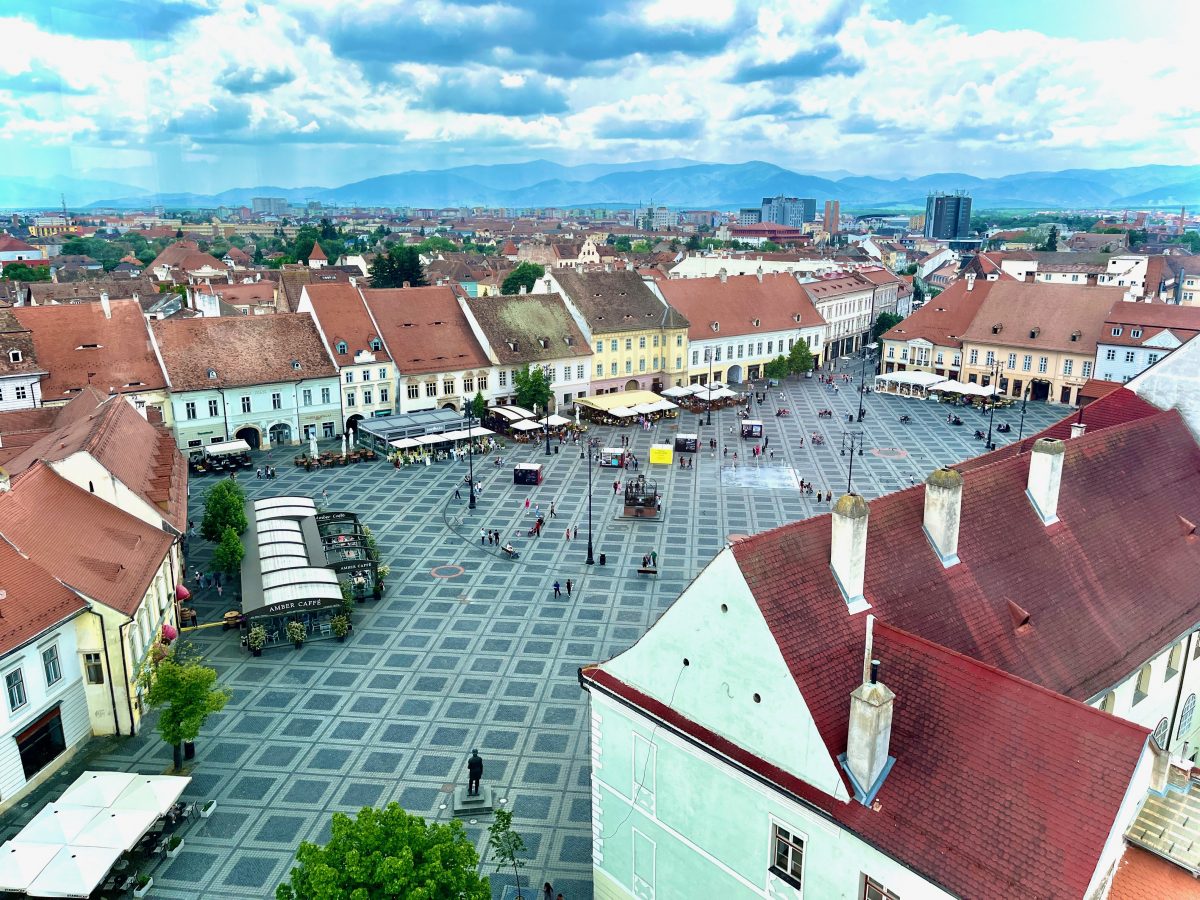
The main square of Sibiu known as the Piata Mare.
We had the normal tourist stops on our itinerary, but really mostly just enjoyed walking around the city. It was a beautiful day and most of the people were locals enjoying their Sunday, I am sure later in the year there will be more tourists, but today it was nice seeing local people out enjoying the town.
People watching on the square.
We found an interesting display that looked quite old but is actually from 2004. During the rebuilding of one of the buildings in town some of the craft guilds restarted an old tradition of setting up a log were each craft attached something representing their work. It was a cool display though we almost missed it, because we were focused on reading the sign describing the process they used, we initially didn’t see the log. Ton tasked me with finding it so I typed it into Google maps and it told me I was one meter from it. I turned around the other way and there it was.
The pole with the tools of various craft guilds on it.
Ton became fascinated with the eyes of Sibiu. Most buildings built in the 1700 and 1800’s have ventilation dormers in the roofs. They are very common and you see them thru out Europe. In the 1800’s builders in Sibiu began putting a unique ventilation dormer in the roofs in the city that resemble eyes. There is no practical purpose to them they just look cool.
These are Tons favorite eyes. You can see a conventional ventilation dormer in the building to the left.
The eyes never really caught on outside of the immediate area of Sibiu so they are unique to the city. In 2017 the eyes were featured in an anti-corruption campaign with the saying “Sibiu” is watching you.
A different variation on the eyes of Sibiu.
Our next stop was the Turnul Sfatului or Council Tower in English. It is a seven story tower built in the middle ages that overlooks the Piata Mare. Ton usually is not a climber (heights are not her thing), but she really wanted to visit this tower. When we first arrived there was a sign on the door in Romanian that I interpreted to mean that entry was only during the first 10 minutes of each hour. We had a little bit of time to kill so we went off to do some window shopping.
The Turnal Sfatului from the ground.
We arrived back about 10 minutes before the top of the hour, and after a few minutes were joined by a few small groups of Romanians who read the sign and joined us waiting for the top of the hour. When one o’clock came round we all expected the imposing door to open up and we would be granted access. One o’clock came and went and nothing happened, so we all waited a few more minutes, finally one lady gave the door a tug, it opened so she went up the stairs. Everyone else followed her and found the ticket seller sitting one floor up the tower waiting patiently for us to arrive.
This is Tons favorite picture from a composition point of view, because it shows some eyes, the Carpathian Mountains, and the new town in the distance. She is not happy with the clarity due to the window in the tower being dirty.
After visiting the tower we went over to the Bridge of Lies. It is a cast iron pedestrian bridge over a sunken road. There are several stories about liars associated with the bridge, the legend I like the most is that if a merchant lies to or cheats a customer he was taken to the bridge and thrown off. The truth appears to be that the name is caused by German being a complicated language. The original name meant Lying Bridge (as in Lying down) which had something to do with the construction. The German for that apparently is close to Bridge of lies which is where all of the tales came from.
The Bridge of Lies with a couple of nice eyes in the background.
The Holy Trinity Cathedral was our next stop. The churches in the historic area are Lutheran because the population was originally dominated by Germans. Holy Trinity Cathedral is Orthodox which is the religion of most Romanians. We are glad we went out of our way to see it.
The altar and the dome of the Holy Trinity Cathedral. The artwork inside was magnificent.
On our last two trips we have visited many Orthodox churches in Montenegro, Greece and Bulgaria. In Romania we noticed that the artwork was quite different than in those countries. The themes of the art seem to be the same, but the paintings themselves seem to be less stylistically rigid. It is almost like they are a meshing of the very stylistically rigid art in the Greek and Bulgarian churches with the very natural style of the Catholic churches we have visited. We really enjoyed the art and the iconography in Holy Trinity Cathedral.
Mary and Baby Jesus Icon from Holy Trinity.
We ended the day with a nice meal in what is supposed to be the oldest restaurant in the city. We both tried traditional meals and enjoyed them. I am really enjoying the polenta which is a staple in Romanian food.
An arched buttress from one of the churches on the square framing a road in the lower town.
We got off to an early start today as we wanted to visit Bran Castle before setting off for our next planned stop at Sibiu. Some one in the past did a great job of marketing for Bran Castle and it is now a must stop for tourists visiting Transylvania. The castle is not mentioned in the book. Nor is it tied to the person who many believe Bram Stoker based the fictional character on, Vlad the Impaler who lived in another part of Transylvania. The fictional work Dracula written by Bram Stoker that is the source for all of the American movies about Dracula is not set in or near the castle or the town of Bran. Despite that it has become linked with Dracula by the tour companies that take tourists thru Romania and is therefore a must see stop for visitors.
The approach to the entrance for the castle.
Having said all of the cynical stuff implying that the castle is a tourist trap, our Romanian friends did say it was a pretty cool castle and we should check it out. So we were on the road bright and early to try to beat the Saturday crowds to the castle.
The real story of the Bran Castle revolves around Queen Marie of Romania who had the castle remodeled in the 1920’s.
There has been a fortification on the site of the castle since the 1200’s as the position it occupies controls an important mountain pass on a trade route between western Europe and Byzantium/the Ottoman Empire. The fortification has been called a castle for a long time, but did not get the towers and buttresses that give it its current look until the redesign commissioned by Queen Marie of Romania in the 1920’s when it became the royal families summer residence.
Every mysterious castle has to have a hidden passageway. This one was located behind the lectern in the chapel.
She was a very popular Queen who was instrumental in convincing the King to have Romania join the allies in WWI despite his German heritage. She was known as the warrior queen and would visit the trenches of the Romanian army in uniform to raise morale. She also acted as a volunteer nurse to the army during the war.
Not a hidden staircase, but a cool one.
During the communist era it was confiscated by the government and the royal family fled, with the Queens daughter ending up living in the US. After the fall of communism the Hapsburg heirs living in the US regained ownership and developed it into the attraction it is today.
The mountain pass the castle was originally built to defend.
We were some of the first people to arrive for the day so we had time to explore the rooms and get nice pictures without a lot of people in the way. By the time we left at about 10 am the line to get into the castle was growing fast, so our timing was good.
The last 10 days we have seen a lot of school groups everywhere we go as everyone gets to enjoy a good field trip to celebrate the end of the school year.
We had about 180 km’s to cover to get to Sibiu, and it happened without incident until the end. As we were motoring along Ton saw one of her new favorite grocery stores called Kaufland. We have not seen these until we arrived in Bulgaria and Romania. It is a German chain operating here and in Bulgaria they are almost always located adjacent to a Lidl which is Tons old favorite chain. We ran in to stock up on some Romanian food and to get a bit of a stretch. We are now well prepared with food (and wine and beer) for the next few days.
The castle trying to generate some spookiness by talking about other Romanian scary legends.
Our only adventure for the day was going to the campground I had picked out. When I checked on Sibiu about a week ago it showed one place with good reviews but about 10km’s from town. Last night when I went on our go to website for campgrounds to get the location I saw a brand new campground listed that was much closer to town. I decided to put the coordinates in for that one instead figuring it was brand new and we would give it a try.
The Queens bedroom in the castle.
When we were about 1.5km’s from the site Greta told us to turn down a dirt road. It is not unusual to have to go down dirt roads for a few hundred yards/meters so I did not sweat it too much, but this particular road was one lane wide. It was pretty rough and the area did not look particularly enticing but we carried on and when Greta stated we had arrived there was nothing that looked like it would be a campground, or a sign pointing at a campground. There were some small farms with homes but they were all fenced in. At this point I decided to get out and investigate the area on foot.
Looking up at the interior of the castle from the center courtyard.
We have a standing rule that if either of us is uncomfortable with a place we move on. I could tell Ton was very skeptical and after a short walk down a side road and having 3 or 4 dogs come running up to the fences aggressively I decided it was time to try the well reviewed campground instead.
The original well in the courtyard.
Half an hour later we arrived at our second choice campground which is in a nice village a little bit out of town. For the first time on the trip the campground is near capacity. I guess shoulder season is winding down.
Today was a day for tourism. Our Romanian friends strongly recommended we visit Brasov. It is famous for its Black Church and its charming old town. After a mostly driving and working day yesterday, I didn’t mention we washed clothes yesterday, we slept in a little today. Before heading into town Ton prepared a nice breakfast made up mostly of stuff leftover from Bulgaria.
We believe these ladies are Roma, who make up about 1% of the population in the area. This is the first time we have seen Roma in the traditional costumes associated with them.
We started the day by going to the biggest attraction in town the Black Church. It is called the Black Church because after a major fire in the 1600’s the exterior was coated with soot and the stone turned black.
The exterior of the Black Church. The white blocks are a result of several restorations recently and in the communist era that used non-matching stone.
The church began as a Roman Catholic Church founded by the German settlers in the region. During the reformation Brasov was an early adopter of Lutheranism and in the mid-1500’s the Church became Lutheran.
The interior of the Black Church.
I was surprised that it was not classified as a Cathedral as it is the size of a Cathedral, but the history of the church indicated that it was over built in order to try to advance the status of the city. We were lucky as the organist for the church was practicing while we were inside so we got to listen to the very impressive organ.
The organ sounds as impressive as it looks. If you look carefully in the right center of the picture near the bottom of the organ you can see the organist playing.
As is typical with Lutheran churches they are much more austere than Catholic churches. Brasov was a trading center between western Europe and the Ottoman Empire, so the walls of the church were lined with Turkish rugs from the Ottoman empire. Most of the rugs hanging in the church were from the 1700’s.
Some of the pews from the church. Each guild had its own set of pews. You can also see some of the Turkish Rugs in the background.
Something we learned today was that seats were not provided by the church. Each guild sat together and provided their own pews. The location and the quality of the pews was determined by the wealth of the guild. The guilds competed for the best locations in the church. They also tried to design pews to represent their trades. Once we understood this we made another tour of the church to look at the different pews.
One of the original gates for the town. The walls have been torn down, but this one gate was kept as a landmark.
After the church we took a pass thru town. Like many European cities the main square and one of the roads are pedestrian only. This is a feature we really enjoy as it makes for a nice relaxing way to see the town, and allows for a lot of outdoor dining for the restaurants.
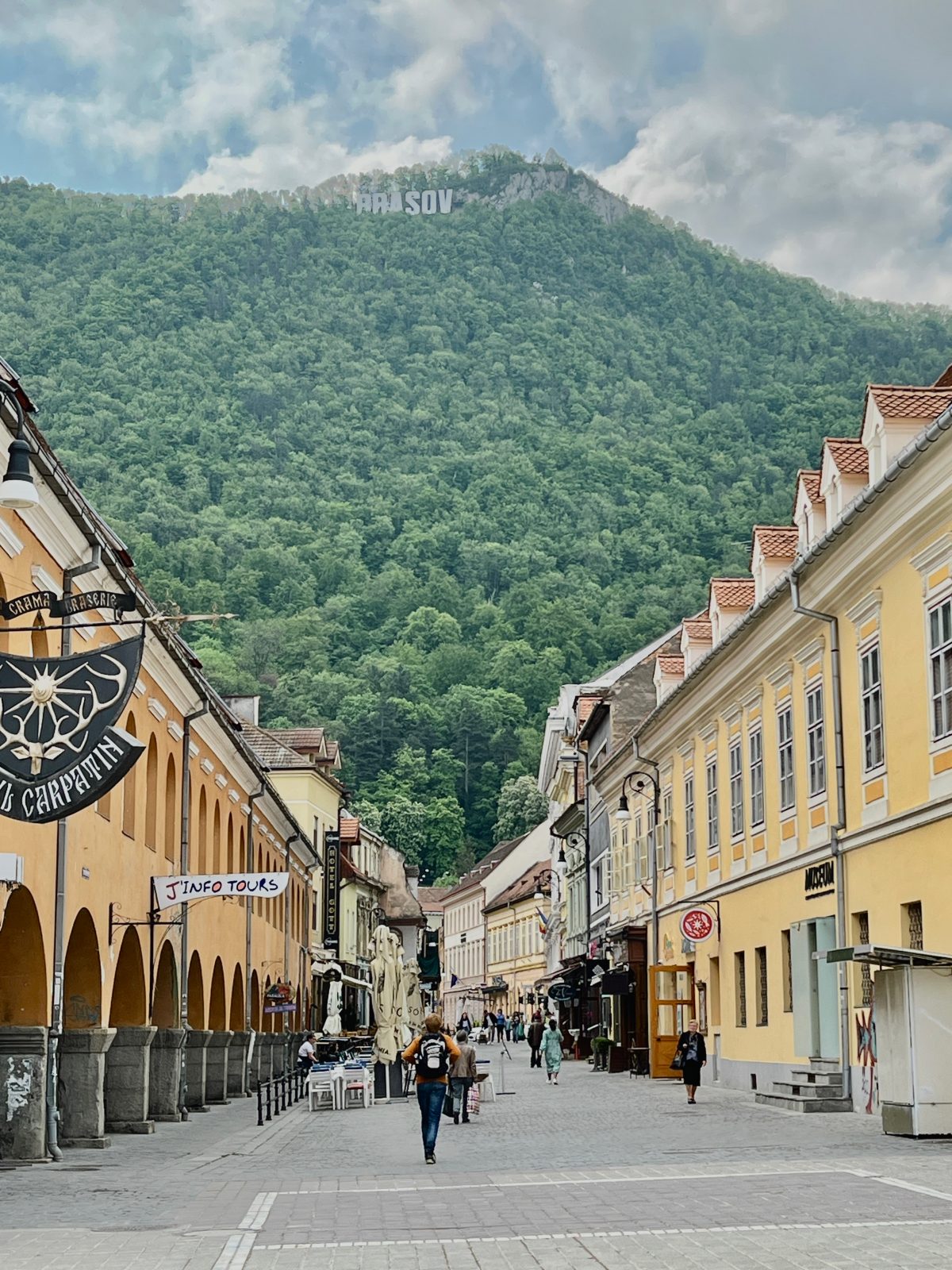
A section of the Strada Republicii, with the outdoor dining that we love. If only we could get them to make a least part of it non-smoking!
We popped into a small pub to sample a local beer. We ended up having a nice conversation with the server because Ton noticed his Las Vegas Raiders hat. He was very proud of the beer, they have revived a local beer using a recipe from 1893. It is a Lager, but a little maltier than modern Lagers. He really appreciated our praise and gave us a run down on other craft producers in the region.
A locally produced beer using a recipe from 1891.
After refreshing ourselves we headed towards Strada Sforii, or Rope Street. Apparently there is a list of narrowest streets in Europe with official measurements and everything, and Strada Sforii is the third narrowest in Europe at 1.3 meters (about 4ft). It was left in place to allow medieval fire fighters a quick passageway between main roads.
The narrowest part of Rope Street. Too bad about the graffiti.
Next to Rope Street we found the Jewish Synagogue. The building survived the war, though unfortunately most of the Jewish population of the town did not.
The Synagogue and the communal dining for the local Jewish community. There was a touching memorial to 10 young men from Brasov who were killed in the 1973 Israeli-Arab war while fighting for the Israelis.
We had our first Romanian meal. Ton was really happy with her stuffed cabbage and she also liked my goulash. I am going to be open minded but so far I think I like Bulgarian and Greek food better.
The stuffed cabbage with sour cream and polenta is a local specialty. The Mustata Beer (Mustache) is the other local beer in town.
There are places whose name brings forth images that make you feel like you have accomplished something. Today we are in Transylvania, how cool is that.
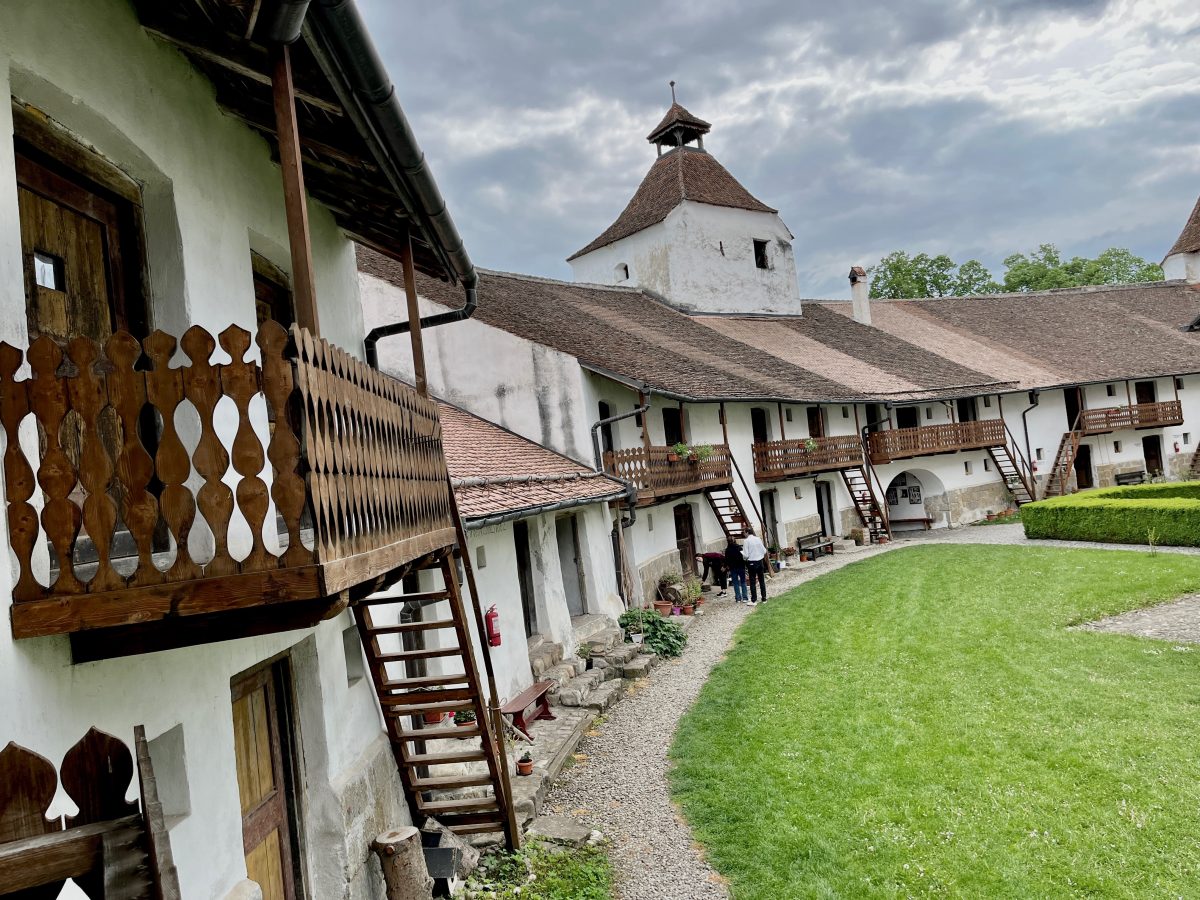
The interior courtyard of the fortified church in Harman.
Today was one of the days that I think makes traveling like Ton and I do so special. The day started terribly as we got caught up in rush hour traffic leaving Bucharest. We were crawling along at 15 to 20 kph for about 40 minutes. Then I managed to miss two consecutive turns because the Romanians have an interesting way to do interchanges that is not used any where else in the world; for good reason. After we managed to escape Bucharest the next couple of hours were busy but we were moving along at a fair pace.
The church tower of the fortified church of Harman.
We then entered the southern Carpathian mountains and passed thru a succession of pretty mountain towns that were geared for skiing and tourism. But we were focused on making it to our stop for the day in Harman. I had read about a campground that is located within the walls of the rectory of the fortified church of Harman.
The view of the church from our campsite.
After a stressful 4 hours of driving we arrived at the campsite, and I was immediately happy. The grounds of the campsite are within the walls of the rectory. The manager of the campsite welcomed us and gave us a tour of the facilities of the campsite, they utilize the buildings of the rectory which is really cool. He stated that the profits from the campsite go to maintaining the church across the street so we immediately felt even better about staying here. On top of that they had a friendly cat who thought she owned the campsite and allowed us humans to use her space as long as we were willing to pet her when she was ready for it.
The bell tower of the church reminded us of Burgundy in France because of the colorful tile designs.
The fortified church of Harman was originally established in the late 1200’s by German immigrants from Saxony who moved here at the request of the Hungarian rulers of the region. The region was at the edge of the Hungarian empire and was often attacked by Mongols and Ottomans. So the church in the city was surrounded by circular walls that acted as a fort when the attackers showed up.
The interior of the fortified walls. The windows on the right are to allow the defenders to shoot arrows and dump boiling oil on the attackers.
The walls are extremely well preserved. I am not sure if they have been rebuilt but they feel like you would expect a castle wall to be. Of the many castles we have visited in our turns around Europe these walls felt the most original and authentic. You could imagine yourself defending the place against the Mongols.
In the center is one of the seven towers that are part of the fortifications of the church.
The church is not spectacular, but instead feels sturdy. But it felt authentic to the era because it was not overly ornate. One of the touches I really liked was that the seats were mostly rough hewn benches instead of elaborate chairs.
The split log seats in the church were something I have never seen in a church anywhere in Europe.
The church allowed access to the bell tower which was about 60 feet in the air. I climbed to the top, and one of the sets of stairways consisted of logs with flat notches cut in the center. Again this felt much more accurate to the era than anything we have seen before.
The staircase to the bell tower. The handrails are modern but the stairs felt like what you might have seen a few hundred years ago. While navigating the steps I was grateful for the modern hand rails.
The final thing that made this place special was one of the seven towers of the wall had been originally built as a chapel, but was converted to a fortification. The frescoes in the chapel/tower have been recently uncovered and were quite beautiful.
One of the frescoes from the fortified church of Harman.Ton loved these frescoes.
We had never heard of the Fortified Church of Harman, and if we had not selected the campground we stayed in we would never have visited the site. But it turned into one of the most memorable places we have visited in Europe. Finding places like this is why we put up with navigating rush hour traffic in places like Bucharest with bizarre interchanges and signs we cannot read. It is all worth it when you stumble on to a gem like this. And as a bonus it is in Transylvania.
The exterior of the chapel that the frescoes are in.
We woke up to a pretty solid rain. A quick check of the weather showed rain on and off all day. Earlier in the trip we probably would have just hunkered down for the day and waited for better weather. Now we are feeling time pressure, so we decided that after all we are from Oregon, so we broke out our rain gear and headed out for the day.
Rain covered street in the old town of Bucharest.
We started the day by heading to the old town in Bucharest. This part of town has some of the few 19th century buildings that survived the communist government. It is a small area, but now has a nice mix of shops and restaurants. We enjoyed walking around and enjoying the sites.
The touristy old town. Things were a little slow today due to the early season and rain.
We took in a couple of pretty churches, and some of the larger buildings left over from the 19th century including the Bank of Romania, and the Art Museum.
We both liked this building though we never did figure out its name. The literal translation of the words around the clock is Economy Registration Deposit House. I wonder if it was the central bank.
It was starting to rain and we had passed a beautiful looking restaurant called Caru’ cu Bere. Ton said it was a beer hall and was the oldest restaurant in operation in Romania. Between the beer and the rain it looked like a good place for a break so we headed in.
The entrance to Caru’ cu bere. A beautiful beer hall and restaurant.
I was immediately glad that the rain drove us inside as the interior of the building was stunning. We both stood and just looked around for a few minutes. At first we intended to only get a beer, but we decided to order a light meal to go with our beer so we could enjoy the interior of this beautiful building. The food we picked was ok, but we really did enjoy the interior. I think it was nicer than any of the beer halls we went to in Munich.
The interior of Caru’ cu bere. Like a church for beer lovers.
Ton loves book stores and she said she wanted to stop at Carturesti Carusel as it was supposed to be a great place. It was a short walk from Caru’ cu bere and it was as nice as advertised. It is 6 stories of books, art, and coffee. We really enjoyed exploring every part of it. The interior of the building is incredible by itself, and the way the store is decorated enhanced the beauty of the interior. It really is a special book store, which unfortunately are a dying breed.
The interior of Carturest Carusel is incredibly beautiful, it is the perfect place for a book store.
Our last stop for the day was an area called Central Civic. During the communist era the dictator of Romania visited North Korea and was inspired by the monumental architecture of Pyongyang. He returned and ordered the construction of several large avenues and gigantic buildings to emmulate what he saw in Korea. To do this he destroyed a large section of the 19th century buildings in the center.
Part of the Palace of Justice along the river in the Central Civic. The scale is enormous, but it is dwarfed by the Palace of Parliament.
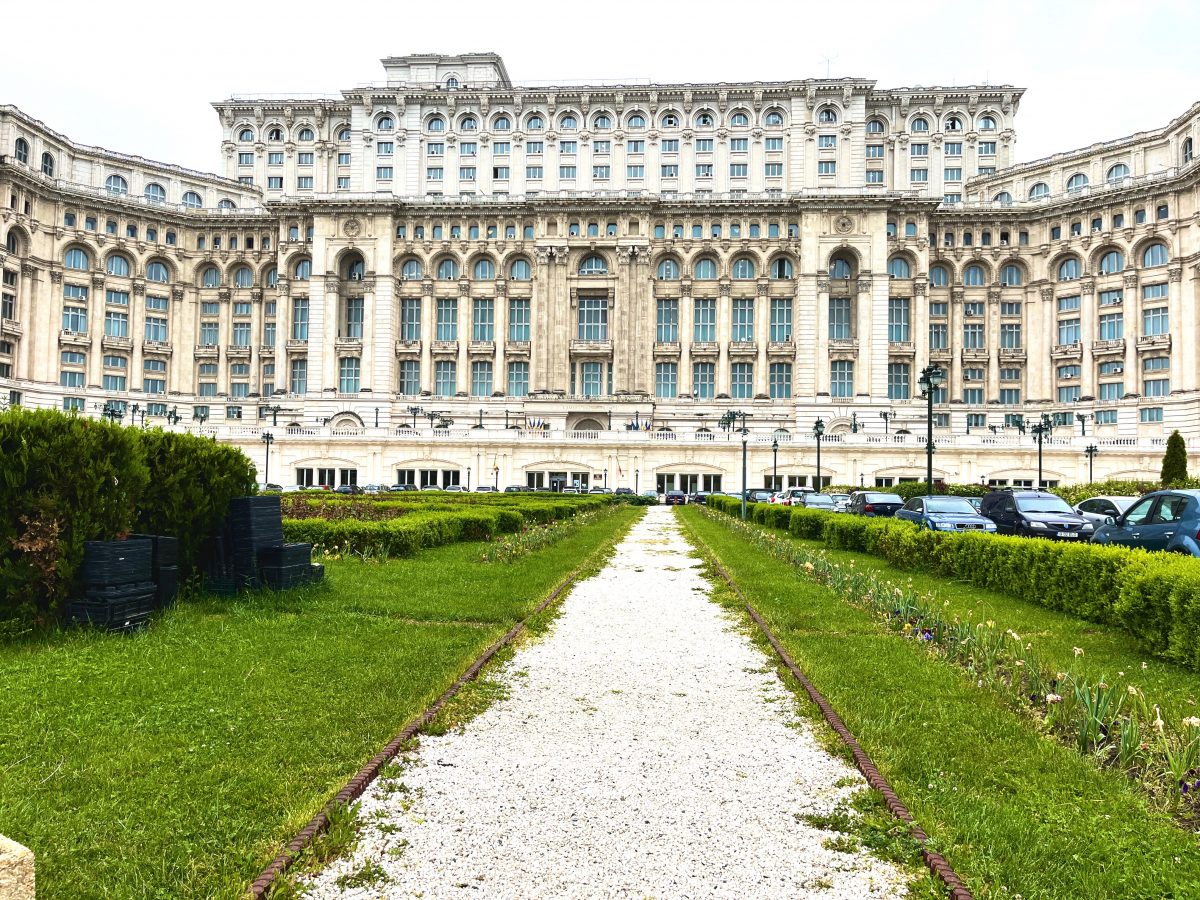
The main feature of his monumental downtown is an immense building called the Palace of Parliament. This building is enormous. To give you a feel, when I told google to take us to the building the path it choose was closed off by a security post. Not knowing which way to go we ended up walking to the back of the building. From the center of the back of the building it would take 1.4 kilometers (nearly one mile) to walk to the front. It is not a particularly handsome building, and the Romanians seem to have very mixed emotions about it. Apparently in addition to destroying much of the existing downtown hundreds of workers died building it.
The Palace of Parliament from behind. We never made it to the front.
We started to head to the front, but were drawn to a large Cathedral on one side of the Palace. When we got to the National Cathedral it was closed as it is going thru a major renovation, but it is a striking building.
The National Cathedral closed for a very major renovation.
However on the grounds of the Cathedral was a beautiful wooden church. There was a long line of people lined up in front of an icon. Eastern Orthodox churches usually have metal icons that people will kiss and then say a short prayer. Today one of the icons had a long line of people waiting to say a prayer.
This beautiful little church is on the grounds of the National Cathedral.
We were still a kilometer from the front of the Palace of Parliament and it had started to rain again. When we were going to the city in the morning our driver told us that if we didn’t head back before 3 pm that we might as well stay downtown until 7 pm because the traffic would be crazy. When we finished at the church it was about 2:45 so we decided to head back to the campground.
We have not seen wooden churches or wooden crosses like this anywhere we have traveled before arriving in Romania. We like them they have a simplicity that appeals to both of us..
Today we moved north to Bucharest. We are not quite done with Bulgaria, but we decided to pop up into Romania for a couple of weeks. The drive was short, and the border crossing was a simple. Ton was even impressed that the Romanian border officer smiled at us, after several weeks of Bulgarian poker faces.
The fishing lake next to our campground.
After we set up and settled in, Ton sent me off to find a bank to get some Romanian Lei. The only bank nearby robbed us on the exchange charging 8%. But as Ton said we needed the money. We just won’t be recommending the Austrian Raiffeisen Bank to anyone. Over our years in Europe we have always felt comfortable changing money at ATM’s and the rates have always been fair. Today was an exception to the fairness we have experienced. I noticed that there was both a Kaufland and a Lidl nearby so our first afternoon in Romania was spent window shopping groceries, the only thing we bought was a liter of water, but Ton enjoyed herself.
Ton and I have been married 41 years but we still mis-communicate with each other. The plan this morning was to head to Bucharest and we were just about done packing up by 9 am. Ton said she was going to call her friend in Thailand before we took off, so I went and sat down and was enjoying my coffee and taking in the incredible view in front of François.
Art from the box wine of a winery near us.
As I was sitting there I was really enjoying myself and decided to propose a day off to Ton, while she was still speaking to Dang in Thailand I stuck my head in and said lets take today off. Ton immediately agreed, and went back to talking to Dang, and I went back to my coffee.
Vines and Roses.
What I meant by a day off was sitting around listening to the birds and enjoying the view while relaxing and having another coffee, then maybe a nap and a short walk. What Ton meant by a day off was a 70 km round trip drive to Ruse, to walk the town, wash François, and do a final Bulgarian food shopping expedition at a Lidl. Anyway we were off for Ruse about 30 minutes later for our day off.
Part of our day off was a very nice wine tasting at a winery about 15 km’s away.
We accomplished everything on Tons list but the walk thru Ruse as I could not find parking in the city center of Ruse. Instead we substituted a wine tasting at a winery on the way back from Ruse. The wine tasting was nice and interestingly it involved only wines taken directly from the vats, or barrels which we enjoyed.
The tasting room of Rabchev Winery.
Next time I ask for a day off I am going to have to be a little more specific!
The image above is from the front window of François tonight. Its places like this that make the whole motorhoming/RVing thing worth while. For those who are following you will remember that yesterday we were sitting on the Black Sea. Today we are obviously not on the ocean.
We have left the Black Sea behind.
Every one of our trips has the same pattern. The first month we meander along taking it easy, spending several days in one place because we like the vibe or are just feeling lazy, and then at some point something kicks in and we feel pressure to get moving because we have ground to cover. That tipping point happened last night.
If you have been following along you will know Ton loves Canola fields. Bulgaria has nearly as many as France, so Ton is very happy.
The debate last night was whether to head up the coast to the major city of Varna which is the main port for Bulgaria, or head towards Bucharest. Our first exposure to the Black Sea did not wow us, and while we are sure that Varna is a nice city that probably deserved at least a day of visiting, we were not excited about going there. So we decided to push on towards Bucharest.
The Ruseneki Lom National Park in Bulgaria.
We were not completely ready to leave Bulgaria. We have been really enjoying ourselves here, so I looked for a place near the Romanian border we could move to. Some research came up with a highly rated campground called Koukery Campground and it said it was next to the Ruseneki Lom National Park, and a UNESCO site called the Rock Hewn Churches of Ivanovo. So that is where we are as I write this.
These wood carvings represent the Koukerys that the campground is named after.
The drive over was about 200 kilometers and a large part was back tracking over the same ground we covered yesterday to get to the Black Sea. But as Ton said if we had not gone and seen the sea we would have been disappointed. Hopefully, we will return to the Black Sea again in the future.
I’m point man on the trail and chasing away the vipers!
After an easy three hours we arrived at the parking lot for the Rock-Hewn Churches. Around 1270 monks began occupying the caves in this area and converting them into sanctuaries. Eventually there were three hundred caves occupied and 4o small churches had been carved out of the caves.
Many of these caves were occupied by monks for 400 years from the 1200’s to the 1600’s.
There were two sections to the caves, the main cave that most tourists visit and three smaller caves that most tourists do not visit. I chose to take Ton to the three smaller caves first. Traveling to these caves involves walking along a natural trail thru the National Park. Ton was a little nervous as we were the only one on the trail and it was pretty wild. I kept telling her not to worry as the trail was well used so I was sure nothing could happen. Right after reassuring her that all was well we came upon a snake on the trail. It was only a couple of feet in front of us and I could hear it hissing at us which means it was pretty agitated. I stopped short and backed away bumping into Ton. The snake slid off into the brush on the side of the trail. I do not like snakes, but I told Ton it was no big deal as I didn’t think they had poisonous snakes in Europe. Later when I googled snakes in Bulgaria the snake that looked like the one we had almost stepped on was a common European viper, and vipers are poisonous.
The ladder up to one of the minor caves we explored.
When we got to the first of the minor caves it was quite a climb to get up and view it. After we climbed up we were disappointed to see that it had been closed off with a gate. Ton got a picture of the interior of the cave which I think was a living quarter.
The interior of the living quarter for one of the monks residences.
We went on to visit the other two caves on the trail, but the climb up to them was even steeper and higher so we passed. At this point we decided to turn around and head back to the Rock Hewn Church.
You can see the enclosure for the front of the Church, and a balcony that was added to the church.
We headed up to the church site trying to stay ahead of a tour of 40 Romanian tourists. We got there just ahead of the tour group and ended up with about 15 minutes in the church by ourselves, as the tour group negotiated with the Bulgarian ticket takers over what currency to pay for the tour with. The Bulgarians wanted Lev or Euros, and the Romanians wanted to pay with Romanian Lei. I am not sure how the negotiation turned out but it allowed us to enjoy the interior alone.
The interior of the cave that makes up the Rough Hewn Church with the Frescoes on the ceiling and wall of the cave.
The interior was beautiful. The space is small, and some of the Frescoes are quite weathered, but the effect is special. Ton and I wandered around the cave in awe of the beauty.
A frescoe we believe is of the last supper.
I am not particularly spiritual, but this place impressed me. The dedication to convert a cave on the side of a cliff into a church takes a spirit that most people do not possess. We have seen a lot of religious art on our travels thru Europe and sometimes we become a little jaded. But today I was really awed.
More of the art from the Rock-Hewn Church.
Our time alone with the church came to an end, so Ton and I headed down from the cave back to the valley floor. On the way we stopped to take in some of the views we had rushed by to get ahead of the tour. They were also magnificent.
Another mural from the church.
Yesterday we felt like we were just making a tick mark on our travel itinerary. Today a place that was added to the itinerary on a bit of a whim turned into the kind of day that motivates us to do this kind of traveling.
Another set of images from the roof of the cave.
The cherry on top of a great day was arriving at the campground. Greta Garmin insisted that the best way to the campground was on a dirt track thru some wheat fields. After I double checked her using Google Maps and turned around Greta refused to recognize the paved road Google picked even existed.
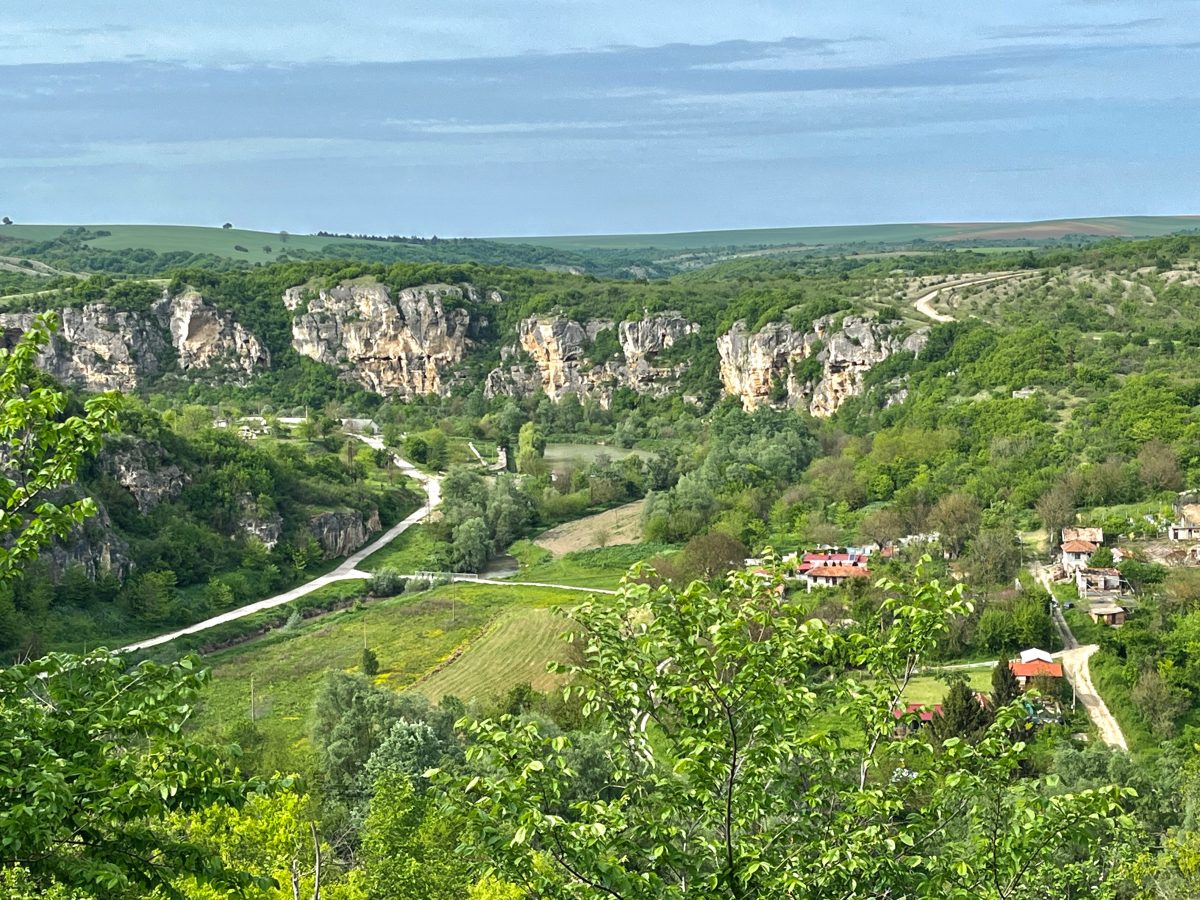
The village below the campground in the river gorge carved by the Rusenski Lom River.
The owner of the campground welcomed us with open arms. In addition to running the campground here he also teaches traditional Bulgarian dance in the city near here. He and his students have represented Bulgaria multiple times in international folk dancing competitions. It was great to talk to him and Ton is proud that he is going to add the Thai flag to the 31 other flags on display in the office representing the nationalities of all of the people who have visited here.
We made it to the Black Sea. After a slow departure because we had to say good bye to several new friends we reluctantly moved on from Veliko Tarnovo towards a campground on the Black Sea. The drive over was quiet most of the way. As we were passing thru a large town we saw a Lidl and turned in to stock up on food. We forgot it was Saturday and the parking lot for Lidl was packed and there was no where to park François. We were about to give up on getting food when I noticed a Kaufmans which is another big chain and they had room in their parking lot. An hour and a couple of hundred Lev later we were back on the road.
We’ve been seeing signs warning of horse and buggies on the roads, but today we had our first encounter with them. All together we passed about 6 on todays drive.
We learned from Nick and Nicki that the full on tourist season in Bulgaria doesn’t begin until June 1, and there is almost no shoulder season. Today that bit us a bit. The campground we chose is in a small sea side resort with 8 or 10 hotels. As we pulled in we noticed that despite it being a weekend the place was pretty much dead. All of the hotels seemed empty, and when we pulled up to the campground the gate was closed. There was one guy cleaning up the site, but he was not interested in dealing with us, so we needed a plan B.
The river near our campground.
Park 4 Night listed a campground about 40km’s away that said it was open on May 1st, there hadn’t been any reviews this year to confirm this and we have learned that the open and close dates are not always accurate on the app, but there was one in May of last year so we bet on it. When we arrived we were met by a very nice man and his dog and we became his second customers. The campground is located on a river and is also only about 200 yards from the Black Sea.
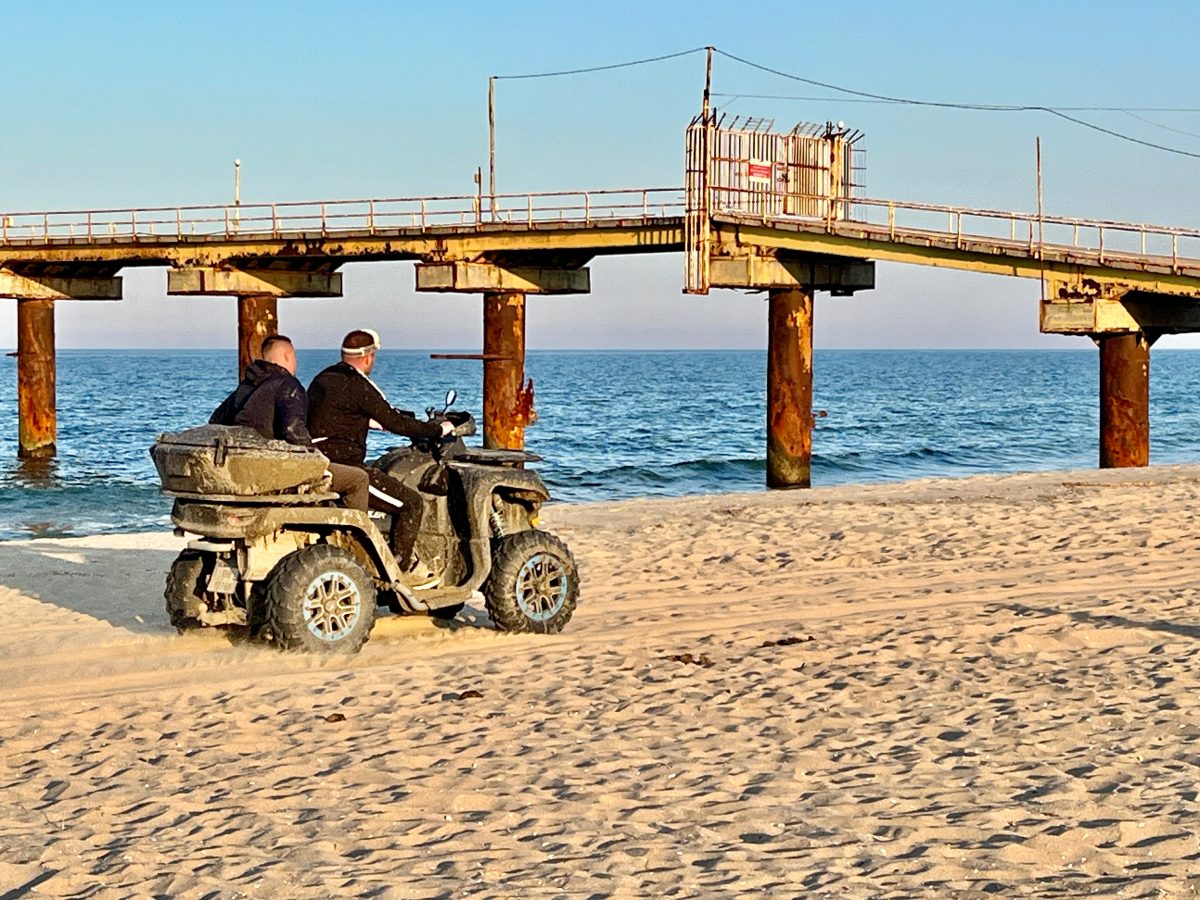
Guys were launching these boats and I suppose going fishing. The pier behind me is another communist era mystery. The water is not deep enough for an ocean going ship, it is too tall for a ferry, and it does not look to have been built for recreation.
After dinner we took a walk along the beach and the river. The beach was nice, but dead. The river does not need people to feel alive so today the river felt more interesting and beautiful.
We don’t know the name of this river but at this point it is only 300 yards from the sea. The boys were fishing from the bank.
Our day started with a visit to a local mechanics shop recommended by Nick and Nicki from the campground. Nicki called ahead to say we were on the way. When we arrived we were guided right in. The mechanic took about 10 minutes to install the bulb, and we purchased a spare bulb for the future and we were on our way. Bulgarians don’t smile to strangers and we both laughed when we left as while the guys at the garage were professional and courteous not one of them showed any emotion what so ever. One guy at the end did say “good day”, which we took as a small victory.
Ton pointed out that the images in the Orthodox icons never show any emotion either, so the lack of smiles is cultural.
We wanted to visit the village of Arbanasi, which has several small churches and monasteries in it. It happened to be close to the mechanic so we were there in a few minutes. From the road it is not an imposing looking place, a slightly nicer version of the village the campground is located near. We found a place for François next to the village recycling and headed off on foot.
Part of the charm of Arbanasi besides the churches is it its a spruced up version of a typical Bulgarian village.
We set off on foot to the St. Mary Monastery because I picked it at random. When we arrived a lady was tending the garden near the entrance. We tentatively stuck our heads in to see if they were open and without smiling she said come in. She then carefully rolled down her trousers and led us to the chapel and opened the door. I asked her if photos were allowed inside and she said “no” and took us to a sign in Cyrillic and pointed to it and gave us an explanation in Bulgarian to prove she was not making up this restriction. The interior was typical, but it is too bad that photos were not allowed because two women were working on restoring the murals inside and it was very interesting to watch how they worked.
The exterior to the chapel at St. Mary Monastery.
We set off to find the center of the village and knew we had when we saw three tour busses parked up. A quick walk thru the shops in town sent us off to another monastery. Ton has been admiring Bulgarian embroidery for the whole trip, and one lady had set up a stall at a strategically placed cross roads that we kept passing in our walks thru town. After some one way negotiating we walked away with a very pretty blouse.
Looking down on Veliko Tarnovo with the snow capped Balkan Mountains in the background.
Our last stop in the village was St. Nikolay the Miracle Worker Church. It looked to be the biggest church in town. The churches in Arbanasi are some of the oldest in the area because after the Ottomans captured Veliko Tarnovo a lot of the Christians fled to the hills around it. The rule was basically as long as the churches were small and modest they would be tolerated by the Ottomans.
St. Nicholas the Miracle Worker Church.
The grounds of the church were pretty. Unfortunately the church was locked up. At one point a lady stepped out of one of the buildings and shouted at us in Bulgarian. When I replied in English she shouted back OK turned on her heel and went back into the building and never reemerged. After poking around the grounds for a few minutes we headed back to François.
The entrance to St. Nicholas.
It was a short drive back to the campground. We spent the rest of the afternoon hanging out and talking to Nick and Nicki about life in Bulgaria. We have been following a British couple Dave and Amanda who are traveling around Bulgaria in an Airstream. They invited us to join them for drinks later in the day so we ended the day with a nice chat with them and an Australian gentlemen who is traveling with his daughter in laws father. The talk was fun and everyone enjoyed exchanging stories about being strangers in strange lands.
We have been cheating a bit in our planning for Bulgaria. One of Ton’s best friends from Thailand is coming to Bulgaria with a tour in June and she sent Ton her itinerary and we have been using it to plan our trip. Dangs group had several locations in Veliko Tarnovo on their itinerary, and our friends the Howes told us we must come to this city. We want to thank both of them as it was a great day today.
The gates leading to Tsaravets Palace with the Patriarchal Cathedral in the background.
One of the highlights for me today was at the beginning when I successfully negotiated a 12 hour rate with the parking lot attendant. He didn’t speak much English, and I don’t speak any Bulgarian but when we arrived at the lot he showed me a sign that said each hour was 3 Lev for motorhomes and he gave me a laminated number and manually recorded our license plate number in a ledger with our time of arrival. He then let us in. He seemed like a bit of a character and his pantomime was pretty good. I asked Ton how long she thought we would be in town and she said 4 or 5 hours which gave me an idea. On the sign that said each hour was 3 Lev it also said 12 hours cost 12 Lev, so my thought was if we paid for 12 hours and stayed 4 we broke even and if we really enjoyed the town and stayed 5 or more we would be ahead if we paid for 12. I went back to the attendant with my laminated number and asked him using google translate how much would it cost if we stayed 5 hours and he said 15 Lev. I then pointed at the sign that said 12 hours cost 12 Lev and asked to pay for 12, after a minute he got my point, smiled and took my laminated number from me, made some entries in his ledger and produced a receipt. I gave him 12 Lev, he then hit us with a rapid burst of Bulgarian basically telling me to make sure we keep the receipt safe in case he was not on duty when we came back. With a big smile he sent us on our way.
Looking down on the Yantra River. The complex of buildings near the top of the hill is the University.
Veliko Tarnovo was the capital of Bulgaria during the second Bulgarian empire from 1185 to 1393. The ruins of the palace and the fortifications of the city dominate a hill above the city. The walls of the fortifications are largely intact and quite impressive. Since I was determined to spend at least 4 hours in town we covered almost the entire length of the walls.
The Patriarchal Cathedral.
After our extended tour of the walls we visited the Cathedral inside the fortifications. It is a new building built in 1981 to celebrate the 1300th year since the founding of the first Bulgarian state. It does not look like it is used as a church, but it does have some really interesting artwork that has some Christian scenes in it, but mostly seem to celebrate Bulgarian nationalism. The art is very interesting and reminds me of War posters from the Soviet Union during WWII.
One of the large murals on the interior of the Patriarchal Cathedral.
The building was well constructed and followed the style of Orthodox Churches but did not seem to have an altar. Instead of Icons of saints and Jesus normally found in Orthodox churches, there were these very stylized scenes from what I assume are Bulgarian history. It was a very different church than any we have seen since we entered the Balkans, more of a museum.
The door of the Patriarchal Cathedral, some form of metal relief art. Very intricate, Veliko Tarnovo is known for it metal working.
Having now used up 2 of our hours we headed into the town itself. Our first stop was Samovodska charshya where many of the craftsmen have set up shops. After a little wandering we found it, and it was a charming little stretch of road. We enjoyed looking at the silversmith shop, and a metalworking shop that was producing containers mainly to hold coffee and tea. The workmanship was meticulous. There were also some typical tourist shops. We had just walked into one to look for a couple of small glasses to drink Rakia, when we suddenly were surrounded by about 30 5th graders on a school outing. The store instantaneously turned into chaos and the store owner was perturbed until she realized they all were buying a small souvenir of their trip to Veliko Tarnovo, she suddenly lost interest in us and headed to the cash register.
Samovodska Charysha street, the main tourist shopping street in town.
By now we had walked quite a bit and were hungry. Ton had picked out a restaurant that she said served traditional food. When we got there it was a very modern restaurant, that was serving contemporary takes on traditional Bulgarian food we were also the only customers which is not a good sign. But we were famished so decided to stay. The food turned out to be excellent, and by the time we finished eating another 5 groups had turned up.
Gurko Street, the best collection of 19th century buildings left in the city.
Leaving the restaurant we stumbled on the last landmark of the city we wanted to see. Gurko street is named after a Russian General who liberated Veliko Tarnovo from the Ottomans in 1878. He is an important fellow in modern Bulgarian history, but what is cool about the street is that it was the main street in the 1800’s but over time the commercial district moved up the hill, but the buildings that made up the old commercial district in the 1800’s survived largely untouched until today. There were a lot of well preserved old buildings to look at as we slowly walked back to François in our 4th hour of touring the town.
There were three of these large works of street art on the main street of town. They look like a new project and are really well done.
We arrived at the parking lot and met my new friend who was still on duty. He met me with another blast of Bulgarian and a smile, so I think we won our 3 Lev bet (3 Lev is about $1.55).
Last night was the coldest night of the trip. In addition to a hard rain the temperature dropped into the low 40’s for the night. We both got dressed pretty quickly once we got out from under the blankets and while it was chilly the rain had stopped.
There was a Bulgarian military base down the road a bit so I walked down in the morning to take a look. As I was shooting this photo the sentry came out and gave me a long look, so I moved on. The jet is a Mig-19.
We had about 130km’s to transit thru the Balkan Mountains to our next campground Camping Veliko Tarnovo. This campground had been recommended to us by our friends Rick and Kathy Howe as they had stayed here during their trips thru Bulgaria, and had made good friends with the owners who were just starting up the campground when they visited.
After a pretty but uneventful drive over the Balkan Mountains we arrived at the campground around 12:30 and settled in. We spent some time talking to Niki the owner about tips on things to do and I asked for a place I could find a new headlight bulb for François as he has blown one of the ones we just replaced in Montenegro in the fall. Niki and her husband Nick are a nice British couple who moved here in 2009 with the intention of building a campground as they saw an opportunity when they toured thru Bulgaria in 2007. They have built a first class campground. Business has taken a hit since Covid, but hopefully it will rebound this year. Nick is now the head of the Bulgarian campground organization, and they are starting to do some national marketing to make sure people are familiar with what is available for campers in Bulgaria.
Dragizhevo didn’t seem to have a proper church, just this bell tower.
Niki mentioned there was a village down the road about 1 kilometer so Ton and I walked in to see what we could see. The countryside around here is beautiful, rolling hills with mountains and very green fields. In fact the whole country has that verdant green that comes with spring.
While the village had some nice houses on the edge, the center felt a little neglected. Many of the buildings were unoccupied and run down. This is a pattern in rural Europe where between a declining population, rapid urbanization and in countries like Bulgaria emigration to more affluent countries in the EU a lot of the villages are emptying out. In a town that once looked like it had a sizable population we only saw two small markets and two coffee houses/bars.