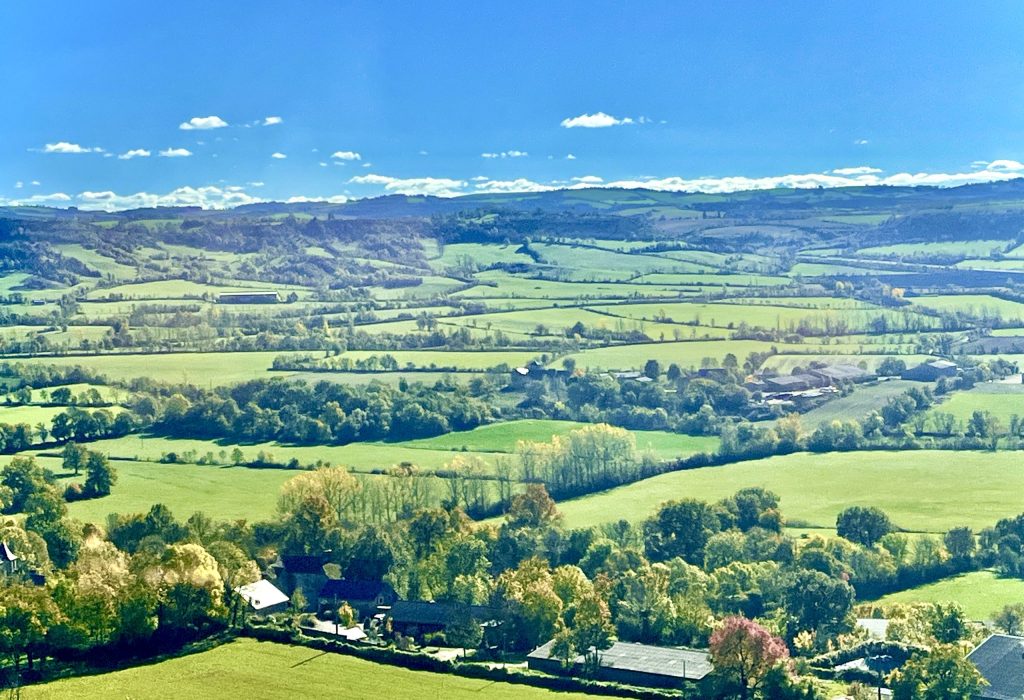
Our plan is to pass thru France quickly and get to Flanders in Belgium to do a little beer tasting. We want to be in Amsterdam on November 4 so we can prep for our departure on November 7. So today we drove 468 kilometers north to the municipal campground in Issoire France.
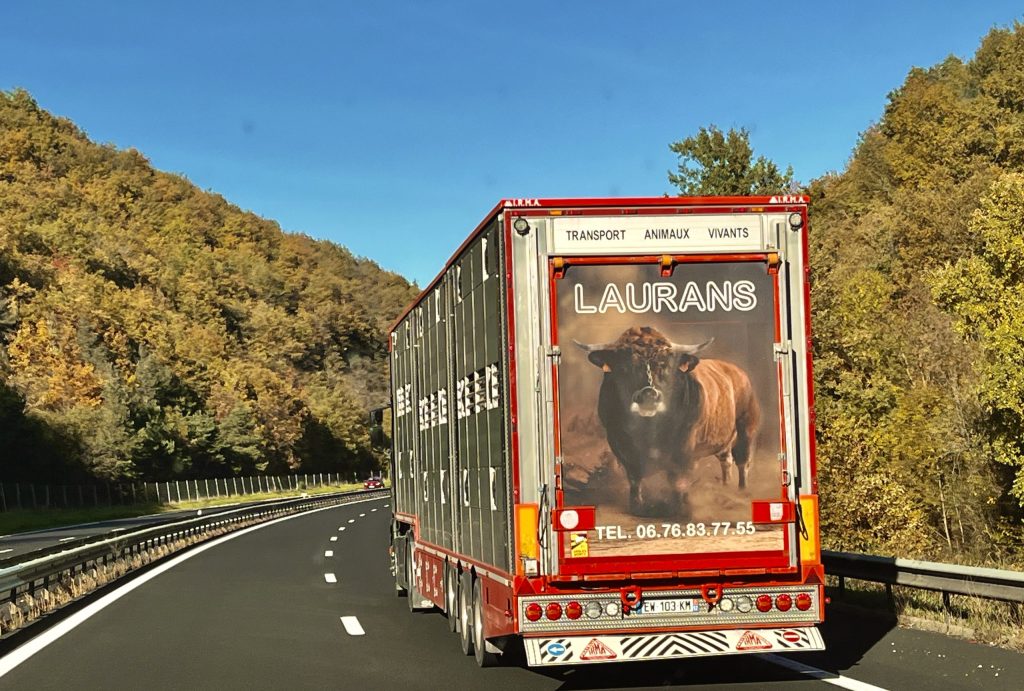
Ton liked the art on the back of this cattle truck.
Before leaving Spain we made one last stop in a grocery to stock up on some of our favorites. I got some Tortillas, Ton bought a bunch of fruit and vegetables, you can tell who has the healthy diet, Spanish Tortillas are made from potatoes, cheese, egg, and onions. It is a very delicious hash brown.
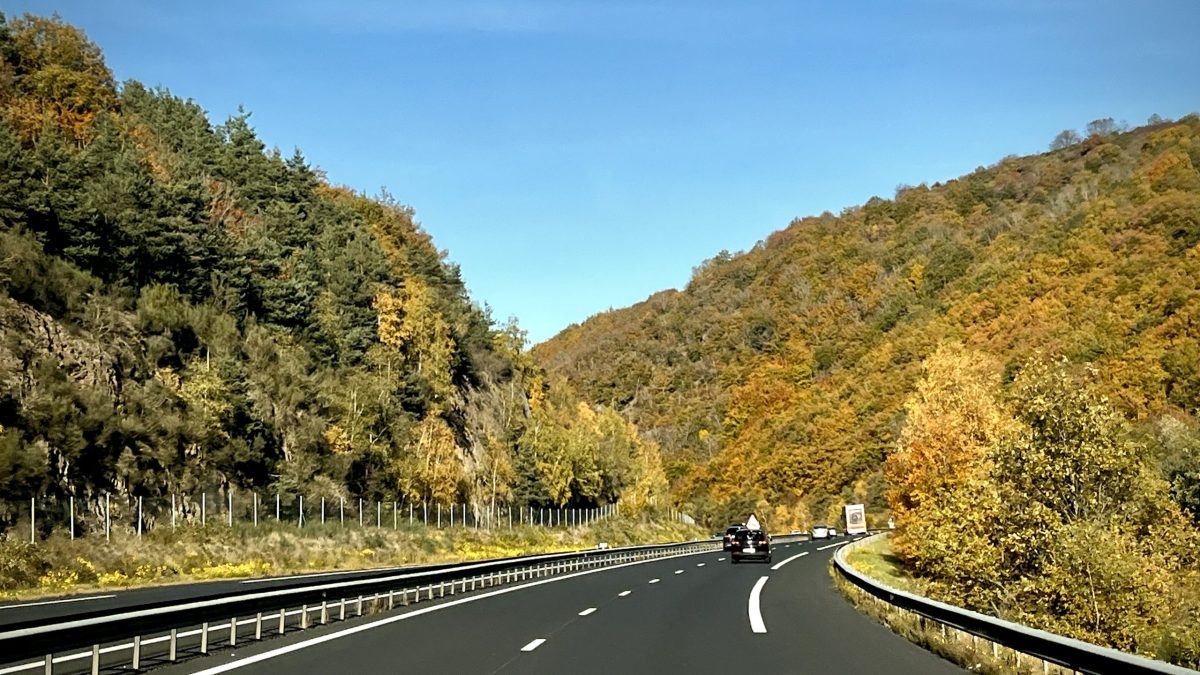
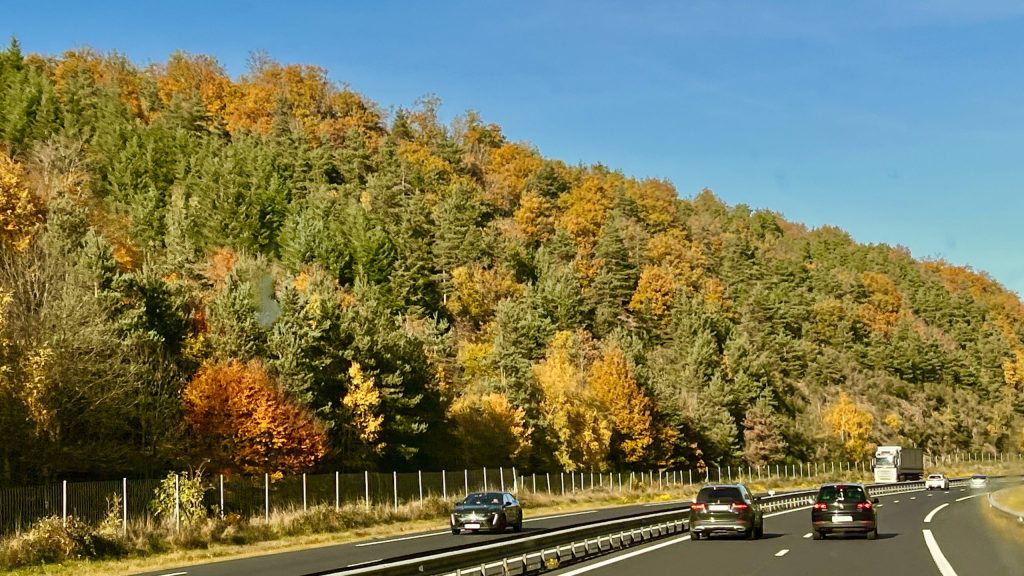
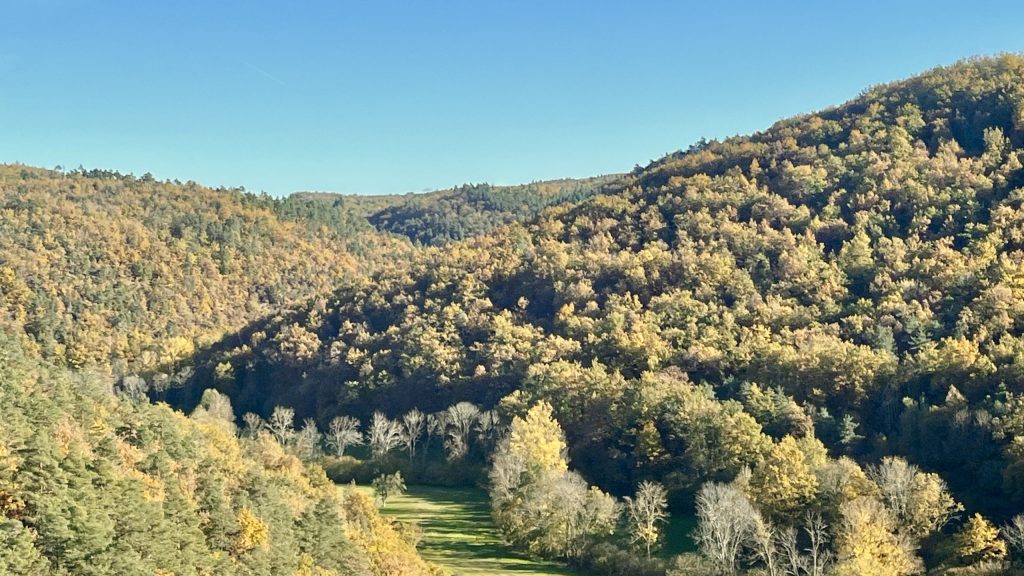
The fall colors were coming out as we gained altitude and headed north.
Most of the drive today was thru an area of France that is called the Central Massif mountains. It is a part of France we have not explored much. Every time we pass thru we say we need to spend more time here. Hopefully we will one day.
A beautiful mountain valley.
The campground in Issoire is closing for the winter in two days as are a lot of the campgrounds in France and Spain so we have to be careful when picking places to spend the night. Tomorrow will be another big driving day to spend the night just south of Paris.
I selected Vichy for todays visit because of its association with World War II. Today and historically Vichy was famous as a spa town with hot springs and naturally carbonated water. Unfortunately for about 3 years of WWII it served as the capital of the puppet French government under Nazi Germany. For me that is always what I will remember it for. When the US and British invaded North Africa early in WWII the initial resistance to the landing was not from the Germans or Italians, but from French troops fighting for Vichy.
Fishing in the l’Allier River.
We both slept well last night (Ton said I slept very well, meaning I snored), so we both woke early (Ton said her early rise was not entirely voluntary but related to how well I slept.) We were underway early and I was hopeful of arriving at the campground in Vichy before the customary 90 to 120 minute lunch. I respect that the French need two hours for lunch, but my one request be that they get together and agree on which two hours. Some campgrounds break noon to two, some 12:30 to 2:30 and some from 1 to 3. We were on track for a 12:30 arrival, but missed by a couple of minutes, and the barrier to the campground was down meaning lunch was on. There were already two other campers waiting, but the good news was this campground only takes a 90 minute lunch from noon, so we had a little less than an hour to wait. So we also had our lunch.
Downtown Vichy.
We headed into town around 2:15 and crossed the bridge to the Avenue of the United States. Running parallel to the Avenue of the US was a lovely park full of trees imported from around the world including an iffy looking Sequoia which still dwarfed all of the other trees.
This Sequoia looks like it has seen better days, but it still dwarfed all of the other trees in the park.
We turned onto Avenue Franklin Roosevelt (there are more roads named after Americans in France than in any other country in Europe) to visit the old Spa hotels. The road and the park that were integral to the old spa are getting a major upgrade, so we were dodging construction sites and equipment.
The Opera House is also getting a major upgrade.
The spa concept was a major tourism draw in the 1800’s and up to WWII in Europe. The concept of going to take the waters was touted as both medically beneficial as well as restful. There was a structured routine that included baths in the thermals, prescribed outdoor walks, healthful meals, and evening relaxation.
One of the halls containing thermal springs. The taps in the foreground are available to fill containers for free.
This led to quite a large industry with luxury hotels to support it. In Vichy the infrastructure that was built in the 1800’s is still largely in place, including large parks with covered walkways around the outside of them in case of inclement weather. These covered walks are impressive as they are made of cast iron and stretch for quite a distance around the exterior edge of the park. There is a large building in the middle of the park that contains an opera hall and casino for evening entertainment, and luxury hotels along one side of the park housed those that had the money to spend time here.
Another part of the thermal building.
There are 11 Spa cities still functioning in Europe though they are not as popular as they once were. Vichy was celebrating that it along with the other 10 cities throughout Europe had been declared UNESCO cultural sites.
An advertisement from the era touting the sparkling water from Vichy. It is still for sale today.
Vichy is also know for a kind of candy called Pastilles. This year they are celebrating the 200th anniversary of the invention of Pastilles. We decided that this would be a good gift for friends so we spent the rest of the afternoon searching for Pastilles to take home. After visiting three stores we are now well stocked with this delicacy.
Some canoes near our campground.
While walking around town we saw many references to Vichy as a spa town, and as a source for Pastilles, but only one mention of its role during WWII. I guess I am not surprised as one story is much more pleasant than the other.
The jet lag is starting to wear off so we woke a little earlier to head into Lyon. We purchased an all day pass for public transport in Lyon which is a good deal for €6 as we wanted to cover a lot of ground today.
On the way to Lyon we asked a young gentlemen to confirm we were at the correct bus stop, and ended up chatting with him most of the way to downtown. He is trying to start a company to refill wine bottles directly rather than sending them to recycling first and then remolding them. He told us there is a similar program going on with beer bottles in Oregon that we were not familiar with. We enjoyed a wide ranging conversation from tax methods to population density of Oregon vs France. These small contacts are always fun and encouraging.
The finish line of the Lyon Marathon, Ton was trying some tricks with her camera so we caught some ghosts running the marathon.
When we finally arrived in downtown Lyon after a detour due to a market along the route and getting caught in a major traffic jam, we ran into the finish line for the Lyon marathon. We spent a little time watching the runners finish, and enjoying the good mood of the spectators and runners as they crossed the line.
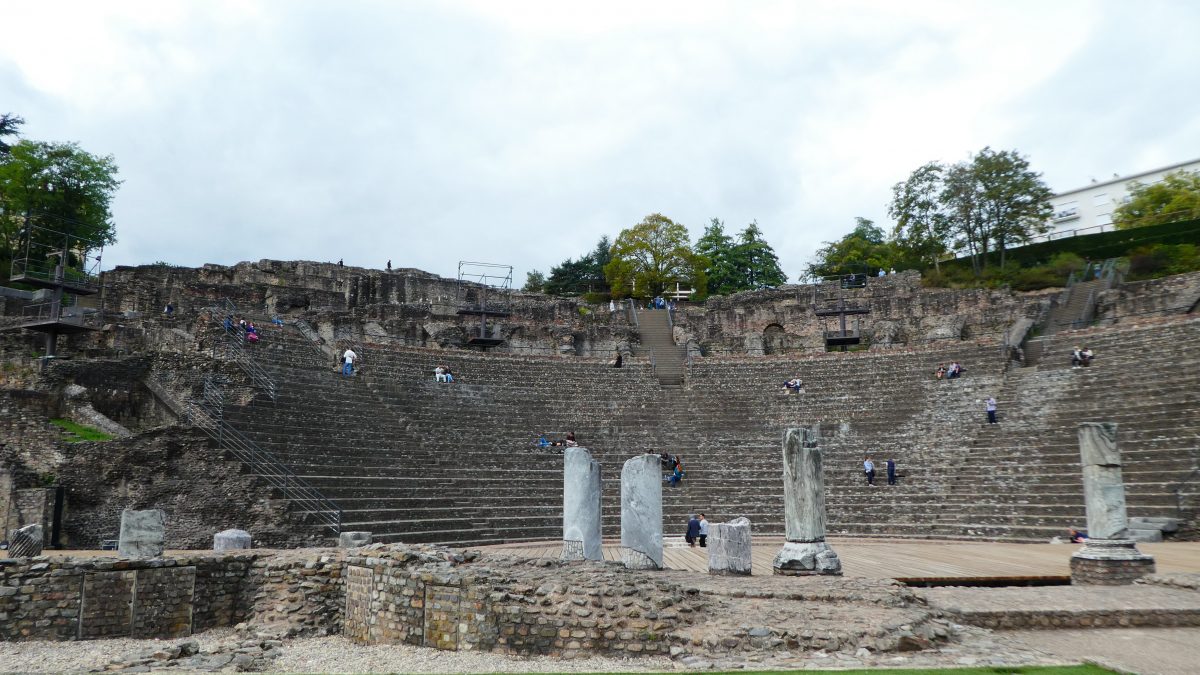
Our next stop was the Roman theater which was pretty close to the finish line, the problem was it was about 600 feet higher on a pretty steep hill. There were two funiculars up the hill which were covered by our transit pass, but I could not find them so we ended up climbing the hill. The Roman theater is quite large and well preserved. It is still used to stage plays during the year, and holds about 6000 people in its current configuration. During the Roman era there was a second wooden deck that accommodated another 5000 people.
The Roman Theater in Lyon is one of the largest in France.
In the distance we saw a cathedral dedicated to the Virgin Mary and headed over there. It was a fairly modern cathedral built around 1872. The story about the cathedral is it is on a hill overlooking the original cathedral in Lyon Saint-Jean. In the 1500’s when the plague was going thru Europe the town prayed to Mary that if she spared Lyon from the plague they would do an annual procession to the top of the hill, and the plague skipped Lyon. In the 1600’s there was a cholera epidemic in the area, and the citizens again prayed to Mary and promised a church on top of the hill if Lyon was spared, and it was. Finally during the Franco-Prussian war in 1870 the citizens asked Mary to spare them from destruction by the Prussians this time promising a cathedral, which was duly built when the Prussians by passed Lyon.
You rub the Lions nose for good luck as you enter the cathedral in Lyon.
We also found the funicular so our trip down to the main city was much quicker and easier on the knee’s. I have become quite reliant on Google for navigation, and it was at this point that I realized that despite Lyon being the third largest city in France, its transit system was not loaded into Google maps. So now to get to our next destination I had to go back to the old way of trying to compare a city map with a transit map to figure the best way to get to a food hall with several famous restaurants. It was not pretty but eventually we arrived just in time to watch all of the restaurants close up for the day.
The food hall that was just closing up as we arrived.
So instead we headed back to François where Ton prepared me a delicious meal.
We are both battling a little bug coupled with jet lag and a pretty good storm resulted in a poor nights sleep for both of us. As a result we decided to just jump on the road and get some miles towards our ultimate destination.
We have been wanting to visit Lyon and it was about half way to Toulon so we decided to head there for the day. Ton suggested we go ahead and pay to use the Autoroute so it was a very easy day of driving for me, but a little expensive. By the time we arrived in Lyon we decided to just explore the area around the campground. The area around us appears to have been part of the fortress system for Lyon in the past, so there were a lot of tall walls. The town center was nice and we gawked at some beautiful French pastries, the French really do pastries right.
A father and son Petanque game in the village square near our campground.
After stretching our legs we decided to turn in early and get ready to try to take Lyon by storm tomorrow.
The plan today was to hit two villages in the Cantal region of France. Cantal is famous for its cheese and the ruggedness of its mountains. We experienced the ruggedness of the mountains and enjoyed the least populated part of France we have been in so far. At one point we went almost 15 kilometers between two towns which is a record for us in France.
Passed by this castle very early in the day. It is really striking, do not know anything at all about the history of the place though.
We stopped up in Cheylade to visit their church which is famous for its roof and nave. It was a nice spot and while we were in there we had a good conversation with a group of Belgians who showed up to take in the church.
A shot of the ceiling of the church in Cheylade. The ceiling tiles are from the 15th century after the church was rebuilt.
After getting confirmation from the Belgians that the pass was open we headed towards Salers. Salers is considered one of the most beautiful villages in France. It has retained almost all of it’s medieval structure. After years of obscurity that allowed it to stay virtually unchanged for centuries it has been discovered, and last year had over 400,000 visitors.
One of the many medieval buildings in Saler that are stil in use today.
It is certainly a nice place in a nice location, but maybe it was the bad weather (cold and wet), but we were both a little let down by the town. It felt a little too touristy and more commercial than we expected. (I think our bad taste started by having to pay 3euro to park François when the parking lot was empty.)
The city walls of Saler. Saler is considered one of the five most beautiful villages in France.
When we first arrived we went over to the city campground for the night, but were totally perplexed about how it worked. There was what appeared to be a proper campground, but it did not appear to have any water on site, but it did have electricity. There was also an aire next door. The perplexing part was there was not a soul on site to take money or give directions. After wandering around for a while we decided to head into town and come back later and see if we could figure the place out. When we returned a couple of hours later the situation was the same, no one on site and no one using the facility. We decided we would grab a spot in the area that looked like an aire. While we were eating the Gendarme (national police) passed thru a couple of times without moving us on so we figured we must be legal and free. When Ron went out for his evening walk he ran into a gentleman who turned out to be the campground manager. Patrick is quite a character and we ended up talking to him for quite a while and he is going to take us into town for cheese tomorrow. But our free site turned into 13 euro when he collected the fee.
Today we reluctantly left Burgundy. But before leaving we wanted to take a look at some more of the Beaujolais country. Somewhere around Julien we made a wrong turn and quickly found ourselves on some small mountain roads heading into the Haute Beaujolais. It turned out to be a nice mistake as it is beautiful country. The Haute Beaujolais looks like it is dairy country with lots of valleys full of pastures and a pure white breed of cow we do not have in the US. After a while of wandering around and completely unsure of exactly where we were (reminds me of a line from Band of Brothers when one soldier asks if they are lost, the officer replies we are not lost, we are in France), we decided to punch in our final destination for the day and let the GPS take us there.
This breed of white cow is pretty large and all over Burgundy. We have never seen anything like this breed in the US. The background is typical of the country we drove thru today.
After a couple of hours and our first experience of a French A road (think interstate with tolls) we ended up at Le Puy de Dome. It is an inactive volcano cone, where you are supposed to be able to see 11 departments of France from. The weather was not ideal as it was cold and windy, with high clouds. But the views were there to see, just a little gray from the clouds. The wind made it a little uncomfortable but we completed the circuit around the dome.
The view from the top of the Puy de Dome. Not a great day for photography but we will not be back on this trip. We think it would be spectacular on a bright day.
At the top is the ruins of a roman temple to Mercury built around 124 AD. The Puy de Dome apparently has been a tourist attraction for quite sometime.
Some of the ruins of the Temple of Mercury on Puy de Dome. Puy means volcanic hill in French.
After a week with François it was time to fill up for the first time. The cost was $129 for 19 gallons which is $6.78/gallon. The good news is the distances between things to do are a lot less, so our daily cost of fuel so far is less than at home. On this trip our biggest cost has been admission to sites. Interestingly we are spending less per night than at home for campgrounds and we have not really tried to find free spots which abound around here.
François is the RV in the middle. Taken from the top Puy de Dome.
We woke up to a pretty steady rain in our Aire in Cluny. Ton pointed out that I had been throwing the term Aire around in the blog when there is nothing like it in the US. An Aire is a very basic place for RV’s to park up for the night. There are thousands of them in France and they range from designated areas in parking lots with no services, to parking areas with electric, water, and dump stations. Most of them do not provide electric, but do provide a place to get rid of the waste water. A surprising amount of them are free, and the rest charge a nominal amount. The towns put them in figuring if you park up for the night you will end up dropping a few Euro somewhere in town.
Typical coutryside in Beaujolais. It is as green as Oregon this time of year.
After a quick check of the weather and seeing that it was supposed to clear up shortly, we hit the road. The intent was to follow the route of one of the scenic drives in Ton’s DK Backroads France book. The drive was called the heart of France and was about 60km’s. We managed to keep on it for most of the trip though there were a couple of unexpected detours caused by missed turns.
Typical vineyard just as the bud is breaking on the vine.
Around lunch we came to Chateau de la Greffirere that advertised tasting and a museum. When we arrived we were met by a lady who asked if we spoke any French at all when we said no, she looked a little flustered but began pouring us wine. A couple of minutes later we were greeted by another lady who completed the tasting and gave us a tour of the facilities. At the end she opened up the real prize for us and as it was lunch time handed us an English guidebook and went off to lunch. The museum was fantastic as it was full of antique wine production equipment. We spent about an hour wandering around and really enjoyed ourselves.
Antique wine making equipment.
Leaving we continued following the Heart of France drive, but went amiss somewhere and ended up in the town of Macon. It felt more urban than anything else we have encountered so we punched in the place we planned to stop for the night and let Garmin guide us from there.
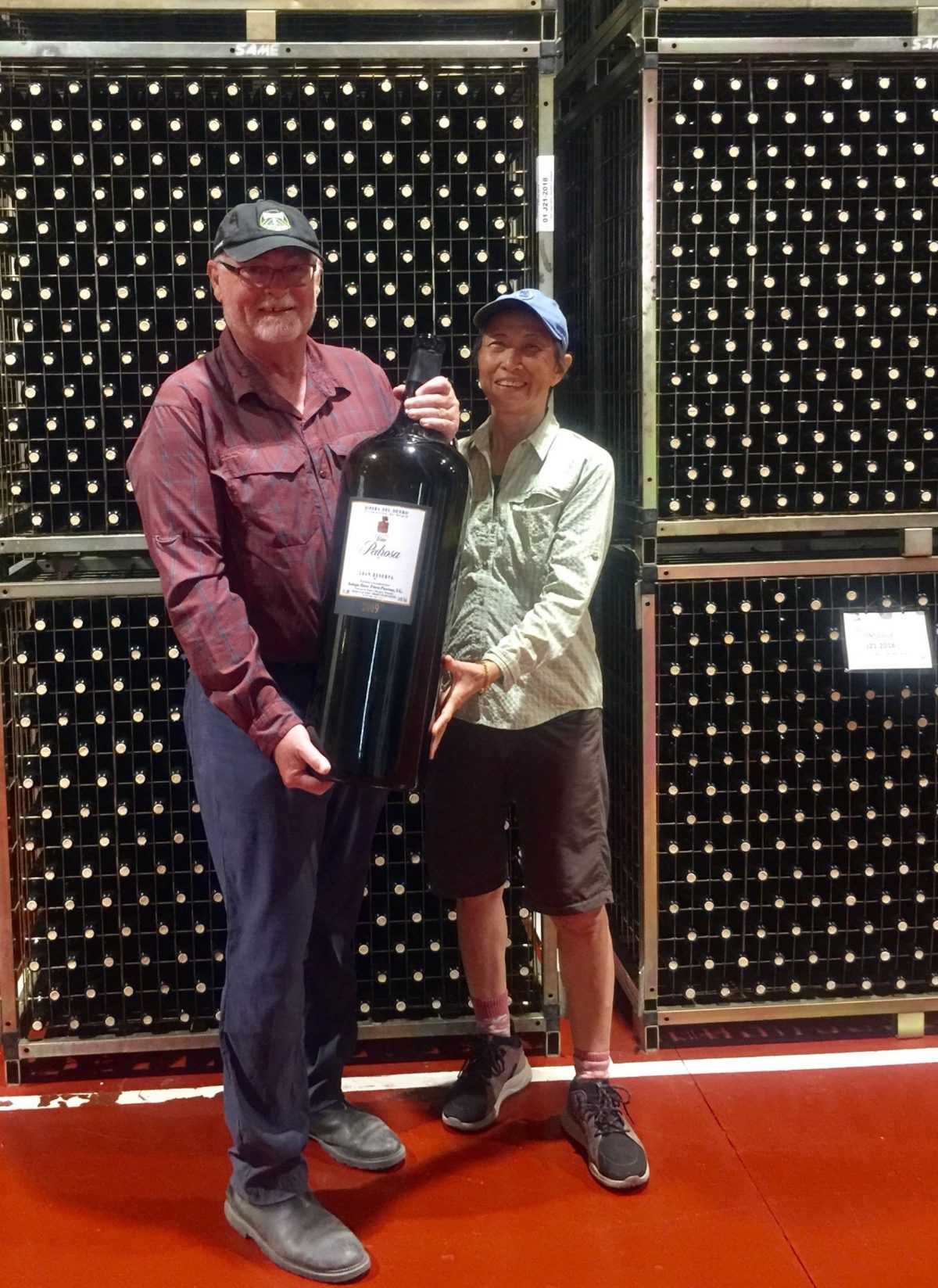
For the night we are staying at a France Passion site on a winery called Domaine Mortet. We were greeted by Jean Pierre Mortet after we parked up for the night. He was just in from the fields, but took us down into his cellar for a personal tasting. It was fun and very interesting speaking to Jean as he is a literally a one man show. He is the owner, winemaker, vineyard manager, and sales manager. He took over the winery from his father, who dropped in while we were tasting. We want to thank Jean Pierre for his hospitality.
Jean Pierre and Ton in the cave of Domaine Mortet. Thanks so much Jean Pierre