We spent our last day in Rioja enjoying two or our favorite things. Armed with research from Ton and advice from a Scottish/Irish couple we have been sharing campgrounds with we headed into town to do a run on the Tapas and Pinxto bars on Calle Laurel.
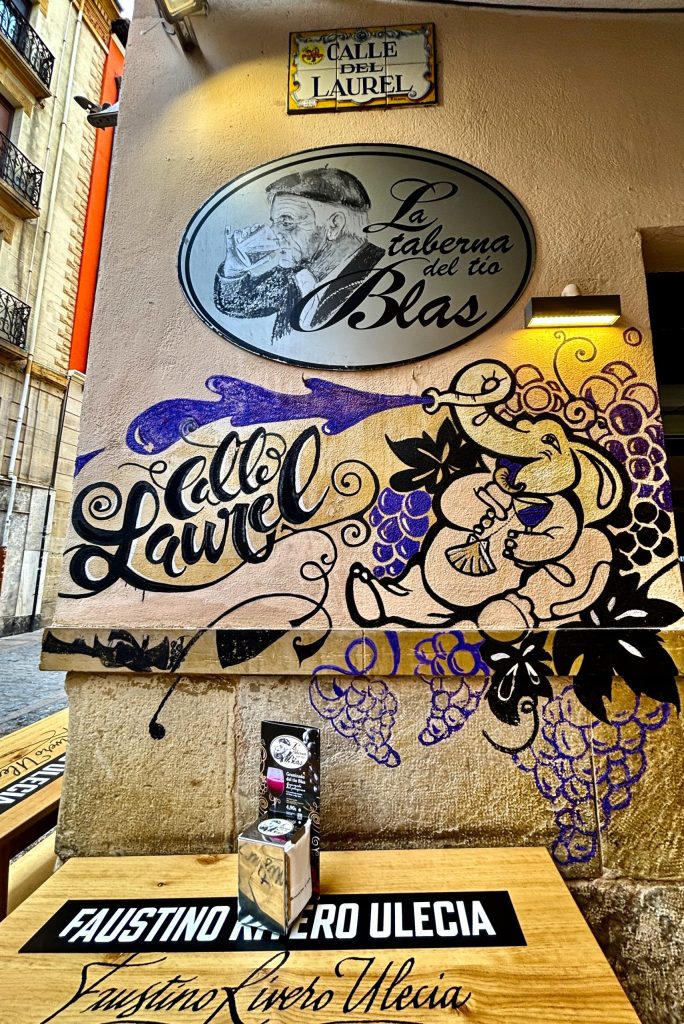
Calle del Laurel one of our favorite gastronomic experiences.
We left François at 11:30, because Ton wanted to check out some of the Santiago Camino infrastructure. All of northern Spain has tremendous infrastructure to support the pilgrims on the way to Santiago de Campostelo. Historically Logrono was one of the main stops on the camino and they have a lot of hostels to cater to the pilgrims.
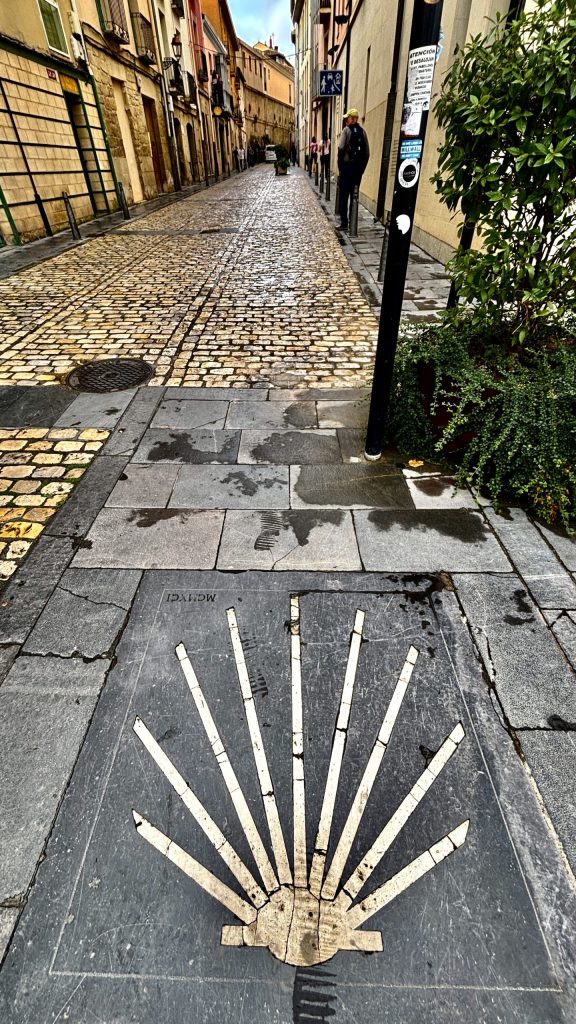
The shell designating the route for pilgrims is a little more abstract in Logrono. This is the street dedicated to pilgrims.
As we were walking up the street we saw a group of mostly older gentlemen gathered on the street in front of us. They were dressed in capes and berets so we walked up curiously. Ton whispered to me to pretend to look at something so she stealthily take their picture. Before we could execute our plan; one of the gentlemen came over grabbed Ton and called over some of his friends to pose for a group picture. We had a good laugh together and after the picture there was much handshaking and goodbyes. Another time when we wished we could speak Spanish.
Our not so stealthy group photo with the Society of St. Gregory.
Now it was time for the main part of the day-eating. We had a plan for Calle Laurel , we would only have one dish and one drink in each bar. We would split the dish and the drink and then move on to the next bar. This plan was helped by the fact that several of the bars only offer one dish, but they are very good at it.
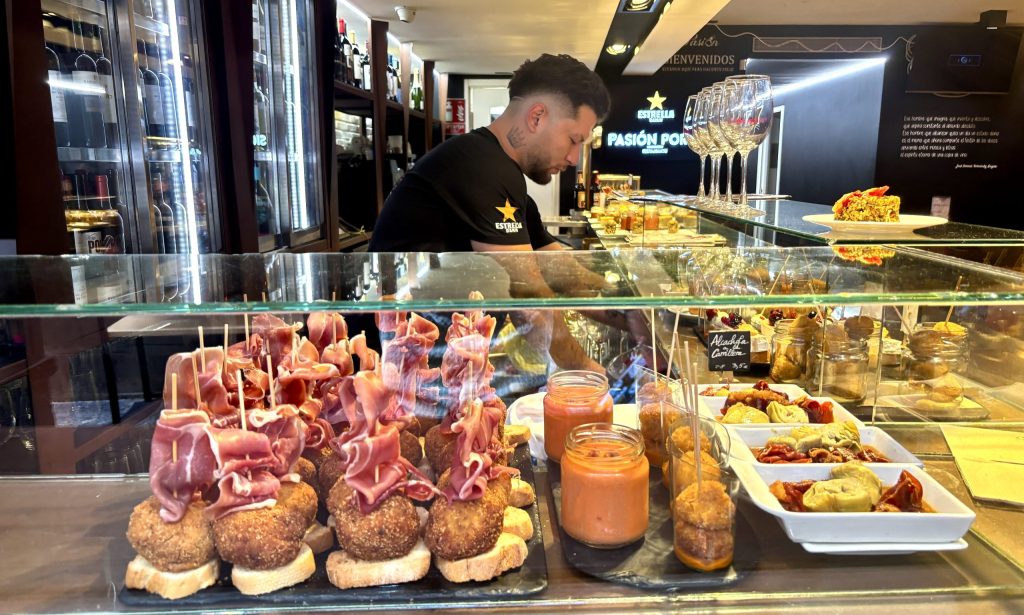
Sometimes the hardest thing was selecting the one thing to try.
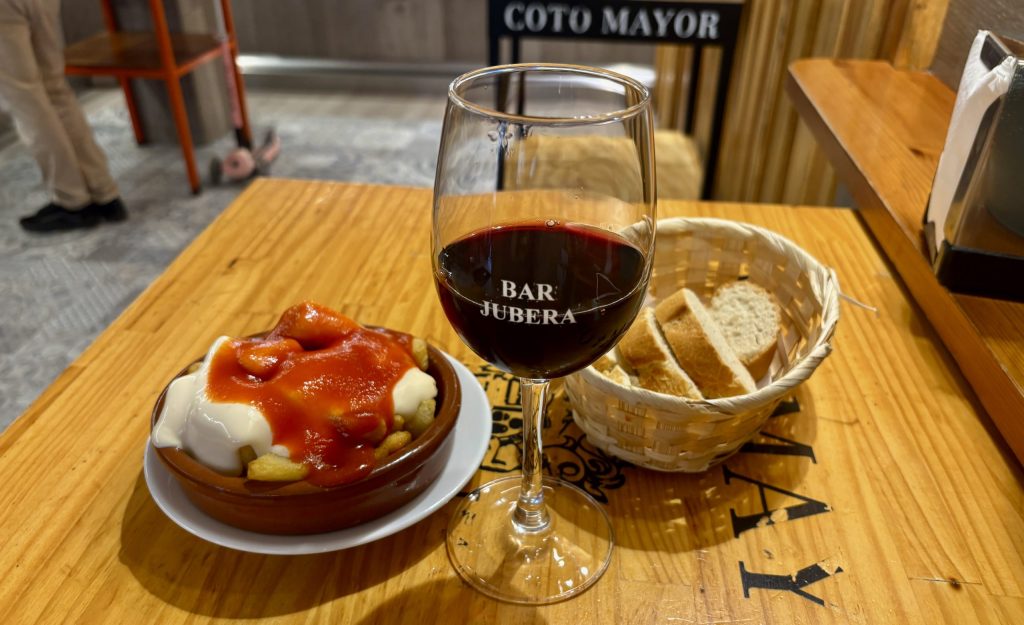
The only place on the list I picked was the first one. The only dish they offered was roasted potatoes. In this place we each got a glass of wine to set a base. Our next stop was about 50 feet up the street and the only dish they offered was roasted mushrooms. This time only one glass of white wine.
My roasted potatoes with pimento and cream sauce.
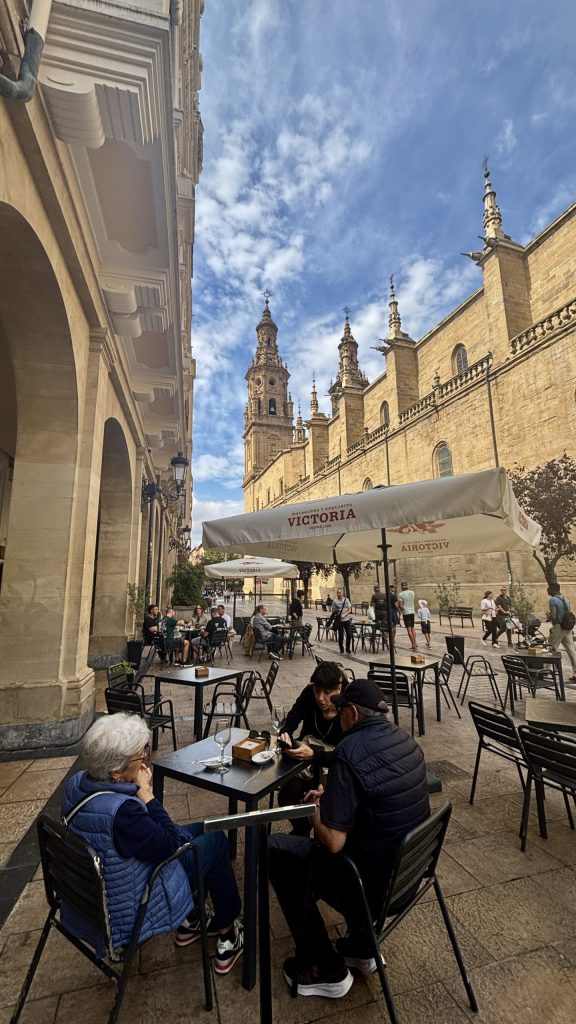
We spent the next hour working our way up Calle Laurel from one place to the next. We weren’t the only one, there were hundreds of other people doing the same thing. You walk in to a bar find a place at a table or a counter, go up to the bar order your tapas and a drink, pay, eat and when you are ready to move on take your glasses and plates back up to the bar. In every place as soon as we cleared our table another couple would step up and grab it and continue the routine.
At 2pm the tapas flurry was winding down and the streets were starting to empty out.
We continued this routine for a total of 6 places. The total spend for 6 plates and 5 drinks was €23. We were full and very happy. The tapas culture here is fantastic. We did not see an unhappy person even though all the places are packed. The Spanish really have something special here.
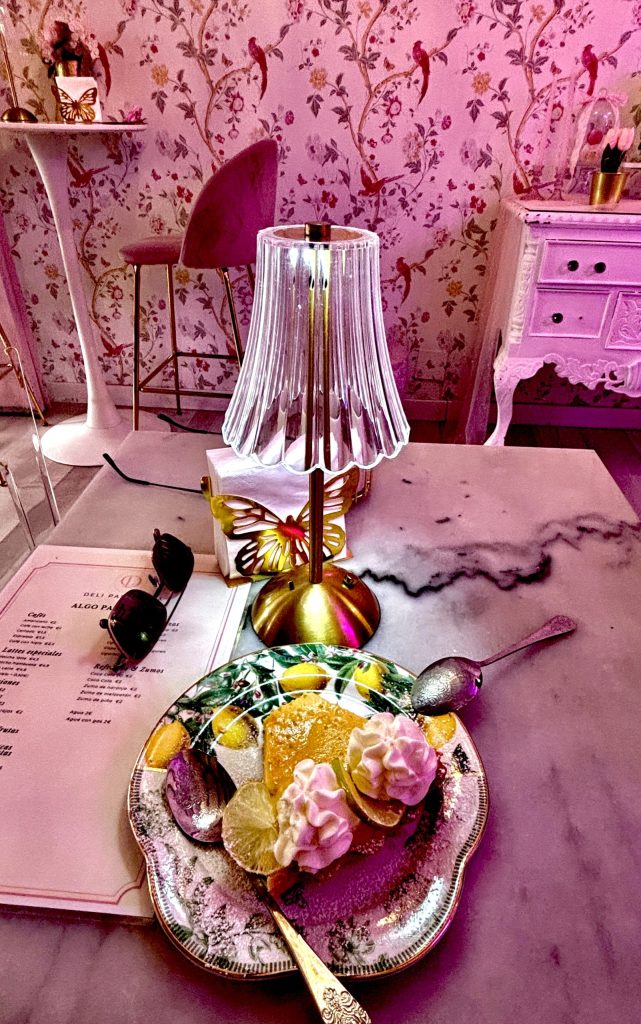
Our last stop was dessert, key lime pie.
After our trek up Calle Laurel, and under the threat of thunderstorms we returned to François for a well earned siesta. The thunderstorms rolled in around sunset, but we were too stuffed to care.
We have arrived in the capitol of Rioja where we are planning to wrap up our visit to Rioja. Rioja is the smallest Autonomous Area (kind of like a state) in Spain in size and population. The population is under one million for the region, and half of that is in Logrono. This region along with Extremadura, and La Mancha are know as the empty region.
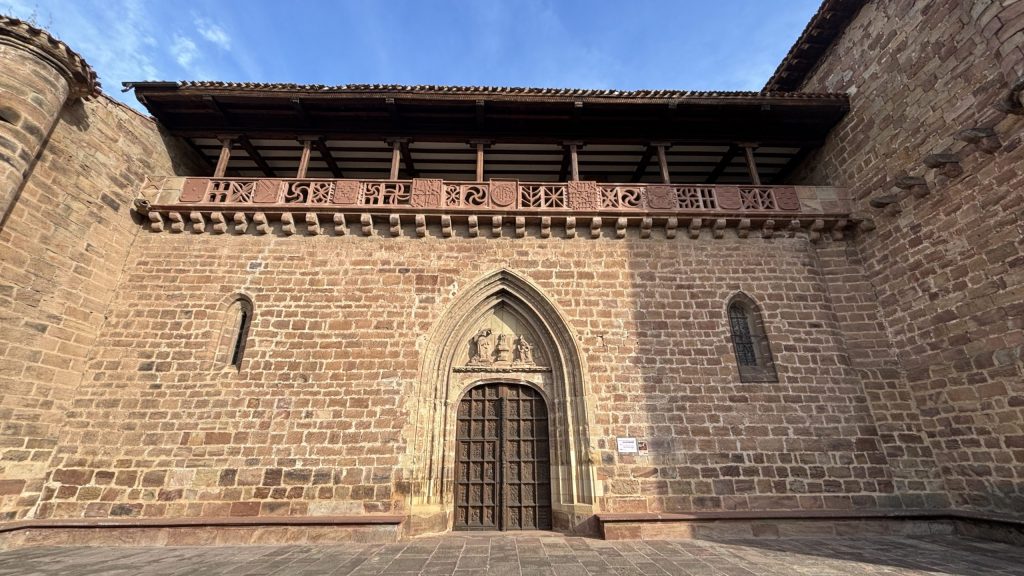
The entrance to the Romanesque Church in Ezcaray.
The population is low and has been falling since the 20th century as the younger population is moving to the cities, or immigrating. For the last two days as we have driven through multiple small villages we did not see one child, and the vast majority of people we did see were our age or older.
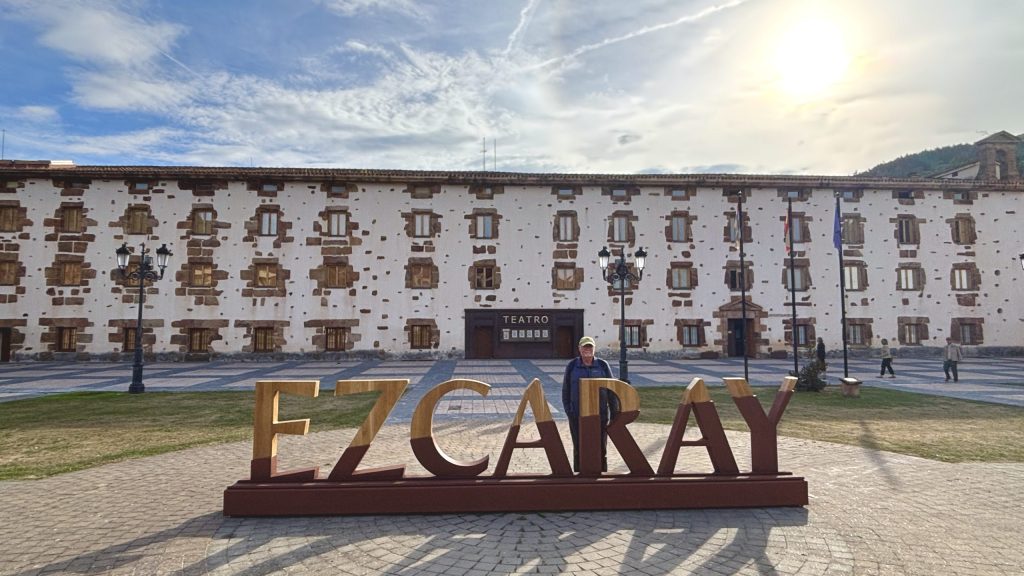
The former Royal Cloth Factory building in Ezcaray.
The villages have an all most ghost town feeling with many of the apartments and homes looking well maintained but closed up. I understand that a lot of Spaniards maintain a home in their ancestral village even have they have moved to one of the cities, but they may only use it for a few weeks per year. Most of the villages have no services outside a bakery and maybe a butcher shop/grocery store.
Ezcaray was the first town we passed through that had a variety of businesses still open.
On our way to Logrono we made a short stop in Ezcaray which was described to us as a resort town with a ski resort. It was larger than most of the towns and villages we passed through and still had banks, grocery stores, and even a few touristy shops. But it was also very quiet and again walking through the streets we saw no children at all, and very few young adults.
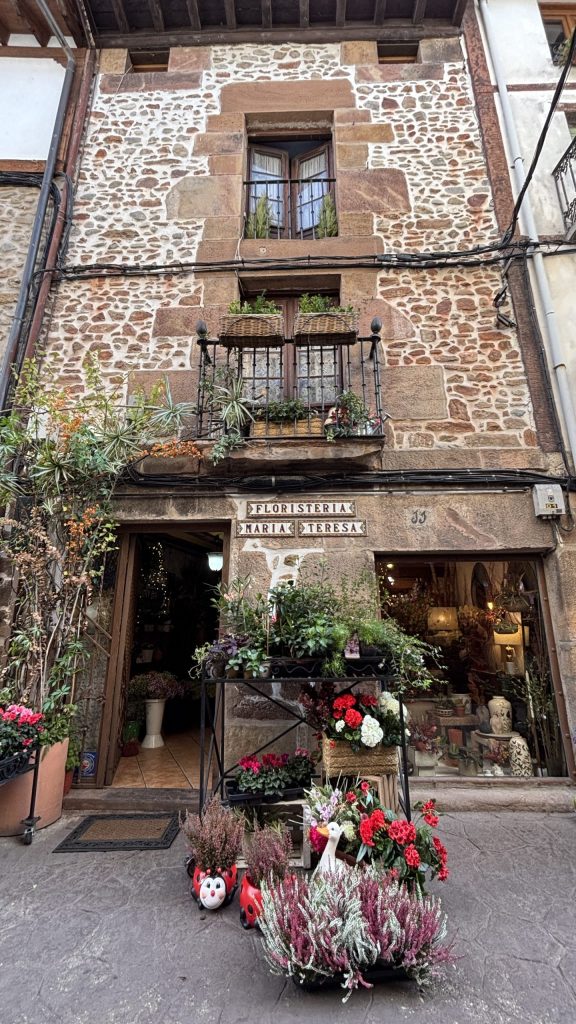
Ezcaray is a tourist hub, but we mostly had the place to ourselves.
But Ton and I love Rioja because of the remoteness. The land is beautiful with wide valleys and mountains. The Ebro River and it’s tributaries cut through it and pop up in unexpected places. The land also seems very fertile and as we were driving around today the potato crop was being harvested so there was work in the fields. The people we have met have been open and welcoming and we have really enjoyed them.
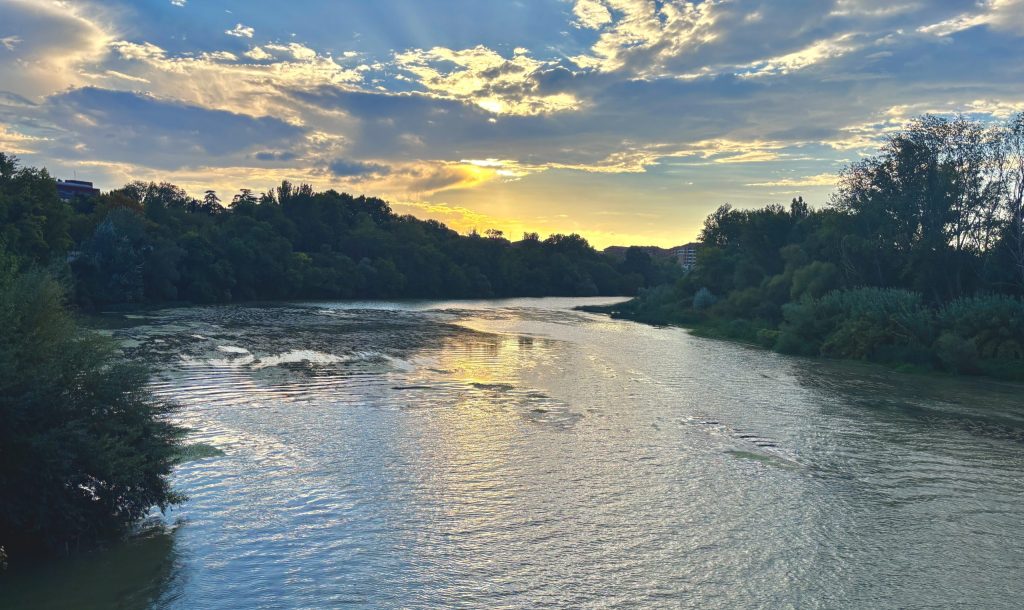
The Ebro River from the bridge near our campground.
We arrived in the only campground in Logrono about noon, it has a great location about 10 minutes from the heart of the city, but the layout is pretty tight and weird. At first I wasn’t sure we were going to get in as they were pretty full. First François was given an inspection by two of the workers, then they had an intense discussion in blistering Spanish about whether he would fit. I was becoming concerned we were going to get turned away when they guy gestured for me to follow him and walked me to a site and said we could park here. It was one of the bigger sites so in the end we did well.
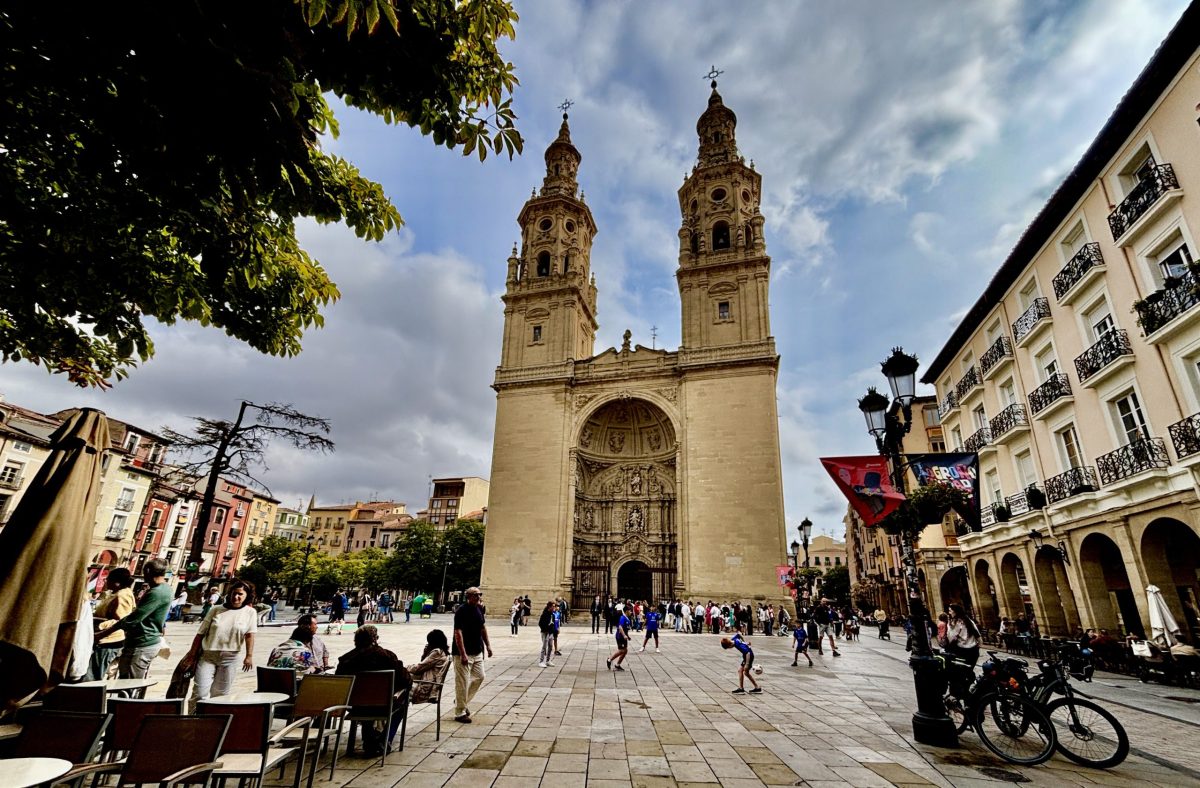
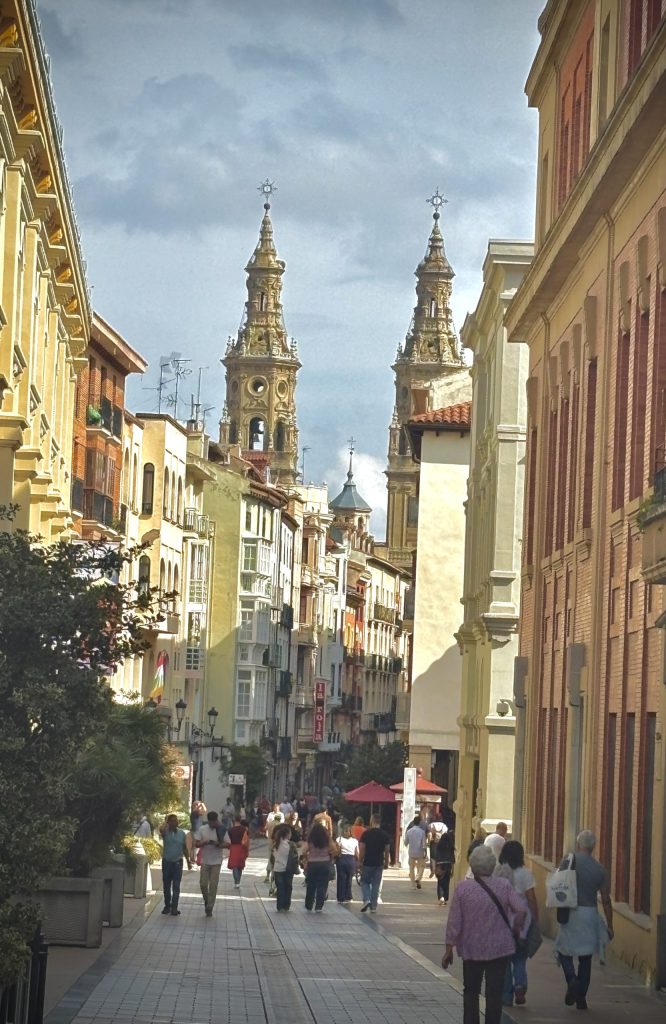
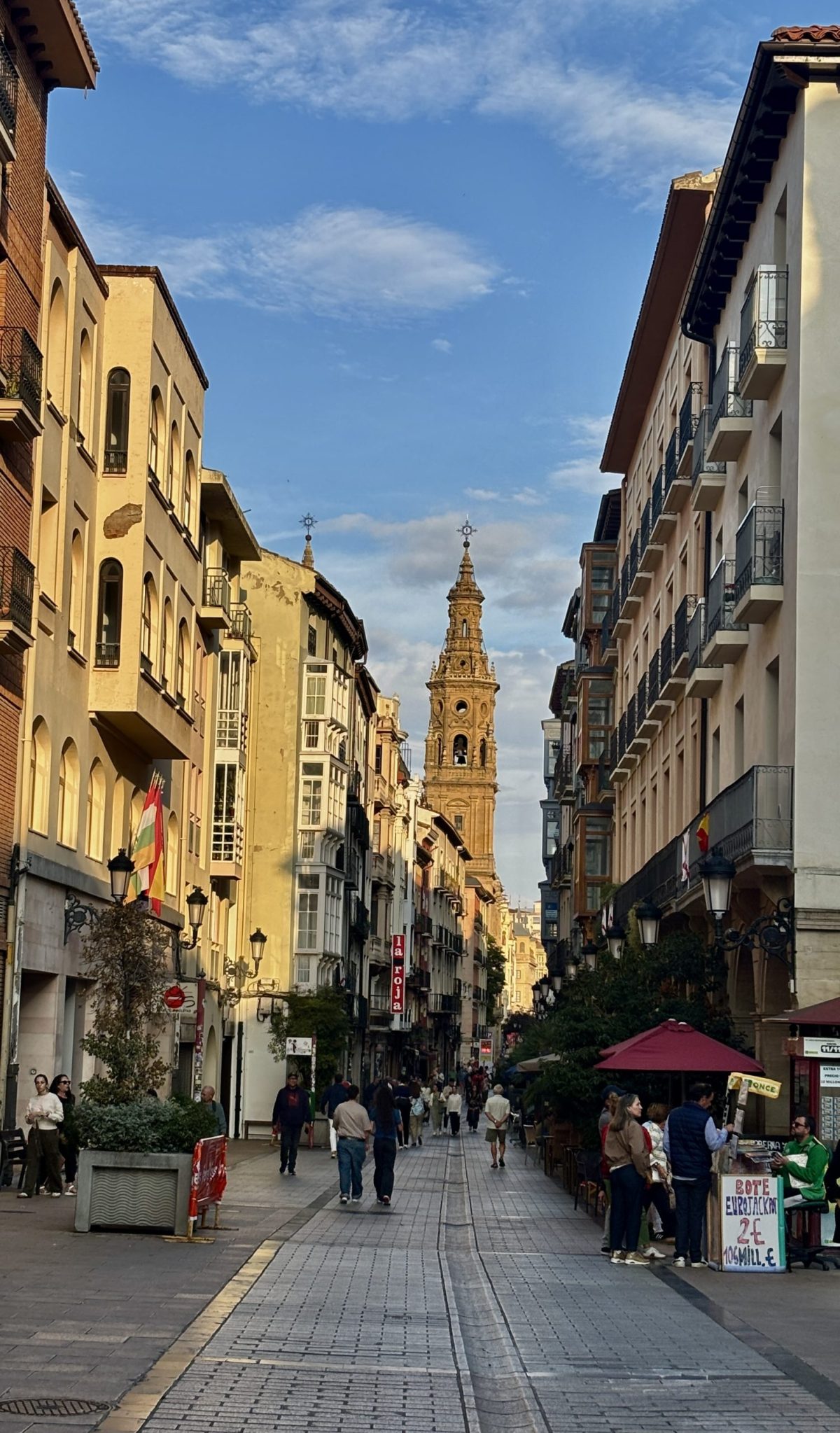
The center of Logrono at 4 pm.
Right after we got François parked another van was trying to squeeze out of a tight spot, and he maneuvered around a tree with about 1/2 inch to spare. It was impressive driving. I gave him a thumbs up and he said I knew I had it in an American accent. Every trip we usually have one encounter with an American in a campground. We had a short conversation as they were departing, they seemed to be enjoying themselves.
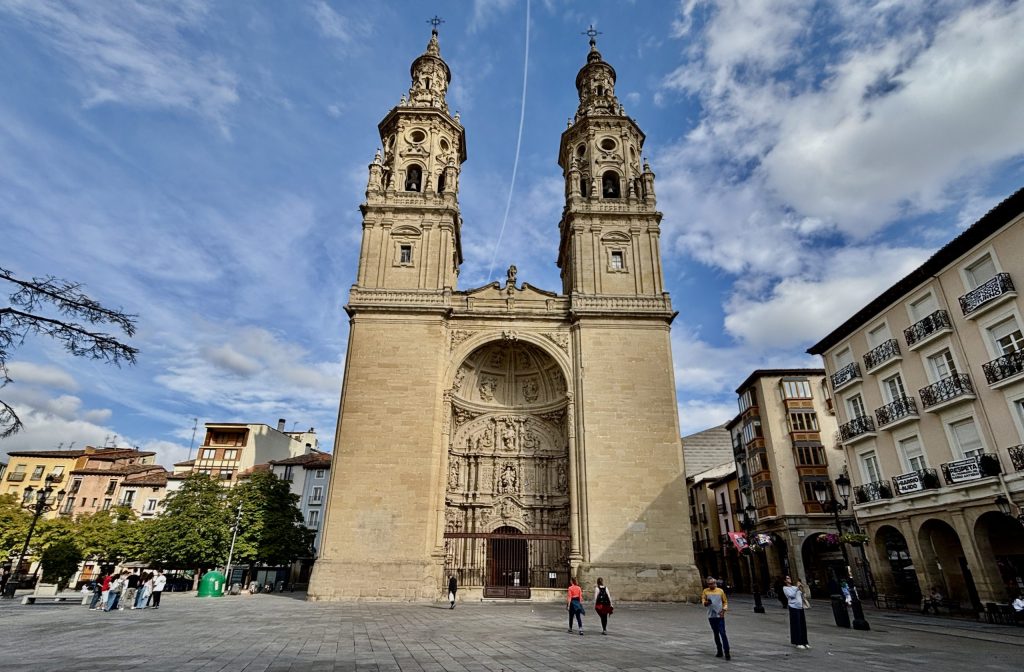
The exterior of the Burgos Cathedral.
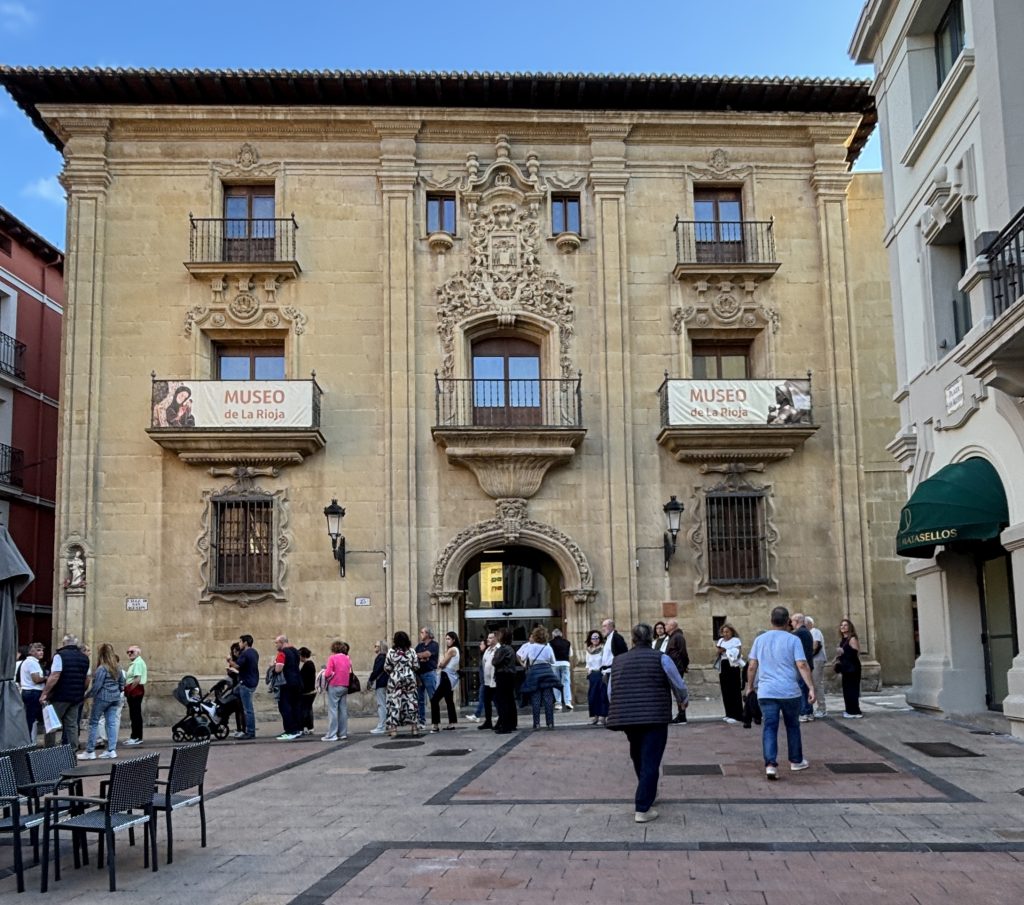
By the time we were settled it was 2pm and well into siesta time. So we had a lunch and I took a nap. We headed into town about 4pm which was still too early as the streets were empty. We found a couple of churches to pop into and visited the Rioja Museum which was excellent.
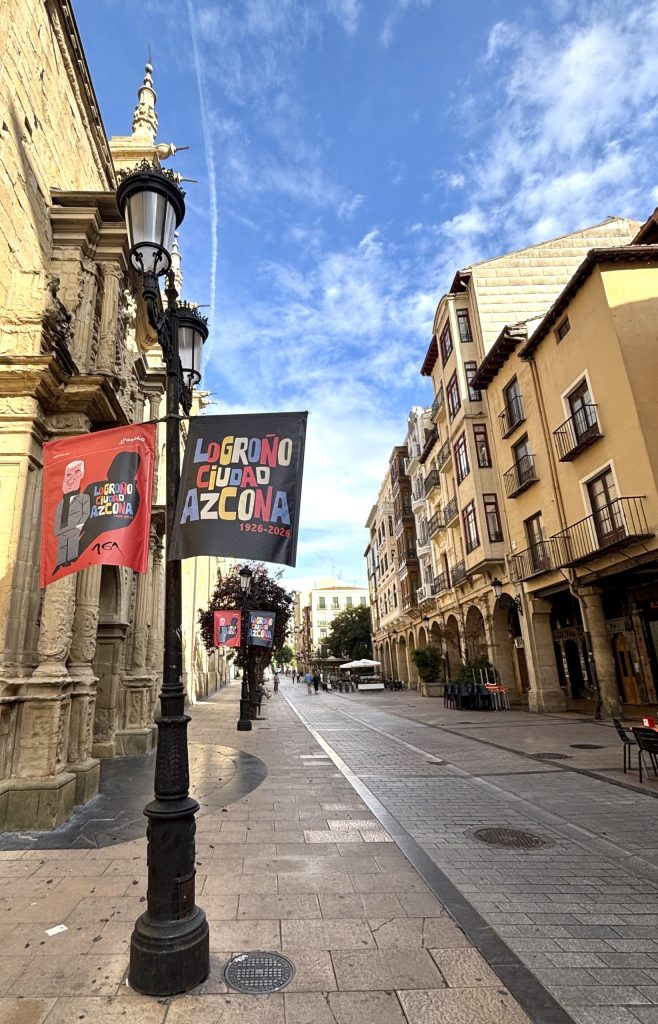
The streets starting to fill up at 6pm.
When we came out of the museum the shops were opening up and the empty streets were beginning to fill. But it was time for us to head back to François for dinner. The Spanish have such an unique internal clock. Most of the restaurants showed that their bar was open at 4pm but the kitchens were not open until 8 pm. We eventually get used to eating lunch at two pm, but we never have mastered the 8 pm dinner.
We have visited many Cathedrals, Abby’s, Churches, and Monasteries in our visits in Europe so when we set out to visit the Monastery in San Millan this morning I was a little blase. What I did not expect was one of the best experiences we have had in all of our travels. Days like this I wish I was a better writer so I could share the magic that happened with others.
The main text you see in this book is Latin. The translations in the margins are the first known examples of written Spanish.
The Monastery in San Millan is known as the birthplace of modern written Spanish. The monks at the monastery transcribed books as one of their tasks and in the margins of some of the texts the monks would translate the Latin text into the common spoken language. This is the first known example of written Castilian Spanish. At least one of the monks was Basque as in 5 of the texts there are also the first known use of written Basque. For Spanish and Basque linguists this is a very important place.
A picture of St. Millan. He is not riding a horse but an Unicorn. He is also considered one of the patron saints of Spain along with St. Santiago. He was also more of a hermit than a warrior.
We walked from our campsite in Bercia (named after the first Spanish poets known by name who was from here) to the monastery through a very quiet village. Like yesterday in Briones hardly anyone was in site and no one under the age of 50. So my expectations for what we would find when we arrived at the home of Spanish did not grow.
The lone person in the photo is me. The fiesta is definitely not today.
But suddenly the monastery appeared in sight and it was very well preserved and much larger than I expected. There were a couple of people in the courtyard but otherwise it was still very quiet. But I was surprised by the state of preservation and beauty of the building.
The entrance to the courtyard of the Monastery.
We went to the ticket office to buy tickets and were greeted by a very attentive gentleman who came around to explain that there was an English tour in 45 minutes. He told us that there was a coffee shop in the hotel where we could wait until the tour started.
The mountains surrounding the town and monastery.
Spain has a program where historical buildings such as castles and monasteries are converted to hotels. So we went into the part of the monastery that had been converted to a very posh hotel. Again it was very quiet but the building was impressive and the conversion to modern usage was very elegantly done. I was impressed enough to give serious thoughts to staying in the hotel tomorrow. The day was becoming more interesting.
This stand is over 7 feet tall and the book and the writing is large enough for the choir to see the words and notes from the benches along the wall.
We joined 3 other Americans for the tour, and as the guide was explaining the general run of things I thought I heard him say that this was the first English tour since the new museum was opened yesterday. Since I was still adapting my ear to his accent I wasn’t sure I had heard it correctly. It turns out I had.
Part of their large collection of books produced in the middle ages. This one also has marginal notes in old Spanish.
Today was the first day that the museum had been reopened to the public since it underwent a major renovation and expansion. The official opening is Saturday and it appears that we had stumbled into their soft launch. The day was getting more intriguing.
Part of the Sancturary where the monks live.
As we started the wife in the other couple told the guide and us that her forbearers had immigrated to Guatemala from San Millan in the 1750’s, so it was a very special visit for her. In addition to being a special day for her it was a special day for the guide who was experiencing the upgrade in the displays for the first time and was truly excited and enthused by what he was showing us. I now knew this was not going to be just another walk thru an old building.
A reliquary for St. Francis who was a hermit who taught St. Millan how to be a hermit and consecrated him as a priest. The last supper on the side is carved ivory.
The monastery had been sacked by Napoleons troops in the early 1800’s and several pieces of early art taken then are in the collection of the Louvre in Paris. While the Louvre has not returned them to the monastery they have lent them for display and we were among the first to see them.
Another text from the Monastery.
But the tour was not confined to just looking at an old building, books, and relics they have added modern audio visual displays. As you enter the building there is an ornate stair case. They have an amazing light and sound show that is projected onto the stairs. At another point they have a virtual reality room where you don an elaborate head set and walk through a VR story of how books were produced during medieval times. I was skeptical at first, but it was a much better visual experience than I expected. Also, the information presented was well done and educational.
Part of the monks quarters. The table is from the 13th century. The wood carvings are from the 16th century, and the painting on the ceiling is from the 18th century. All incredibly well preserved.
Our next stop was the library which had not been open to the public until the redesign. It contains over 1000 texts from the middle ages. To make it accessible they have built a glass walkway into the center of the library. It allows public access while preserving the temperature and humidity of the room in a way that allows for the books to be preserved.
The library with its collection of medieval books. In addition to religious works there are books on architecture, science, and wine making. Behind the small green door in the center are “forbidden books” on topics that were not explained in detail.
The last stop was the chapel. It had some interesting religious art but for me the most interesting thing was the design. There was a kind of wall with a door in it that divided the Nave (where the people sit) into two parts. Originally when there were about 80 monks living here the monks sat in front and the lay people sat in the back half. Today there are only 7 monks living on site and the youngest is in his 60’s. So the seats in the lay part of the church have been removed and everyone uses the front. Ton asked what happens when the 7 monks die and the guide said that it could be a big problem and hopefully some younger monks will come in the future.
The altar in the church with the original painting of St. Millan on the Unicorn with his sword of fire from the 19th century.
If the day had ended at this point it would have been remarkable. But more was to come as after we said good bye to the guide the five of us on the tour did not want to move on. So we continued to chat in the courtyard. The other couple on the tour were walking the Camino de Santiago for the third time and were retired park rangers from Yellowstone. They had served there at the same time that our son Dylan had been a ranger there and new of his experience with the Grizzly though they don’t remember meeting him. The wife managed the visitor centers in Yellowstone and said at the end that what she had just seen blew away any visitor center at a National Park in the US.
A nice window into the main church.
The other lady on the tour was an 80 year old from New York traveling by herself. On a whim she had taken a taxi from Logrono which is about 50 kilometers away. She said she was nervous but was now very glad she had. The five us continued to talk about what we had just seen for about 30 minutes when the rangers told us they needed to head to their room.
The door separating the two halves of the nave.
Ton asked Lauretta what time her taxi was coming from Logrono and she said 4 pm and she asked us if we would mind joining her for lunch. We both said of course. We asked the gentleman we had bought our tickets from if he could recommend a place-he said of course, and walked with us to the parking lot, he pointed at one restaurant and said he worked at that one from when he was 16 until he went to University, then he pointed at another restaurant and he said he worked at that one for the last 8 years because his wives family owned it. I asked if he was still married and he said yes so we went to the one owned by his wives family.
A wall in San Millan on our walk back.
We spent the next two hours sharing another delicious Spanish meal and talking about travel and life. It turns out Lauretta who is a widow had been on a tour with some friends and one of the friends asked her to extend the trip to visit his son. But when the arrived in Logrono she noticed he wasn’t breathing well and she insisted he go to the hospital. It turned out his blood oxygen level was extremely low and they admitted him immediately. She had spent the last three days taking care of him and had not had a proper meal. Last night he was officially out of danger and his son insisted she take a day off so she had come here. We were both very impressed with her stamina and her bravery to travel on her own. She remarked that today had been a good day for her and thanked us for joining her for lunch as she had enjoyed the chance to relax and speak with us.
San Millan had a lot of nice street art.
Most days traveling are interesting and fun, a few days are annoying, but the good days outweigh them and keep us going. Then once in a while something magical happens like today. A day that you have low expectations for turns into a day that you will carry with you forever. A small village in Rioja where we saw one of the most innovative and interesting museums, that we shared with 3 fun and warm Americans as well as two proud and helpful Spanish workers will be a day we will remember for the rest of our travels.
Nature also contributed to our day by surprising with this beautiful flower on a fruit vine that we did not recognize.
When we arrived in Rioja Ton gave me a list of places we should visit so today we moved 7 kilometers to the next stop. Briones is considered one of the most beautiful villages in Spain. It is set on a hilltop on the border of the Basque lands and Rioja with a commanding view of the Ebro River valley where much of the grapes for Rioja are produced.
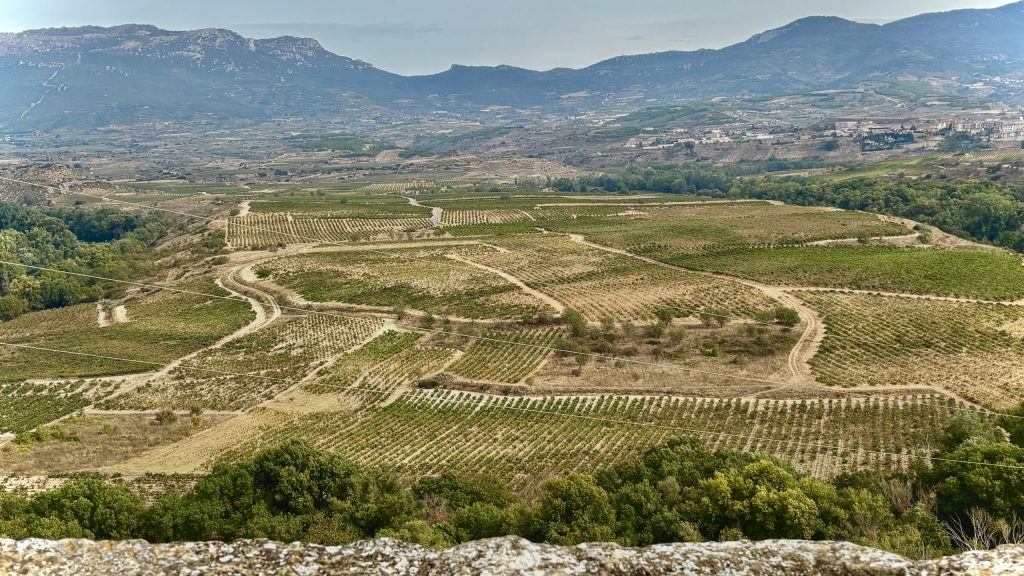
Looking towards the Cantabria Mountains from the castle in Briones.
We found a good parking lot at the base of the hill and then began a strenuous climb to the center of the village. Google said it would take 15 minutes, but they don’t factor in elevation gain.
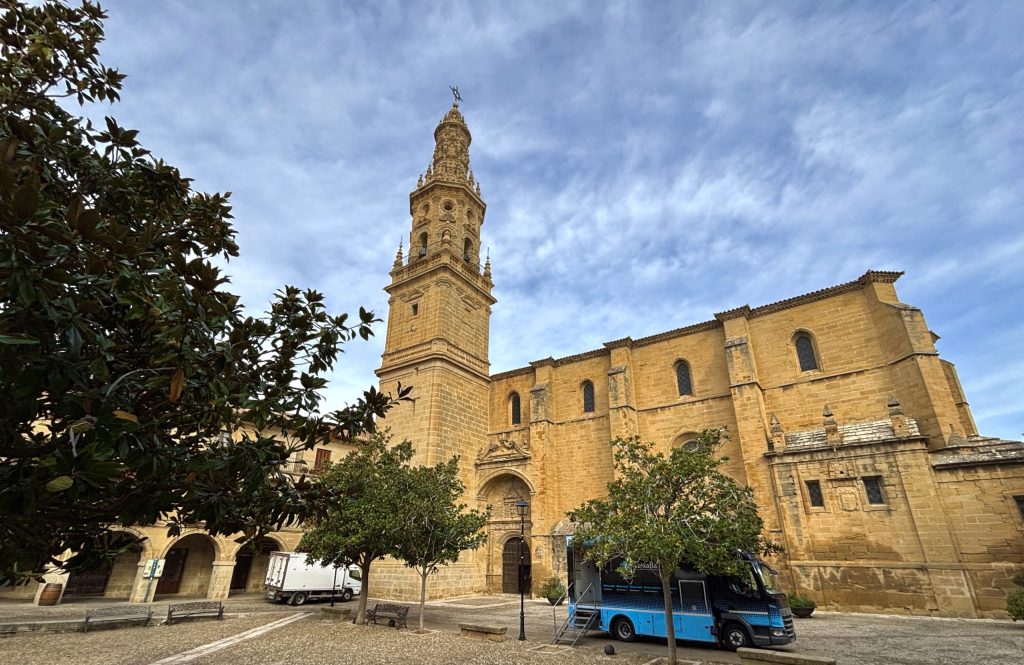
The church and the bank on the main square. The bank is the blue truck.
It is a picturesque village that has retained most of its original buildings, but it was eerily quiet. Most of the buildings appeared lived in but unoccupied. There were no kids on the streets, no sound of a school, and everyone we came across was at least 50 years old.
The oldest home in Briones.
There were a few tourist oriented businesses, a couple of hotels/B&b’s, and a few restaurants. There was also a nice museum showing what a middle class home in Rioja looked like in the 1800’s. But no other sign of commerce or non-tourism businesses.
The view looking across the Rioja valley towards the Sierra del Demande.
It looks like the town has lost its bank as there was a truck parked on the main square with the logo of one of the main banks in Spain calling itself a mobile bank. In the right place this town would be teeming with tourists. Ton and I were quite startled with how very quiet it was.
Vivanco Winery on the edge of Briones.
Looking down from the town I saw a very large and modern structure. Ton had mentioned a wine museum near Briones, and this turned out to be Vivanco Winery which is the site of the wine museum. After finishing our walk through Briones we decided to head there.
The entry to Vivanco winery.
When we entered the winery and inquired about the museum entrance fee the lady at the counter told us the price and then said for €10 more we could also do an English tour of the winery. Ten minutes later we were on the tour.
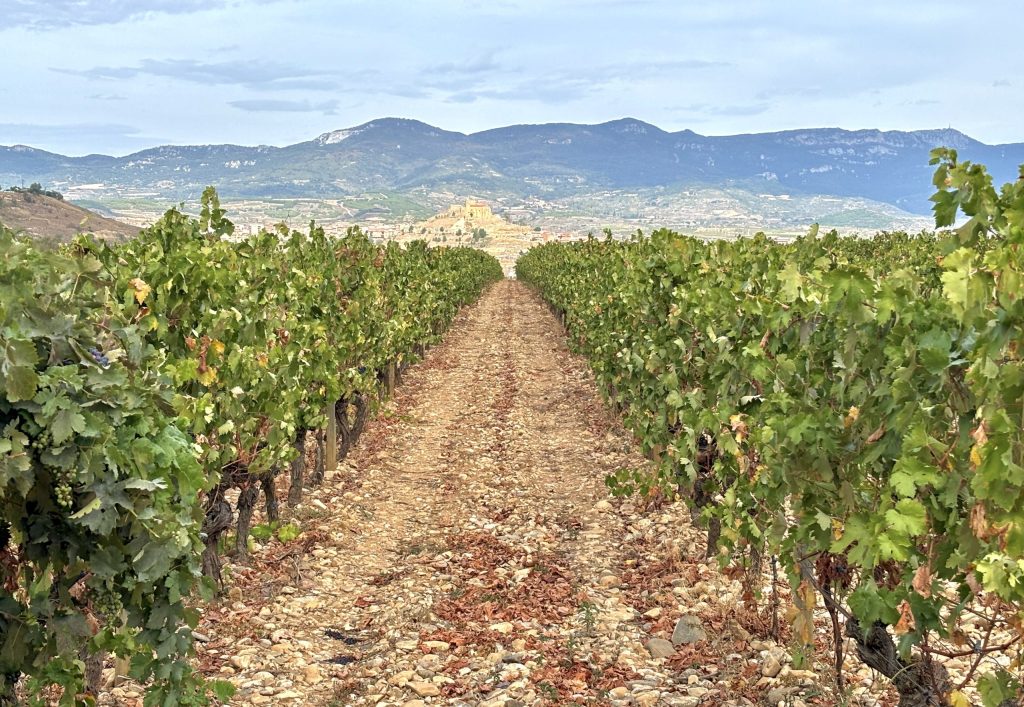
They had just finished harvest so there are no grapes left on the vines.
The tour guide was awesome, there were 4 couples on the tour and we had all done a wine tour before. He said great then he would focus on winemaking in Rioja instead of beginner winemaking. It was perfect. He started by saying this was the earliest harvest in the history of Rioja. Most of the time because of the geography of the valley harvest is spread out over 3 months with the grapes around Briones being one of the last to be brought in. I learned a lot about the bureaucracy of winemaking in Rioja which was both interesting and perplexing.
Some of the 4000 barrels of wine that make Vivanco a medium producer in Rioja.
This winery is new for Rioja having been founded around 1990. The facility was very modern and beautify designed. While the buildings are modern the process they use is traditional for their Crianza’s and Reservas which are the standard Rioja wines. But they produce 14 non-traditional wines that they use modern methods on.
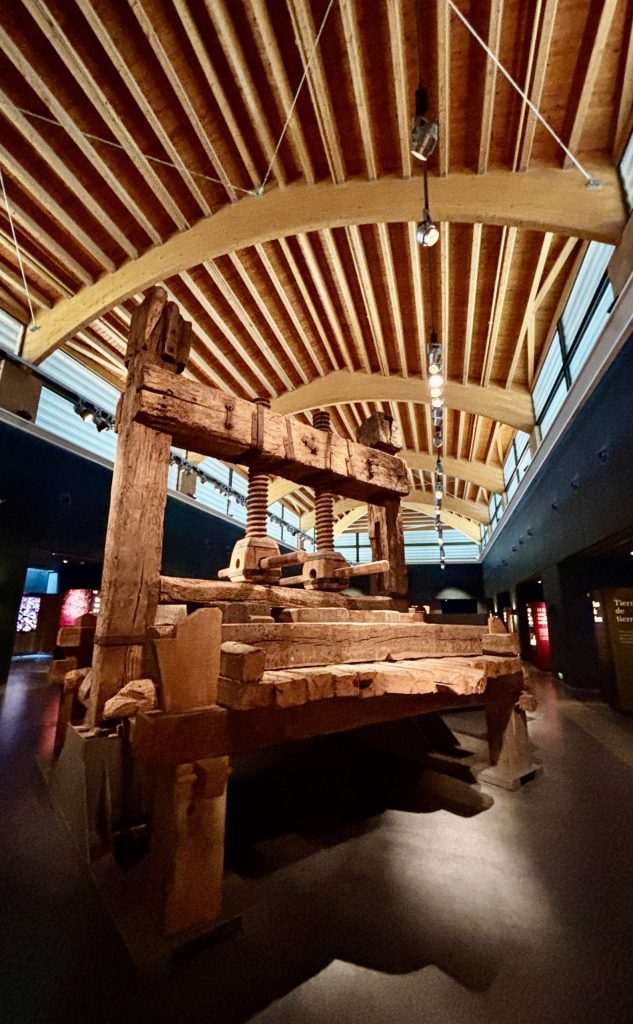
The owner of the winery has a large collection of antique wine presses including this giant one in the museum.
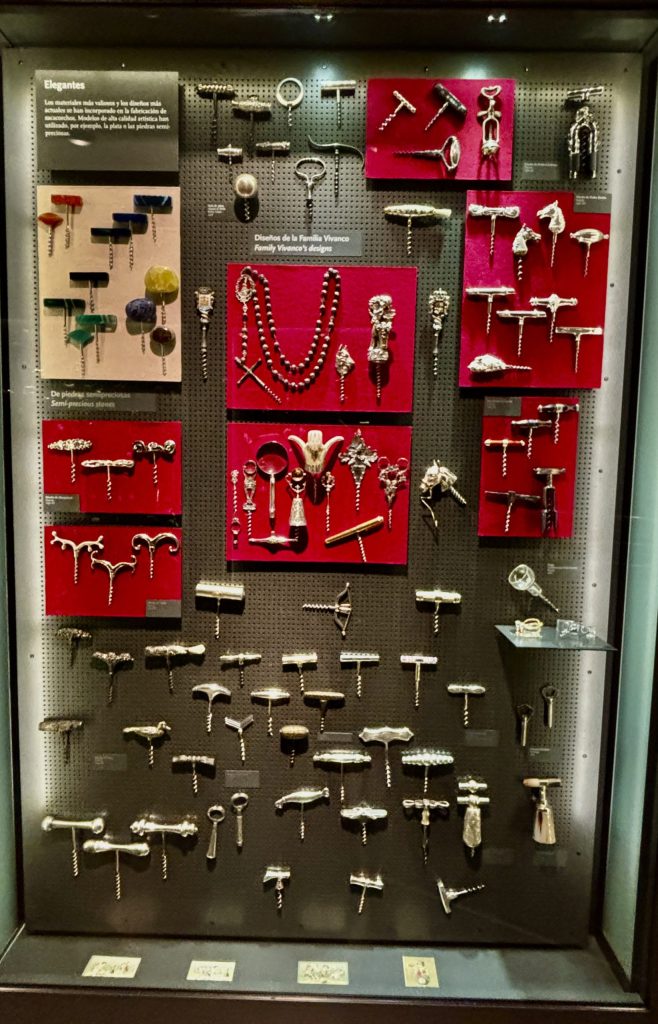
After our tour we headed into the museum for what we thought would be the anti-climax. But the museum was amazing. It focused on different technologies needed in wine making and consumption including pressing, lab machines, storage vessels, and the largest collection of corkscrews in the world.
Part of the cork screw collection. I really like the one built into a rosary with the cross on the rosary acting as a cork screw.
We spent much longer in the museum than we planned and before we knew it was 4 pm and time to move to our next campground on the other side of the Rioja valley.
We had a couple of chores to run in the morning. So we set off to the post office about 10 am to send a postcard back to the US. We got to what I believed to be the door of the post office to find it locked with a note on it. The way I interpreted the notice was that the post office was only open from 1 to 3 pm today and tomorrow. If I was not illiterate I would have known that this service door was closed but that the rest of the post office was open. But based on my illiterate reading of the sign we wandered off trying to find something to do for 2 hours until 1 pm while muttering about Spanish productivity.
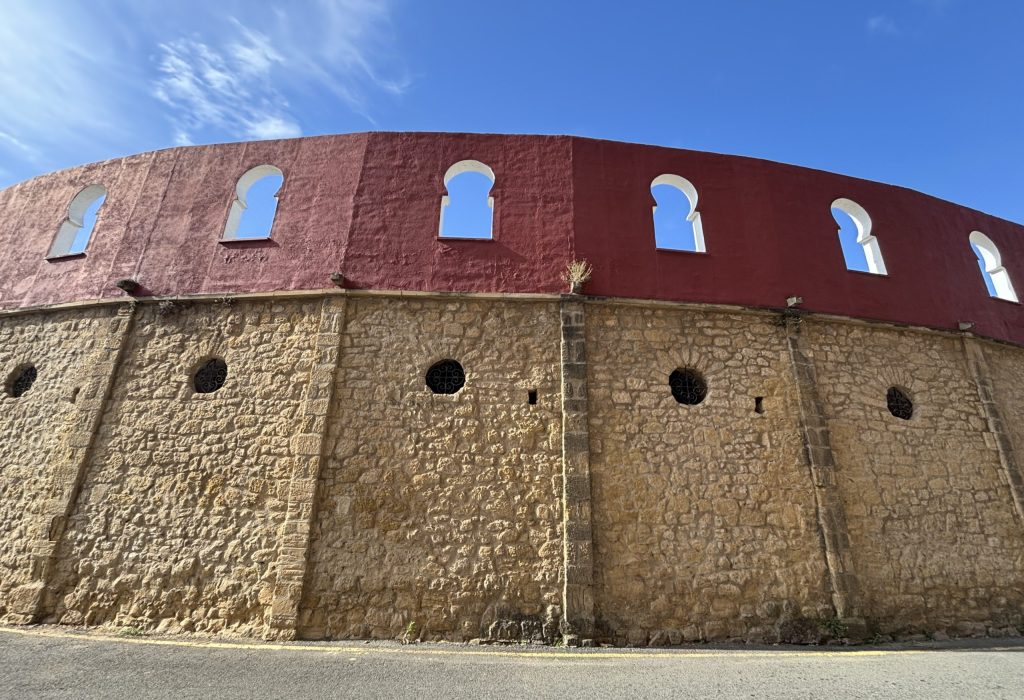
The bull ring in Haro.
Our other chore was to try to find a step stool to help boost us up into François. Near the post office was a large Chinese Store. In Spain most towns have Chinese Stores that sell everything under the sun. And as the name implies they are usually run by Chinese families. The one here was quite large and stuffed to the gills with everything you could want from kitchen gadgets to clothes. Unfortunately their assortment of stools were all a little too tall for our needs so we failed there.
Street scene in the wine district.
We still had 90 minutes until we believed the post office would open so we decided to head towards the bull ring in town to check it out. When we arrived it was also closed. So far our morning had not been very productive.
They have an annual wine battle in Haro which is a big attraction, but strikes us as a waste of good wine.
While our day had not been productive it had involved quite a few steps and a fair bit of climbing. We still had an hour to kill so Ton suggested a bar she had noticed across from the post office. As we arrived at the bar I noticed someone entering the post office from another door so we headed over there and entered into a very open and active post office. So I had egg on my face but we did get our postcard mailed.
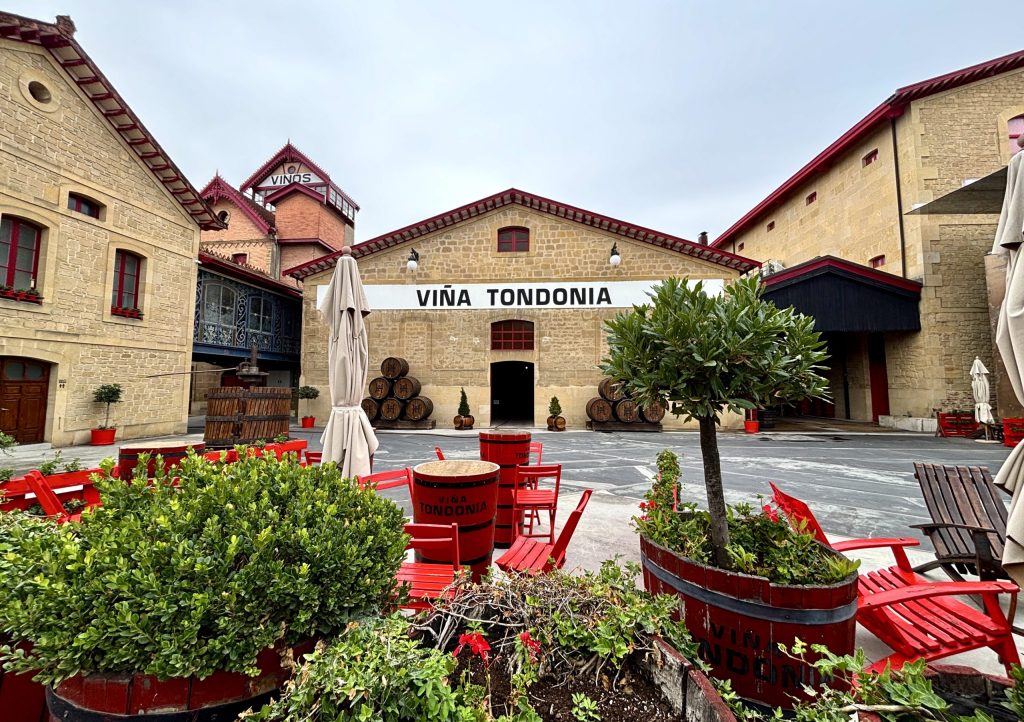
The very large and impressively ornamented entrance to Mugu winery.
Now that we had accomplished our chores we could move on to the fun part of the day which was wine tasting. Our first stop was a big high end winery. We enjoyed the wine but felt a little neglected by the staff so after completing our tasting we decided to move to smaller winery.
Tihom winery where we felt much more at ease.
Tihom winery is a smaller winery than our first stop, but it had excellent reviews. As soon as we arrived we liked the vibe there. As we were settling we noticed the couple at the next table had gone through most of their wines. I asked them which they liked the best and I ordered a bottle for Ton and me to split. We struck up a conversation with them and they were a Brazilian-American couple from Mission Viejo California. We hit it off and a chance meeting turned into a full afternoon of conversation about traveling, driving a RV in Europe and how best to manage retirement.
They used to yes these large casks to ship wine by train.
After we finished our bottle at the winery they joined us in going back to François to try one of our Belgian beers. By this time we were all a little hungry so we decided to head into town for a late lunch. What we didn’t know was Tuesday was the day all the bars in Haro shut early. There was only one bar left open and it was shutting down. They were nice enough to let us pick a couple of Tapas, and offered a plate of tomatoes and cheese soaked in olive oil that was delicious. We continued our conversation with our new friends until nearly 6 pm when they had to work on getting a taxi back to a hotel in a village about 5 kilometers from Haro. So our frustrating day turned into a wonderful afternoon with two new friends.
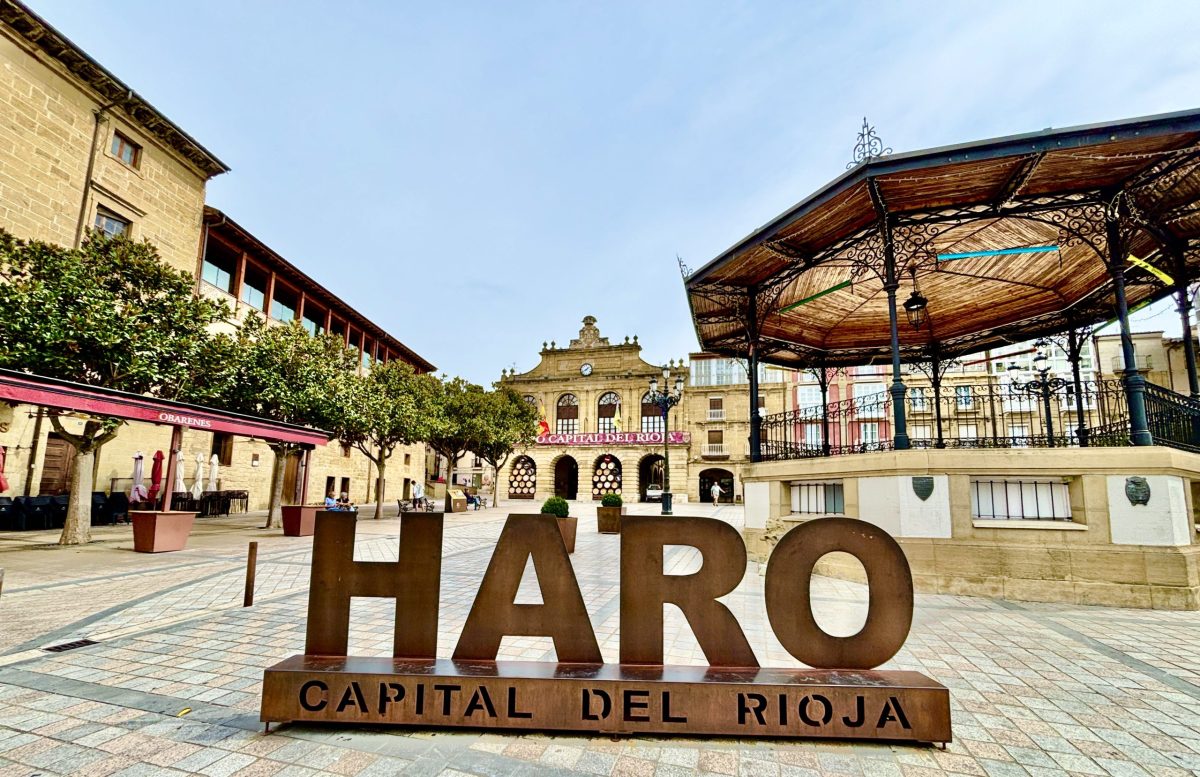
We are in one of our visions of heaven. Ton came up with a plan to spend the next several days in Rioja which is a very famous wine region in Spain. Rioja wines are one of our favorites and today we are in Haro which is the center of the Rioja wine region.
The old town hall of Haro now decorated with wine barrels from some of the biggest producers near the town.
It was a short shift to Haro from Burgos. Strictly speaking our planing for this trip has not been great. Today we are closer to Vitoria than Burgos so we have doubled back significantly. But I guess at this point our travels are not about efficiency but enjoyment.
The center of Haro with the church in the background.
After about an hours drive we settled into our campground and headed into town on a reconnaissance. Because it was Monday we knew it would be quiet as many of the restaurants and businesses close on Monday.
This is part of the gastronomical part of town. We think it will be much more active tomorrow.
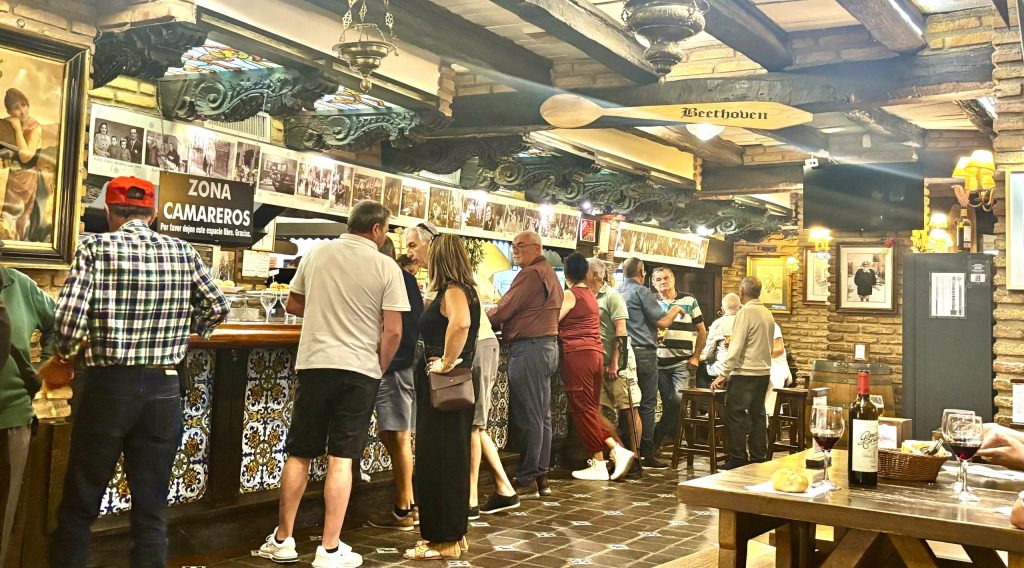
We did find a very nice restaurant open on Monday and as it was the only one open it was doing good business. We grabbed a table and I went to the bar to impose my bad Spanish on another patient Spaniard. Despite my stumbling Spanish we got what we wanted. I have been impressed about how nice the Spanish have been when I break out my bad Spanish on them. They are clearly fluent in English, but go along and even encourage me to try to speak Spanish instead of switching to English.
The inside of Beethoven Restaurant.
There are several wineries here in town that we plan on exploring tomorrow. We made a quick run out to the wineries and saw one Bodega open. We popped in and while they didn’t sell wine by the glass they were happy to sell us a bottle that we could pour a glass from and take home the rest . When the server delivered the bottle he also brought a nice plate of sausage and almonds for us to eat.
The winery where we enjoyed a nice glass of wine.
After we sipped our glasses of wine we packed up the rest of the bottle and headed back to François. Just as we returned there was some ominous thunder off in the distance, so we settled in for the rest of the afternoon and relaxed.
We had wanted to visit some of the caves under Laguardia, but when we arrived yesterday it was too late to get in. We decided to stay around another day and get in a tour.
With time in the morning we lazed around a bit before heading over to Laguardia. We had a specific winery we were most interested in, but today they were only offering tours in Spanish, we contemplated going along, but they said it would be a waste as they spent a lot of time explaining the process and if we were not fluent it would be boring.
While waiting for the tour we watched the Basque dancers on the clock tower on the town hall.
Instead we went to another winery and booked ourselves on a tour of Bodega Carlos San Pedro. We had a couple of hours to kill so we settled into a coffee shop and watched a replay of the Real Madrid game with the local team Since we did not know the score it was live to us. In the end the local team scored literally at the final whistle, and all of the locals who had kindly not given away the score shared a big high five with us.
Ton liked the Basqueness of this fellow.
When we got to Carlos San Pedro it was packed. In fact the owner was startled about how many English speaking guests he had. Towards the end he began asking people to wait 15 minutes and he would run a second tour. Ton and I decided to join his tour, as he was clearly the owner and winemaker. It was a good decision as Carlos gave an in depth and clear description of the winemaking process in the Rioja region. He showed us the original winemaking facility before admitting that they had moved to a modern facility about 15 years ago. They did have a splendid video of the process using the old equipment including a hand operated press that was still on display.
After the explanation we went down into the caves under the winery to see the cement tanks they use, as well as the barrel and bottle rooms. The caves have been under the town for hundreds of years, and go back to the time when the town was a fortress. There are over 300 caves under the town, and many have been used for winemaking and storage for the last 150 years.
Ron looking into the 6000l tank of Rioja Wine.
It ended with a taste of the wine that was in a 6000 liter tank aging, as well as two from the bottle. The wine was superb, and we have been on a lot of wine tours in our time, but this was one of the best.
Thank you Carlos.
It was still pretty early so we decided to move south a little bit to get us positioned for another town tomorrow. Tonight we are in the parking lot of a major grocery store with 6 other motorhomes. We were able to get some supplies. The drive to here was thru the Cebollera National Park, and it was quite beautiful, though the weather was a little sketchy or we may have stopped for the night. It gives us something to aim for in the future.
We are in Rioja country. The plan for the day was to drive to the fortified town of Laguardia which is famous for its cave bodegas (wine cellars). Ron did his normal research on where to stay for the night and found the location for an aire that he thought was in Laguardia. After punching in the GPS coordinates we had a very pleasant drive of about 1 1/2 hours to the aire. After parking we headed into town to look for a particular bodega (winery). After wandering around the little village (which was quite nice) and some head scratching Ron realized we were one town short and not in Laguardia but Elciego.
In addition to wine the area is famous for peppers. Any area that has good peppers is good with Ton.
We headed back to the aire and drove the 5km to Laguardia. The town was humming with all of the local families coming into town for Sunday. We finally found a place to park on the shoulder of the main road and headed into town. Laguardia is a “puebla bonita” of Spain. It is a hilltop fortified town surrounded by vineyards. There was a concert going on in the main square and people socializing at all of the bars and restaurants. We popped into the tourist office to ask a couple of questions. She gave us the information we were looking for but than told us that as it was Sunday everyone but the restaurants was closing at 2pm for the day. Ton and I took a pass thru town and decided it was worth coming back when everything was open, so we will return tomorrow.
When we pulled into Laguardia Ron thought there must be an event, but it was just a typical Sunday.The clock tower with Basque Dancers.
In the end we decided to return to the aire in Elciego. The tourist information in Laguardia told us we were welcome to sleep in two of the town parking lots, but they were jammed. Elciego is another wine centered village and has a fantastic hotel, winery, restaurant in it. The Hotel Marques de Riscal is designed by the American architect Frank Gehry. It really is an interesting building though you can debate whether it fits the terroir of the area. At first Ron did not like it but it grew on him after we took a walk down to take a look at it and the surrounding vineyards.
The Hotel Marques De Riscal is quite arresting. Off season rate for rooms was €400. It is also harvest time here and the town was buzzing with tractors running thru town with grapes loaded on them.These are wild grapes growing by the road.