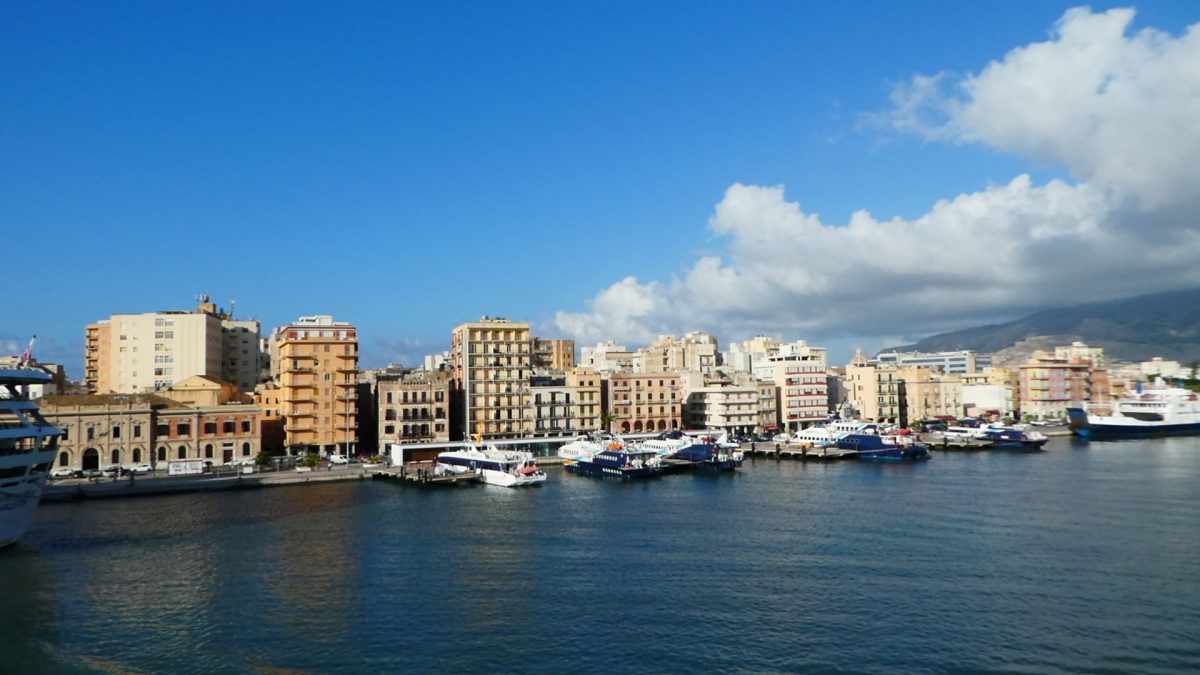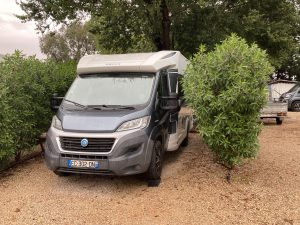
We woke up early with only two things in mind for the day. Head over to the Valrhona Chocolate company, and then jump in François and do a marathon drive on the Autoroute to Sens.
Both missions were accomplished, when we went out for our walk to the chocolate company we were surprised to see two river cruise ships tied up to the docks right next to the campground. The fog was dense and you could barely see them but they loomed in the dark. We think all of the passengers had already taken off for their day trips as the crew of one of the ships were engaged in a vigorous snow ball fight on the top deck which is usually used for the passengers to enjoy the sun and the views.
The pedestrian bridge across the Rhone shrouded in fog.
We arrived at the factory and Ton did some sampling and shopping while I sampled and tried to figure out why our internet was out of order. Ton was much more successful than I was. After much sampling and comparison we departed Valrhona with a kilo of chocolate to take home to Oregon.
François sitting on the banks of the Rhone, trust me.
We quickly packed up and headed to the autoroute. At the entrance to the autoroute I was distracted going up to the gate where you get the ticket to enter. In France they have a Telepass station where you put a transponder in the car and do not need to stop at the toll gates. As I drove up to one of the two entrance gates I was not paying attention, so when I pulled up to the machine that usually dispenses the ticket you need, nothing happened, and then after a few seconds a recording began lecturing me in French about the fact that I had entered the telepass gate, after about 20 seconds of being scolded in French, and having a picture taken of our plate (there was a flash at the rear of François which I presume was a camera going off), the machine dispensed the ticket we needed, the barrier went up and we were on our way. I fear there may be a fine in our future.
Windshield shot of a castle off of the A6.
The rest of the day consisted of us navigating the 430 km’s on the autoroute, and paying a huge toll at the end. Before heading back to the aire in Gron which is our normal beginning and end of trip stop we also filled up a thirsty François to the tune of €120. The days when we see the least are often the most expensive.
Our plan when we arrived was to head towards Spain, so of course we drove north today to Chartres. Along the way we decided to visit Normandy and Brittany on our way to Spain, so we had to divert north to get to Normandy.
We decided to visit Chartres primarily to see its Gothic Cathedral. We visited Sens Cathedral the other day which is billed as the first Gothic Cathedral, and Chartres is supposed to be the best example of a Gothic Cathedral. Chartres still has its’ original stained glass as during both wars they removed it and stored it safely. During WWII the cathedral was in danger as the allies moved towards Paris, but an American Colonel successfully negotiated with a German General to declare Chartres an open city, so there was no battle fought for the city.
The exterior of the Chartres Cathedral. Note the contrast between the recenly cleaned upper part, and the uncleaned lower part. The maintenance of these buildings is daunting.
On our way out of Chinon we decided we wanted to visit a winery, we drove thru the countryside only to find it was closed. Disappointed again, we wrote off getting a taste of any Chinon wine, but on our way out of town Ton spotted the new tasting room for the winery we had driven out into the country to see. Pierre and Bertrand Couly had opened a new tasting room on the highway to Chartres, Chinon Red wines are what we call Cabernet Franc in the US. We spoke to the wife of the owner and she did a great job explaining the wines of the area. She was aware of Oregon wines as her husband had spent some time at Sokol Blosser winery in Oregon in the 1980’s.
The very fine winery Pierre & Bertrand Couly. As the owner said you do not have to have an old facility to make traditional wines.
The three hour drive to Chartres was uneventful as the “N” road that we used most of the way was quite good. We parked in a free overnight spot, and walked about a mile into town to see the cathedral. The cathedral was indeed impressive, and the interior stain glass windows were among the best we have seen in France. The cathedral was constructed in the early 1200’s after the previous Romanesque Cathedral had burned. The cathedral is deservedly a UNESCO world heritage site. Besides admiring the beauty of the building we also again discussed the maintenance of these immense buildings. Just keeping the exterior clean is a full time job.
One of the stain glass “Roses” at Chartres, this one dates from around 1210 and is the original glass.
After touring the cathedral we decided not to wait for the light show, so we walked back to François. Frankly we were a little peeved with one of the attendants who would not let us take the last crypt tour, and did it in a way that seemed unnecessarily officious to us while simultaneously refusing to speak English, even though we had just heard him giving an explanation of the tour in perfect English to another person. I hope he was just having a bad day. We had a light dinner and a relatively early night as we have a long drive to Normandy tomorrow.
Well, plans change. We had originally planned to go to Orleans for the day, but last night we discussed spending a few days in the Loire Valley. When we woke up it was spitting rain and a little windy, The Weather Channel said it was going to improve as the day went on so we decided to skip Orleans, and head to Chateau de Chambord.
Ron plugged a GPS coordinate into the Garmin which was supposed to be for the motorhome parking at the Chateau and we took off. The Garmin said it was only a 68km drive, and the roads were good. Right at the end we started to think something was amiss as we suddenly started to get on smaller and smaller roads and this is maybe the largest tourist attraction in the Loire Valley. At the end the GPS proudly announced we had arrived, but we were looking at a field next to a little village. Either Ron inputted the coordinates wrong or the coordinates were wrong in the app we use to find places to stay. Anyway after a little more research we were on our way to the Chateau.
Thirty minutes later we arrived and what a first impression. The chateau is magnificent in scale. As we walked up to the entrance Ton said that this must cost a fortune to maintain. This would become a theme of the day.
The first view of the Chateau, it really is immense.
The Chateau was originally constructed from 1519 to 1547 by King François I. It is built in the Renaissance style and has 11 towers on the roof that are supposed to look like Istanbul.
The back of the Chateau. The roof was supposed to be modeled on the skyline of Constantinople (now Istanbul).
While it is really something to look at it is indeed difficult to maintain. When you watch the movie of the history of the Chateau it goes something like this, François builds it, and then loses interest in it and it deteriorates, another king gives it to someone who spends a fortune on it and then loses interest and it deteriorates, it passes to another owner who spends a fortune etc. In fact it may be the greatest white elephant in France.
The ceiling on the third floor, the salamander was the symbol of François I.
It is now maintained by the French National Park Service and they are clearly spending a fortune to restore and maintain it. Hopefully they will succeed as it is worth keeping.
It was time to get moving. Last night with some encouragement from Robyn we decided to head to Normandy. Orleans seemed like a good first leg for the trip. The first few days of the trip the weather had been perfect, but when we woke this morning it was just starting to rain. It pretty much rained the whole way to Orleans though the roads were good and pretty stress free.
Our first stop was the aire which is about 5km from the city center. When we got there the weather was still pretty unsettled so we decided that Orleans could wait for tomorrow and settled in. The one thing interesting was the aire shared its space with the local pétanque club which is the French version of Bocci. Unlike other pétanque games we had watched, this group was really good.
The view from the aire tonight.
In the evening we decided to take a stroll on the footpath along the River Loire. Not expecting much we were surprised when around a bend in the river about 200 yards from the campground there was a really nice church. Exploring a little further we came into a little village with a park on the grounds of an old Chateau. It was an unexpected find for us.
We are finally having to focus more on direction than interesting places. We picked the destination of Tournon-sur-Rhone based on it being a good distance north towards Sens.
When we arrived in Tournon we were not initially impressed. It was a nice enough town with a nice view of the Rhone River. There were two river cruise boats docked near town. We learned that Tournon had a sister city on the other side of the river called Hermitage. They were connected by a nice wooden pedestrian bridge.
The wooden bridge across the Rhone between Tournon and Hermitage.
We found another aire for the night and headed into town. We did a pass thru Tournon and it was nice, and then headed over to Hermitage as Ton wanted to get some pictures of the Rhone and the river cruise boats. Once we reached Hermitage we saw they had a chocolate museum. The chocolate museum was really awesome. It is called Valrhona, and is attached to a factory by the same name. We decided not to take the tour, but just went thru the attached store. The store had all you could eat samples of all of their chocolates. Ron probably ate about 5€ worth of samples, and Ton about 4€ worth. The chocolate was excellent, and we were almost tempted to buy some but we were full from our free samples!
One of the river cruise ships pulling away from the dock in Hermitage.
On the way back we saw some vineyards on the Tournon side of the river that were really interesting looking. They were on this incredible slope of about 15 degrees with old stone walls between parcels. We decided to walk over to get a better view. They were even more impressive up close. It turns out that this is a Grand Cru ( the highest quality wine in France) for Syrah, and is considered the spiritual birth place for Syrah. So we are going to look for a bottle of the local stuff tomorrow to check it out.
The hills above Tournan which are supposed to be the spiritual home of the Syrah grape.
Today we enjoyed Brittany. We had to make a decision, who said there is no stress on these trips. We are really enjoying Brittany and the weather is great. But to really explore Brittany is going to take another 3 or 4 days, and we will still be 3 or 4 days from Spain. We are now on the 11th day of the trip, and we are no closer to Spain than when we arrived. France is addictive. So we had to decide whether we spend time here in Brittany, or head south towards Spain. After much talk and discussion we decided today was going to be the only day in Brittany and we were going to head to Spain.
The next trick was getting diesel. Suddenly our credit cards have stopped working at gas stations. We have had no problems with our cards until now. A quick call to one of our credit cards confirmed we were good, and they did not even see the attempt to charge that was rejected. After a couple of attempts today we found a fuel station that would take one of our cards, we were under a quarter tank so it was expensive to fill up.
Leaving our campground we saw a nice windmill near the road so we swung in.While we were there the French Army decided to stage a paradrop for us, Ron was thrilled. These guys landed right next to Mont St. Michel.
Having made the decision, Brittany is making it hard to leave. We started the day at St. Malo which is a port town. St. Malo was pretty much leveled during WWII as the German garrison would not surrender. After a substantial siege the Allies finally took it. So except for the city walls the city has pretty much been rebuilt since WWII. But they did a great job of rebuilding the old city within the walls of the fort.
Part of the fort at St. Malo.
We spent most of our time in St. Malo walking the battlements of the fort. St. Malo was a fortified port for 500 years. Some of the forts were built by the man who is considered by many to be the greatest fort builder in the western world, Vauban. They are indeed impressive, and were even able to pretty much withstand 20th century weapons during WWII. In addition the natural setting on the Bay of St. Malo is really beautiful. We really enjoyed St. Malo.
One of the forts designed by Vaubin. The bird in the foreground seemed very happy to have his photo taken.
Brittany was originally settled by Celts, and St. Malo has a strong connection to Wales. Ron believes his family name is originally Breton so it is a special place for him. They are famous for a cake called Kouign Amann. That is a good Celtic word and we could not master how to pronounce it, but it tasted good. It tasted a little like an apple fritter.
We had the smallest Kouign Amann. A prize for anyone who can pronounce this.
Our last stop for the day was Dinan which unlike St. Malo was bypassed during WWII and has a lot of its original buildings. It is also a fortified town, but here we focused on the town and enjoyed walking down the narrow streets within the fort and enjoying the timbered buildings.
There are two iconic images of France for tourism. One is the Eiffel Tower and the other is Mont. St. Michel. Since we were close by and it is off season we decided to head there and cross it off the bucket list.
Before we left the campground in Bayeux Ron had a touching conversation with an English lady. She came up to Ron and said that she recognized him from yesterday at the American Cemetery. She told him how moved she was by the sites there and the sacrifice of the young men who came to another continent to help. I told her that they were honored to do it, and explained to her that the families had the choice of burying them here or having the body transported home for burial. She teared up and said that she was honored that so many chose to be buried here. I am bad with tears and did not know what to say, but thanked her for her kind thoughts.
The Garmin had been choosing pretty easy routes on nice wide roads, but decided to test us today by sending us off on small D Roads for the first 30 km, including one that turned out to be closed for construction. After some wandering around on back roads we came out to a pretty major road and the next thing we knew we were on a nice freeway for the last 60km.
Our first view of Mont St. Michel.
Mont St. Michel is a spectacular site and that is why it is an icon. We had a pretty good walk to the free shuttle to the island. The bus was packed, and the initial impression was of a big crowded tourist site, but it won us over. The site on the outcropping surrounded by mud flats is right out of any movie. The abby is both beautiful and a marvel of construction. Expecting something sterile and packaged we came away impressed.
A shot across the Knights Hall which was the dinner place for the Knights.On the way back we had a nice snack of mussels with some Normandy Cider. We guessed that it was about a Kilo of mussels. The coffee style cups are for the cider.
We wanted to cap the night off with some pictures of the Mont at night. We walked down to the river to the bridge as we thought it would be a nice shot. Tonight is warm and there is not a breath of wind, and we are basically in a big swamp so the mosquitos were swarming. We fought them for about 30 minutes waiting for the lights to come on, but the mosquitos won and we headed back to François for the night with no pictures.
Not the shot with the Mont lit up like we wanted, but the mosquitos drove us home.
We are still on the Normandy peninsula basically moving from the area of Utah Beach to Omaha Beach. We got a late start as we decided to take care of some housekeeping chores in the morning. After Ton paid some bills and we knocked out a load of laundry we headed out for Omaha Beach.
When we arrived at the center of Omaha Beach it was quite crowded with several bus loads of Americans taking their lunch break al fresco around the memorial. We poked around for a while and mourned with a fellow Oregonian about the football teams loss on Saturday to Stanford.
Standing on Omaha Beach in front of the Sculpture to commemorate the 60th anniversary of the battle.
Done with Omaha we headed over to the American Cemetery in Coleville. This cemetery is maintained by the US Battlefield Memorial Commission and is the final resting place for over 9000 soldiers and sailors from the battles around Normandy. After the war the families of the fallen were given a choice to have the bodies shipped home or buried in place, so this does not represent all of the Americans killed in the battle.
he view towards the memorial and reflecting pool.
The visitor center and the grounds are inspiring and a true honor to the young men who are there. The visitor center has an excellent display about WWII and D-Day. After you walk thru the visitor center you enter the grave sites, and the location overlooks Omaha Beach and the Atlantic. The site is immaculate and clearly lovingly taken care of by the French staff.
The grave markers go on forever.
When we completed the tour at the cemetery we headed into Bayeux which is about the only major city that was not leveled during the invasion. It is also famous for the Bayeux Tapestry which is a famous medieval artwork. As we entered the city we made a quick stop at a Carrefour Market to restuff the refrigerator. We headed into the city but just missed our opportunity to see the tapestry as the museum was closing. We took a quick walk by the Cathedral to look at the Norman style Cathedral, and then headed back to François for the night.
A gargoyle on the Cathedral at Bayeux. They are not only an interesting feature but actually serve as the drains for the gutters when it rains.
Today we covered the most distance we have covered in one day on the trip, about 200 miles. We got up a little early, and the trip was pretty easy as the roads were frequently 4 lanes wide, and we did not have very many small villages to pass thru.
Our target for the day was Utah Beach from the Normandy invasion in 1944. Our first stop of our D-Day tour was at the Airborne Museum at St. Mere-Eglise. St. Mere-Eglise was the initial focus of the 82nd Airborne Division during the invasion. It is said to be the first town in France to be liberated by Americans during WWII. The museum itself is well done, focusing on the issues of the airborne forces during the invasion. It mostly covers the 82nd Airborne, but does also give information about the 101st Airborne. It is an interesting collection of equipment, weapons, and stories. One of the most interesting exhibits attempts to give you the feel of doing a night drop from a C-47 transport plane. It gets your attention.
A US Sherman tank on Utah beach, this one is painted in the colors of the French LeClerc Division which landed here, and passed thru St. Mere-Eglise.
We also visited the church in town which is famous for the story of one paratrooper John Steel, who had the misfortune of getting hung up on the steeple of the church where he was shot in the foot by a German, and played dead for several hours hanging in the air above the center of town. If you have seen “The Longest Day” movie about D-Day you will probably remember this story as it is featured in the movie.
The church at St. Mere-Eglise, note the replica of the parachutest hanging from the church.
We ended the day at Utah Beach to see the monuments there, and to walk on the beach. The monuments and displays we saw today were really touching, and shows the deep respect and thanks the French have for the Americans who landed here.
Ron standing on Utah Beach, evaluating the suitability of the beach for an amphibious landing.Nothing to do with D-day, we saw this horse and rider driving thru the surf. We have no idea why.
The jet lag is starting to wear off so we woke a little earlier to head into Lyon. We purchased an all day pass for public transport in Lyon which is a good deal for €6 as we wanted to cover a lot of ground today.
On the way to Lyon we asked a young gentlemen to confirm we were at the correct bus stop, and ended up chatting with him most of the way to downtown. He is trying to start a company to refill wine bottles directly rather than sending them to recycling first and then remolding them. He told us there is a similar program going on with beer bottles in Oregon that we were not familiar with. We enjoyed a wide ranging conversation from tax methods to population density of Oregon vs France. These small contacts are always fun and encouraging.
The finish line of the Lyon Marathon, Ton was trying some tricks with her camera so we caught some ghosts running the marathon.
When we finally arrived in downtown Lyon after a detour due to a market along the route and getting caught in a major traffic jam, we ran into the finish line for the Lyon marathon. We spent a little time watching the runners finish, and enjoying the good mood of the spectators and runners as they crossed the line.
Our next stop was the Roman theater which was pretty close to the finish line, the problem was it was about 600 feet higher on a pretty steep hill. There were two funiculars up the hill which were covered by our transit pass, but I could not find them so we ended up climbing the hill. The Roman theater is quite large and well preserved. It is still used to stage plays during the year, and holds about 6000 people in its current configuration. During the Roman era there was a second wooden deck that accommodated another 5000 people.
The Roman Theater in Lyon is one of the largest in France.
In the distance we saw a cathedral dedicated to the Virgin Mary and headed over there. It was a fairly modern cathedral built around 1872. The story about the cathedral is it is on a hill overlooking the original cathedral in Lyon Saint-Jean. In the 1500’s when the plague was going thru Europe the town prayed to Mary that if she spared Lyon from the plague they would do an annual procession to the top of the hill, and the plague skipped Lyon. In the 1600’s there was a cholera epidemic in the area, and the citizens again prayed to Mary and promised a church on top of the hill if Lyon was spared, and it was. Finally during the Franco-Prussian war in 1870 the citizens asked Mary to spare them from destruction by the Prussians this time promising a cathedral, which was duly built when the Prussians by passed Lyon.
You rub the Lions nose for good luck as you enter the cathedral in Lyon.
We also found the funicular so our trip down to the main city was much quicker and easier on the knee’s. I have become quite reliant on Google for navigation, and it was at this point that I realized that despite Lyon being the third largest city in France, its transit system was not loaded into Google maps. So now to get to our next destination I had to go back to the old way of trying to compare a city map with a transit map to figure the best way to get to a food hall with several famous restaurants. It was not pretty but eventually we arrived just in time to watch all of the restaurants close up for the day.
The food hall that was just closing up as we arrived.
So instead we headed back to François where Ton prepared me a delicious meal.
We are both battling a little bug coupled with jet lag and a pretty good storm resulted in a poor nights sleep for both of us. As a result we decided to just jump on the road and get some miles towards our ultimate destination.
We have been wanting to visit Lyon and it was about half way to Toulon so we decided to head there for the day. Ton suggested we go ahead and pay to use the Autoroute so it was a very easy day of driving for me, but a little expensive. By the time we arrived in Lyon we decided to just explore the area around the campground. The area around us appears to have been part of the fortress system for Lyon in the past, so there were a lot of tall walls. The town center was nice and we gawked at some beautiful French pastries, the French really do pastries right.
A father and son Petanque game in the village square near our campground.
After stretching our legs we decided to turn in early and get ready to try to take Lyon by storm tomorrow.
The plan today was to hit two villages in the Cantal region of France. Cantal is famous for its cheese and the ruggedness of its mountains. We experienced the ruggedness of the mountains and enjoyed the least populated part of France we have been in so far. At one point we went almost 15 kilometers between two towns which is a record for us in France.
Passed by this castle very early in the day. It is really striking, do not know anything at all about the history of the place though.
We stopped up in Cheylade to visit their church which is famous for its roof and nave. It was a nice spot and while we were in there we had a good conversation with a group of Belgians who showed up to take in the church.
A shot of the ceiling of the church in Cheylade. The ceiling tiles are from the 15th century after the church was rebuilt.
After getting confirmation from the Belgians that the pass was open we headed towards Salers. Salers is considered one of the most beautiful villages in France. It has retained almost all of it’s medieval structure. After years of obscurity that allowed it to stay virtually unchanged for centuries it has been discovered, and last year had over 400,000 visitors.
One of the many medieval buildings in Saler that are stil in use today.
It is certainly a nice place in a nice location, but maybe it was the bad weather (cold and wet), but we were both a little let down by the town. It felt a little too touristy and more commercial than we expected. (I think our bad taste started by having to pay 3euro to park François when the parking lot was empty.)
The city walls of Saler. Saler is considered one of the five most beautiful villages in France.
When we first arrived we went over to the city campground for the night, but were totally perplexed about how it worked. There was what appeared to be a proper campground, but it did not appear to have any water on site, but it did have electricity. There was also an aire next door. The perplexing part was there was not a soul on site to take money or give directions. After wandering around for a while we decided to head into town and come back later and see if we could figure the place out. When we returned a couple of hours later the situation was the same, no one on site and no one using the facility. We decided we would grab a spot in the area that looked like an aire. While we were eating the Gendarme (national police) passed thru a couple of times without moving us on so we figured we must be legal and free. When Ron went out for his evening walk he ran into a gentleman who turned out to be the campground manager. Patrick is quite a character and we ended up talking to him for quite a while and he is going to take us into town for cheese tomorrow. But our free site turned into 13 euro when he collected the fee.
In the Fall of 2019 we visited the French Riviera for the first time. This area may be the most upscale area in France. It is certainly one of the most famous coasts in the world and oozes luxury and sophistication. We split the trip into two halves visiting St. Tropez on our way to Italy, and Nice on the way back.
Today we reluctantly left Burgundy. But before leaving we wanted to take a look at some more of the Beaujolais country. Somewhere around Julien we made a wrong turn and quickly found ourselves on some small mountain roads heading into the Haute Beaujolais. It turned out to be a nice mistake as it is beautiful country. The Haute Beaujolais looks like it is dairy country with lots of valleys full of pastures and a pure white breed of cow we do not have in the US. After a while of wandering around and completely unsure of exactly where we were (reminds me of a line from Band of Brothers when one soldier asks if they are lost, the officer replies we are not lost, we are in France), we decided to punch in our final destination for the day and let the GPS take us there.
This breed of white cow is pretty large and all over Burgundy. We have never seen anything like this breed in the US. The background is typical of the country we drove thru today.
After a couple of hours and our first experience of a French A road (think interstate with tolls) we ended up at Le Puy de Dome. It is an inactive volcano cone, where you are supposed to be able to see 11 departments of France from. The weather was not ideal as it was cold and windy, with high clouds. But the views were there to see, just a little gray from the clouds. The wind made it a little uncomfortable but we completed the circuit around the dome.
The view from the top of the Puy de Dome. Not a great day for photography but we will not be back on this trip. We think it would be spectacular on a bright day.
At the top is the ruins of a roman temple to Mercury built around 124 AD. The Puy de Dome apparently has been a tourist attraction for quite sometime.
Some of the ruins of the Temple of Mercury on Puy de Dome. Puy means volcanic hill in French.
After a week with François it was time to fill up for the first time. The cost was $129 for 19 gallons which is $6.78/gallon. The good news is the distances between things to do are a lot less, so our daily cost of fuel so far is less than at home. On this trip our biggest cost has been admission to sites. Interestingly we are spending less per night than at home for campgrounds and we have not really tried to find free spots which abound around here.
François is the RV in the middle. Taken from the top Puy de Dome.
We woke up to a pretty steady rain in our Aire in Cluny. Ton pointed out that I had been throwing the term Aire around in the blog when there is nothing like it in the US. An Aire is a very basic place for RV’s to park up for the night. There are thousands of them in France and they range from designated areas in parking lots with no services, to parking areas with electric, water, and dump stations. Most of them do not provide electric, but do provide a place to get rid of the waste water. A surprising amount of them are free, and the rest charge a nominal amount. The towns put them in figuring if you park up for the night you will end up dropping a few Euro somewhere in town.
Typical coutryside in Beaujolais. It is as green as Oregon this time of year.
After a quick check of the weather and seeing that it was supposed to clear up shortly, we hit the road. The intent was to follow the route of one of the scenic drives in Ton’s DK Backroads France book. The drive was called the heart of France and was about 60km’s. We managed to keep on it for most of the trip though there were a couple of unexpected detours caused by missed turns.
Typical vineyard just as the bud is breaking on the vine.
Around lunch we came to Chateau de la Greffirere that advertised tasting and a museum. When we arrived we were met by a lady who asked if we spoke any French at all when we said no, she looked a little flustered but began pouring us wine. A couple of minutes later we were greeted by another lady who completed the tasting and gave us a tour of the facilities. At the end she opened up the real prize for us and as it was lunch time handed us an English guidebook and went off to lunch. The museum was fantastic as it was full of antique wine production equipment. We spent about an hour wandering around and really enjoyed ourselves.
Antique wine making equipment.
Leaving we continued following the Heart of France drive, but went amiss somewhere and ended up in the town of Macon. It felt more urban than anything else we have encountered so we punched in the place we planned to stop for the night and let Garmin guide us from there.
For the night we are staying at a France Passion site on a winery called Domaine Mortet. We were greeted by Jean Pierre Mortet after we parked up for the night. He was just in from the fields, but took us down into his cellar for a personal tasting. It was fun and very interesting speaking to Jean as he is a literally a one man show. He is the owner, winemaker, vineyard manager, and sales manager. He took over the winery from his father, who dropped in while we were tasting. We want to thank Jean Pierre for his hospitality.
Jean Pierre and Ton in the cave of Domaine Mortet. Thanks so much Jean Pierre
Everyone we talked to over the last few days told us we had to go to Bordeaux. Ron was a little intimidated with the idea of driving into a big city, and there are no official aires or campgrounds in the city. After some research our Dutch Parking App listed a parking lot next to a soccer stadium and municipal pool that had good access to the city by bus.
One of the new trams in Bordeaux, there is a lot of work going on to expand the tram lines.
To everyone who told us not to miss Bordeaux thank you we both enjoyed it very much. It is a medium sized city with a very well developed transit system that was easy to use. The waterfront promenade goes on for a couple of kilometers and is wide and pleasant to walk. The promenade has cafes on one side, and river cruise ships, and one very expensive yacht on the other.
These Buildings fronted the river. Bordeaux is one of the larger ports in France.
We visited the World of Wine Museum which is a little pricey, but a very modern multi-media museum, and the entrance did come with a taste of one wine from their world selection. The different multimedia displays included something to taste touch, and many different ways of visually presenting information about wine. It was interesting to see how curators are trying to integrate all of the audio visual stuff that is available now. We also got a small taste of French humor in some of the presentations which was fun.
A display on Egyptian Wine.Most museum stores have books and t-shirts for sale, this one has wine. My kind of museum.
After cutting ourselves off after over three hours in the museum we headed down town to look at some of the buildings in town. The city center is quite nice, and looks like it was not terribly damaged during WWII despite being a major base for German U-Boats. With a city as tuned into wine as Bordeaux is the cafe scene is quite extensive, and a lot of people were enjoying an afternoon drink, so we decided to join them for a beer. We had a couple of French microbrews and they were quite satisfactory.
We spent the day exploring the wine region on the west side of the Gironde River. This area has some of the most expensive wines in the world. To get there we had two choices, a 100km drive around the Gironde and thru Bordeaux, for the time and gas, or a 20 minute Ferry Ride that would put us right in the middle of the wine area we were aiming towards, for cash money. We opted for the ferry ride because Ron is a sucker for ferries, and does not like driving thru big cities.
François in the hold of the ferry.François posing in front of a windmill and grape vines.
We really wanted to see the town called Margaux which is the center of the Premier Cru wines. As we were driving there, harvest was in full swing everywhere. This limited our opportunity to visit wineries as the smaller wineries that we tend to visit were closed due to the harvest. When we got to Margaux the town itself did not make much of an impression, besides having a couple of larger than normal homes it could have been any small French village.
Surprisingly to us they harvest a great deal of the grapes in Bordeaux with machines.
We decided to get out to take a quick walk thru town, and were about to head back to François when we saw a winery that was open, in France we have learned that an open sign does not always mean they are open. We were poking around the outside trying to decide when a lady stuck her head out of the door and informed us they were open. We went in with her and found ourselves in the poshest place we have been to in quite a while. She offered us a tour of the winery for €50 each. We decided to splurge for a glass of wine and some desert instead. While we were savoring our small moment of poshness, another American couple came in and joined us. We had a nice conversation with them before heading out. The wine was really good.
Ron enjoying a good wine, and trying to look like he belongs in such a nice place.
On our way out of town we saw the signs for Chateau Margaux whose wines retail for over $1200 per bottle and decided to do a drive by. On arrival we saw that their parking lot was pretty full so we turned into the winery, but were stopped by a security guard and told to turn around. We clearly are not Chateau Margaux customers!
Chateau Margaux where we were not welcome.
We spent the rest of the afternoon driving around looking at the Chateaus, and the harvest process before parking up for the night in a little village in the center of the wine country. The village of St. Laurent Medoc is not nearly as posh as Margaux so we fit in.
We had an early start to the day. The weather continues to be great, highs in the low 70’s and lows in the low 50’s. We headed into Bordeaux which is the home of Cabernet Sauvignon, the area we wanted to visit produced some of the most expensive wines in France.
Our Dutch App that we use to locate places to stay recommended we stay at a winery called the Marquis de Vauban. It was free so we punched it in as we left Rochefort, after a nice relaxing Sunday drive of about 110Km’s we arrived. Our expectation was a spot in a parking lot. We were very pleasantly surprised to find we are parked right in the vineyard of the winery with electricity, and water provided. We went into the tasting room and signed up for the 4pm English tour.
The view from the front of François.
We had a few hours to kill so we walked into the town of Blaye to see the fortifications there which is a UNESCO world heritage site. This is another fort designed by the French designer Vauban, (the same guy our winery is named after). It was designed in 1660 on the site of a medieval fort on the River Gironde. The Gironde is the largest River estuary in Europe and it is about 3 miles wide here. The purpose of the fort was to protect Bordeaux from ships coming up the Gironde. It is an immense fort and was put to the test in 1814 when the British besieged it. The fort withstood the siege and kept the British from getting down the Gironde. It was decommissioned after WWII and turned over to the town.
Looking across the Gironde River towards the town of Paulliac. Goats have taken over one of the outer parts of the fort.An inland entrance to the fort with a bridge over the dry moat facing the town.
We took our winery tour and tasting with a couple from Wales. After the tour we took a nice horse carriage ride into town to top off the night. While we were relaxing there was a knock on the door of the RV and it was the guide from the horse carriage wanting to know if we wanted an aperitif for the night, of course we did. The aperitif was poured from a used Evian water bottle. After everyone from the campground got their glass he asked what it was, we had no idea, but felt better when none of the other guests knew either. It turned out it was blackberry currant mixed with red wine. It was delicious. After that we returned to the RV to have our dinner, and call home.
This black swan was out looking for dinner outside the RV.
Today we reluctantly left Brittany and decided to take a big bite out of our trip to Spain. We covered over 350km today to the city of Rochefort. The roads were generally good and for almost half of the way were limited access free ways with no tolls.
Rochefort is an interesting town. It was founded in 1666 to support a naval yard that was placed here by one of the kings. Unlike any French city we have ever visited it is actually laid out in a grid. The town itself had a kind of mediterranean/California vibe. Ton thought it was kind of boring, but Ron was comfortable in a town he could navigate without getting lost!
Even thought the roads were straight there was still a nice old gate in Rochefort.
We made another attempt at getting a French phone. The guy at the Orange store (the biggest French mobile phone company), was really nice, but basically told us that there were no good solutions to our problem. We could either get a standard French mobile plan and pay the monthly cost, or get a sim card that only works in France and nowhere else in Europe. We are going to keep trying, there must be a way to make this work.
We went down to the old naval yard. It was a major producer of vessels for the French Navy from 1660 to the 1920’s. In addition to building French Ships of the Line (really big sailing battle ships) and Frigates like the USS Constitution, it also built France’s first submarine (scarily named the Plunger). Unfortunately the location was not good for larger modern ships and it was abandoned.
The French Frigate Hermione reconstructed.
Today they have a replica of the French Frigate Hermione. This ship is famous here for being the ship that took Lafayette to the US during the revolution. It is really well done.
After that we took a look around the ropery which was a large factory used to make all of the ropes used in the French Navy. By the end of the walk we headed to an aire for the night and relaxed.
The ropery building at the French Maritime Museum.