May 11, 2023 Veliko Tarnovo BU

We have been cheating a bit in our planning for Bulgaria. One of Ton’s best friends from Thailand is coming to Bulgaria with a tour in June and she sent Ton her itinerary and we have been using it to plan our trip. Dangs group had several locations in Veliko Tarnovo on their itinerary, and our friends the Howes told us we must come to this city. We want to thank both of them as it was a great day today.

The gates leading to Tsaravets Palace with the Patriarchal Cathedral in the background.

One of the highlights for me today was at the beginning when I successfully negotiated a 12 hour rate with the parking lot attendant. He didn’t speak much English, and I don’t speak any Bulgarian but when we arrived at the lot he showed me a sign that said each hour was 3 Lev for motorhomes and he gave me a laminated number and manually recorded our license plate number in a ledger with our time of arrival. He then let us in. He seemed like a bit of a character and his pantomime was pretty good. I asked Ton how long she thought we would be in town and she said 4 or 5 hours which gave me an idea. On the sign that said each hour was 3 Lev it also said 12 hours cost 12 Lev, so my thought was if we paid for 12 hours and stayed 4 we broke even and if we really enjoyed the town and stayed 5 or more we would be ahead if we paid for 12. I went back to the attendant with my laminated number and asked him using google translate how much would it cost if we stayed 5 hours and he said 15 Lev. I then pointed at the sign that said 12 hours cost 12 Lev and asked to pay for 12, after a minute he got my point, smiled and took my laminated number from me, made some entries in his ledger and produced a receipt. I gave him 12 Lev, he then hit us with a rapid burst of Bulgarian basically telling me to make sure we keep the receipt safe in case he was not on duty when we came back. With a big smile he sent us on our way.

Looking down on the Yantra River. The complex of buildings near the top of the hill is the University.

Veliko Tarnovo was the capital of Bulgaria during the second Bulgarian empire from 1185 to 1393. The ruins of the palace and the fortifications of the city dominate a hill above the city. The walls of the fortifications are largely intact and quite impressive. Since I was determined to spend at least 4 hours in town we covered almost the entire length of the walls.

The Patriarchal Cathedral.

After our extended tour of the walls we visited the Cathedral inside the fortifications. It is a new building built in 1981 to celebrate the 1300th year since the founding of the first Bulgarian state. It does not look like it is used as a church, but it does have some really interesting artwork that has some Christian scenes in it, but mostly seem to celebrate Bulgarian nationalism. The art is very interesting and reminds me of War posters from the Soviet Union during WWII.

One of the large murals on the interior of the Patriarchal Cathedral.

The building was well constructed and followed the style of Orthodox Churches but did not seem to have an altar. Instead of Icons of saints and Jesus normally found in Orthodox churches, there were these very stylized scenes from what I assume are Bulgarian history. It was a very different church than any we have seen since we entered the Balkans, more of a museum.

The door of the Patriarchal Cathedral, some form of metal relief art. Very intricate, Veliko Tarnovo is known for it metal working.

Having now used up 2 of our hours we headed into the town itself. Our first stop was Samovodska charshya where many of the craftsmen have set up shops. After a little wandering we found it, and it was a charming little stretch of road. We enjoyed looking at the silversmith shop, and a metalworking shop that was producing containers mainly to hold coffee and tea. The workmanship was meticulous. There were also some typical tourist shops. We had just walked into one to look for a couple of small glasses to drink Rakia, when we suddenly were surrounded by about 30 5th graders on a school outing. The store instantaneously turned into chaos and the store owner was perturbed until she realized they all were buying a small souvenir of their trip to Veliko Tarnovo, she suddenly lost interest in us and headed to the cash register.

Samovodska Charysha street, the main tourist shopping street in town.

By now we had walked quite a bit and were hungry. Ton had picked out a restaurant that she said served traditional food. When we got there it was a very modern restaurant, that was serving contemporary takes on traditional Bulgarian food we were also the only customers which is not a good sign. But we were famished so decided to stay. The food turned out to be excellent, and by the time we finished eating another 5 groups had turned up.

Gurko Street, the best collection of 19th century buildings left in the city.

Leaving the restaurant we stumbled on the last landmark of the city we wanted to see. Gurko street is named after a Russian General who liberated Veliko Tarnovo from the Ottomans in 1878. He is an important fellow in modern Bulgarian history, but what is cool about the street is that it was the main street in the 1800’s but over time the commercial district moved up the hill, but the buildings that made up the old commercial district in the 1800’s survived largely untouched until today. There were a lot of well preserved old buildings to look at as we slowly walked back to François in our 4th hour of touring the town.

There were three of these large works of street art on the main street of town. They look like a new project and are really well done.

We arrived at the parking lot and met my new friend who was still on duty. He met me with another blast of Bulgarian and a smile, so I think we won our 3 Lev bet (3 Lev is about $1.55).

A shot of spring from the palace complex.

May 10, 2023 Dragizhevo BU

Last night was the coldest night of the trip. In addition to a hard rain the temperature dropped into the low 40’s for the night. We both got dressed pretty quickly once we got out from under the blankets and while it was chilly the rain had stopped.

There was a Bulgarian military base down the road a bit so I walked down in the morning to take a look. As I was shooting this photo the sentry came out and gave me a long look, so I moved on. The jet is a Mig-19.

We had about 130km’s to transit thru the Balkan Mountains to our next campground Camping Veliko Tarnovo. This campground had been recommended to us by our friends Rick and Kathy Howe as they had stayed here during their trips thru Bulgaria, and had made good friends with the owners who were just starting up the campground when they visited.

After a pretty but uneventful drive over the Balkan Mountains we arrived at the campground around 12:30 and settled in. We spent some time talking to Niki the owner about tips on things to do and I asked for a place I could find a new headlight bulb for François as he has blown one of the ones we just replaced in Montenegro in the fall. Niki and her husband Nick are a nice British couple who moved here in 2009 with the intention of building a campground as they saw an opportunity when they toured thru Bulgaria in 2007. They have built a first class campground. Business has taken a hit since Covid, but hopefully it will rebound this year. Nick is now the head of the Bulgarian campground organization, and they are starting to do some national marketing to make sure people are familiar with what is available for campers in Bulgaria.

Dragizhevo didn’t seem to have a proper church, just this bell tower.

Niki mentioned there was a village down the road about 1 kilometer so Ton and I walked in to see what we could see. The countryside around here is beautiful, rolling hills with mountains and very green fields. In fact the whole country has that verdant green that comes with spring.

While the village had some nice houses on the edge, the center felt a little neglected. Many of the buildings were unoccupied and run down. This is a pattern in rural Europe where between a declining population, rapid urbanization and in countries like Bulgaria emigration to more affluent countries in the EU a lot of the villages are emptying out. In a town that once looked like it had a sizable population we only saw two small markets and two coffee houses/bars.

May 9, 2023 Skobelevo BU

Today has been an interesting day. We woke up to rain, and it has continued to rain all day. We decided to head into the Balkan Mountains to check out an area called the Rose Valley. One of Bulgarias major agricultural products is rose oil which is used in cosmetics and perfumes and this area is the center of production for the roses.

A very lonely François at the campground near the rose oil factory in the Balkan Mountains.

When I punched the campground into Greta Garmin it was only about 120 kilometers so today was going to be an easy drive. Since we had time and the weather was pretty dreary we decided to stock up the refrigerator before leaving Plovdiv. We joined rush hour traffic into town to go to a grocery we had seen the last couple of days from the bus and were there in a few minutes.

A still used to produce rose oil.

Having stocked up our pantry we set out for the Rose Valley. The drive was uneventful but slow as we were on 2 lane roads the whole way. The quality was pretty good, but there was a fair amount of traffic so progress was slow but steady. It rained all of the way and as we climbed up into the Balkan Mountains the temperature started to drop into the low 50’s. We arrived at the campground around noon and were startled by what we found.

A Moscow sedan produced in the Soviet Union during the communist era. This was the luxury car for the Soviet Bloc.

We pulled into a nearly new very posh looking campground, but there was no sign of life at all. There was one trailer on site but it looked like it was in storage. Ton and I wondered if it was open, when we saw a head pop out of one of the buildings. It was open but we are the only customers. All of the buildings are nearly new and there are spots for 100 campers. It is a little lonely, but the showers are clean and the free internet is lightning fast so we are enjoying our solitude.

As we were walking to the Rose Oil factory we spotted this Soviet era armored car on display. I told Ton oh look, a BRDM. Later I double checked to make sure I identified it correctly and I am proud to say that even 25 years after retiring my armored fighting vehicle recognition training is still fresh. It is indeed a BRDM-2.

Our other interesting experience was at the Damascena Ethnographic Center. Next to the campground was this very impressive looking building. As we walked up there was a parking lot that would hold a couple of hundred cars and places for 8 to 10 tour busses to park. The parking lot was completely empty so once again we wondered if it was open, it was and we were the only customers.

This statue of an ancient Thracian queen greets you as you enter the complex. The long building in back is a coffee house that can seat about 100 people, occupied by 4 very cold looking employees.

The region we are in was the center of ancient Thrace so the complex we were in was advertised as both a rose oil factory and a museum about Thracian culture. The building was striking and it had a large grounds with water features and statues. It looked like something you would find in Las Vegas.

A mural from the Rose Oil production area.

The complex was extremely luxurious. It had an outdoor coffee shop that could easily seat 100 people. There were 4 very cold looking workers huddled under blankets and no customers.

Rose oil tanks on display, I am not sure they are currently in use as the area looked a little uncared for.

The interior was marble and glass and quite large. There was some artwork on the wall depicting scenes from ancient Thrace, and a few photographs of relics from archaeological sites around the area. As a museum it was not very impressive, but the building was fantastic.

The artwork was eclectic, some statues of figures from ancient Thrace, some statues of guys from the late 1800’s who we think had something to do with Rose cultivation, and this knockoff of the famous statue from Brussels of the peeing boy.

The floors were highly polished marble, all of the railings were hand made iron. The furniture was hand made wood of really high quality. We found a restaurant that looked like it could seat a couple of hundred people in high luxury. There were a few workers about but not much being done as we wandered around, they almost seemed startled that there were customers in the building.

This painting reminded Ton of pictures you see of Freida.

There was also an amphitheater on site that looked like it could seat 500. All of this looked like it had been built in the last 5 years. The only thing missing was roses. We bumped into the guy who sold us the ticket and he explained that the roses used for oil production only bloom from mid-May to mid-June so we were a week too early. We could see the fields but there were no sign of roses.

Ton liked this tapestry of roses .

He then showed us a small vial of frozen rose oil. He explained that pure rose oil will freeze and form crystals and is stored that way. He then warmed up the vial in his hands for a couple of minutes and it turned to liquid. He put a couple of drops on our hands and it smelled wonderful. The vial of about 1 ounce costs €25. To produce one kilo (2.2lbs) of oil he said takes 3.5 tons of Rose buds that have to be picked by hand. So we now understand why it costs so much.

I am not sure what this statue is all about. It looks like lady Liberty is morphing into some kind of monster and is chained to the Earth. I guess it is some kind of political statement.

We did make some purchases in their gift shop as they had some very nice Rose oil based products. We also bought a bottle of Rakia made from rose oil that we tried with our dinner. Ton loved it and regretted we did not buy more.

May 8, 2023 Plovdiv BU

Plovdiv definitely needed another day, so we headed in late morning. Today is the final day of a long weekend, most of the stores were open, but the roads were pretty quiet heading into the center. We got off the bus near the town center and heading for the fountain in the main square. The pedestrian mall was still full of people out enjoying the long weekend and good weather.

The Roman forum site near the main square in Plovdiv.

Without a clear plan except to explore some more and maybe go to a museum we set out to see where the day took us. We came across an archaeological site that was the forum from the Roman era. We joined a large group of Romanian students exploring the area, and after the Romanians left we had it to ourselves. It was uncovered during some construction in the 1990’s like a lot of the Roman ruins in town.

Tsar Simeon park is a nice green space adjacent to the new town.

From the forum we spotted a beautiful park a few hundred yards away so we headed over to see what was there. The park was quite large and held quite a lot of artwork. The trees were mature and we enjoyed the shade. Ton was really fascinated with a temporary exhibit by a local photographer. She had shot a series of photos featuring local women dressed to the nines and posed in front of local landmarks, the catch was that they were all very pregnant. Ton thought the women looked beautiful and she lingered for quite a while looking at the photos.

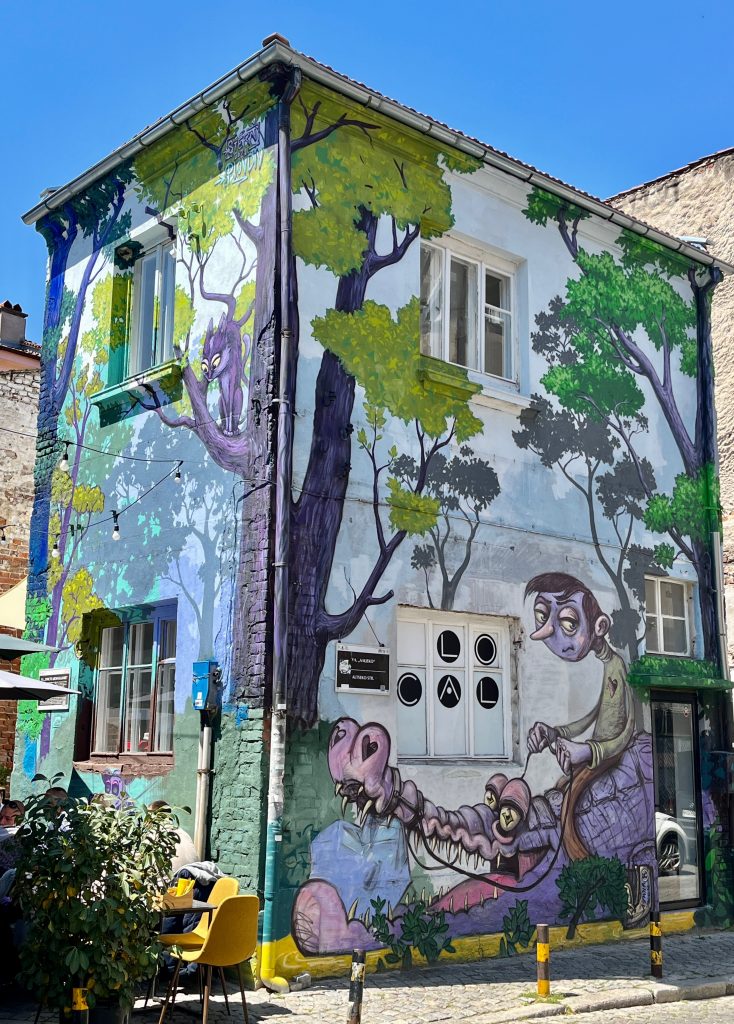
Plovdiv has a nice selection of street art and I had a hard time picking one for today.

Ton had picked out the Bishops Bascilica of Philippopolis (Philippopolis was the Roman name for Plovdiv) as our museum for the day. In the 1990’s again, the city was doing work on one of the main avenues in the city when they unearthed this site which had been built around 350 AD. It was the main church in town.

You walk on a glass floor a couple of feet above the mosaics, and to help keep the floors clean you step into a machine that temporarily covers your shoes in plastic.

In the Roman empire the mosaic makers of Plovdiv were renowned for their craftsmanship and artistic ability so they took great pride in working on the floor of the Basilica. As the work took place over a century, you can see the development of mosaic art over several generations.

A series of Gordian knots from the middle period of the development of the floor.

When the site was discovered some preliminary work was done to survey the site and archaeologists were very excited about the find. In this period Bulgaria was just emerging from the communist period and the government did not have the money to pay for full scale work on the site so it was covered with a temporary cover and sat mostly untouched for about 8 years. The temporary cover collapsed and the floors that had been preserved for over a thousand years were in danger of being severely damaged.

A later section of the floor, in this period more colors are used and objects are being integrated into the patterns.

The US Agency for International Development stepped up with a grant to begin to work on a proper cover and restoration of the site. The grant eventually became the American Society of Bulgaria that continued to fund the restoration, and the eventual building of the museum we toured today.

A late section of the floor with different birds. Birds had special meanings to early Christians in this area, and are featured prominently in the later stages of the Basilica.

After a long and enjoyable tour of the large Basilica, and a short tour of a smaller Basilica that came with the ticket, we were ready for some refreshment. We turned up at a local beer hall that features Bulgarian microbrews as well as beers from all of Europe. We each had a beer but they did not have any food except peanuts.

The view from our restaurant in the old town.

We remembered a place we had seen at the top of the hill in the old town that seemed promising so we headed back up the hill to check it out. It still seemed promising when we got there. We lucked into a table by the railing with a great view of the city. The place was full of locals (for us a local is a Bulgarian, they may all have been from Sofia for all we know.) Unfortunately, the food was mediocre.

This street art was in an underpass. Plovdiv is sometimes called Lion City.

We headed back to the campground and settled into François for the night just as a thunderstorm rolled in. Plovdiv has been a real revelation for us, we both agree that it is one of the prettiest and most interesting cities we have visited in Europe.

This old communist era building on the hill is visible from all over the city center. We began calling it the ugly building. The various era of satellite dishes and microwave panels don’t enhance its beauty.

May 7, 2023 Plovdiv BU

I’ve always felt that I was a seasoned traveller who had a pretty broad knowledge of many countries history and geography. I had studied Bulgaria a bit during college and in the military, but not enough. I had never heard of Plovdiv until we started reading that it is a must see during any visit to Bulgaria. It turns out it is the second largest city in Bulgaria, it is believed to be the longest continuously inhabited city in Europe with evidence of habitation going back 8000 years. The fact that I had never heard of it until last month humbled me.

The Roman Theater in Plovdiv. It was only recently re-discovered in the 1960’s.

Our day started with an act of kindness from a bus driver. We were about 100 yards from the bus stop when I saw the bus approaching from behind us, so we started running to try to catch it, but didn’t have much hope as at our age we are not exactly sprinters. As he came opposite us he stopped and opened the doors and let us get on, and then drove the 80 yards to the proper bus stop.

The central fountain in Plovdiv, on the weekends in the evening they light it up and play music.

We stumbled onto a free tour of Plovdiv and decided it would be a good way to get oriented to the city so we joined up. Plovdiv has undergone a bit of a renaissance in the last 10 years as neighborhoods that had deteriorated under communist rule have been revitalized thru good urban planning.

Part of the 1.8 kilometer pedestrian zone thru central Plovdiv.

The biggest contributor was converting a major road and a section of old shops that had fallen into disrepair to a pedestrian only zone. This pedestrian zone is the longest in Europe and now is thriving with shops, coffee houses, and restaurants. It was especially busy today as it is a long weekend and the weather is perfect. All of the restaurants were packed, and people were enjoying strolling up and down the pedestrian zone.

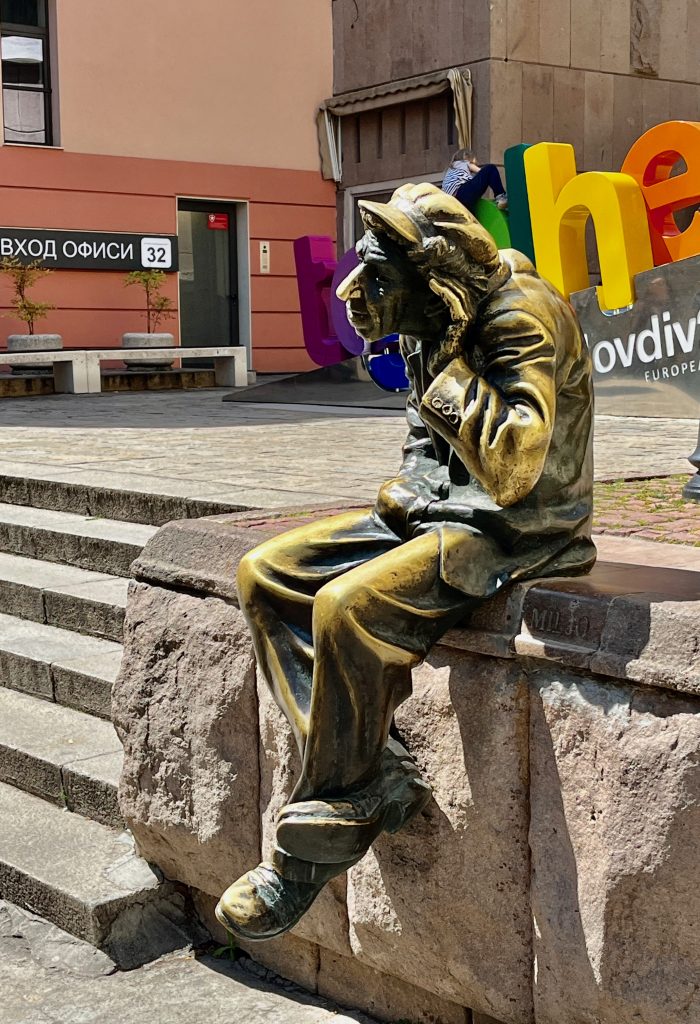
Milo, was an unemployed worker who frequented Plovdiv in the 70’s and 80’s. He was a character, and eventually became a local icon as it became good luck to run into Milo as you were doing business in town. After he died they put this statue up so people could still run into Milo for good luck.

With 8000 years of continuous inhabitation Plovdiv has its fair share of ancient sites to look at. In the new town a Roman stadium was located during construction in the 1980’s. Part of it is on display and it is well preserved, the rest of it is still there but it runs exactly under the main road of the town and it turns out many of the 16th and 17th century buildings are built directly on top of the viewing stands, because of that it has not been fully uncovered as the buildings themselves are also rich cultural heritage.

The entrance of the stadium and some of the seating uncovered for viewing along the main road in Plovdiv.

Our next stop was the old town which is on one of the seven hills that make up Plovdiv. The buildings are mostly from the 18th and 19th century so they are not nearly as old the Roman ruins, but the name was given before most of the ruins were discovered and at that time they were the oldest buildings in town.

Many of the buildings in the old town were built right on top of the Byzantine city walls. This arch was preserved because it was integral to the home built on top of it.

The old town was where the wealthy residents of the city lived and the homes are very large. They are built in a style called Bulgarian National Revival. They have been restored and we enjoyed seeing a different style of architecture than we have seen in other European countries. The differences are small, but make for a totally different feel.

A beautiful home in the old town.

After the tour was over we headed into town to try to find lunch. The first restaurant on our list told us they could not accommodate us until tomorrow. We noticed all of the restaurants were absolutely packed and began to wonder if we would get in anywhere. Our second choice restaurant had one table left, and while it was not great we took it. Right after we got our beer and appetizer the sun umbrella next to our table got hit with a gust of wind and tumbled into our table. Ton caught a glancing blow as it landed. Somehow our beers did not get knocked over, but the vinegar jar did and some of it got onto Tons favorite hat. The staff reacted weirdly though. After finding out we were ok, they began repairing the damage and cleaning up the mess. They did move us to another table, but other than that they never acknowledged the incident again, no apologies or anything.

The entrance to this Mosque is thru the coffee shop in front of it.

Having survived lunch we took another turn thru town looking at sites and mostly people watching. When we got back to the old town there were several couples getting their wedding photos done. The light must be better in the afternoon.

The Bulgarians do street art very well.

We headed back to the campground in the afternoon having discovered a beautiful culturally rich city neither of us had heard of before last month. To make up for it we are going to go into town again tomorrow to check it out again.

May 6, 2023 Plovdiv BU

We decided to move on to Plovdiv this morning. We debated whether to go back into Sofia for one more day, but we were afraid that it would be crazy with the military parade and all of the other St. George Day festivities, so it was off to Plovdiv.

We got an early start, and even though the freeway was busier than any we had seen in Europe except Germany we arrived at our campground before noon. We are staying at the Plovdiv Glamping Alliance which is absolutely the most high tech campground we have ever stayed at in either North America or Europe. George at the campground in Sofia warned us that we needed to book in advance because you need a QR code to get access to the site. So last night we picked our spot and got our QR code.

One of the cool cabins at the “Glamping site”. The hotel in the background is accessible, but completely empty including staff.

The first step went ok as our QR code got us thru the two sets of gates, we found our spot and began our well rehearsed set up procedure for François. After I located the electric hook up behind a shrub and crawled on my back to get at it I yelled for Ton to verify we had electricity. She said no so I crawled back into the shrub and confirmed everything was ok, but still no power. This happens sometimes and our standard procedure is to shift to another spot and see if the power works there. In this case we were committed to this spot, and even though the place was about 80% empty I wasn’t sure we could just move. So I decided to set off to find a human to talk to.

As I was walking towards the 4 story hotel that the Glamping is attached to I saw a German camper and asked him about the electricity, or if there was a human around. He said I could check the hotel but he hadn’t seen anyone all day. My QR code got me into the hotel, but in fact there was no one there. It was kind of weird wandering thru a brand new hotel by myself, but they really take this contactless stuff seriously here. After some research I discovered I had to activate the electric on a website and as soon as I did the power came on.

They also had a washer/dryer combination machine and we decided we’d do a quick load of clothes before heading into town. After some more on line gymnastics our QR code was updated to allow us access to the washer/dryer. We loaded our clothes and started the cycle and the timer said it would be 5 hours and 48 minutes to completion. At first we thought it was a mistake, but we noticed the other washer that was running showed over three hours to completion so our thoughts of going to town were dashed and we ended up spending the day in François and chatting with our German and Korean neighbors. I think you can take this high tech stuff too far, and they may have accomplished that here.

May 5, 2023 Sofia BU

I had low expectations for Sofia. I think my views of the former Soviet Bloc countries are sometimes skewed by my experience serving in the US military during the cold war. I expected a cold, ugly downtown, and Sofia was not that. Ton on the other hand had done research on Sofia and she expected a pretty city center with lots of gardens and flowers. Her expectation was correct and mine was wrong.

An example of why Tons vision of Sofia was correct, lots of flowers and interesting buildings.

Last night was the chilliest night of the trip, so neither one of us was in a big hurry to get out from under the covers in the morning. Eventually we got moving and after some coffee we headed downtown. We took the subway from near our campground and the fare was the equivalent of 80 US cents each.

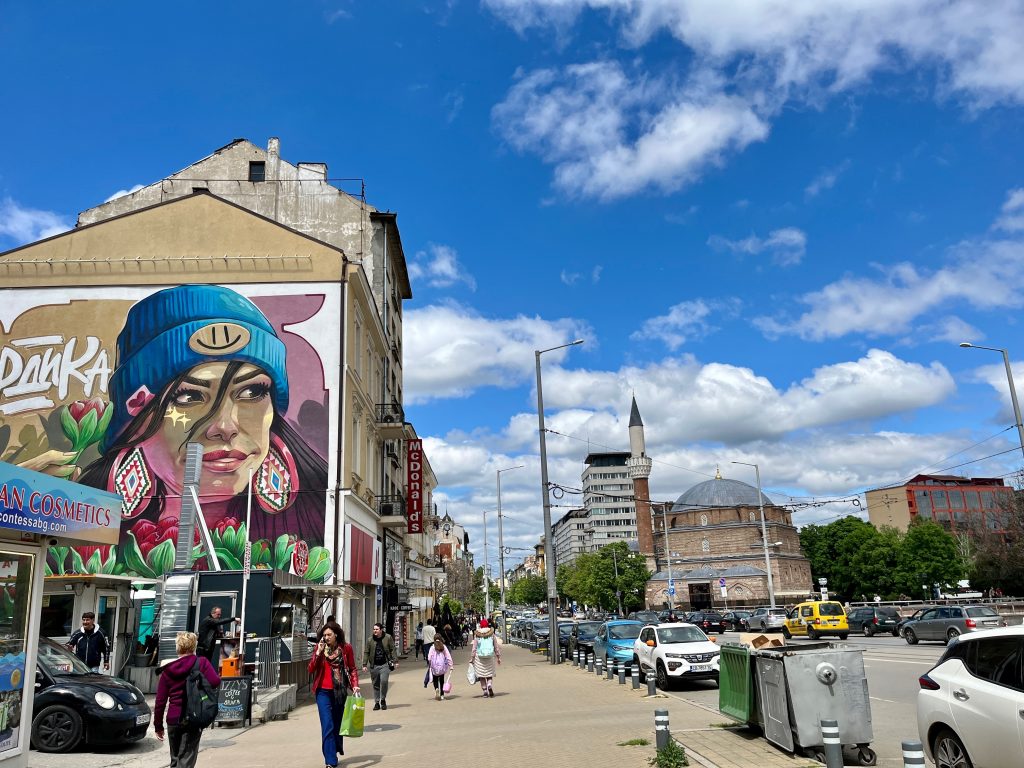
The street scene where we popped out of the metro station. Hip street art on the side of a McDonalds and a Mosque dating back to the Ottoman Empire on the other side of the street.

As the capitol Sofia has its fair share of monumental buildings, and we spent time trying to figure out what they were. We identified the building that the parliament meets in, and the Ministry of Defense. But there were several other important looking buildings that we could not figure out, including the one the two soldiers in the cool uniforms with big feathers were guarding.

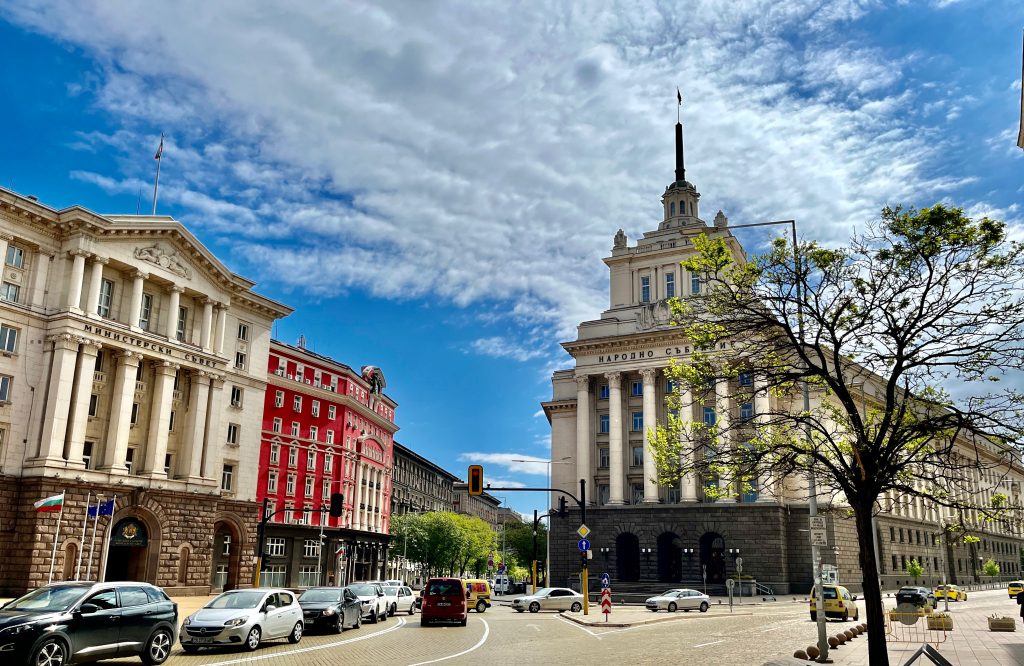
This is the building the Bulgarian National Assembly meets in. The building on the left is the building the Prime Minister and his cabinet occupy.

After we got all of the big buildings out of the way we headed to the main Cathedral. Along the way we passed thru a series of nice parks that were full of Tulips in full bloom. Ton really enjoyed the gardens and I kept losing her as she would see something and stop for a photo. I finally had to walk behind her so I could keep her in sight.

The tulips were in full bloom in the parks.

Tomorrow is St. Georges day which is a national holiday. As we were walking there was suddenly a low pass by about a dozen different aircraft from the Bulgarian Air Force who must have been rehearsing for tomorrows parade. Later in the day they repeated the low pass and flew over us in the campground at about 500 feet.

This is a statue of St Sofia who the city is named after. In 2004 it replaced a statue of Lenin that used to occupy the column.

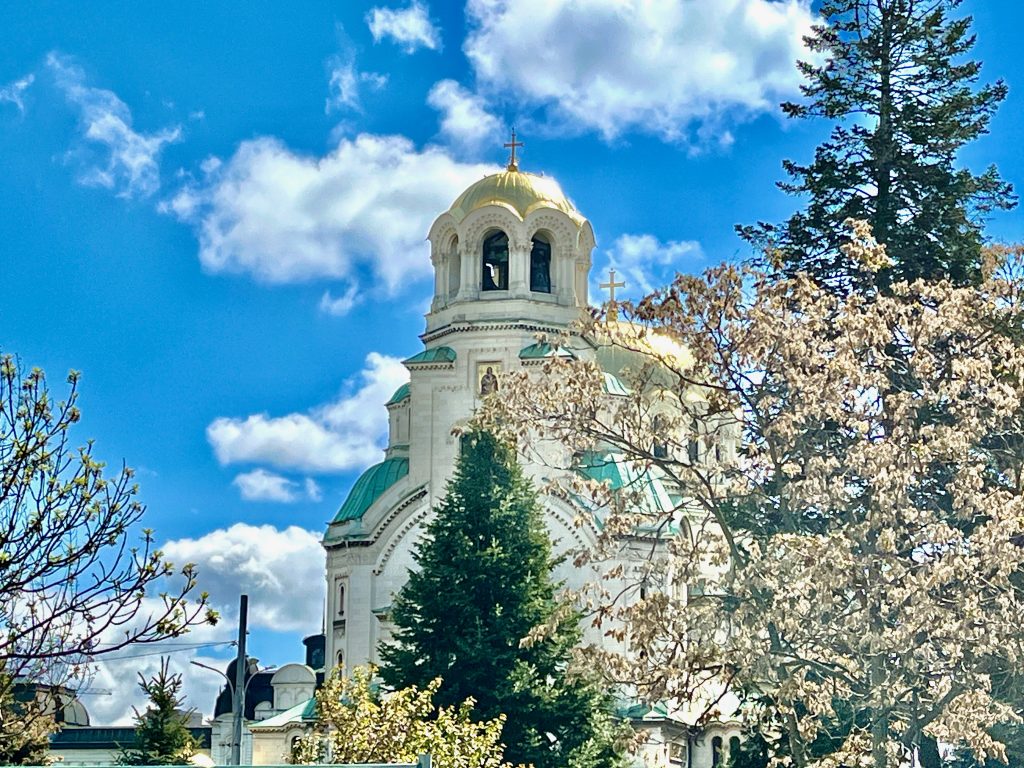
Alexander Nevsky Cathedral occupied the center of a large square. It is one of the largest Orthodox Cathedrals we have seen. The interior is interesting because a lot of the pictures of the saints are rendered in a more modern, less rigid form than most Orthodox art.

The exterior of Alexander Nevsky Cathedral.
We have noticed that most Orthodox Churches have chandeliers in them, but I have been unable to find out if they have any particular religious meaning, or is it just how they lit them before electricity.

After the Cathedral we headed to the main shopping street with the intent to people watch and find some food. Ton had a traditional tavern in mind she had found on line last night. After walking down the long pedestrian street with the normal mix of high end stores and coffee shops we found our restaurant.

Our meal for two hanging from hooks above the table. In this photo I am trying to figure out how to eat it without making a mess. It made for a cool photo, but once the photo was done the waiter came back and recommended we put it on the table to actually eat it much to my relief!

We ordered a meal for two which consisted of a large skewer of kebab, some pork cutlets, chicken and sausage plus coleslaw, potatoes, and to Tons delight grilled peppers. Ton pronounced the meal the best she has had on this trip, as the coleslaw and chicken reminded her of Thai dishes, and the peppers were very tasty, but a little mild.

The Hall of Culture and fountains leading to it. This building was probably built by the communist government, it has that Soviet Monumental feeling to it.

We enjoyed Sofia it had a nice mix of impressive buildings, nice parks, and a vibrant street scene. After Greece it felt cleaner and there is certainly less graffiti. For Ton it was exactly what she expected, and for me it was not at all what I expected.

There is a square where water from hot springs naturally flows into a series of fountains that people from the city come and fill water containers. We tried the water and it is warm and has a distinct taste of minerals.

May 4, 2023 Sofia BU

Once again we woke up and realized we were nearly halfway thru our trip and had not reached the country we had picked as the country we were going to visit on this trip. We have gotten very comfortable with Greece, and Nikos had recommended several other places we should visit, but we decided we needed to get to Bulgaria as that was the country we had intended to visit and time was running out.

So we woke up a little early, checked out of the hotel and headed out to the motorhome dealer we had left François at. There was a little drama when we learned from the dealer last night that the warranty against leaks we thought lasted 10 years had expired and they could not do the test. After a quick email with a representative from Knaus we learned that the 10 year warranty started in 2017 and François is a 2016 with a 5 year warranty that had expired last year.

We headed out towards the Bulgarian border for a very quick and relaxing drive on the Greek toll ways. The border was uneventful, except while I was dealing with the Greek passport control guy, there was a knock on Tons door. The guy was not in uniform but announced he was Police and we needed to open the door and let him inspect the interior. I looked at the passport guy and asked him police? When he looked up quizzically the guy not in uniform had been replaced with a guy in uniform so he said yes let them inspect, but I could tell by his face this was unusual.

After I let them in the policeman in uniform told me to open all of the doors and cupboards, but the guy not in uniform said something to him in Greek and asked me to show him the bathroom. While he was looking in the bathroom he asked me where we bought it. He then asked where the kitchen was so I pointed at the stove top and refrigerator. He then asked me how much we paid for it and did we like it. I told him how much and yes we loved it. He then asked if we had enjoyed Greece and I told him Greece was awesome and we would be back soon. He said great and thanked us.

I think the guy might be in the market for a camper van and saw us in line and decided to get a tour of the inside of ours. This explains the confused look from the passport guy, and the other policeman being confused that he did not want to see all of the nooks and crannies of François. The good news was while I was dealing with our “police inspection” the Greek passport guy had handed our passports to the Bulgarian passport guy who he shared an office with and we were welcome to enter Bulgaria.

Our home for the next couple of nights in Sophia.

After weeks of beach front living we are parked in an Aire next to the second busiest road in Sofia and across from a very busy self serve car wash, by the way self serve car washes do not exist in Greece for some reason, so we will be giving François a good bath in the next couple of days. The owner of the Aire lived in Massachusetts for 6 years and said we were his first American customers. He gave us some recommendations for places to visit in Bulgaria and Sofia and we talked about life in the US and Bulgaria for a while.

I liked this muffler shop in a small concrete building.

We started out on a short walk, but it was cold and Ton decided I could finish the walk without her. I went down the road to find a grocery and take the bad pictures for todays blog. Tomorrow we are heading downtown to check out Sofia.

May 3, 2023 Thessaloniki GR

A couple of days ago I wrote about the great weather we have been having and ended it by hoping I didn’t jinx us. When we got to the lobby of the hotel we were both startled when we saw it was raining outside. We had planned a day of exploring the sites of Thessaloniki so rain was not something we wanted to see. I made a quick check of the weather and it showed showers most of the day, so we borrowed an umbrella from the hotel and headed out.

Our first stop of the day was Vlatadon Monastery in the Anopoli district.

The old town district called Anopoli was our first stop of the day. It was a fortified district and a large section of the walls are still intact, the area around the walls is an UNESCO world heritage site. Our second surprise of the day was that it was quite a climb to Anopoli. Just as we arrived in the district Ton spotted a monastery so we went in.

The Vlatadon Monastery was founded around 1300 ad. These frescoes were painted around then, but had been covered. After the monastery was damaged in an earthquake in 1978, they were uncovered.

Thessaloniki was founded around 350 BC and was named after the sister of Alexander the Great who was the wife of the founder. Like much of Greece the region has been under multiple rulers in its history. The history during the 20th century was especially turbulent. In 1900 the city was a multi-cultural city and was known as the only city in Europe where Jews made up the highest percentage of the population. The city was 39% Jewish, 29% Turkish, 25% Greek, and 7% was made up of Bulgars, Roma, and other nationalities.

The walls were mostly built by the Byzantines, but this particular tower was built by the Ottomans.

During the period just before WWI the Ottomans and the Greeks fought a series of wars primarily over control of the region centered on Thessaloniki. Eventually the Greeks won control of the region, unfortunately one of the first ethnic purges of modern times took place after the wars. Even though the Turkish population outnumbered the Greeks in the city they were forced to leave and relocate to Turkey. The Turks also forced out the Greek minority that was located within their borders. These purges still effect the relations between the two countries.

The walk down was easier than the walk up.

An interesting note is that there is a museum dedicated to Kamal Ataturk who is considered to be the founding father of modern Turkey who was born here. But it is not open to the general public, but requires an appointment be made thru the Turkish consulate.

Looking down on the port and the city from the Anopoli.

Unfortunately the history of the Jewish residents of the city is even sadder. After the takeover by the Greeks restrictions were put on the Jewish residents that started a period of high Emigration to other countries. During WWII Greece was occupied by the Germans and the Jewish population was swallowed up by the concentration camps. As a percentage the Jewish population of Greece suffered the highest casualty rate of any country in the holocaust. Today there are only about 2000 Jews left in Thessaloniki.

The Rotunda of Galerius built by the Byzantines as a monument and subsequently used as church and a mosque..

Our next stop was the Rotunda of Galerius built around 306 AD by the Tetrach of Thessaloniki Galerius. He intended it to be his mausoleum and it was adjacent to his palace. However, on his death he was buried elsewhere and it became a church. After the Ottoman Empire took over the church was turned into a mosque and the minaret was added. Then in 1912 after the Greeks conquered the city it was again turned into a church. It is now a museum.

The Triumphal Arch of Galerius.

Not far from the rotunda is a large Byzantine Arch of Triumph also dedicated to Galerius. Galerius led a Byzantine army that defeated the Persians in a war and he had this arch built to commemorate the victory. The relief showing scenes from the war is quite interesting. It originally had one large arch and 4 smaller arches.

Part of the Arch of Galerius depicting scenes from the war with Persia.

Our last stop on our tour of historic sites in Thessaloniki was the White Tower. The White Tower is an Ottoman fort that was built to guard the waterfront of Thessaloniki. Today it is a museum.

The White Tower.

After our long walk we headed down the waterfront to do our favorite thing in Greece, eat. We enjoyed our meal and then headed back to the hotel for a well deserved rest.

Another 14th century fresco from Vlatadon Monastery.

Despite the cold and wet weather we really enjoyed our day in Thessaloniki. We found the history fascinating and enjoyed the vibrancy of the people. The second city of Greece is certainly a fascinating place to visit and deserves to be better known outside of Greece.

The monastery had an extensive aviary for some reason. Is there such a thing as a White Peacock, or is this another bird?

May 2, 2023 Thessaloniki GR

Today we moved to the second biggest city in Greece. Thessaloniki has a population of about 2 million people and is located in North East Greece. We need to get an annual warranty inspection and the only Knaus dealer is located here so our plan is to drop François at the dealer to get the inspections and get a hotel in town.

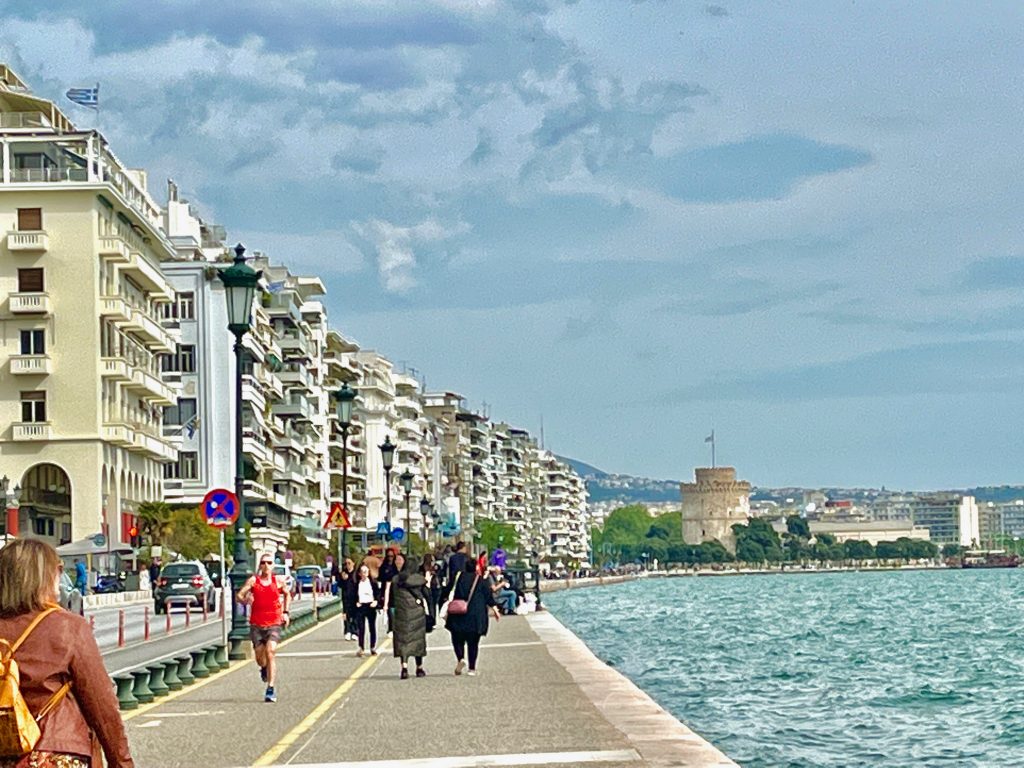
The waterfront in Thessaloniki with a party boat in the center.

The drive over was uneventful and less expensive as we changed toll companies and suddenly François was a car again. Greek toll ways are interesting. We dropped François at the dealer and were in the hotel by 1pm. About a week ago I lost a filling and the tooth was bothering me a bit, so when we checked in I asked if they had a dentist they could recommend. They booked me into a dentist at 2 pm who was literally across the street. By 2:45 I was back in the room with a new filling for the whopping cost of€50.

Cell phones!

Our new friend Nikos is from Thessaloniki and he gave us a list of places to visit in the city. The first was the central market, which is a can’t miss with Ton. The market was originally built in 1925, but has recently been modernized and is now very chic. We walked around the market and did get some of our favorite cheese from Crete.

These are 14kg cans of Feta, the Greeks do love their Feta. We bought quite a lot less.

By now we were hungry so Ton decided we needed to find a place that was a little less chic. About a block from the modernized market was the old market and Ton was in heaven. Even though it was wrapping up there were still plenty of fish stalls and meat stalls open to inspect.

Sheep heads for sale in the old market.

After the market we had a very late lunch/early dinner and then walked down to the waterfront. After a quick look we decided we would save the waterfront for tomorrow and headed back to the hotel.

The modern waterfront with an Ottoman fort in the background.

May 1, 2023 Ioannina GR

Just as we were settling in last night it began to rain quite hard. Usually we end up talking about the weather quite a bit when we are traveling, but so far this trip the weather has been almost perfect. We have had two strong rains and they were both at night. The temperatures have been consistently in the low 70’s and the overnight temperatures have been in the mid-50’s. It really doesn’t get any better than that. I hope I didn’t just jinx it.

Our ferry to Ioannina Island where we spent the majority of the day.

Nikos had really recommended we go to the island for the day. He said it is quite beautiful and it had a very good museum on it. We got off to a late start partially because it was still spitting a little rain so Ton decided to cuddle up under the blankets for an extra hour. Then we ran into an Austrian-Taiwanese couple and ended up chatting with them for about 45 minutes. Ton and Jane really connected, and it turns out her husband is a Knaus motorhome dealer. They had a brand new motorhome that is the next generation of François our motorhome. He gave me a tour and it was interesting to see the improvements they have made in the interior. Unfortunately they were moving on, but we exchanged information and we promised that if we passed thru southeast Austria we would swing by and see them. Hopefully, our paths will cross again.

The view of Ioannina as we departed for the island, with the old Mosque occupying the high ground in the town.

It was a short walk to the ferry dock, but the town was really crowded due to the May Day holiday. Police had some of the roads blocked off to accommodate the extra pedestrian traffic. Luckily we showed up on the dock just as one ferry pulled away, and another arrived so we were heading over to the island right away.

Ioannina Island is the low hill in the center of the picture. The lake is called Lake Pamovotis.

The island was originally settled by monks, and for the first few hundred years it was inhabited primarily by the monks who lived in multiple monasteries on the island. Around 1600 a small fishing village began to grow on one end of the island. Today the village is devoted primarily to tourism, though some fishing is still done.

One of the monasteries on the island that is currently being rehabilitated.

The island is also closely associated with the story of Ali Pasha and has an excellent museum about him. Ali Pasha was the ruler of a large part of Greece and most of Albania from the 1780’s. He was a romantic character of his age and admired and written about by Lord Byron and Alexander Dumas. They both wrote about him as a fascinating “Oriental Despot.” Originally starting as a bandit he fought to gain control of much of Albania and was eventually appointed Pasha for Albania by the Ottoman Sultan in the 1770’s. The Ottoman empire was beginning its decline in this era and so Ali effectively went to war with the Pasha who ruled Ioannina and conquered the town in 1787.

A portrait of Ali Pasha and his Greek wife Kyla Vassiliki who had a large influence on him.

Ali was a cruel ruler who committed many atrocities, but also embraced local culture. He moved to Ioannina, and changed the official language in court from Turkish to Greek. He supported the construction of Christian churches as well as Mosques, and towards the end of his life he only paid for the construction of Christian churches despite being a Muslim. Some say this was the influence of his Greek wife.

Some clothing from the era of Ali Pasha on display in the museum.

He maintained a large army consisting of both Greek and Albanian troops led by both Christian and Moslem Generals. The Ottoman empire had a very loose control over Ali Pasha and he conducted his own foreign policy and even maintained embassies from western European countries to the point where he without permission from Istanbul joined forces with the French to fight the Venetians, and the British to fight the Russians. His down fall came in the 1820’s when the Christians in Greece and the Moslems in Albania both independently revolted against Ottoman rule. He suddenly found himself without an army as his Greek generals joined the Greek independence movement and his Albanian generals joined the Albanian independence movement. He was isolated in Ioannina when an Ottoman army arrived and laid siege to the town. He was eventually captured and held prison on Ioannina island until his execution in 1822.

A collection of silver inlaid knives from the Ali Pasha museum.

After the museum we enjoyed a stroll around the island. The island was having a bloom of wildflowers and was really beautiful, the bees were humming everywhere and it smelled like spring.

Part of the wildflower bloom on the island. These yellow flowers were everywhere.

We checked out a couple of the old monasteries, but they were closed. After walking completely around the island over a couple of hours with frequent stops for pictures we were back in the village.

The entrance door to one of the Monasteries.

Things were getting crowded on the island so we decided to head back to the town and have a quick look to see if we missed anything yesterday. When we arrived the town was even more crowded with holiday crowds so we headed back to François for an early evening.

Another view of Lake Pamvotis from our walk around the island.