Cadaques has been on our list to visit for a long time. We like this part of Spain and have visited the neighboring city of Roses four times. We go out of our way to stop there whenever we come to Spain.
Cadaques is tucked up against the Mediterranean at the base of some fairly steep mountains.
To get to Cadaques we had to transit Barcelona. Like everyone driving a RV transiting cities is never fun. Today went smoothly in our direction, though at one point there was a truck about the size of François on its side with fire trucks and ambulances in the lanes going the opposite direction. This was a reminder of how things can go bad.
The hills above Cadaques had some interesting terracing that didn’t seem to be in use anymore.
The last 20 kilometers were on steep and winding mountain roads. It was a pretty drive though Ton enjoyed the view much more than I did as the road had my full attention.
The waterfront at Cadaques is one of the most beautiful in Spain.
Our campground is only about 400 yards from the waterfront, but it is also about 400 feet higher. The trail/road down was steep and mostly straight. The walk down was hard on the knees, and the walk up was hard on the lungs.
Looking down on the town from our walk in.
Since we are staying tomorrow today was more of a reconnaissance to see what the town had to offer. Tourism is king here and has been for decades. The waterfront was full of restaurants and cute shops. We took a look at a couple of places for tomorrow.
Waterside dining.
Last year we visited the Dali museum in nearby Figueres. Dali had a home here that he stayed at for much of the year. It has now been turned into a museum. We had thoughts of going to it, but there are no tickets available on Thursday and Saturday, and only one on Friday. Since there are two of us we had to pass on the Dali museum.
Ton said that this statue captured the arrogance of Dali perfectly.
We covered about half of the U shape harbor walk today and really enjoyed ourselves. Tomorrow we will spend more time in the town and try to fully explore the waterfront and the narrow streets in the hills above town.
Cadaques used to be a fishing village, now the only boats you see are related to tourism.
Last night will be remembered as the night of the mosquitos. The rain finally let up about 6pm and everybody in the campground emerged from their campers and began drying things. We joined in the drying frenzy and decided to crank up the heat in François to a sauna like 80 degrees. This succeeded in getting a lot of our things dry, but had an unexpected consequence. When the rain stopped the mosquito population in the camp came out in force. During our coming and going after the rain at least 8 gained access to François. Buoyed by our warm camper they were ravenous. Ton and I spent the rest of the night fighting mosquitos. These were particularly agile mosquitos and my kill to strike rate was very poor. By about 1 am I had managed to kill 7, but at least one was still flying when exhaustion kicked in and I fell to sleep.
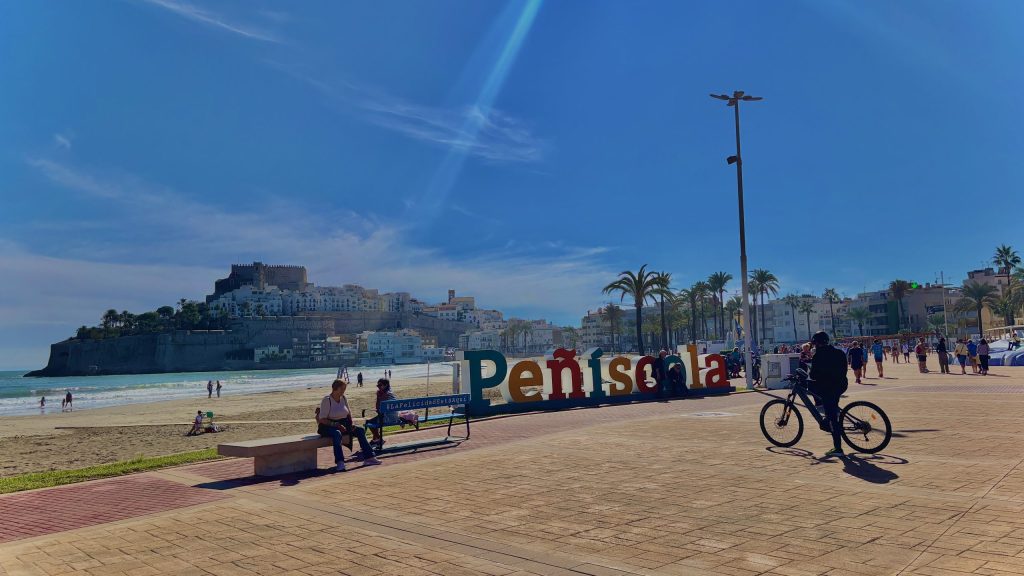
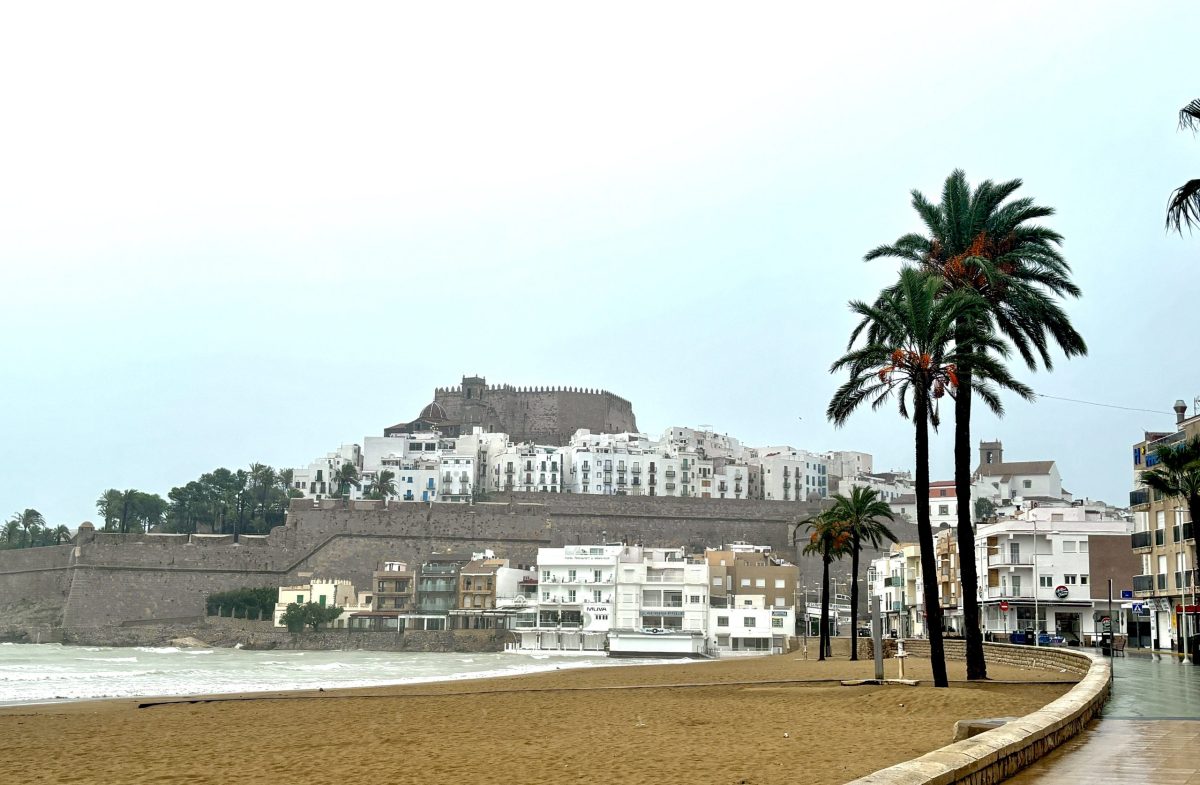
It was much nicer in Peniscola today.
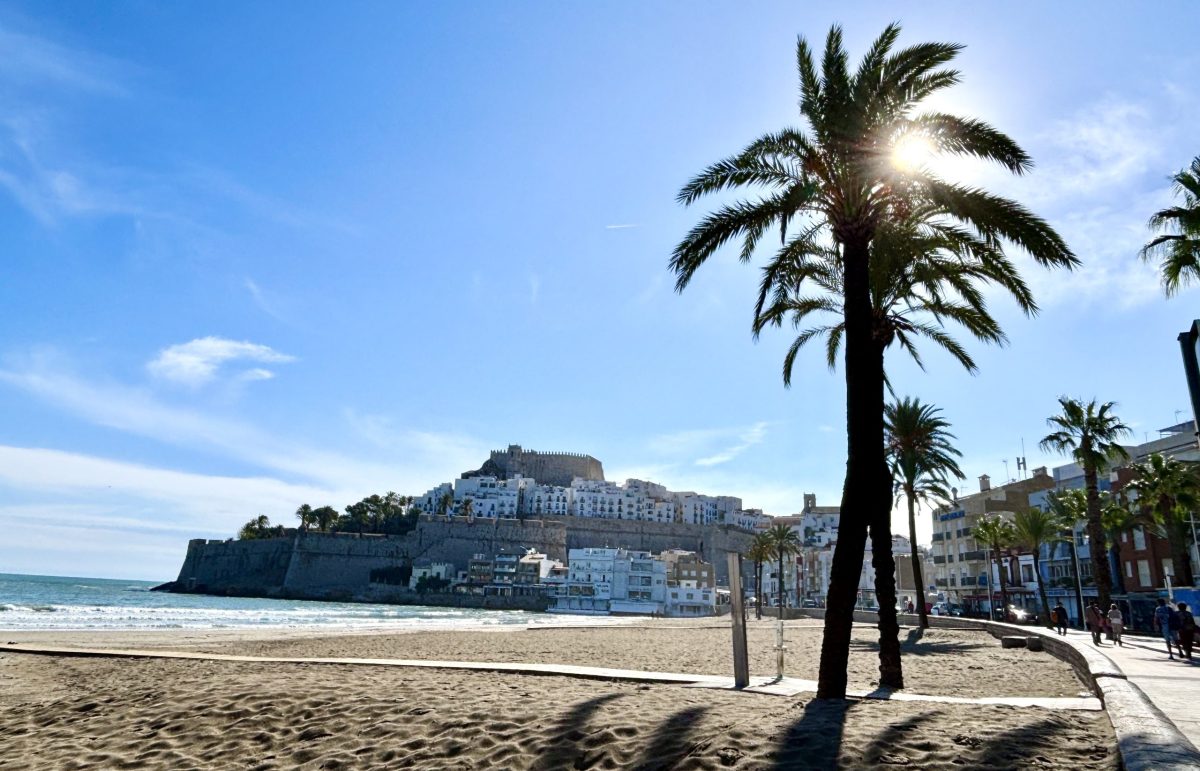
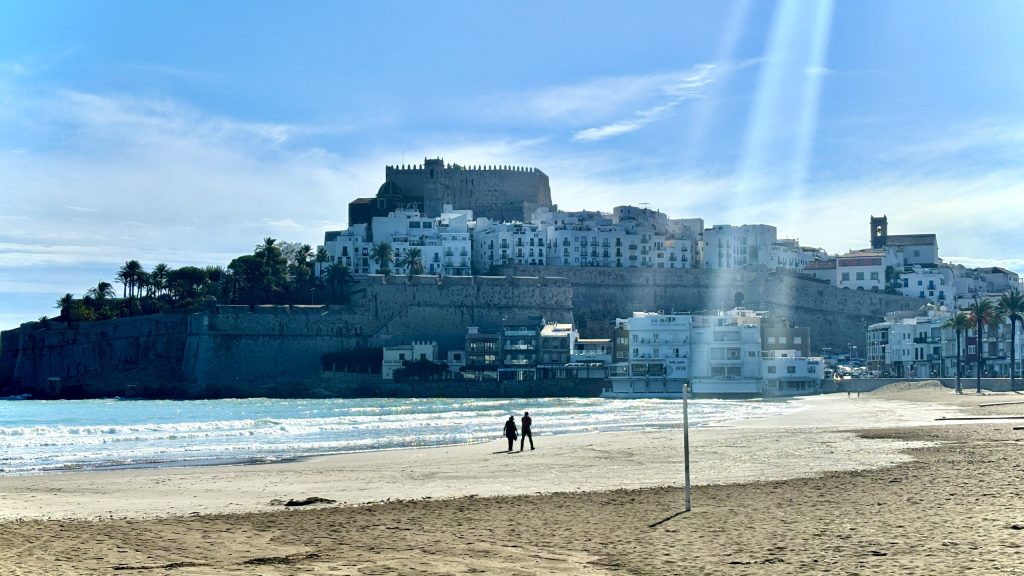
Feeling a little battle worn in the morning we decided to head into Peniscola to see what it was like when it was not pouring. It is a picturesque place, in fact it is frequently used in movies and television shows. Most recently it was a location for Game of Thrones as well as a long time ago it appeared in El Cid.
Old town Peniscola is about as picturesque as they come.
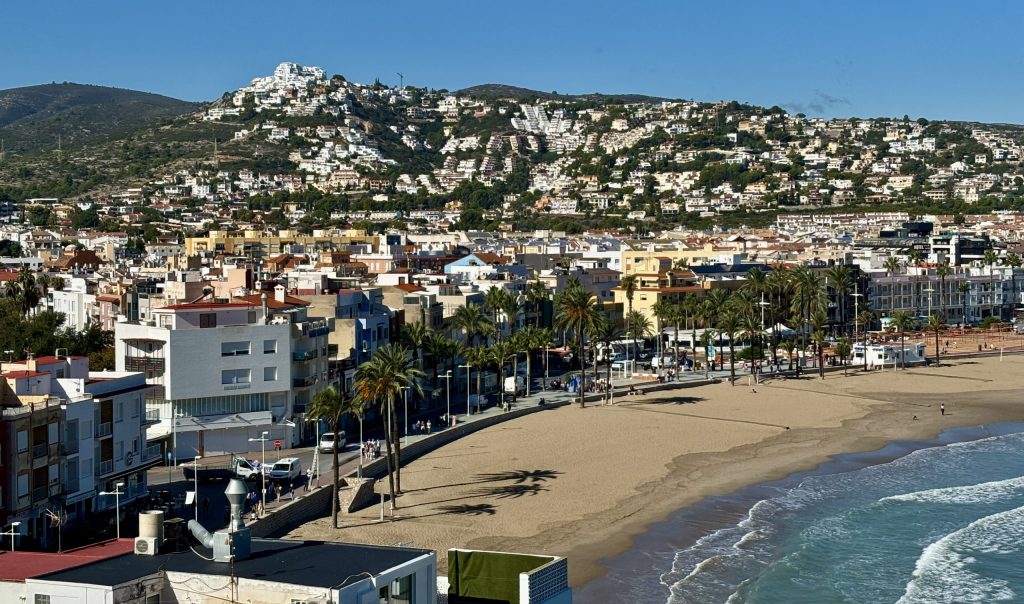
We parked on the waterfront and walked along the beach to the old town. The beach is also beautiful and long. It is about 8 kilometers and lined with hotels and vacation rentals. This part of Spain is some spectacular coast line.
Part of the beautiful beach and vacation sprawl of Peniscola.
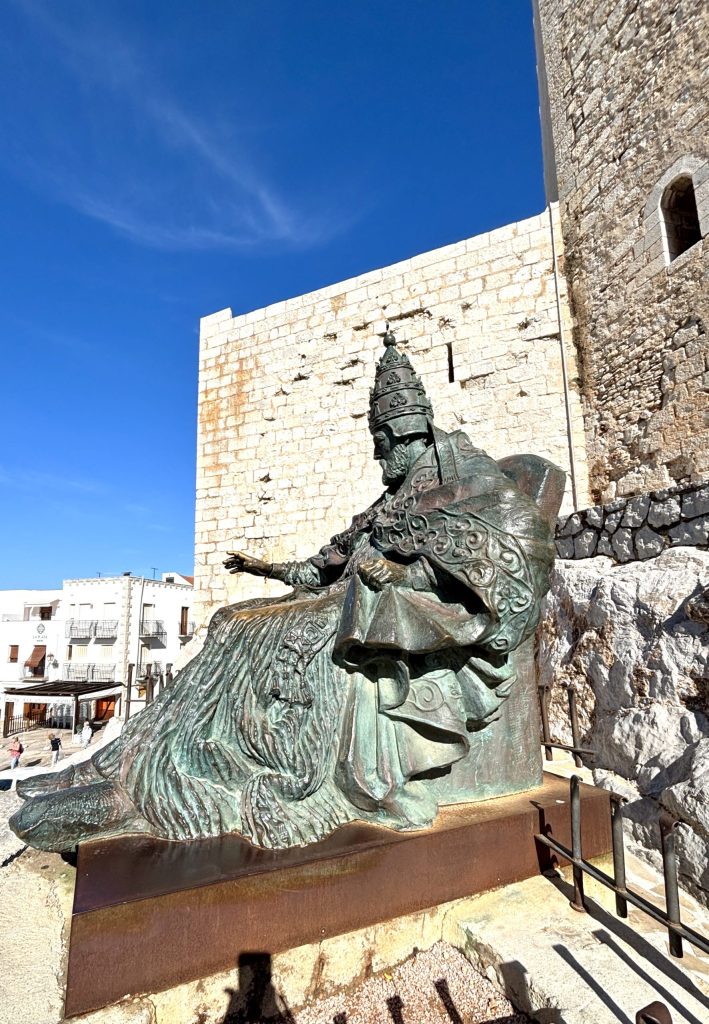
Historically Peniscola is famous as the seat of a pretender pope known as Pope Luna (Benedictine XIII). He was Catalan and during a very complicated period in the Catholic church he was one of two competing popes. He set up his base in Peniscola after he was exiled from Avignon so Peniscola has claim to be one of three sites that have been a Papal base, the other two are Avignon in France, and of course Rome. Eventually he lost the fight and was excommunicated from the church.
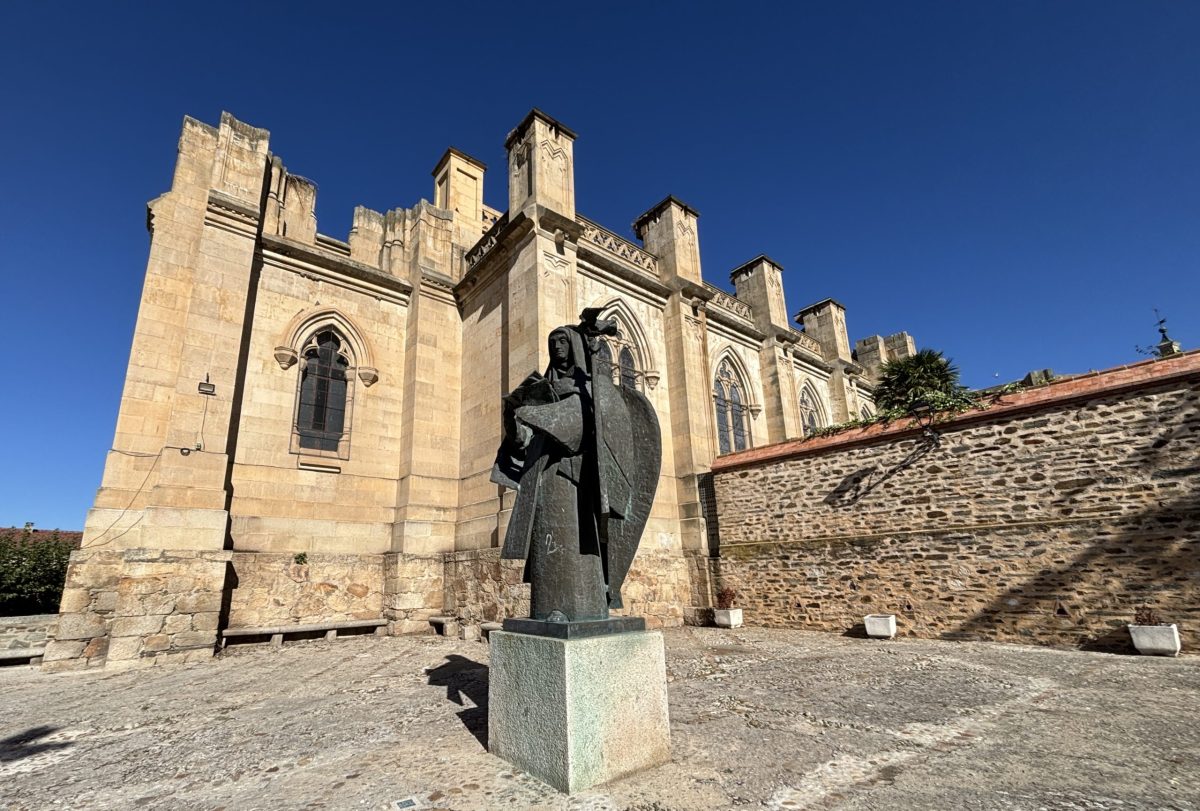
A statue to Papa Luna (Benedictine XIII) near the Cathedral.
We walked around town for about 90 minutes, but after waiting for two days to get to see it we didn’t have time to do it justice. The old town has been occupied for over 1500 years by Carthaginians, Romans, Phoenicians, Greeks, and Spanish. We debated going into the castle, but in the end we decided to move on. I think in a different circumstance we would have been enthralled with Peniscola, and it probably deserves a revisit if we ever pass this way again.
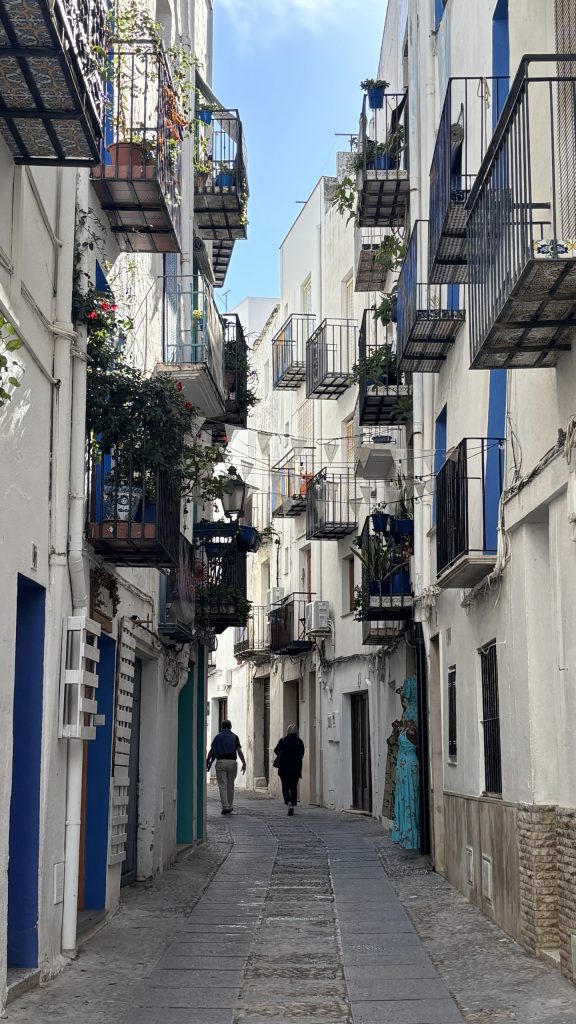
The old town in Peniscola , this road is quite steep.
We decided to shift north a couple of hours and selected a campground we had stayed at last year when we were transiting back to Amsterdam from Morocco. Last year we arrived 7 or 8 days later and had a beautiful seaside campground nearly to ourselves. We were expecting that today only to arrive at a packed campground with numerous German families and lots of kids. I’m not sure why all of these German kids are not in school but they do seem to be enjoying themselves.
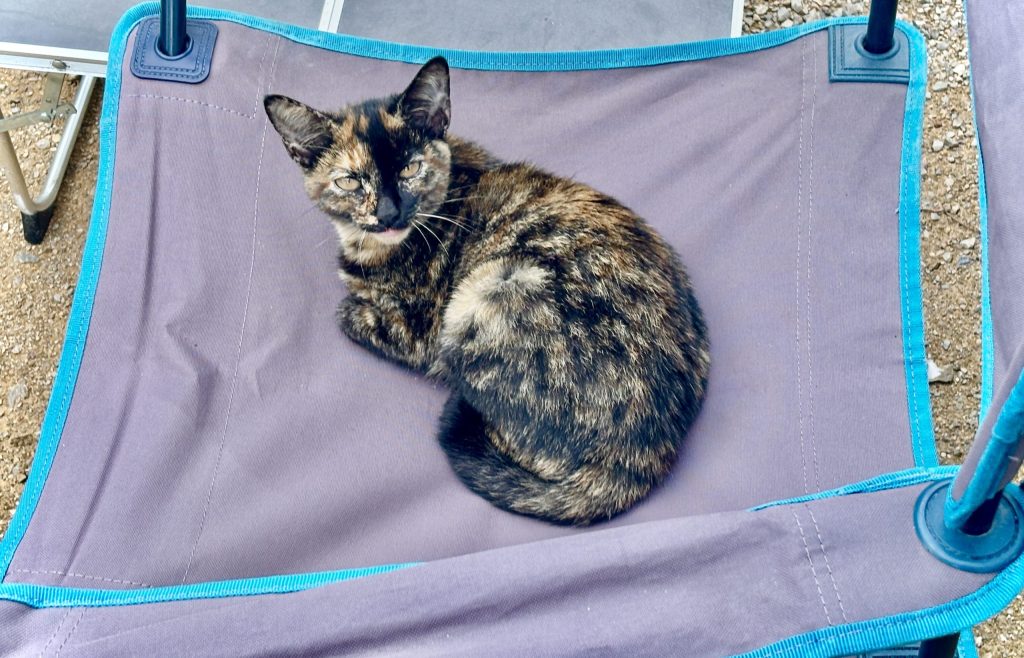
Our cat for today.
Our campsite came with a kitten who immediately attached herself to us. She went out of her way to show us a food bowl someone had left for her. We couldn’t resist and fed her so she has now decided that we belong to her. Ton is already planning tomorrows breakfast for her.
The weather was bad yesterday, but it was worst today. The region we are in is in the process of getting over 1″ of rain in 12 hours and the rain is coming with strong winds. But being intrepid and optimistic travelers we decided to head into town anyway. Our plan was to go to a restaurant for lunch and head into town when the rain let up.
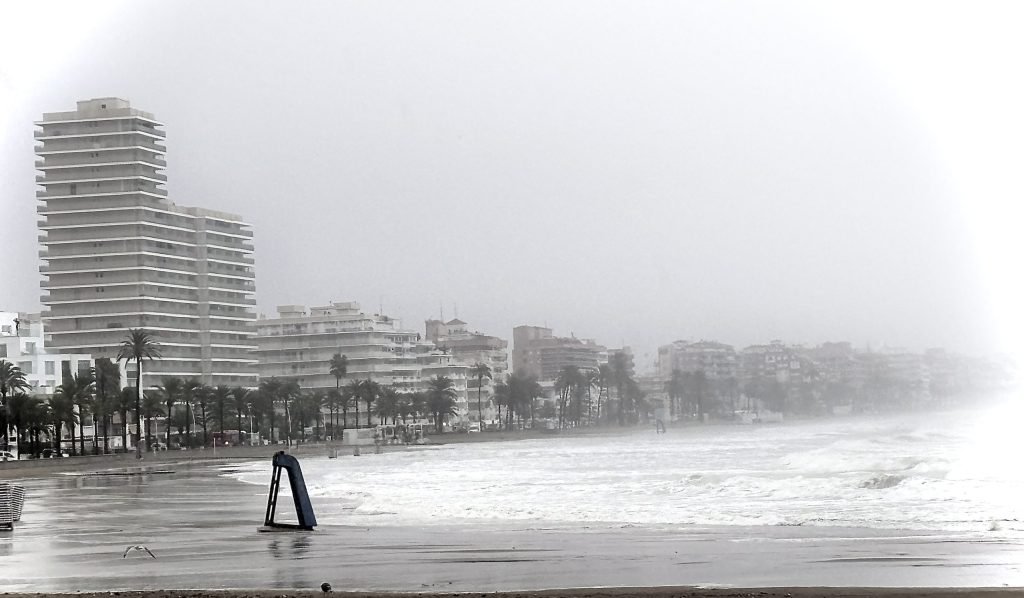
The weather when we arrived. Not quite a tropical storm.
When we arrived downtown the rain was sheeting down and the wind was blowing a gale. We hustled the 200 meters to the restaurant and still arrived dripping wet.
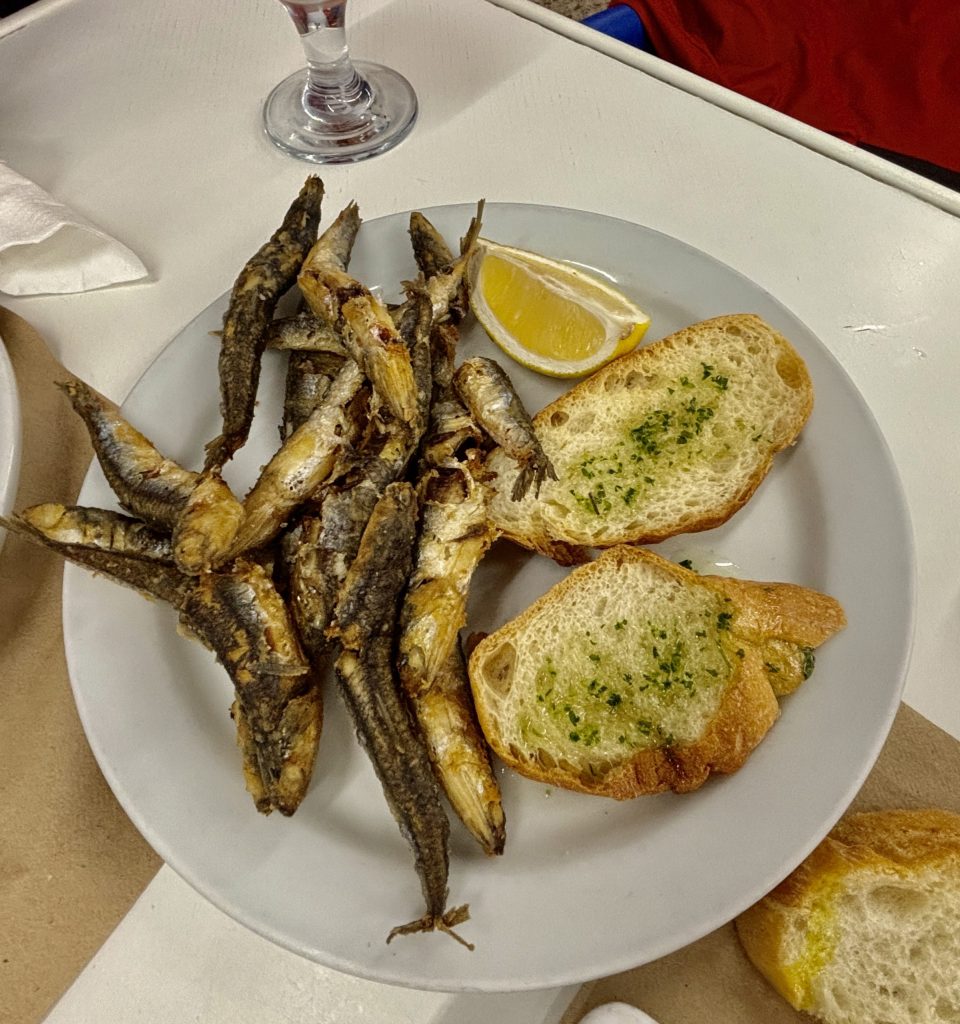
We really miss Mediterranean anchovies when we go home.
The restaurant Ton chose was called El Hogar del Jubilado which roughly translates as “The Pensioners Restaurant”. It is the type of place with plastic chairs, formica topped tables and very simple food made from fresh ingredients. The kind of food your grandmother would make if she was Spanish. You went to the counter, pointed at what you wanted from what was on display and they prepared it for you. We pointed at Anchovies, Squid, a piece of cod, and a potato dish. We were looking at some more stuff as it all looked good, the lady behind the counter saw us contemplating some more stuff when she held up her hand and indicated that we had already ordered a lot of food. When it came it was absolutely delicious and the portions were huge. This didn’t stop Ton from ordering one more dish of egg plant and fried peppers. Our neighbors were getting a kick out of the amount of food we ordered. We had plenty of time to eat as the weather was showing no signs of letting up. We shared the restaurant for about 2 hours with a bunch of Dutch pensioners, nibbling at our food and looking for signs the weather was going to break.
The weather actually got a little worst while we were waiting. This is a color photo.
We finally threw in the towel and headed back to the campground. We may be intrepid travelers, but age has made us wiser- we will try again tomorrow.
Suddenly our decisions are being decided by time, on every trip there comes a point where the logistics of wrapping up the trip start to weigh on our plans. Two days ago we took a day off because we were tired and the normal rainy days that serve as rest days had not happened on this trip. Today our first serious storm of the trip is on us. On top of that we are in a town we really like. Earlier in the trip we would have just hunkered down for a rain day. But we are pretty far south of Amsterdam, so instead of resting we decided to take advantage of light traffic Sunday and head north about 4 hours to Peniscola.
No beautiful vistas today, just clouds and a wet windshield.
The drive went smoothly and we only hit one really wet stretch for about 30 minutes. The rest of the way was light showers. Traffic was light and we by-passed Valencia so all in all a good drive. We arrived in Peniscola and set up in a slightly underwhelming campground for the day. The bad weather is supposed to continue tomorrow so we will have another decision to make.
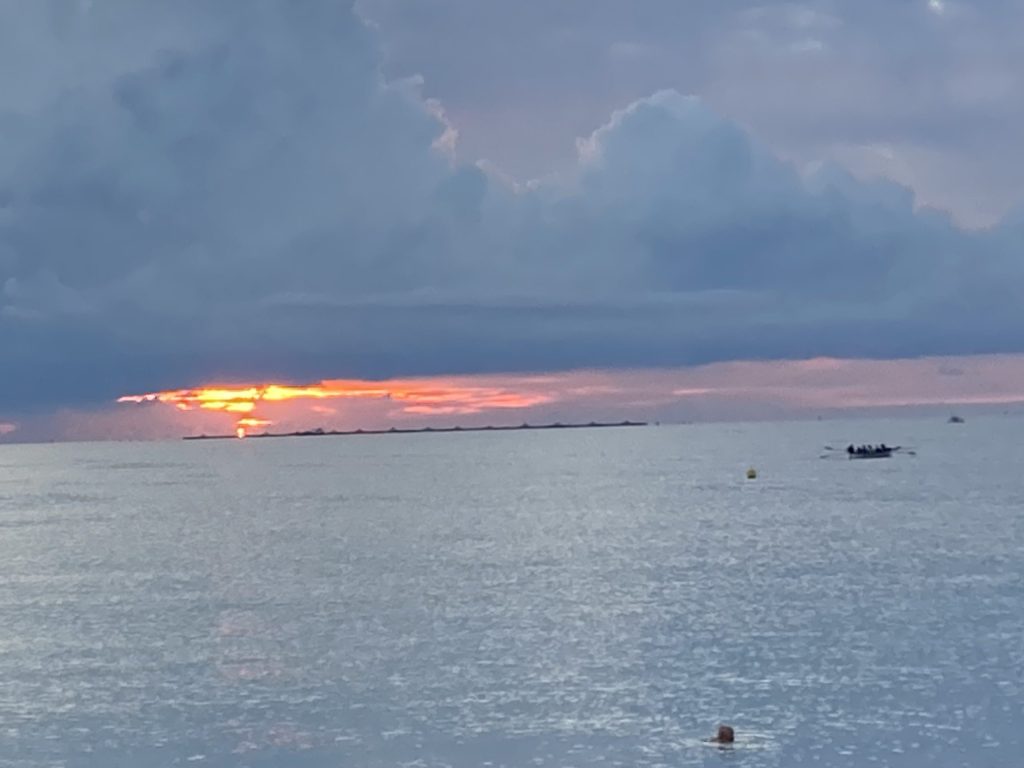
I took my morning walk around sunrise. As the days are shortening up sunrise is around 8 am. The campground is located next to the beach and I got to watch a beautiful sunrise as an unexpected treat.
Sunrise over the Mediterranean.
Ton loves European markets, if a town we are visiting has one it is on our agenda to visit. Today we shifted south to Alicante which is a resort town known for its night life and as a vacation place for northern Europeans. It is not known for its market.
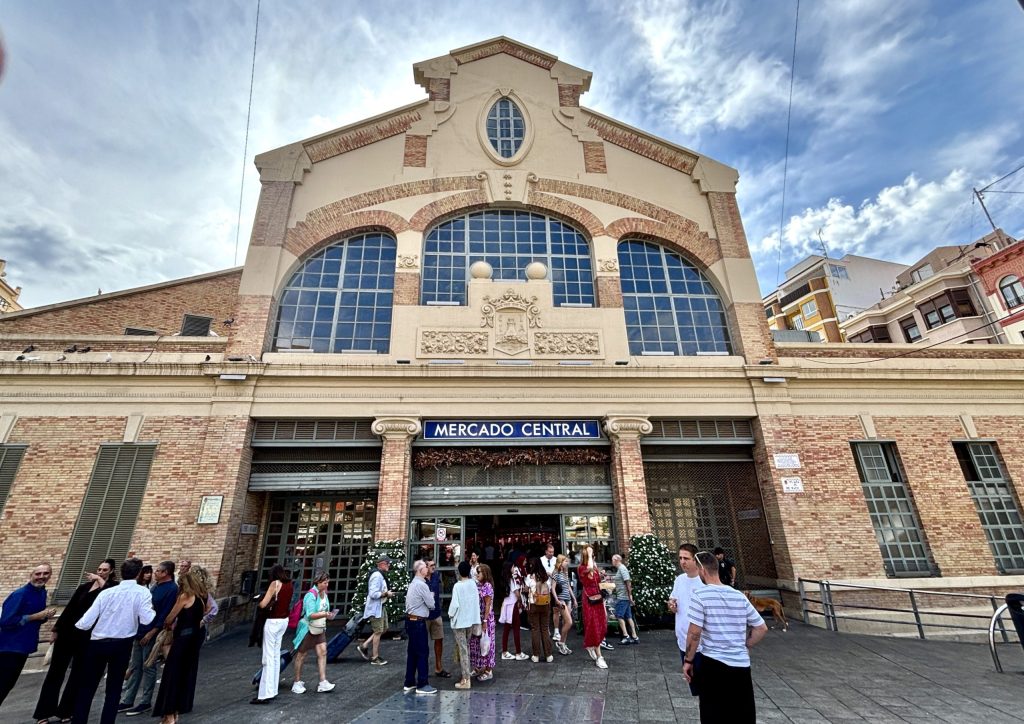
The central market in Allicante is a nice building but not spectacular on the outside. The treat is inside.
Ton’s ideal market is an interesting building selling a variety of things, with a few food offerings, and maybe a tourist store or two. She mentioned that Alicante had a market, and luckily it had a tram stop on the line we were going to take into the town from the campground. So it became our first stop.
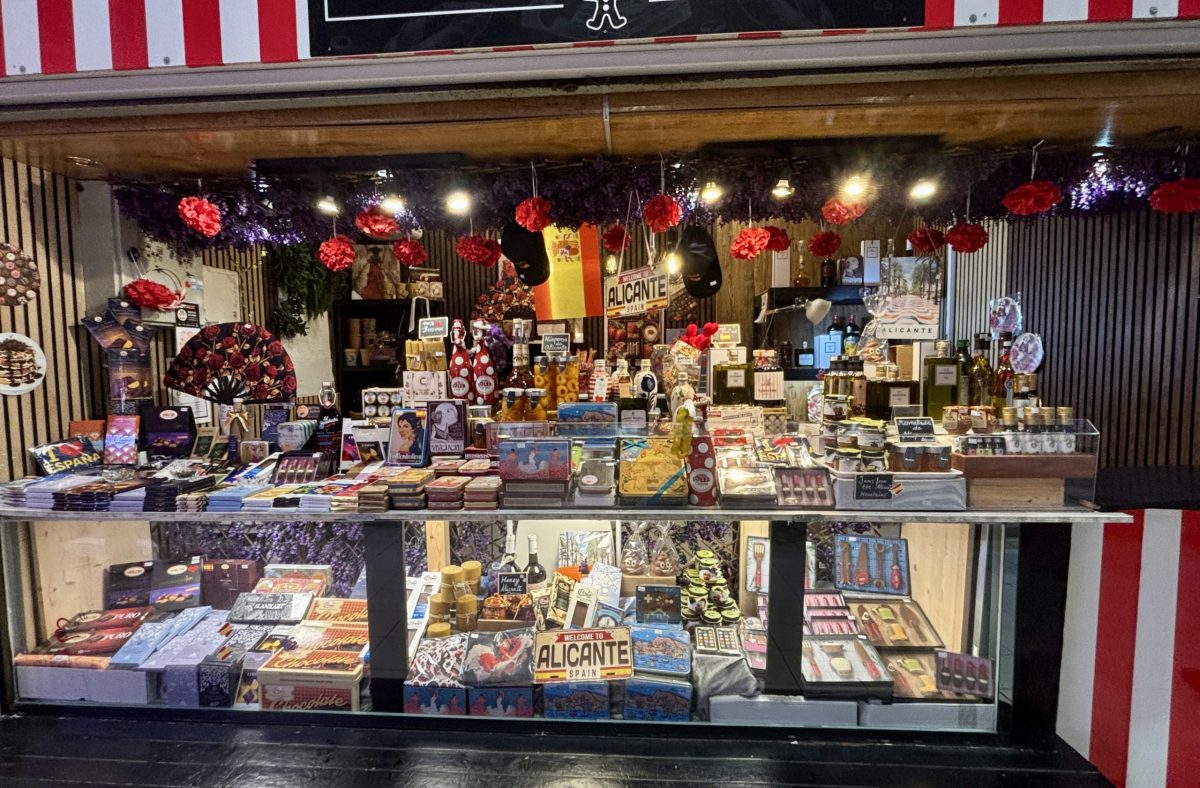
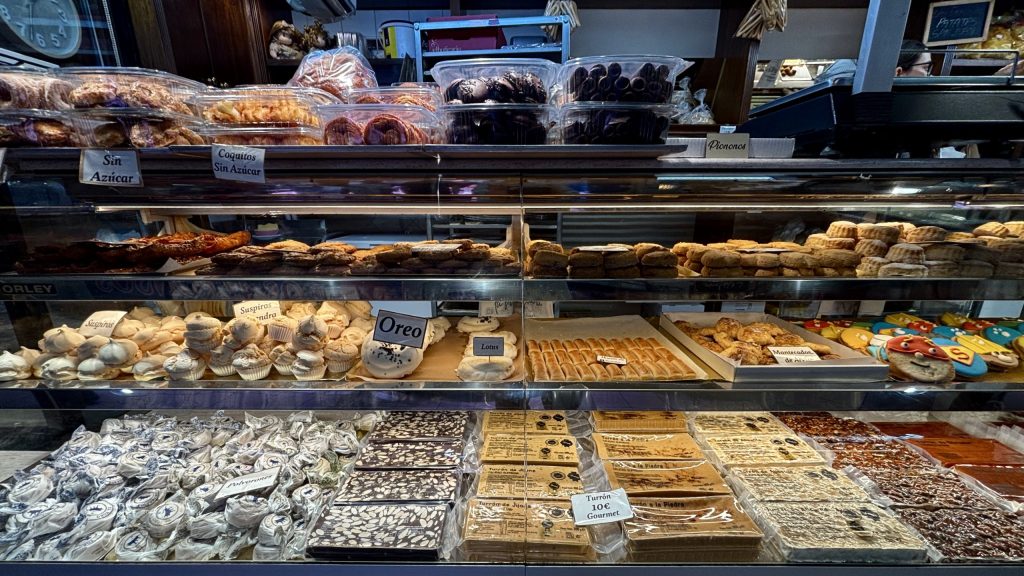
Pastries and the local specialty a nougat based candy.
When we walked up to the market it was in a nice early 20th century building. There were a lot of people going in and out. When we entered without any expectations we walked into a very large market with a great variety of foods on sale. There were fruit stands, bakery stands, butchers, fish mongers, and people selling local wines and liquors. Around the edges were small food stands selling local specialties. It sprawled over two floors and Ton was in heaven.
I think it is a Tuna, and it is very impressive.
About half way through Ton said that this is the best market we have visited in Europe. What really made it perfect was that it was very busy, and the customers were mostly locals shopping for their homes. It gives the market a totally different atmosphere. There were a few tourists mixed in like us but they were not treated as pests, but were also made to feel welcome.
Our lunch spot.
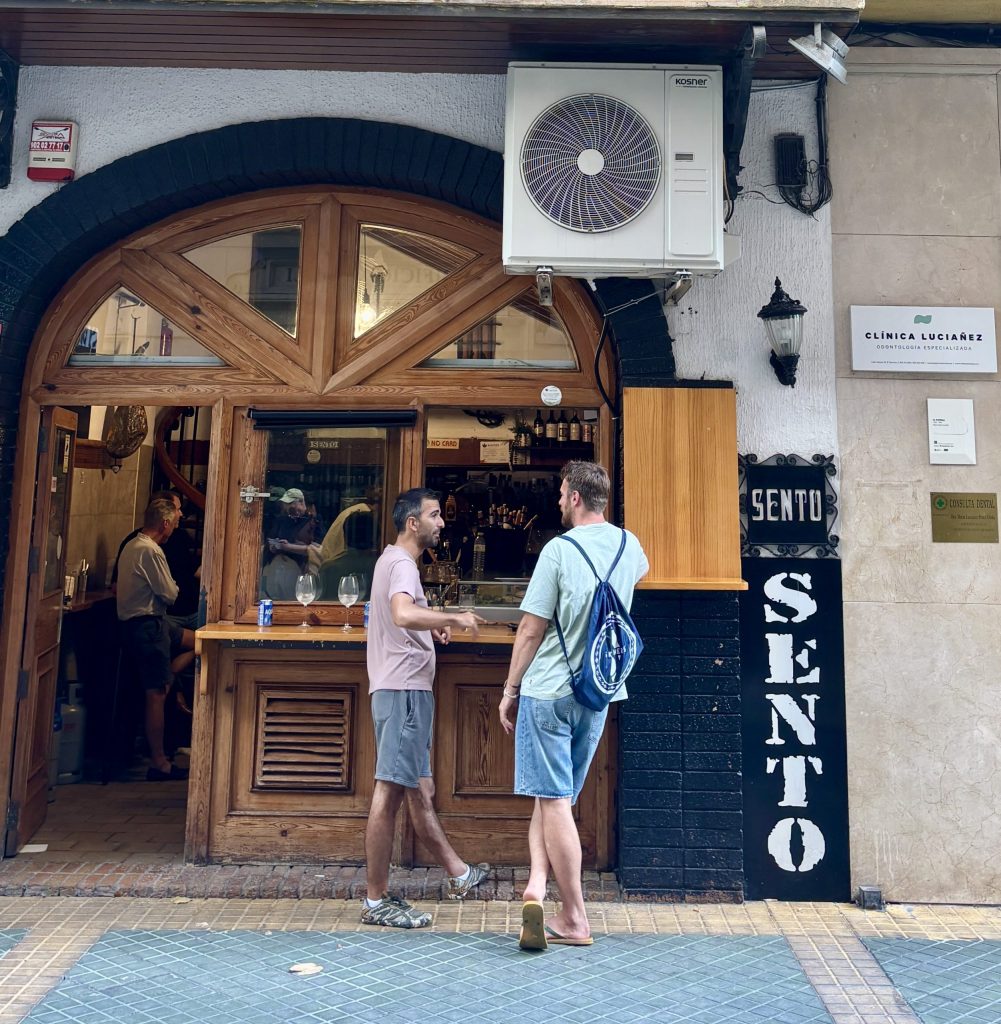
Ton spends a lot of time researching places to visit when we head to a new town. In addition to the things to see she always has a couple of places to eat on the list. Today’s choice was really memorable. It was just down the street from the market, and when we first walked up we almost passed it by. We stopped and looked at the menu, and then looked inside. Sometimes a place that looks tiny from the road is actually bigger than it looks, but in the case of this Cerveceria it was indeed tiny. It had about 8 stools at a bar and another 4 strolls along a back wall, there were also two stand-up tables on the sidewalk where you could order through a window. We looked in and it was packed. We decided to try somewhere else when a waitress appeared on the sidewalk and said she had a spot for us. So we headed in.
Almost the definition of a hole in the wall.
The atmosphere was informal as people were perched on stools or standing leaning on the bar. Drinks and food were passed across the bar with the help of patrons. It lead to a lot of discussion about what are you eating, or what wine is that. We have been to a lot of these informal tiny places this trip and have really enjoyed ourselves. The chef here performed miracles with a grill and panini machine. We had some of the best Tapas we have had on this trip. The guy was a wonderful cook and friendly. The service was quick and delivered with humor. And we enjoyed a friendly conversation with a Swedish/English couple who were just as impressed as we were. We ended up lingering here much longer than we planned as we kept seeing new Tapas that we wanted to try.
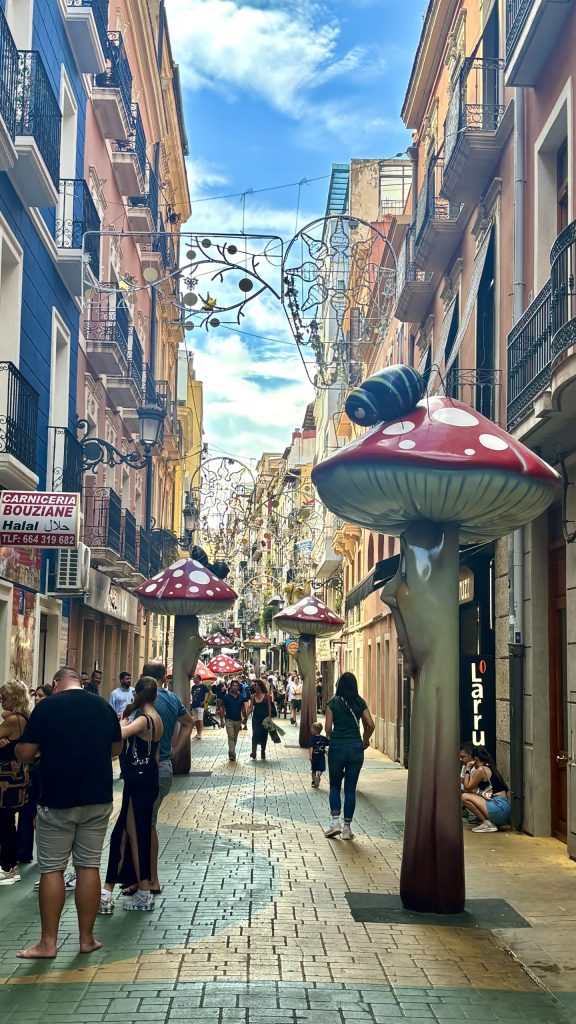
The mushroom street.
At this point we had been in Alicante for about 3 hours and hadn’t really explored the city. Ton gave me a street to find and told me it was the mushroom street. When we got there it was indeed a street full of giant plastic mushrooms. They were whimsical, I don’t know if there is a story behind them, or someone just said why don’t we order a bunch of giant plastic mushrooms and stick them on this street, and the city council said sure. I hope it was the latter. Above the street there were also Christmas decorations, we had a debate whether they were early (my theory), or they just left them up year round (Tons theory). Either way it added to the fun of our walk.
The Esplanade Espana on the waterfront in Alicante.
As I said yesterday the Spanish excel at pedestrian streets. Alicante had one of the best waterfront promenades we have ever seen. I can imagine on a normal night it will be packed about 7pm when the Spanish families go out for their evening walks. I said normal night because as we were walking you could begin to see the thunderheads forming over the ocean so we had to cut our wonderful day in Alicante short to get home before the storms came through.
Before we went to sleep last night we decided to take today off. So today was a day without a plan except to stay put in the campground.
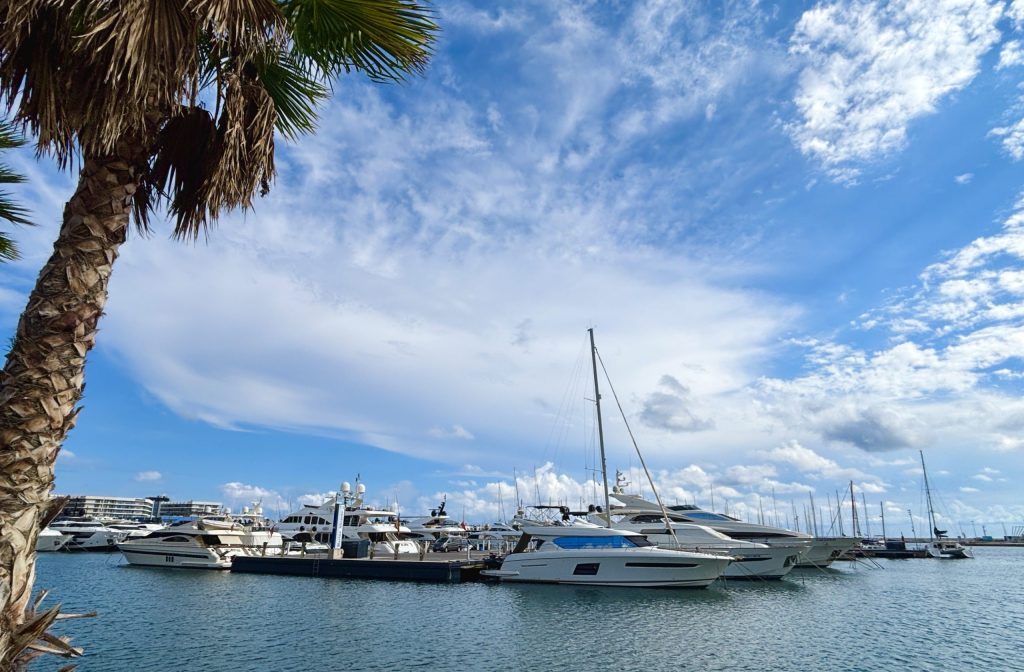
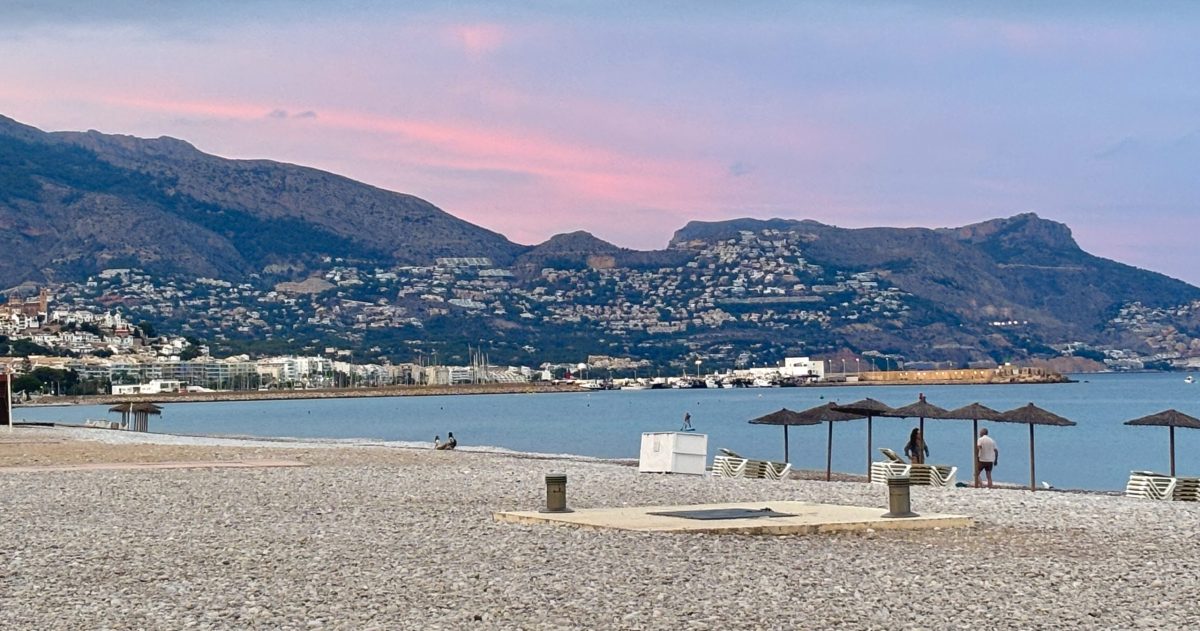
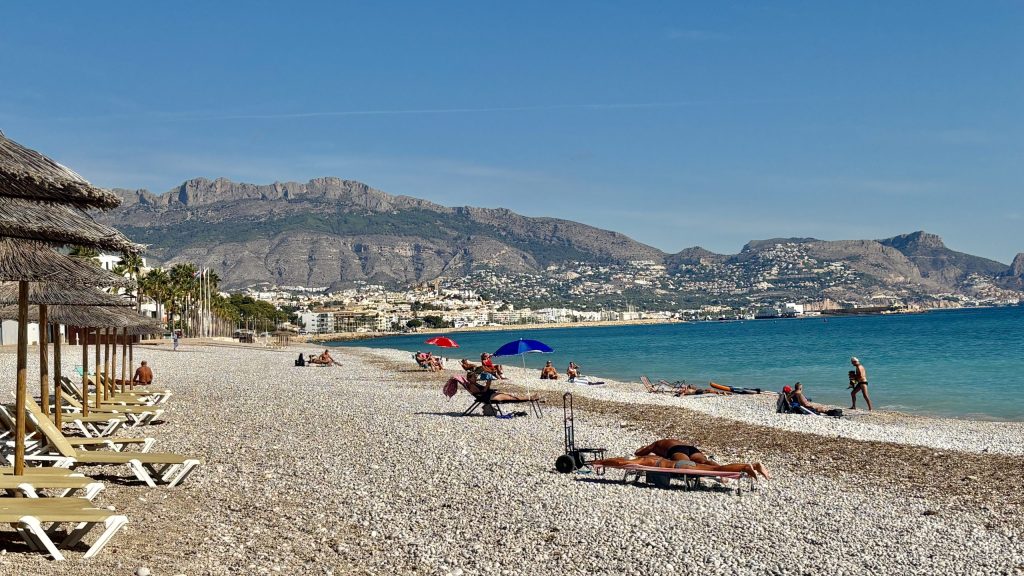
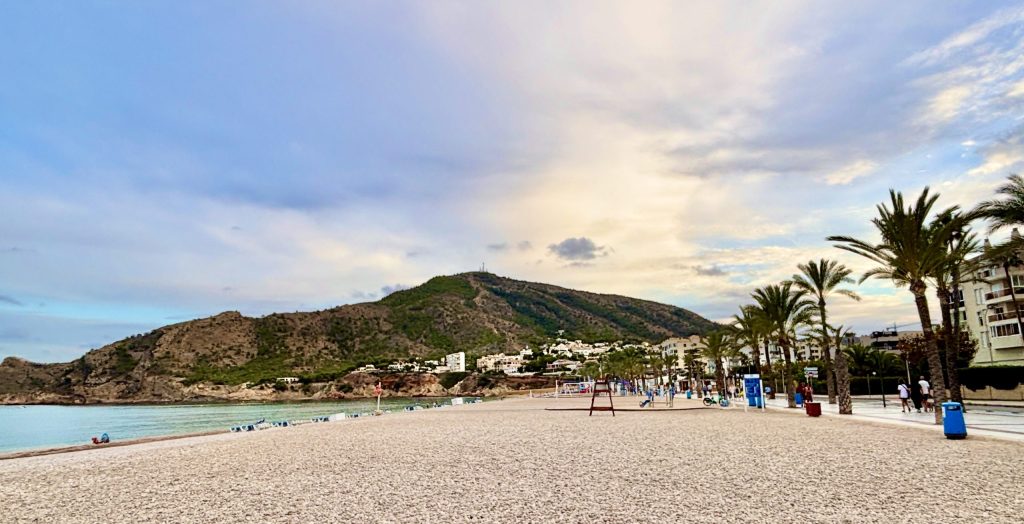
Our campground is located on this beach in the Costa Blanca region.
We took advantage of our day off to sleep in until almost 9am which is not something we do often. After making coffee I took a little stroll along the beach while Ton prepared breakfast.
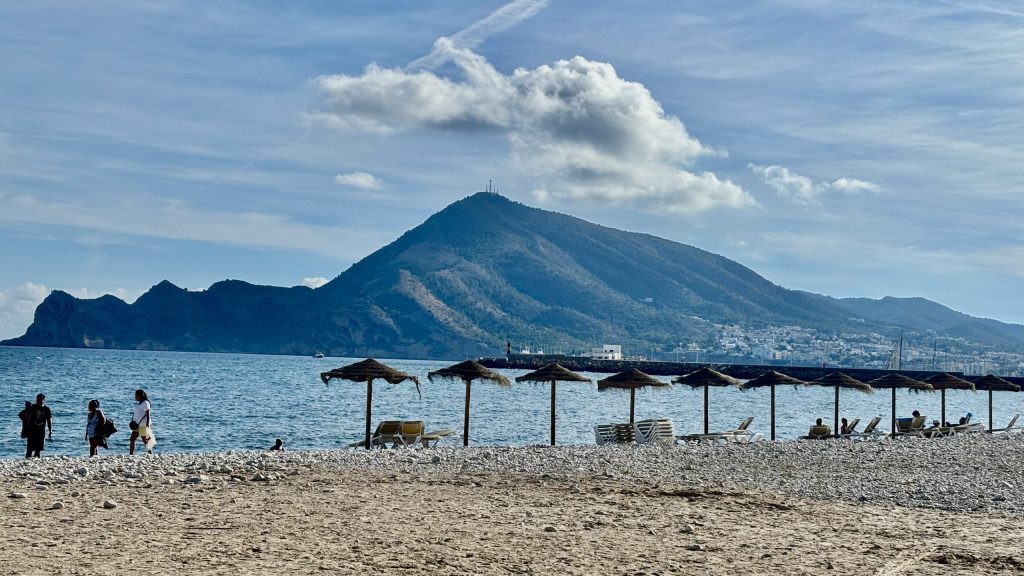
The views from the beach are fantastic.
After breakfast we took another short walk to check out the local grocery. We purchased nothing because as we expected everything was quite expensive compared to the big groceries.
The beach looks beautiful, but it is made up of small stones and not sand.
When we came back Ton told me to go find the washers as it would be a good day to knock out some laundry. When I went to buy the tokens it took to activate the washer I was told that you had to make a reservation to do laundry. The next reservation was at 4pm.
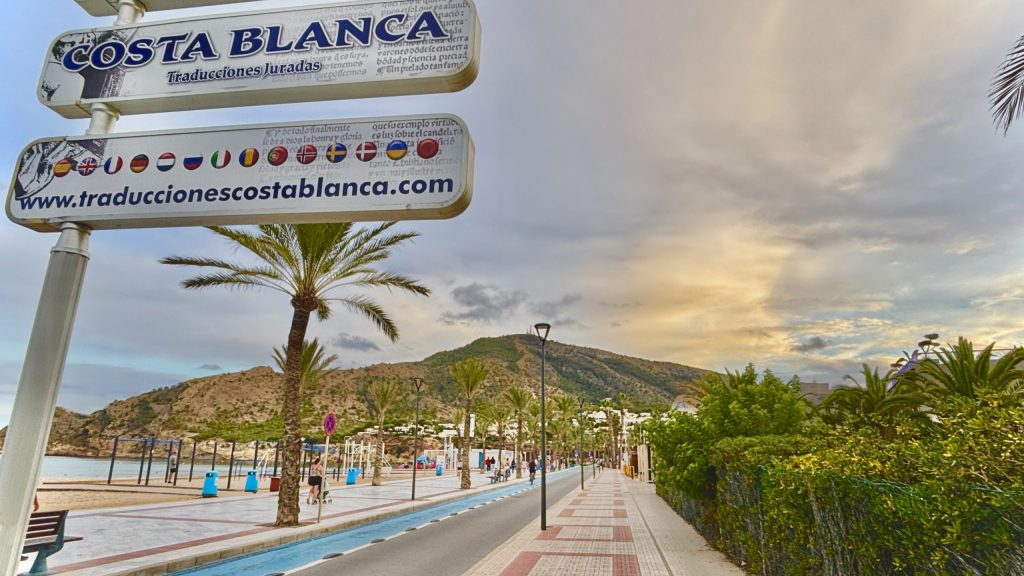
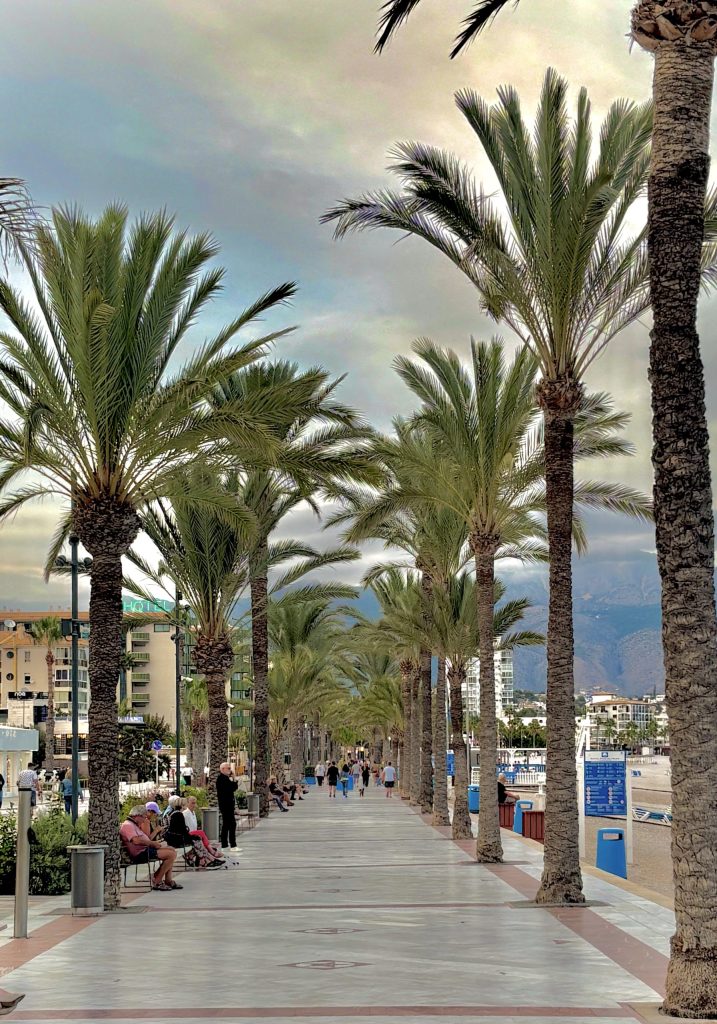
We love how much Spain cares about pedestrians. This walkway along the beach is beautiful, and typical of what you find throughout Spain.
We relaxed all afternoon in our very full campground. Interestingly this campground is probably 85% Dutch. The Dutch are big travelers, but this is probably the highest number of Dutch we have seen in one campground. They seem to be enjoying themselves and have organized line dancing nights, an evening Petanque league, and a knitting club. They seem to mostly be here for long term stays and have formed friendships.
Our evening stroll.
After laundry was done we headed out for another evening stroll and the beach front restaurants were starting to open up. It is interesting here because the restaurants have to cater to two different supper schedules. The British and Dutch eat around 6 pm, and the Spanish around 8 pm. I think from a restaurant perspective if you can attract both crowds you get two good seatings for dinner. It just means longer hours.
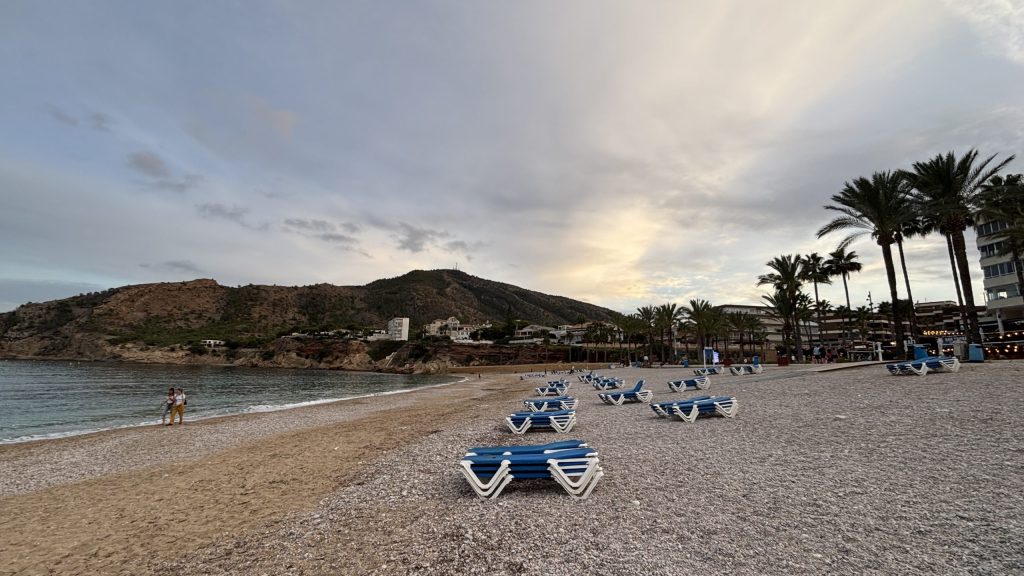
Beach chairs neatly stacked for the evening.
We usually count on the rain to force us to take down days. This trip we have not had any rain induced down days so I am happy that we finally decided to do it on our own, while nothing particularly interesting happened we had a nice relaxing day in a beautiful place.
Altea had a lot of hype to live up to, one of Tons sources of places to visit in Spain called it the Santorini of Spain, National Geographic called it the most beautiful village in Spain.
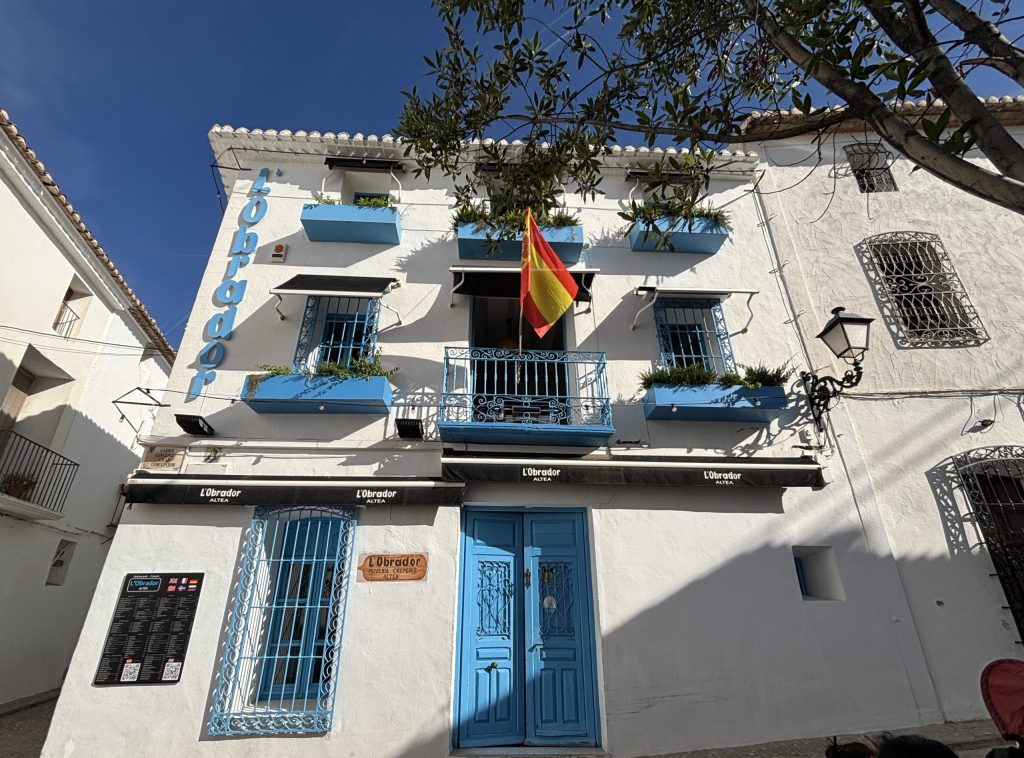
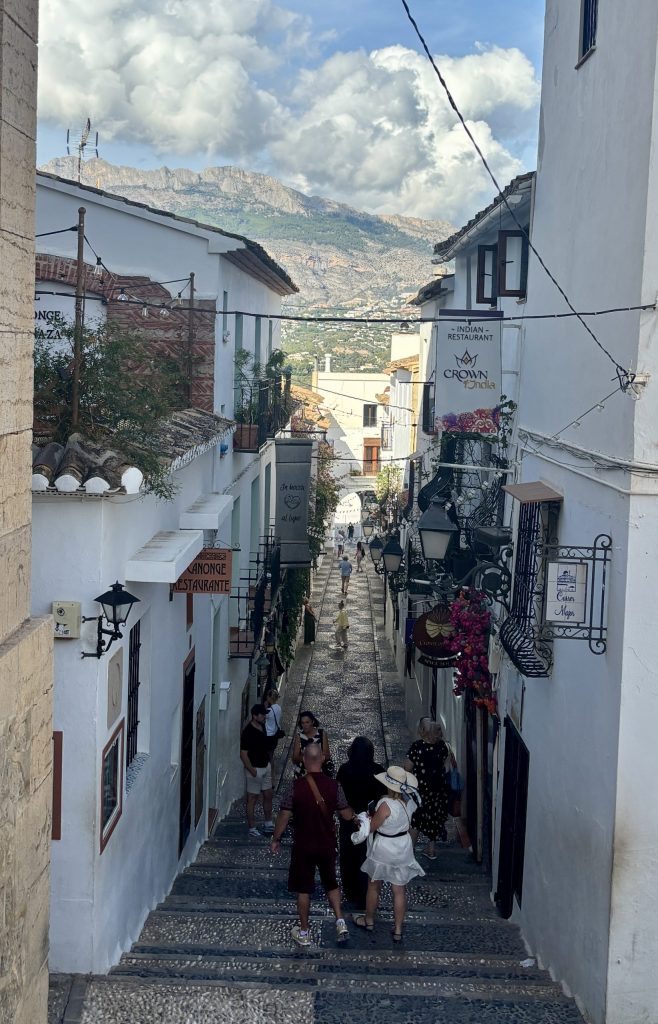
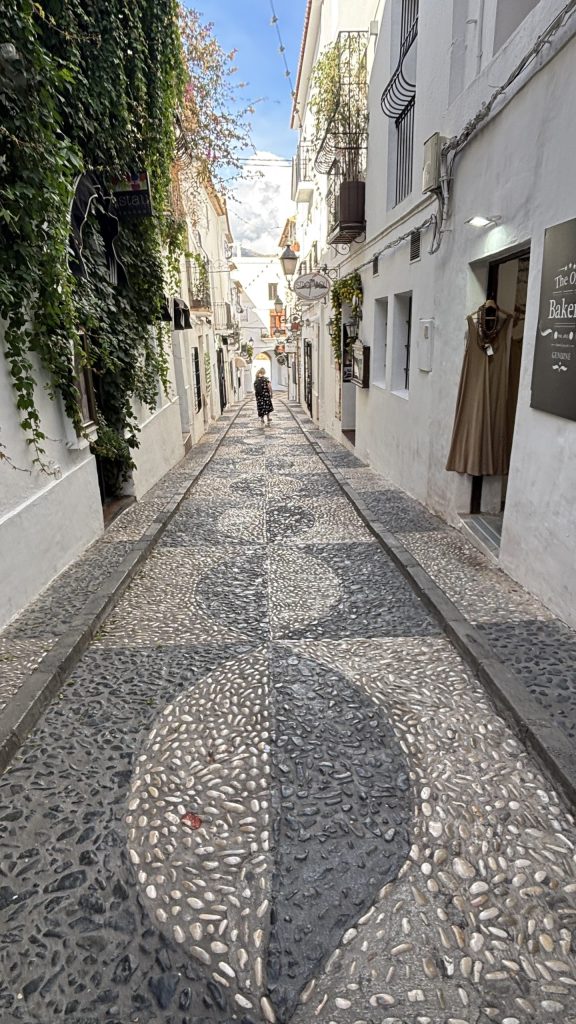
The old town is all white, with splashes of other colors depending on the whims of the owner.
The drive down from Valencia was uneventful and we checked into a beach front campground that we thought would be expensive, we were happy to be told it was only €25. A good start for Altea. After settling in we decided to head into the old town but it was further than we thought. We decided to splurge on an Uber, that was also very reasonable.
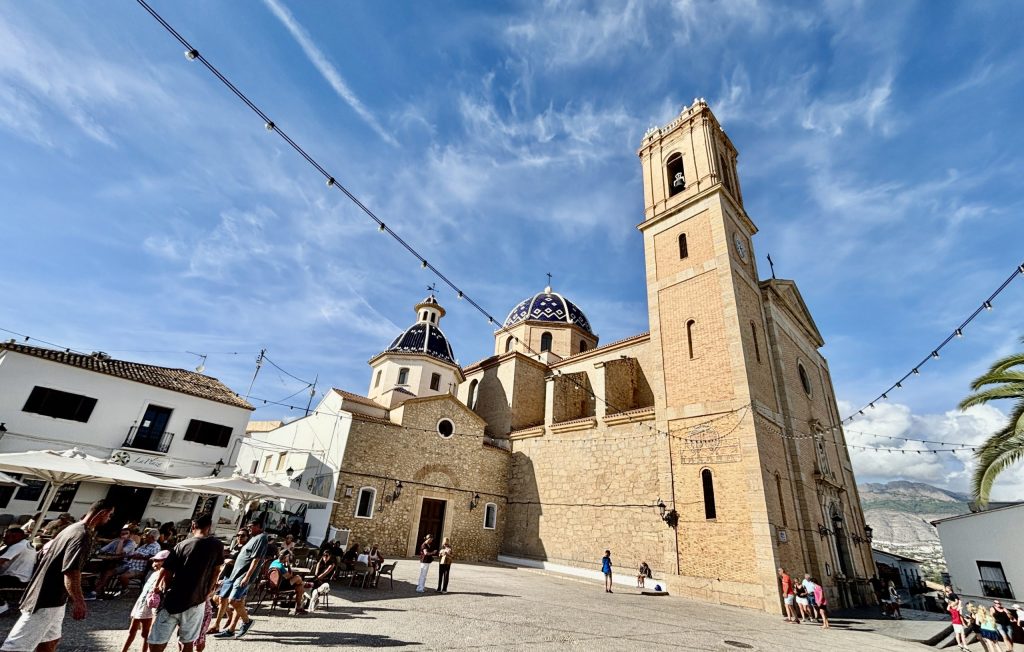
The Renaissance church with two blue tile domes dominates the center of town.
We were waiting for our Uber in front of a Thai Massage shop. Thai Massage places are very common in Europe, but not as common in Spain as Northern and Central Europe. While we were waiting a lady stuck her head out and asked if I wanted a massage. Ton struck up a conversation with her in Thai and she had a nice chat until the Uber came.
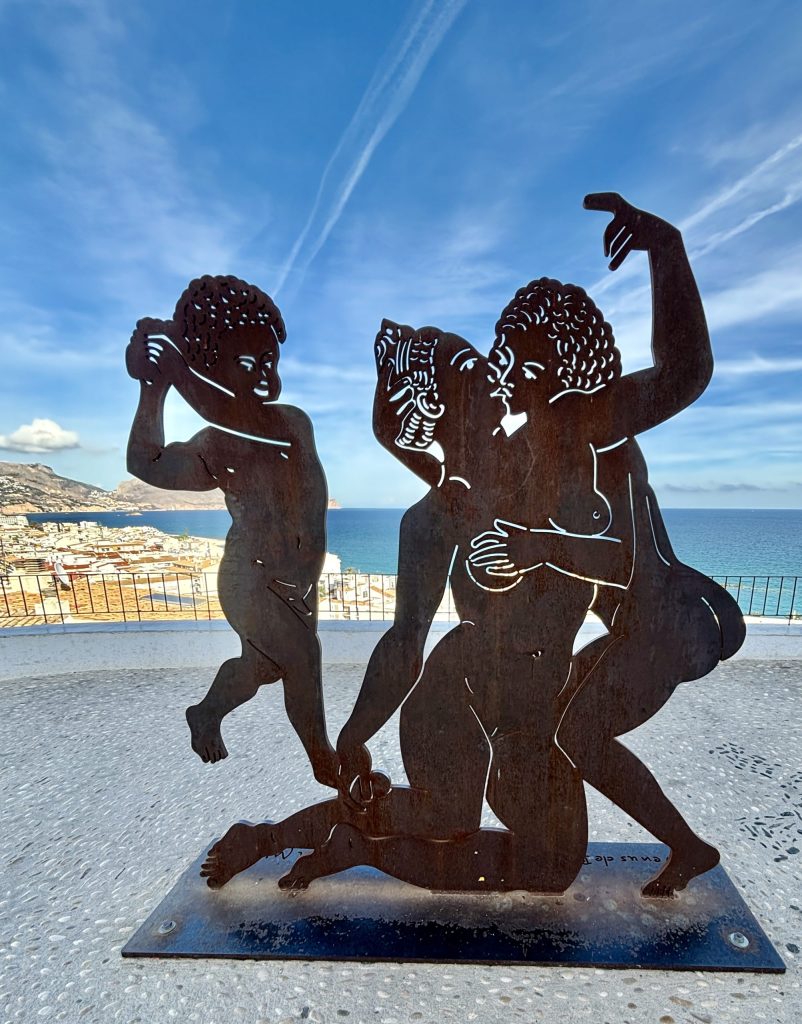
A racy bronze statue overlooking the Mediterranean.
We did a quick walk through town and then headed to a restaurant for lunch. The entrance was off a street and we had to descend to the dining area which turned out to be a beautiful terrace overlooking the town and ocean. We took the menu of the day. We received three appetizers, a giant salad, two nice sausages, and two beef curry empanadas. The appetizers would have been a filling lunch. I ordered salmon and Ton ordered steak. My salmon was the largest piece of fish I have ever been served in a restaurant. It was also perfectly cooked. Tons steak was also good. We weren’t done because our deserts were also huge.
Trying to walk off our immense lunch.
The food was excellent, the service was friendly, and the views were spectacular. After a couple of tough days in Valencia, the Spain we know and love is back.
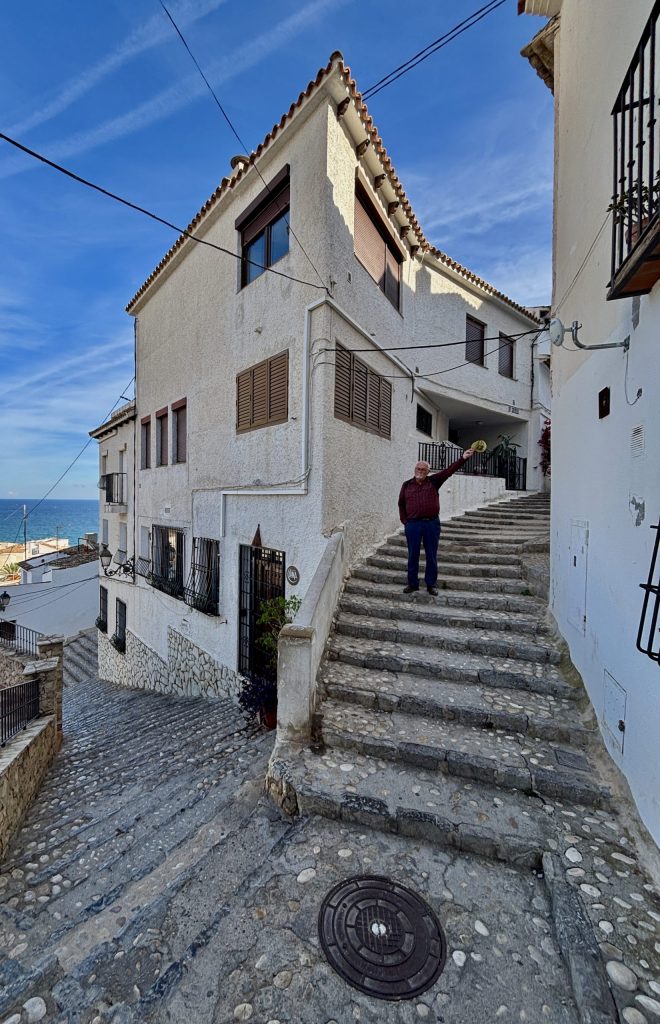
Walking down towards the beach.
We headed down towards the ocean with a thought of walking along the beach, but a food coma set in, we decided we would save the beach for later. The Uber driver explained that this part of the “Costa Brava” is the most beautiful because unlike the towns surrounding Altea it has not been overdeveloped with high rise condos and restaurants. We can see some of them off on the horizon north of us, and according to our driver it gets worst south.
The main shopping street in Altea, full of cute boutiques and art stores, all closed during siesta.
Is Altea the Santorini of Spain, truthfully we don’t know because we haven’t been to Santorini. Is it the most beautiful village in Spain, well that is a matter of taste, it is a beautiful town, but Spain is blessed with beautiful towns. To our taste it is not the most beautiful place we have visited in Spain but it would be near the top of a list of beautiful places.
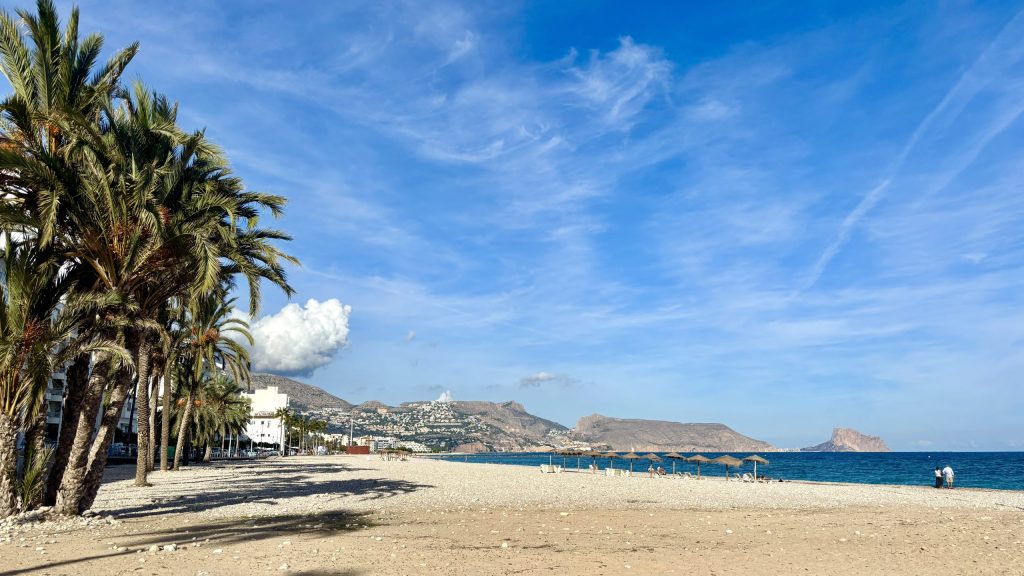
The beach was kind of quiet, but I guess it is mid-October.
We have visited Valencia three times now, and for some reason we do not enjoy ourselves here. I even googled to see what its reputation was among Spaniards, and it turns out it is pretty positive. So Ton and I are scratching our heads about why we have never enjoyed our visits here.
The fountain on the main square.
Our first stop today was the market as Ton wanted to look for some spices, and a local nougat based candy, and Horchata. We succeeded in finding all three. The market is enormous and the highlight of our visit. But the interactions with the shop owners were brusque, usually the shop owners we deal with are friendly and happy to explain things. Here it was tell me what you want and hand over your card.
We found our nougat here.
Ton went to get a picture of the interior of the market, and one shop owner who she wasn’t even pointing the camera at shouted at her-no photos! It wasn’t the warm Spain we are used to.
This lady almost saved the day by being nice. Aqua de Valencia isn’t water but a liquor.
After an hour in the market we headed to the central square to see what was happening. There was another tent city set up in front of the city hall that occupied about 1/3 of the square. Both the protestors and the police looked very bored.
The center spire of the town hall with the bat symbol of Valencia.
We had tried a couple of pastries in the market, but went for a Pinxtos lunch in a very well decorated but mostly empty Basque restaurant. Without the happy crowd of Basques it wasn’t quite the same experience, though the Pinxtos were excellent.
The area around the main square has some very nice early 20th century buildings.
About 2 we ran out of ideas so decided to head back to our garage. The bus was packed when we got on, but we managed to acquire seats. Yesterday, I didn’t hit the stop button and we missed our stop. I kept waiting for the crowd to thin on the bus but if anything it got denser. When we came to our stop and I stood up the way to the door was packed, but usually people will make some effort to get out of the way. In this case nobody did and the people near us who knew we were not Spanish speakers made no effort to help. So once again we missed our stop. I was very frustrated at one guy who smirked and gave me a shrug like-too bad gringo. But I held my tongue.
The tent city downtown.
So during the extra 500 meters we had to walk back to the campground Ton and I came to the conclusion that any further adventures in Spain would not include Valencia. For whatever reason Valencia and the Corbin’s are not made for each other.
A couple of days ago we began talking about Valencia as a destination. We have visited twice before and it is the third largest city in Spain. Despite that it has not made much of an impression on us.
Street scene in the historic district.
But Ton was excited to visit the market as she did remember it fondly, and we wanted to try some Paella as Valencia is famous for it. Ton did some research on why Valencia Paella is the best and told me that it is because the rice here is perfect for Paella. It is not starchy and it absorbs three time the liquid of normal rice so it can really absorb the sauce of the Paella.
The weather was perfect today.
I struggled with the public transport all day and after a slight deviation we found ourselves at one of the best Paella restaurants in town. You are supposed to make a reservation a day in advance, but we decided to see what would happen if we just showed up. When we asked for two the waiter asked if we had reservations, when I said no, there was a pause and I expected to be turned away. Instead he said ok 3 minutes. The Paella was delicious and the rice was different than what we have seen in other Paellas in Spain.
Some nice street art.
We’ve seen most of the tourist sites here so Ton just kind of wandered the streets afterward taking pictures of street art and street scenes. We just strolled around in the center for 90 minutes or so.
This women was being photographed by a professional in front of one of the prominent landmarks. The dress was beautiful. I’m not sure from what era it is but the embroidery was really elaborate.
When it was time to go home I again blew it with the bus and didn’t hit the stop button for our stop. We ended up riding to the next stop which was in front of a Mercadona. Ton decided to take advantage of my carelessness by getting a little shopping in.
This small house is for cats. The residents weren’t home when we were there.
Our campsite tonight is unique. We are parked inside a building in an industrial area. The building is used to store RV’s long term, but they also rent space on a daily basis as Valencia lacks campgrounds. The people are really nice and it has all the facilities you would find in a campground-just inside a warehouse.
The cat house, unfortunately someone decided to tag the wall it is built into. Some people have no class.
The route we picked for the day involved about 150 kilometers of mountain driving in the Sierra de Menara and the Sierra de Albarracin mountains. I was a little hesitant at first because I was worried about the quality of the roads. So before setting off I did some quick research and found out that the route we were preparing to do from Cuenca to Albarracin was supposed to be one of the most scenic drives in Spain.
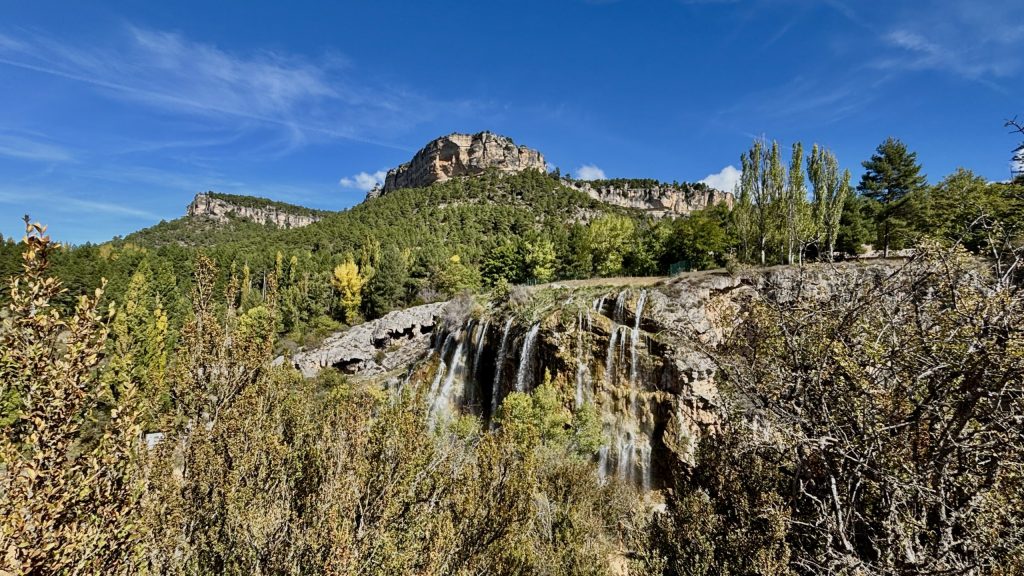
Waterfalls on our scenic mountain drive.
We had planned on stopping at Cuenca for a walk around the city as its old quarter was supposed to be interesting. But after spending about 20 minutes trying to find a place to park François we gave up and decided to pass on Cuenca.
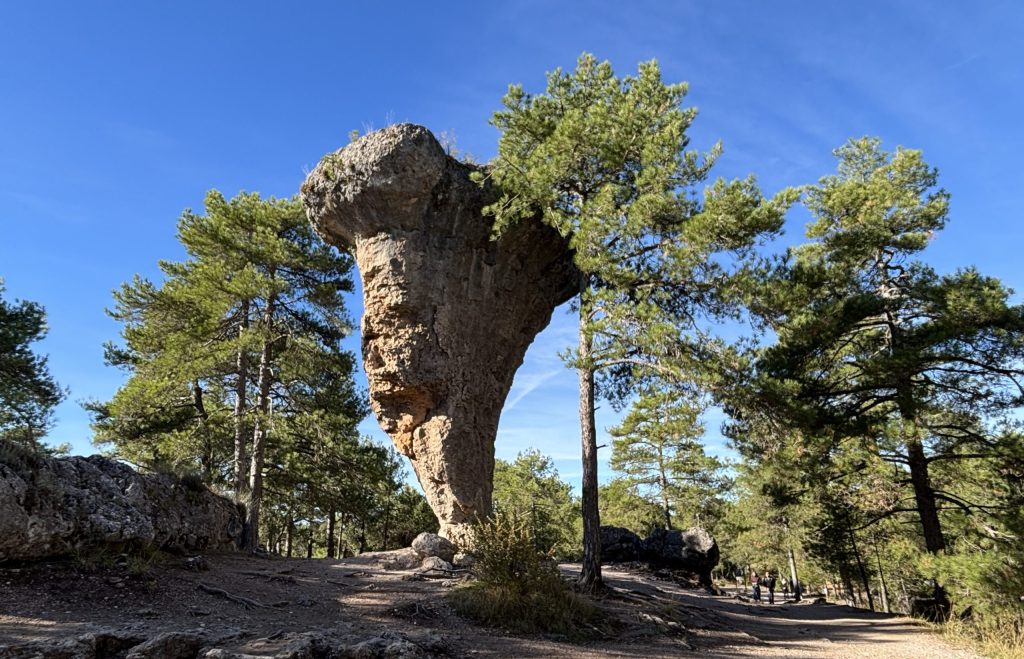
The Giant Tolma in the Enchanted City.
Our first stop was the Ciudad Enchanta. The Enchanted City in English is a series of Limestone rocks in a small area that have been shaped by water and wind erosion into interesting shapes.
Some of the rocks that make up the Enchanted City.
It is part of the Cuenca Mountains National Park. It reminded us of a US national park with nicely marked trails guiding you through the different rock formations. To keep up with the Enchanted City motif the rocks have been given creative names like the “Elephant and Alligator fight”, and the “Two Lovers of Tereul” which if you were Spanish you would know the story (think of Romeo and Juliet).
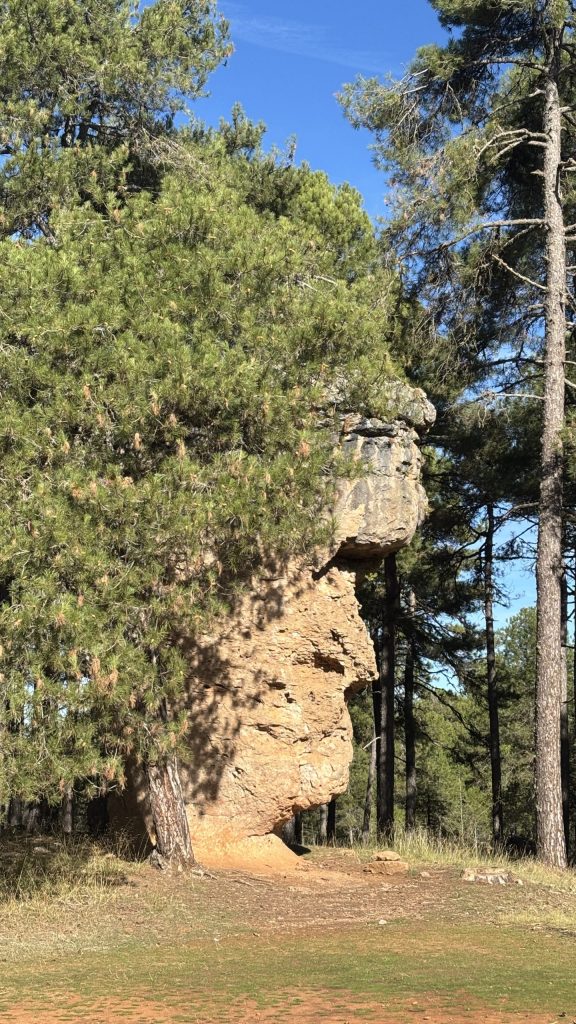
The “Man’s Face.”
The walk was an easy 3 kilometers and there were a lot of very interesting rock formations, though we were not sold on all the names. We enjoyed ourselves and there was a pretty good crowd on hand as it turns out today is a national holiday.
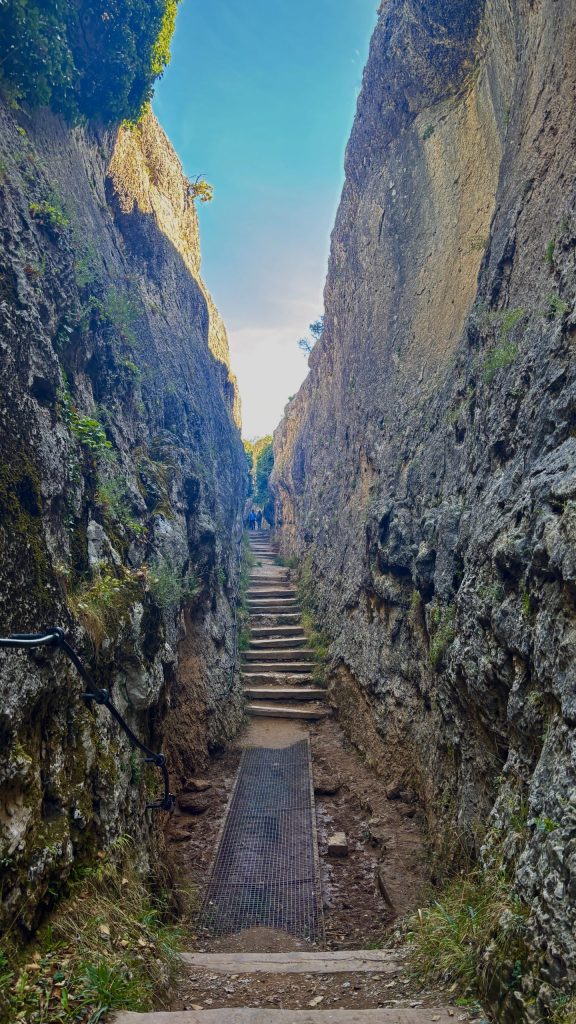
A nice walkway between two sheer rock walls.
We finished with the Enchanted Forest and left on our 2 hour scenic drive through the mountains. On the map it is listed as two separate mountain ranges, but to me it seems like one large mountain range. Our concern about the quality of the road was wasted as the roads were well paved and comfortably wide. The roads were windy as mountain roads are, but the views were superb. Ton and I don’t think we have driven a prettier mountain road in Europe.
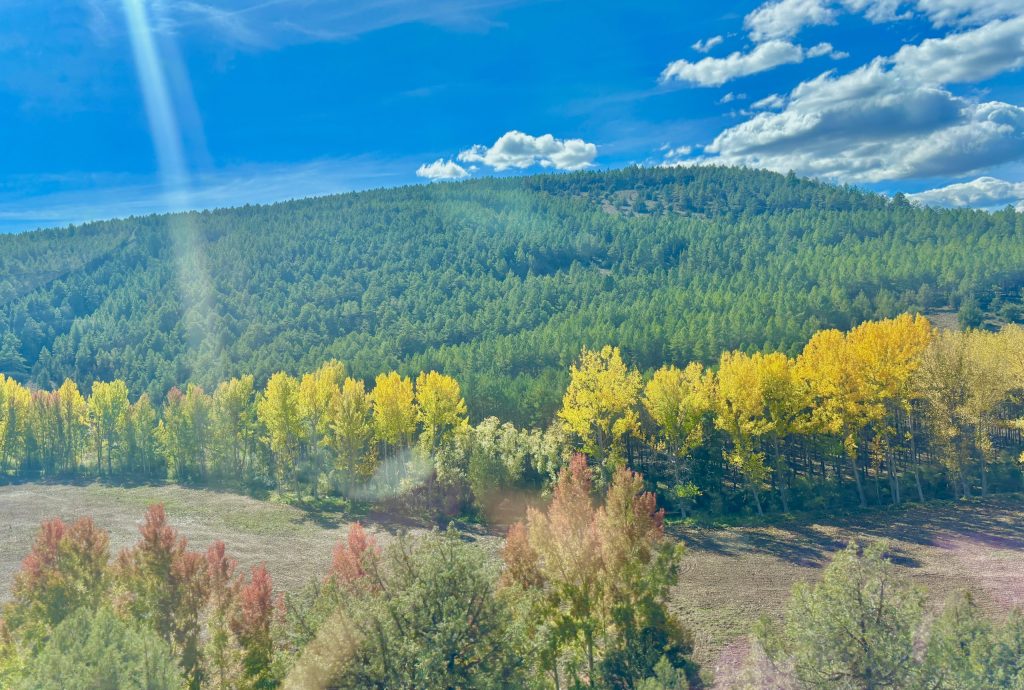
The trees were starting to change color which added to the beauty of the drive.
Our destination today is a mountain town called Albarracin which has been lately touted as the most beautiful town in Spain. We were impressed driving in as you follow a beautiful river gorge to the entrance to town. After a short rest to recover from the drive we headed into town.
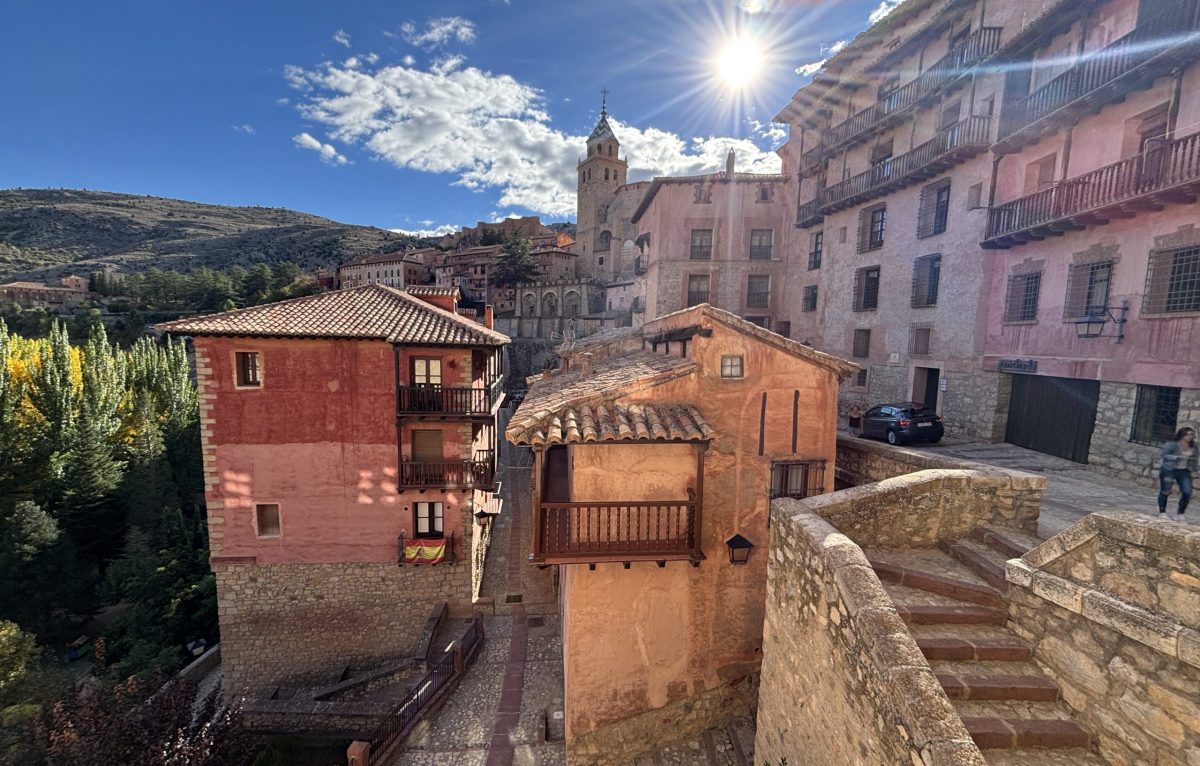
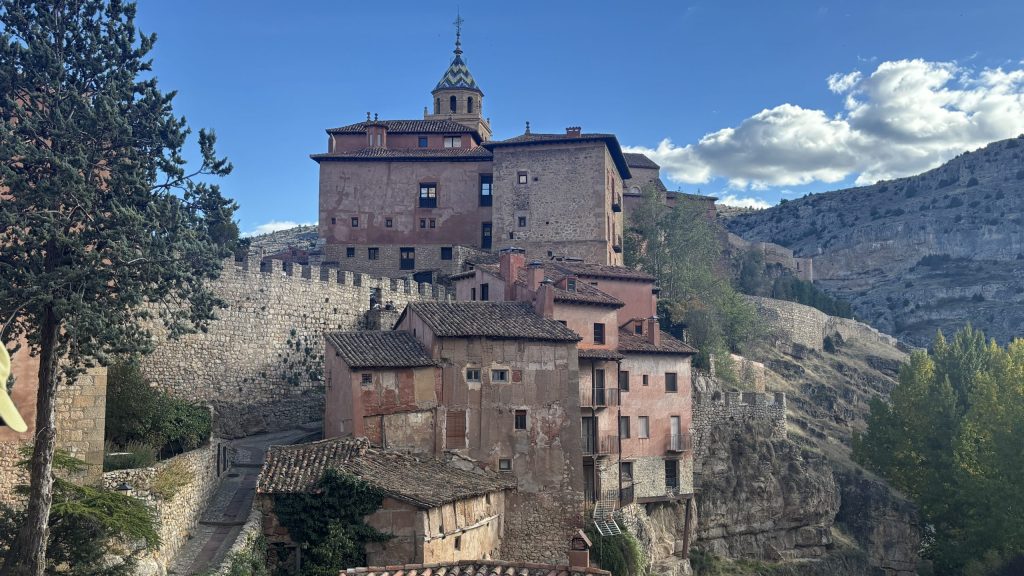
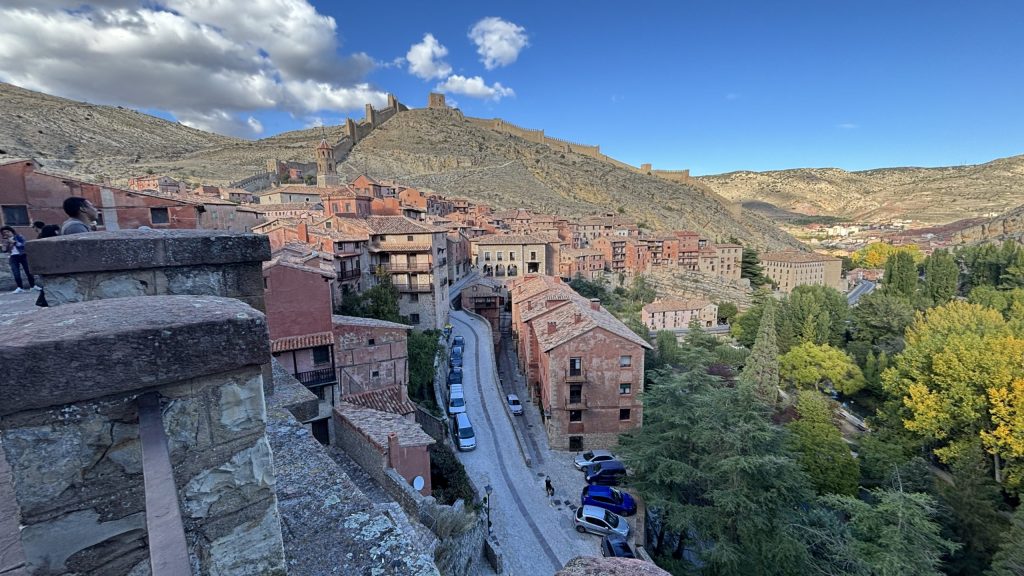
The town is perched on cliffs overlooking the Guadalaviar River.
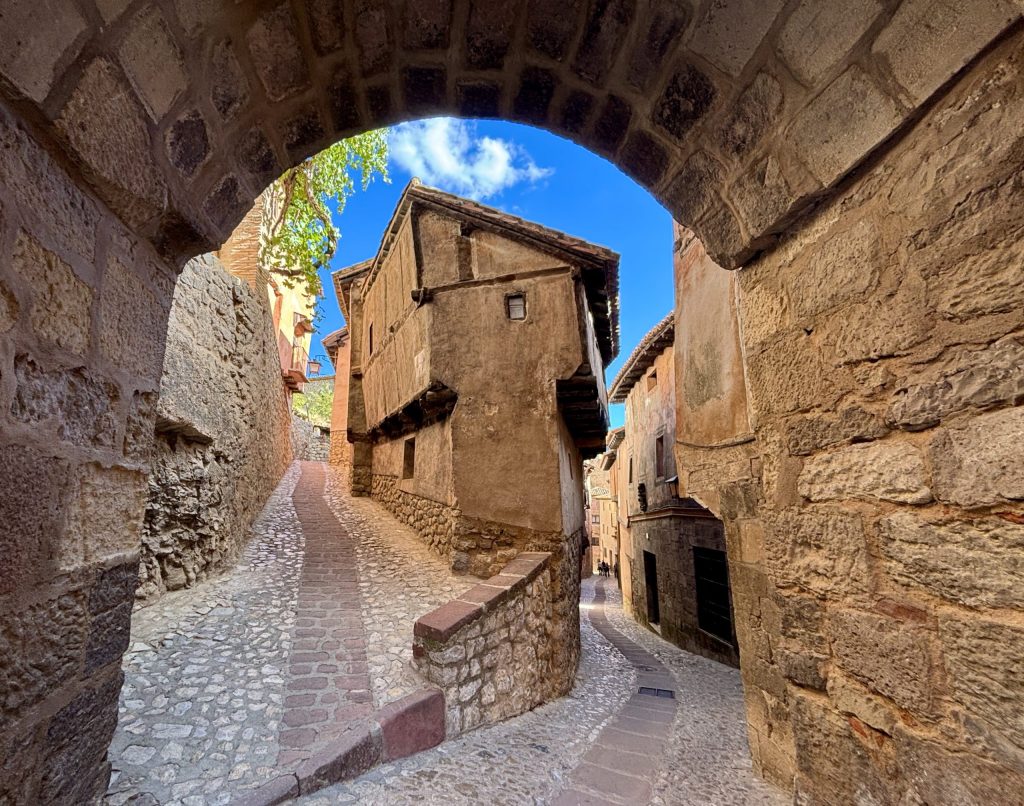
The rocks in the area are red sandstone so the town has a red hue to it that makes it stand out from typical Spanish towns. It is dramatically perched on rocks and cliffs overlooking the valley. The streets are quite steep and narrow.
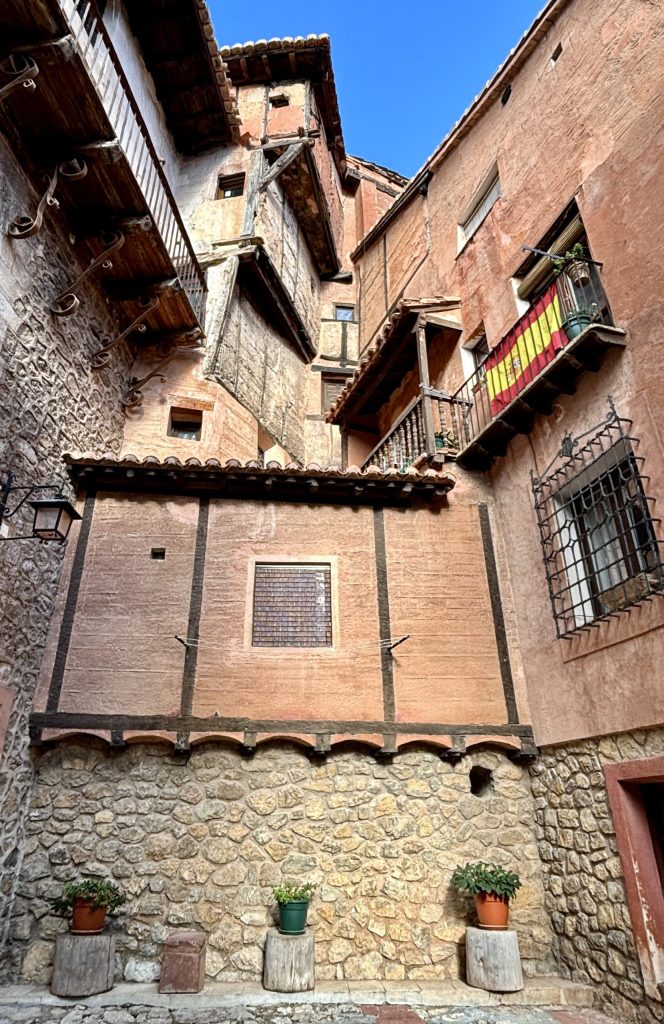
The towns construction is quite vertical.
We enjoyed the meander through town. It is not a large town so you can cover all the must see sites in less than an hour. Things were quite quiet today as all the bars and restaurants were closed. We had planned on getting a glass of wine and enjoying the views but were unable to.
Some of the buildings had quite interesting shapes as they conformed with the hill and the surrounding buildings and roads.
The town has been in place at its current location since about 1050. There were Roman and Visigothic settlements in the area before, but the current town was founded by Berbers who had migrated to Spain with the Moslem Invasion. After about 200 years it was conquered by Christian forces and lost its strategic significance though it retained much of its city walls.
The city walls dominate portions of the city.
It changed hands several times in the Spanish Civil War though there does not seem to have been extensive damage to the town. The town retains many of its medieval buildings.
The Cathedral in the background.
The town is interesting and beautiful, but to me it felt more like a museum than a living breathing town. It appears that most of the residents of town live in modern apartments in the fields at the base of the town. The town itself was kind of dead outside the tourists walking the street. Most of the buildings were closed up and appeared to be either hotels or bed and breakfasts. There wasn’t that spark of daily activity caused by residents that makes a town feel complete.
A beautiful town in a beautiful location.
Having said that the region we were introduced today was one of the most visually spectacular places we have been to in Europe. We really enjoyed the day.
Shifted east almost 400 kilometers to the Mediterranean side of Spain. Didn’t quite get there as there are a couple of towns we want to see in the mountains between the central plains of Spain and the coast. The drive went smoothly even when we did our third crossing of Madrid this trip. Because it was Sunday we were the slowest vehicle on the road which lets me enjoy cruise control and drink my coffee while all of the cars whizzed around me.
The trees in the mountains are starting to show their fall colors here in the mountains.
The campground we are staying at was listed as year round, but when we pulled up the guy said you have to leave by noon because we are closing for the season tomorrow. Like a lot of campgrounds in France and Spain a lot of the plots are now rented by locals year round. After we were parked we got to enjoy watching people preparing to put their campsite to bed for the winter, and creatively packing all the things they had accumulated during the summer into their cars.
We ended up in Salamanca yesterday by accident, but I was in favor of staying a day even though we visited it last year. I remembered it being very picturesque and walkable, plus I was feeling kind of lazy about driving. So I convinced Ton to stay by telling her I would use the truck free Sunday (tomorrow) to shift from western Spain to eastern Spain.
Salamanca is known as the most pedestrian friendly city in Spain. Which based on our experience is a big accomplishment as one of the things we love about Spain is how pedestrian friendly it is.
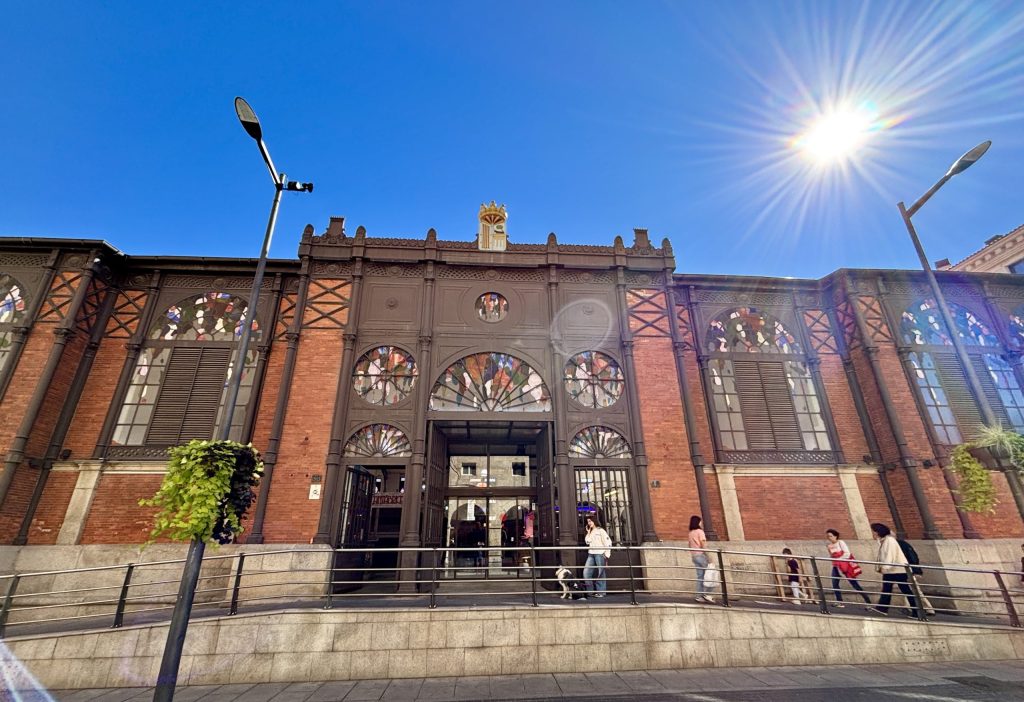
Our first stop was the market as Ton remembered that it was a very good one. She had her eye out for a couple of things, but in the end we struck out. But the market was hopping on a Saturday and the vibe was really fun.
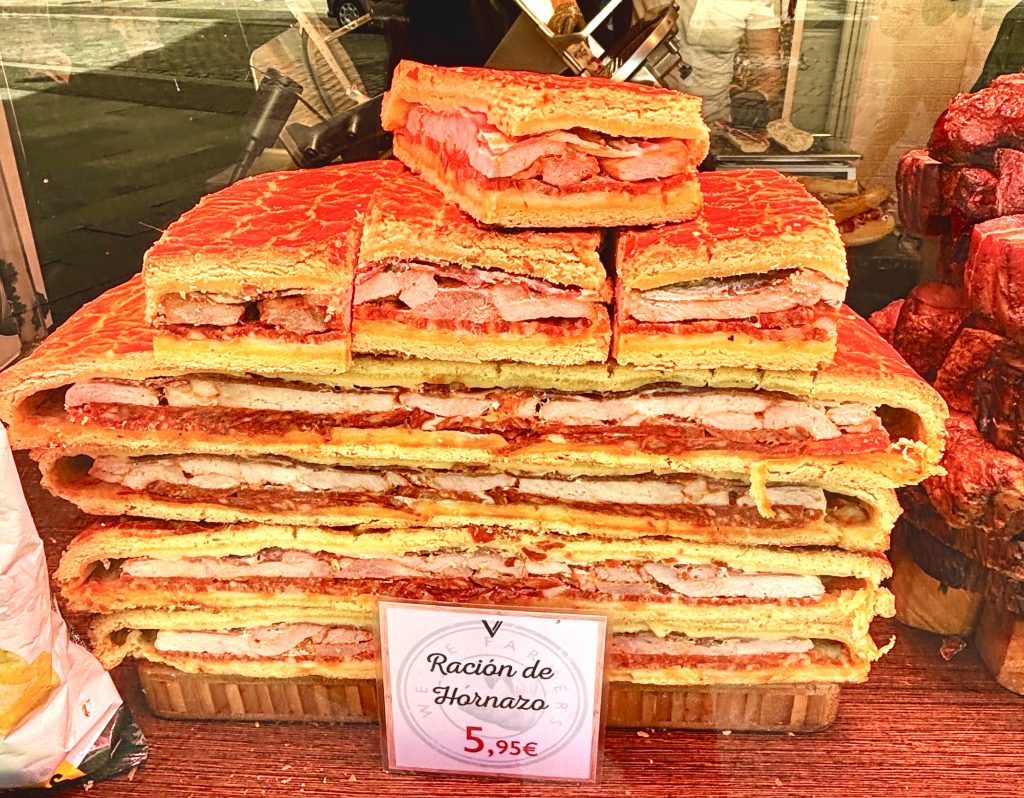
The Hornaro is the famous dish of Salamanca. We spent the whole day debating when to get one, and what was in it, but in the end missed out.
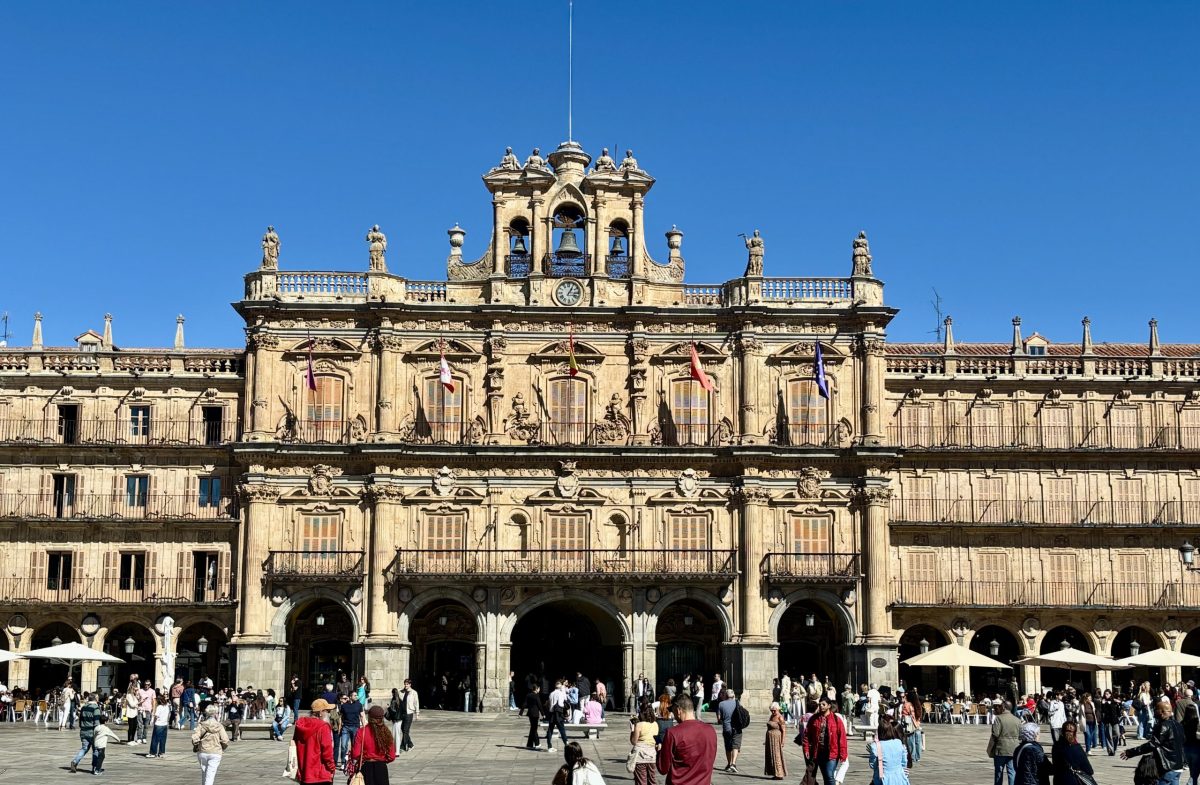
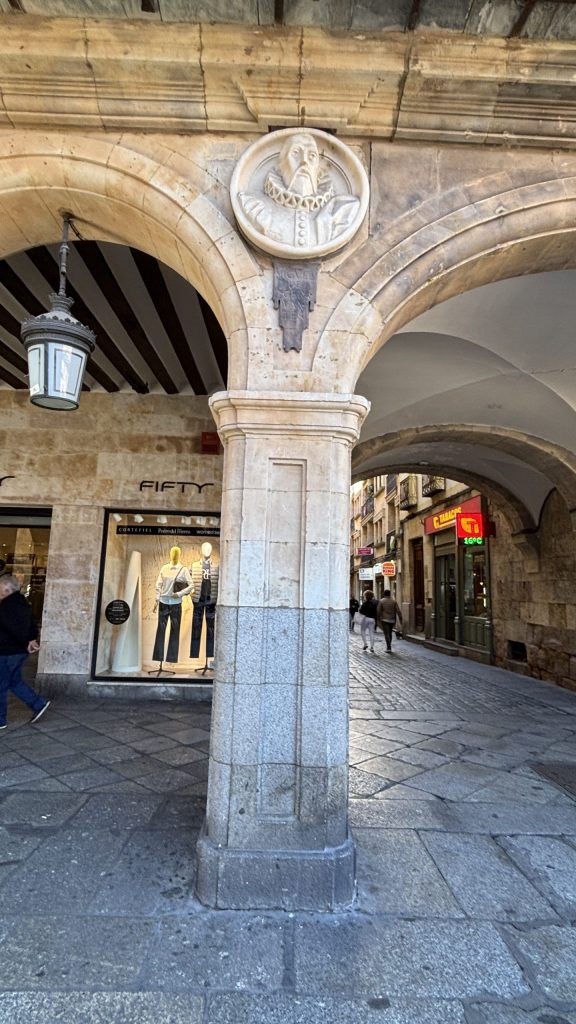
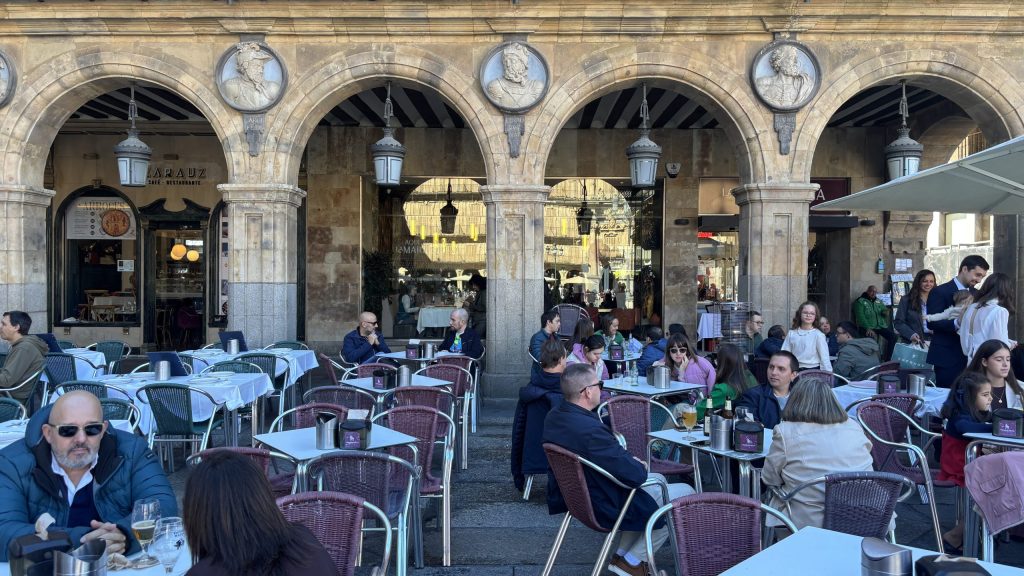
We went to the Plaza Mayor to look for some busts. The Plaza Mayor in Salamanca is unique in Spain as all the buildings surrounding it are made of stone. There are 25 busts of famous Spaniards carved into the walls, with space for more as Spain creates more famous people. We went there looking for the busts of Cervantes, El Cid, and Christopher Colon (or as we know him Columbus). We found El Cid and Cervantes, but could not find Colon/Columbus which in the end seemed appropriate.
The bust of Cervantes.
Ton had read about this neighborhood that was supposed to be a bit off the beaten path but full of good restaurants. After a bit of a walk we arrived to a pretty nondescript street with a handful of nondescript restaurants and one that looked good but was jammed. So in the end we ended up back in the old town at a Tapas bar that was founded in 1890. The food was good and the atmosphere was lively.
The Cervantes Restaurant. An hour later you could not get a table.
We had one more stone figure that we had to find. The University of Salamanca is the third oldest university in Europe and it takes up a big part of the old town. It is famous for those who want to learn Spanish as the Castilian spoken here is supposed to be the purest in the world, as a result it hosts over 5000 foreign students each year.
Part of the University of Salamanca.
At the main portal to the university is an elaborately carved archway. The students are encouraged to find the frog that is carved on the archway, because if you find it you will be more serious in your studies and thus more successful. The frog is supposed to be a symbol for the trouble you can get into as a student. Finding it is difficult and thus proves you are diligent.
Look carefully at the skulls, the frog is there.
We looked and looked, and even followed the laser of a guide. I finally cheated and checked on line to get the location. So I don’t think I am going to be a successful student in the future.
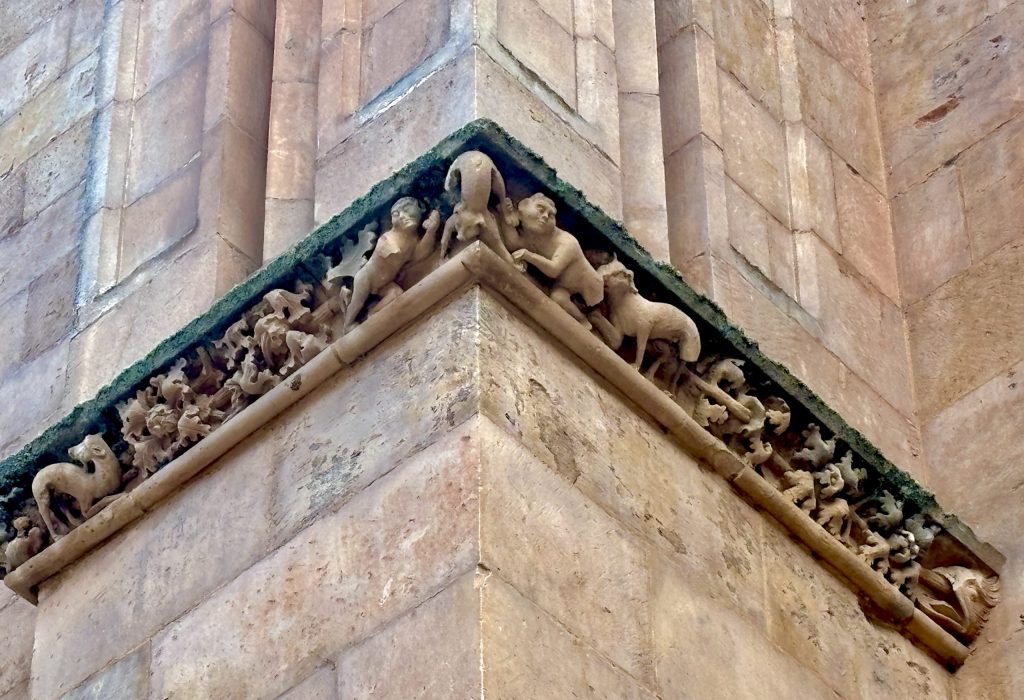
The stonemasons in Salamanca are a whimsical lot. The corner carving here is a pig being fought over by two devils. On the door of the cathedral is a carving of an astronaut, and of course the frog.
The bus back to the campground only ran hourly, so about 4 pm we had to decide whether to linger longer or head back to the bus stop to get the 4:30 bus. Alas, our old age drove us to the early bus.
On the way back to the bus stop we passed the market where we started the day.
Tomorrow we are going to end our 3 week stay in western Spain, and cross over to the east side of the country. We have really enjoyed it here as this is the less populated part of the country. But our experiences tell us we will also enjoy the east.
Ton likes these shells on the side of a building in the university. To let you in on an inside joke between Ton and me, she says that when I am tired and don’t want to come up with a caption, I just say Ton likes this picture.
Well the carnival went on to 11pm, but they shut promptly then and it was quiet for the rest of the night. Before they shut down the volume of the music and other sounds was incredible. My watch kept warning me that the noise levels were dangerous and we should move to a quieter environment.
The road from the gate to the Jewish Quarter in Alba.
Last night during the disco we planned to move to a small town nearby called Alba de Torme. It was about an hours drive. We are still criss crossing the empty zone of Spain but we really enjoy it. Today’s drive was through miles of wheat fields that reminded us of Eastern Washington or the mid-west. The roads were perfectly straight and villages were few and far between.
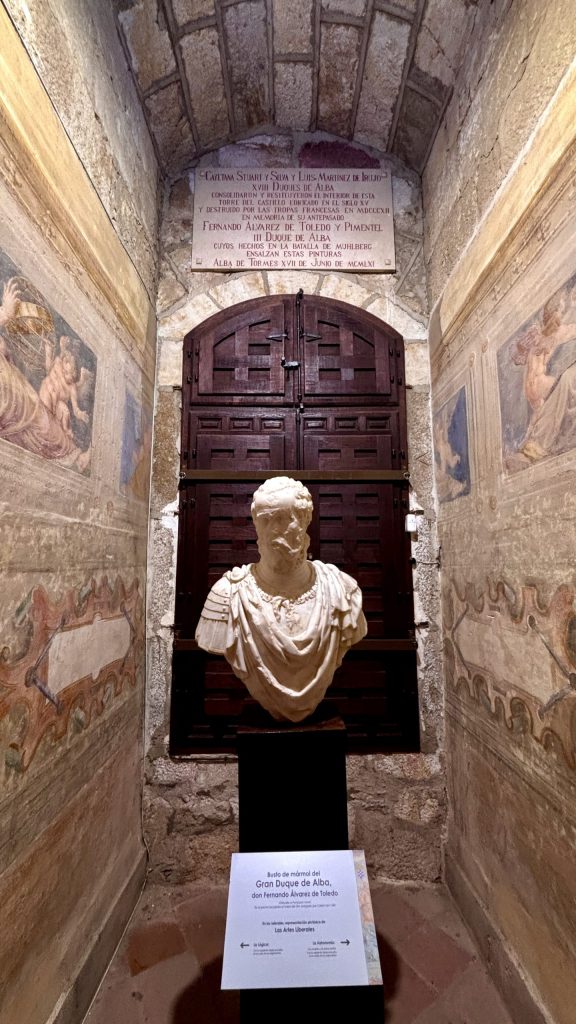
The Duke of Alba who gave his name to Alba de Torme.
Alba was named after the Duke of Alba who led the Spanish forces under King Carlos V in the 1500’s. Under his leadership the Spanish forces beat the German Saxon army at the battle of Muhlenberg. This led to a temporary return of Saxony to Catholicism.
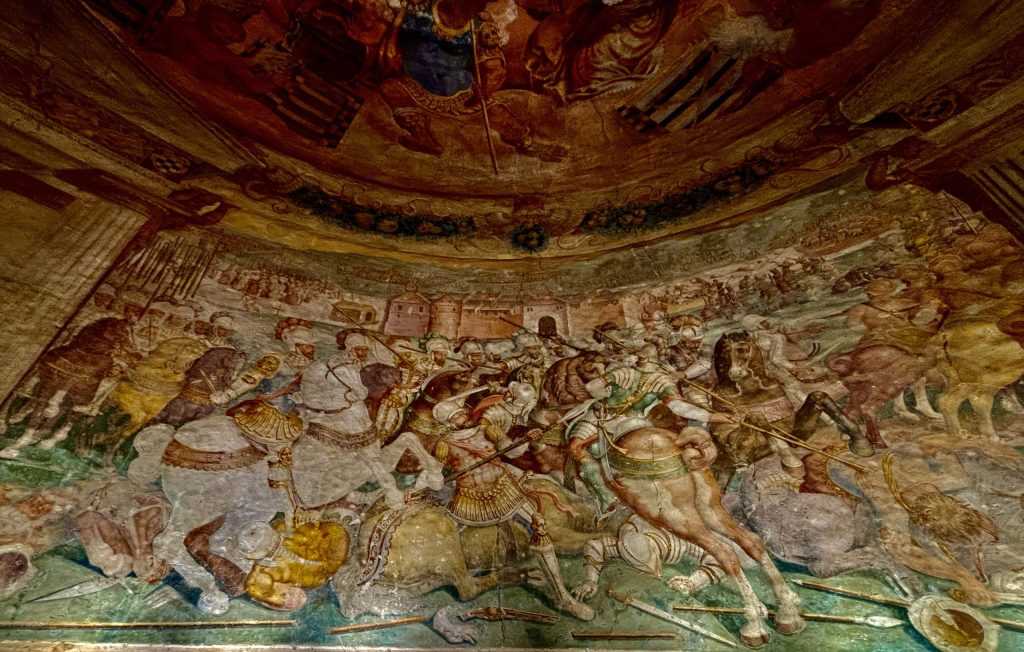
A mural from the 1560’s depicting the Dukes defeat of the Saxons at Muhlenberg.
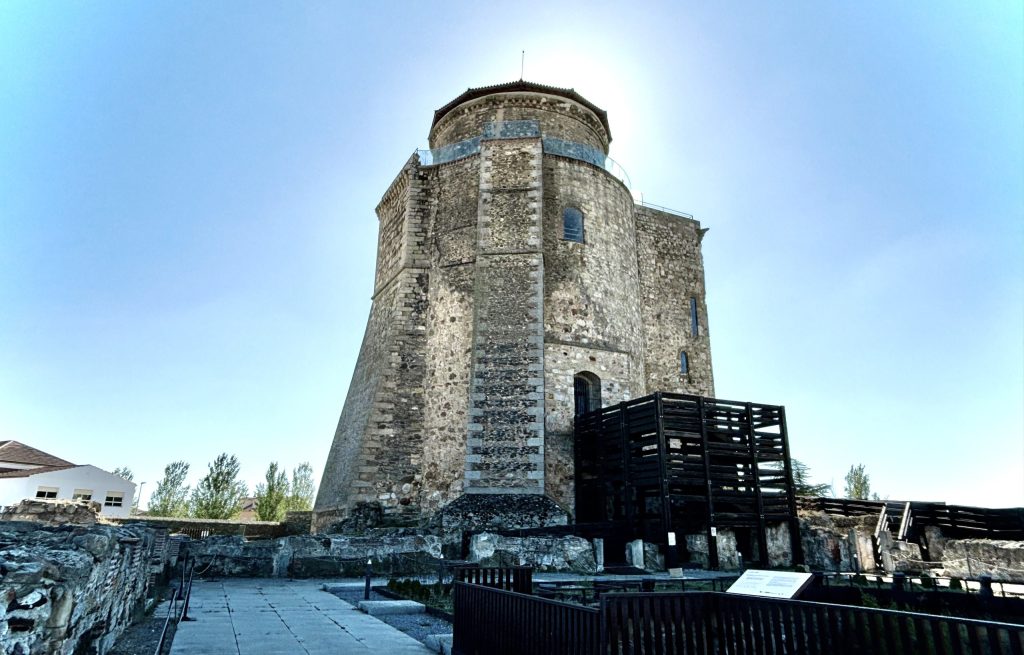
We visited the remains of his castle. Today all that remains of his castle is one tower. Alba was a crucial point during the Napoleonic Wars in Spain as it controlled one of the main river crossings of the Tormes River. It changed hands three times with the French taking it from the Spanish, a combined British, French, and Portuguese army taking it back, and then the French winning it again.
The bridge in the picture was the very one fought over during the Napoleonic Wars. Today it is still a major highway bridge.
When the French were about to retake the town the British commander ordered the castle to be burned to prevent the French from using it. The castle was never repaired and this led to it falling into ruins. Today the only surviving tower has been preserved and is a museum.
The remaining tower of the Castle of Alba. The photo of the bridge was taken from the top.
When we went to look at the tower we wandered onto the grounds only to have a nice lady tell us there was a €2 entrance fee that included the tower and a ceramics museum.
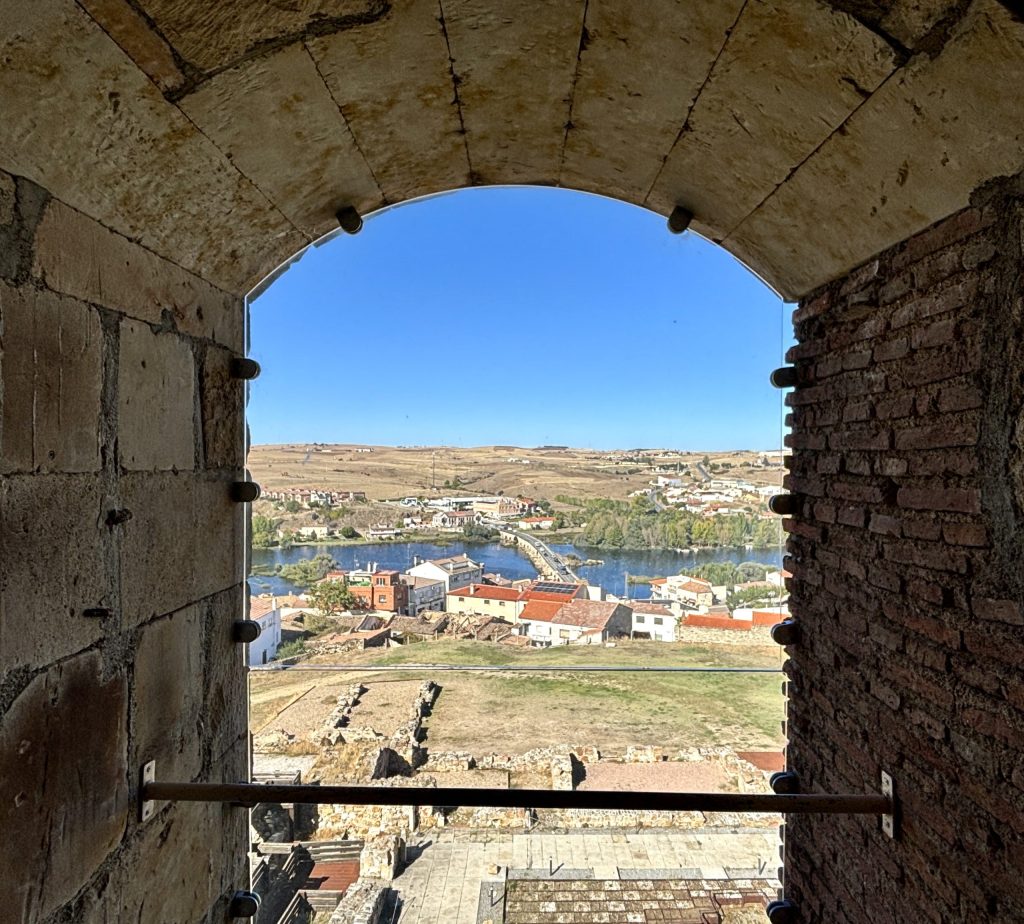
The view from the top most room in the tower.
The tower museum was very nice. It had some of the history of the castle, and an extensive explanation of the battles of the Napoleonic Wars. We spent quite a while looking at the exhibits and enjoying the views from the tower. It was also amazing to us that we had this large historical site entirely to ourselves.
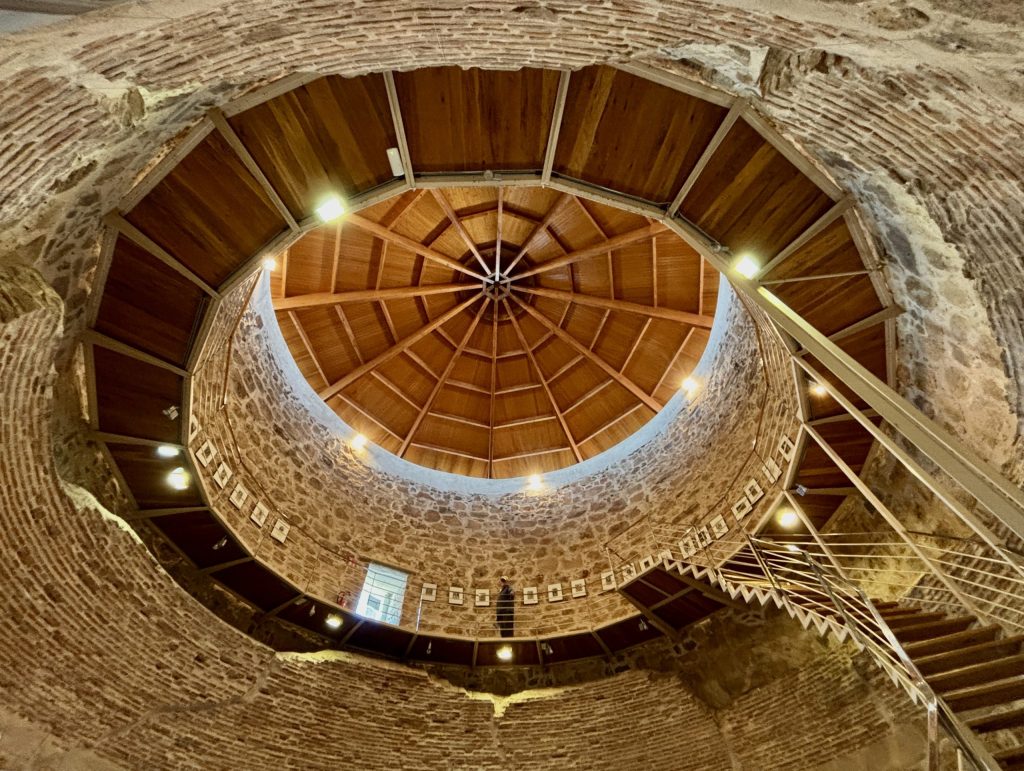
The modern stairway to the top of the tower. I am in the center to the right of the door.
After we finished the tower we headed over to the ceramic museum. I was not sure if it was going to be worth the walk that was mostly uphill.
On the way to the Ceramic Museum we passed the bull ring which interestingly had a roof. We have never seen one with a roof before. We knew it had a roof because we could see it from the Tower.
When we arrived at the ceramics museum we were again the only ones present. The lady at the front desk greeted us and then walked us through the entire museum explaining each display. She was charming, knowledgeable, and enthusiastic about the local pottery.
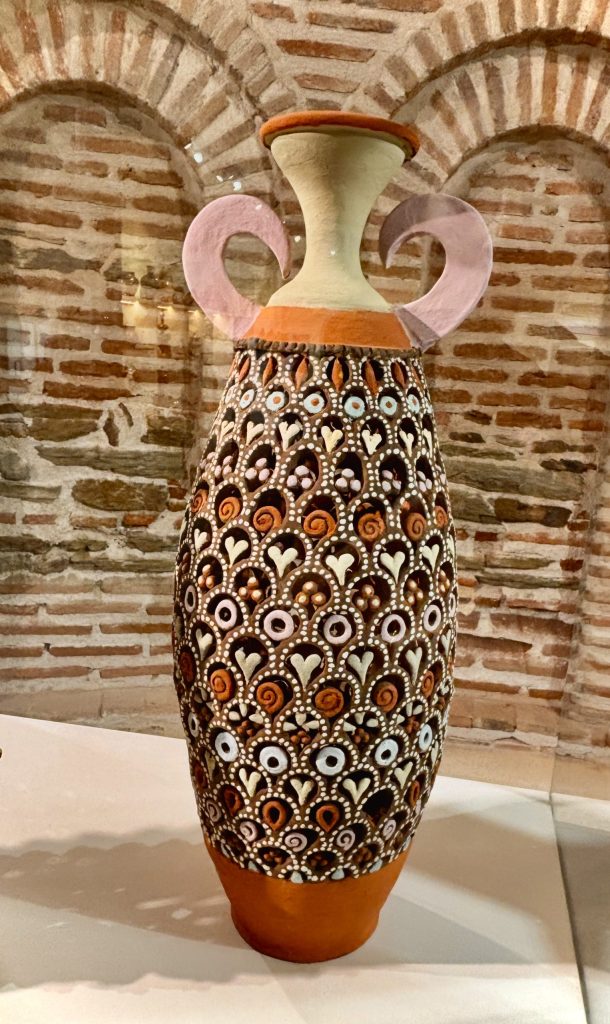
One of the most interesting pieces in the museum.
Alba was a center for pottery for centuries and at its peak had 11 major pottery operations in the town. Over time with the advent of first glass, and now plastic traditional pottery became obsolete.
I really liked this vase its fine clay loops.
Today only one company remains in business and they have shifted to decorative pieces to survive. The artisanship of the pieces was extensive. There were great displays showing the process for turning the clay, adding the handles and fine loops, painting the pieces, and then firing the pottery.
The delicacy of the loops all made from clay is amazing to me.
At first I was skeptical of a pottery museum, but in the end because of a charming lady who went out of her way to make us feel welcome, and really talented artisans who produced some amazing pieces of art, it was the highlight of our day.
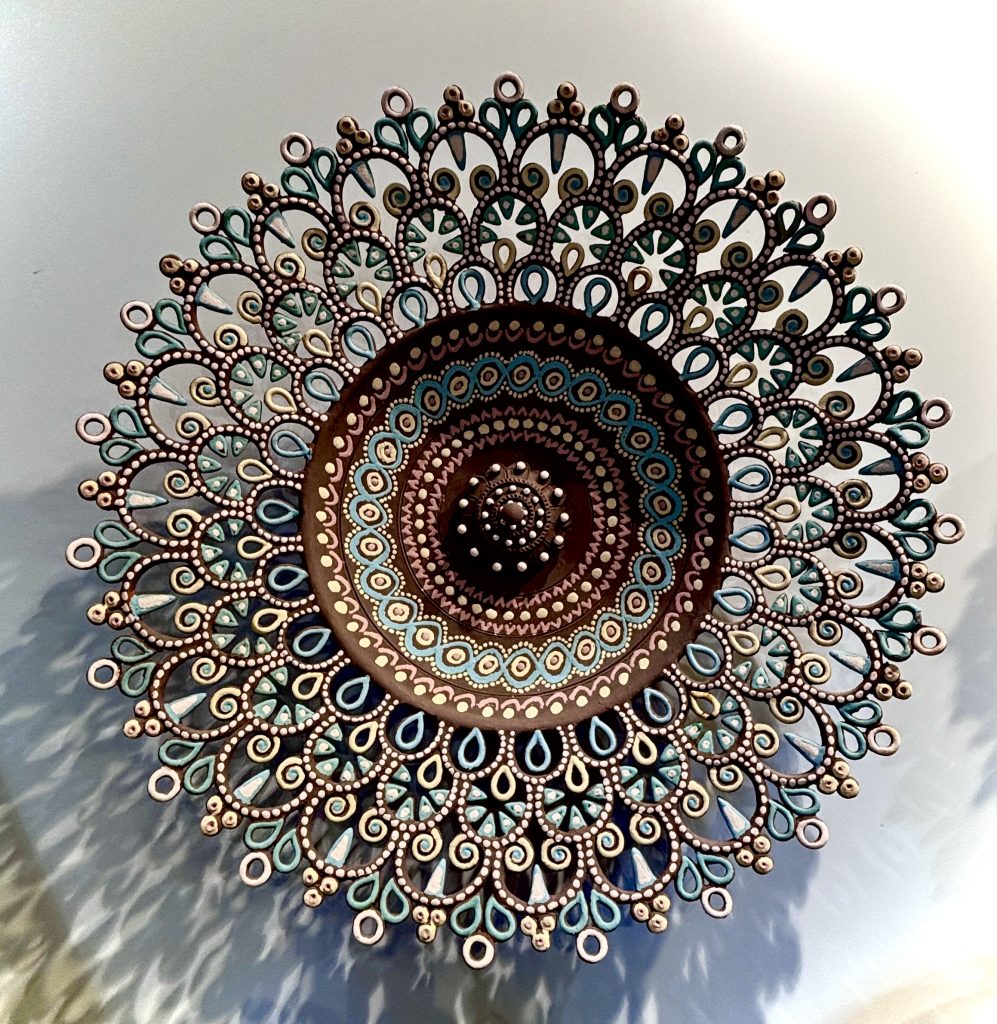
Another beautiful piece from the museum.
For the first time today we came across a campground that had closed for the season. Luckily we were only 30 minutes from Salamanca which we knew from a past trip had an excellent campground. Another bonus was that on the way to the campground we came across a giant LeClerc supermarket. Western Spain is really winning us over.
We added Avila to our list of places when we were in Madrid. So this morning we were up early and crossed around the outskirts of Madrid to get to this beautiful walled medieval town.
This spectacular wall is about 300 yards from our campground.
We have seen some famous city walls in our trips around Europe, the two most impressive until today were Dubrovnik in Croatia and Carcassonne in France. But when Ton and I saw the walls at Avila we both went wow.
A section of the wall looking down from the main gate into the city.
The walls in Avila are complete and well maintained. They are about 2.5 kilometers in total. We think they are the best walls we have seen. They don’t have the ocean like Dubrovnik which is probably why they are not as famous, but we were both surprised that this town is not higher on the must see places in Spain.
Looking down on the newer part of the town within the walls with beautiful mountains in the background.
The old town is nice and has all the things you would hope to see in a medieval city. Luckily for Avila it has not been fought over for over 5oo years. Also, luckily for us it has not boomed since the walls were built so the town didn’t feel the need to knock the walls down to allow for bigger roads and stuff. While it did not boom, it did stay wealthy enough to continue to maintain the walls.
Walking along the ramparts of the wall.
This lucky combination of factors gave us a chance to admire this feat of engineering up close. The city has done a good job of adding safety features that make it easy to walk without feeling like you are at risk. Some of the steps are irregular and steep, but there is always a good hand hold available to help you safely navigate the stairs.
Another gate with a decorative tower that was probably added later.
When we were driving we had pretty much decided to pass on climbing the walls, but as soon as we saw them we changed our minds and went looking for the ticket office. We are glad we did.
This is looking on the new town outside the walls.
After scrambling around the walls and town for about 4 hours we headed back to François with a bit of dread. Avila provides a really nice aire that has beautiful views of the walls. But when we arrived there was a huge traveling carnival set up in the parking lot next to the aire. We had to take a makeshift route to access the aire as the carnival had closed the normal way in. Our hope was that the carnival started tomorrow on Friday and not tonight.
The carnival in the lot next to our campground. The power point you see marked 5 and 6 is part of the aire and about 50 feet from where we are parked. You can just see the towers of the wall behind the ride.
Unfortunately, as I type this at 9pm I am being subjected to a thumping bass, horns, generator noise and whistles from different rides in the park. So as much good luck as we have had on this trip running into cool events unexpectedly, today we are paying back some of that good luck by running into a modern event that is not up our ally. It is not going to be an early nights sleep as the Spanish are notorious night owls so we have no idea what time this is going to shut down.
It was time to get out of the big city so we headed about an hour south of Madrid to the small village of Chinchon. Chinchon is designated as one of the beautiful villages of Spain.
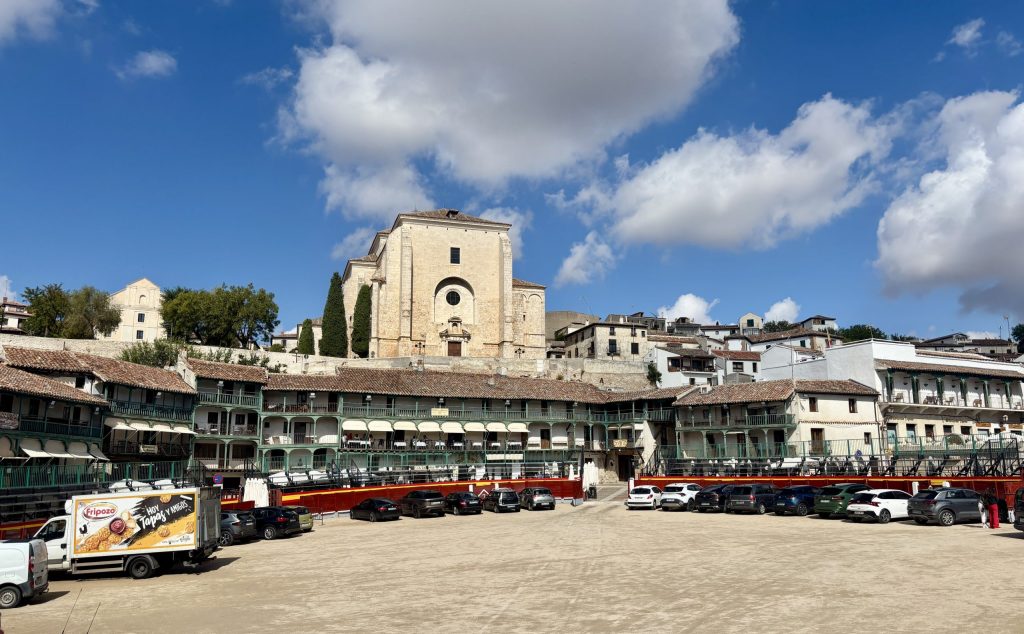
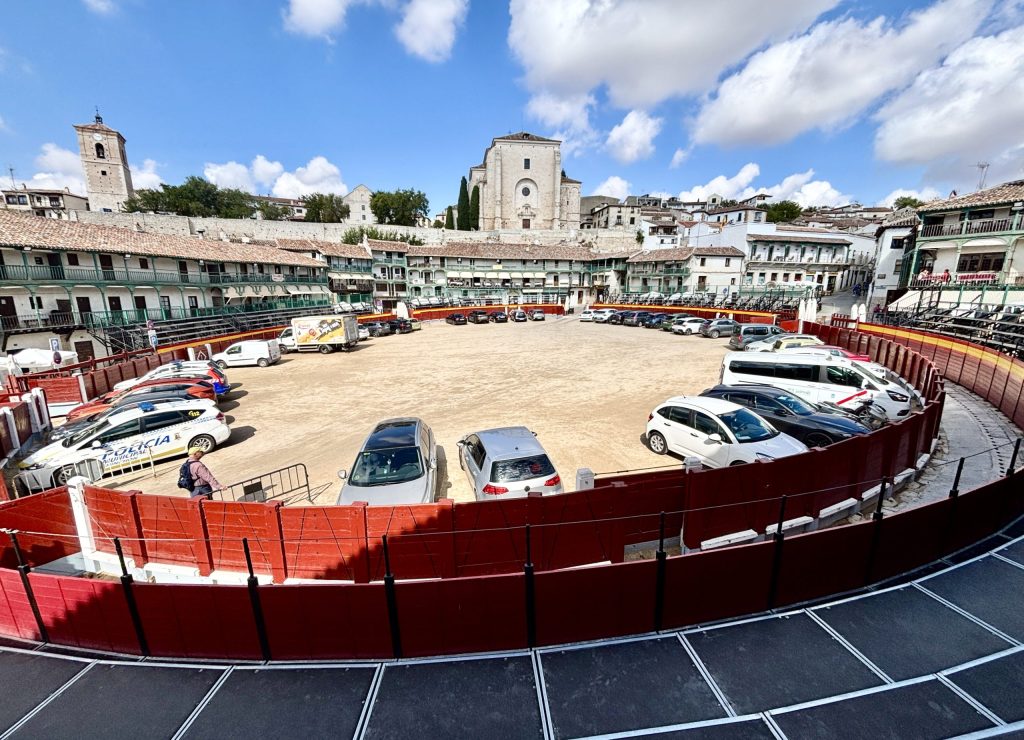
They are having their annual bull fight in 10 days so the Plaza Mayor has been converted into a bull ring.
It just happened that we passed one of the two Costco’s in Madrid so we swung in to fill up François. Today we got the cheapest diesel so far on this trip at €1.68 per liter. All the money we saved on fuel we spent inside Costco on food and stuff, which of course validated their business model.
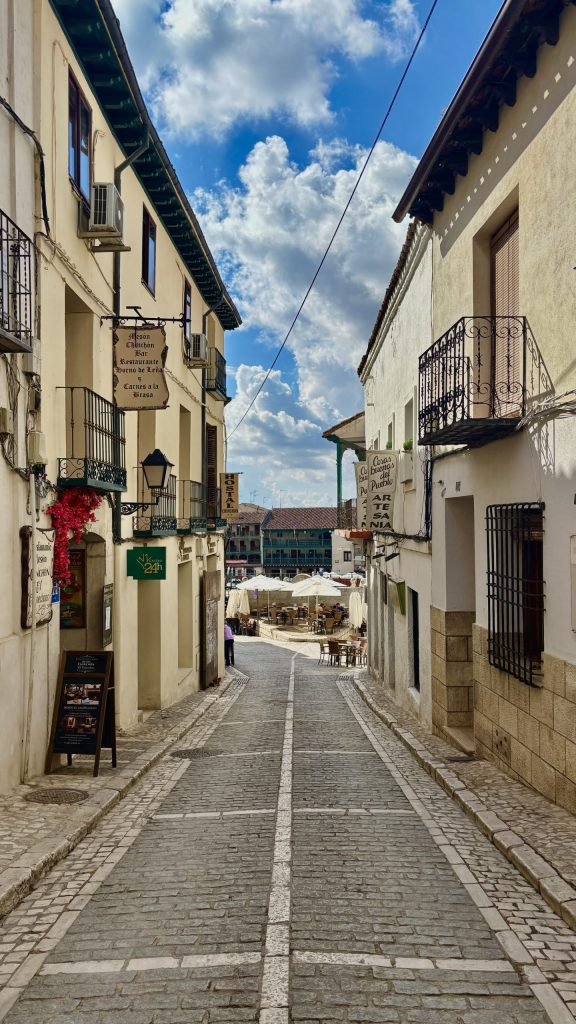
One of the streets leading into the Plaza Mayor/bull ring.
We are sharing a small but very well equipped aire in Chinchon with a Swiss family and their dog. You enter send a text to the owner and he gives you a number of Codes you use to access electricity, the showers, and the WIFI. Once I figured out the system it was easy. When we leave in the morning we will leave our payment in a mail box. It is not all honor system as he has our license number and there is a camera so he can confirm you were here if you abscond.
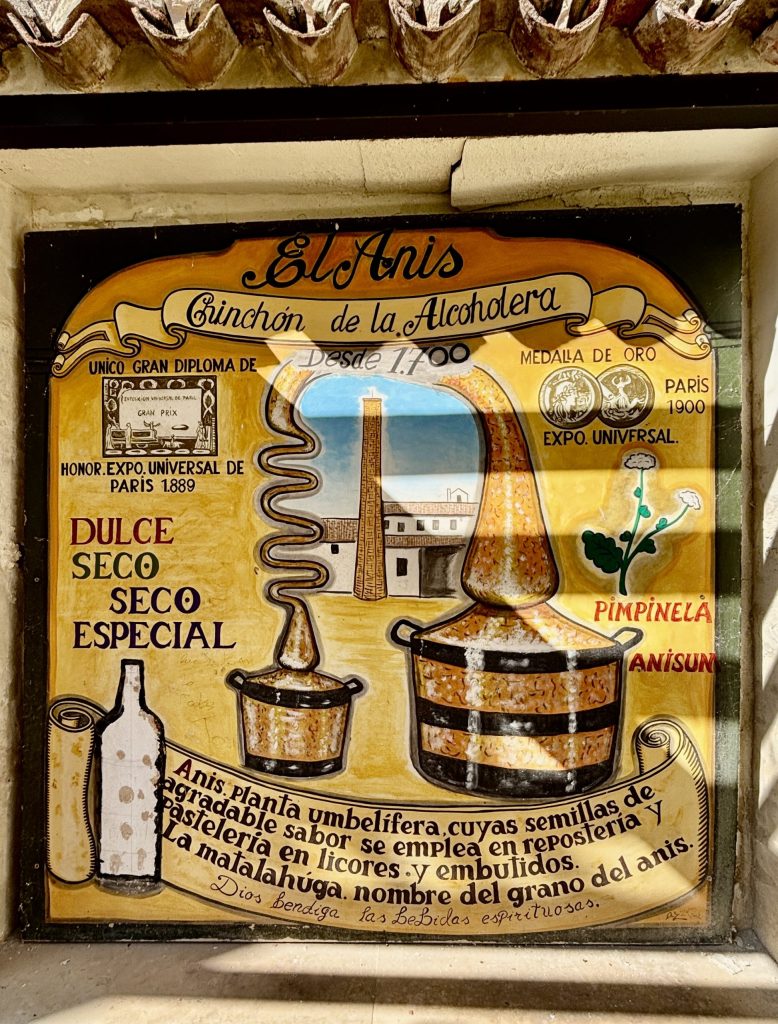
Chinchon is famous for a type of Anis, but we didn’t sample any.
We headed into town about 2 and the town was in Siesta mode. But a few of the bars on the Plaza Mayor were still open and there were a few people in each of them, so it was not entirely dead. During our travels we have come across a few towns that are not large enough to have a dedicated bull ring, but instead designed their main squares so that they can be turned into a bull ring. Chinchon had just finished converting their square into a bull ring and it was interesting to see how they did it.
The upper floor apartments surrounding the Plaza Mayor are rented by the local restaurants for the Bull Fights and they become the expensive seats.
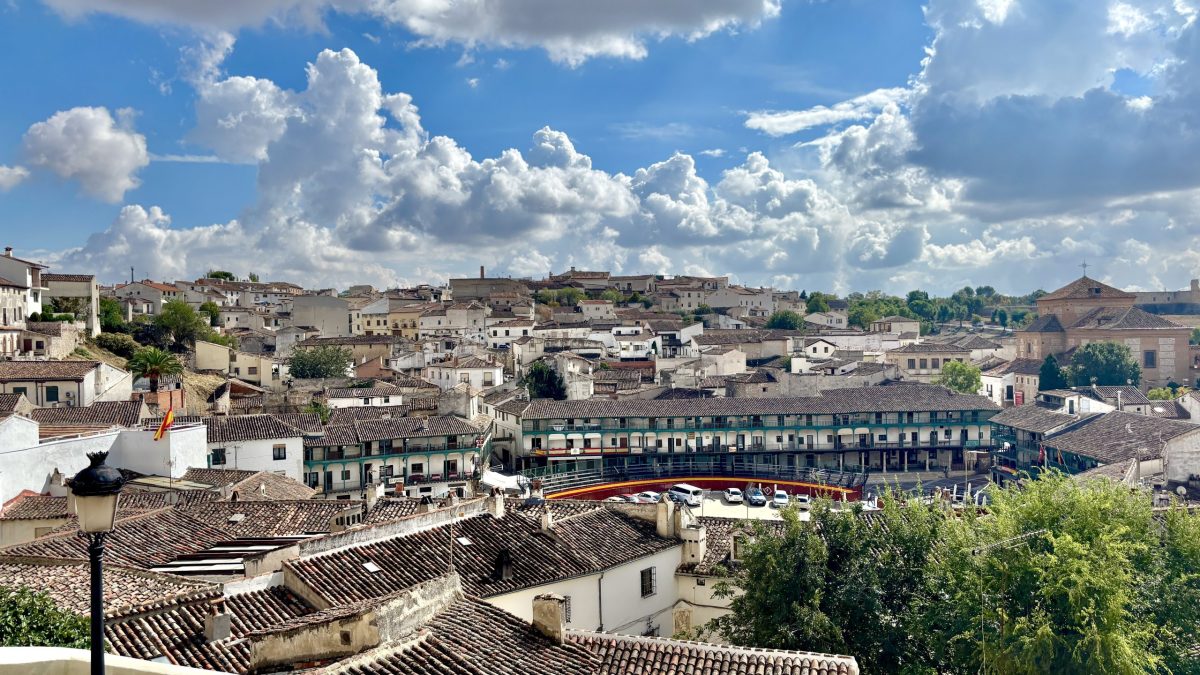
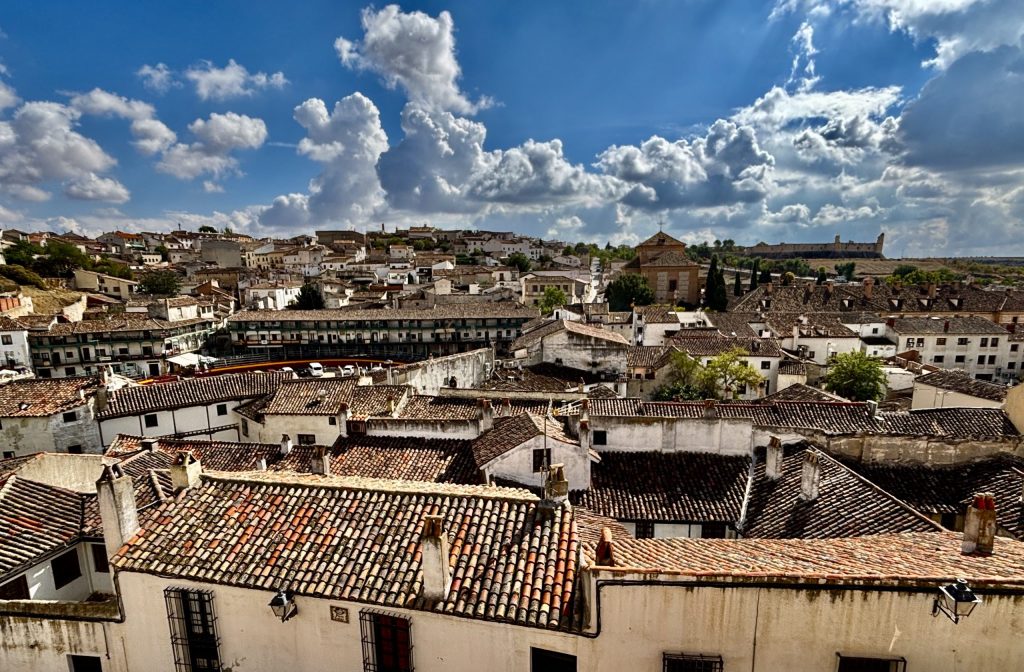
After exploring the bull ring we headed up the hill to the old palace for the local lord of the region. It was another good climb, but fortunately last nights rains had brought in cooler air and knocked back some of the humidity. From the palace we had an excellent view of the city and the surrounding countryside.
Looking down on the roofs of the town from the palace.
The last sight for Chinchon was an old Carmelite Nunnery that had been converted into a very posh and judging by the prices in their coffee shop expensive hotel. Feeling out of place we headed back to the Plaza Mayor and enjoyed an afternoon beverage looking out at the bull ring and up at the palace. After our rest we headed back to François for the rest of the day.
I’m looking down on my imaginary fiefdom from the stairs of the old palace.
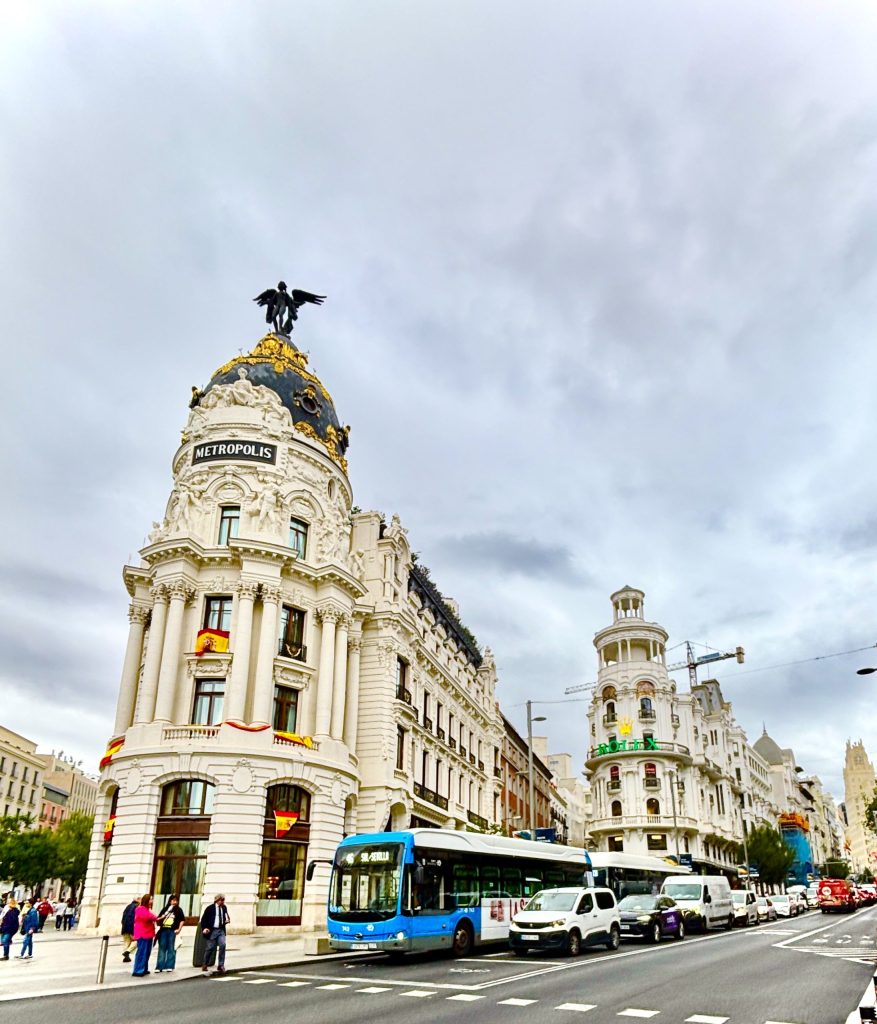
Every time we come to Madrid the power goes out. I wanted to return to Madrid to make up for the day we lost last time we were here when the power went out in all of Spain. We had hit all the big tourist spots on the last trip but we didn’t get a good feel for the city as the day we planned to visit neighborhoods was wiped out by the power outage.
Art deco buildings in Madrid.
Ton provided me with a list of markets, chocolate shops, restaurants and bars in a couple of interesting neighborhoods near the center and our day was planned around visiting these places and sampling their offerings. We were also operating under a bit of pressure as the weather called for thunderstorms starting at 4 pm.
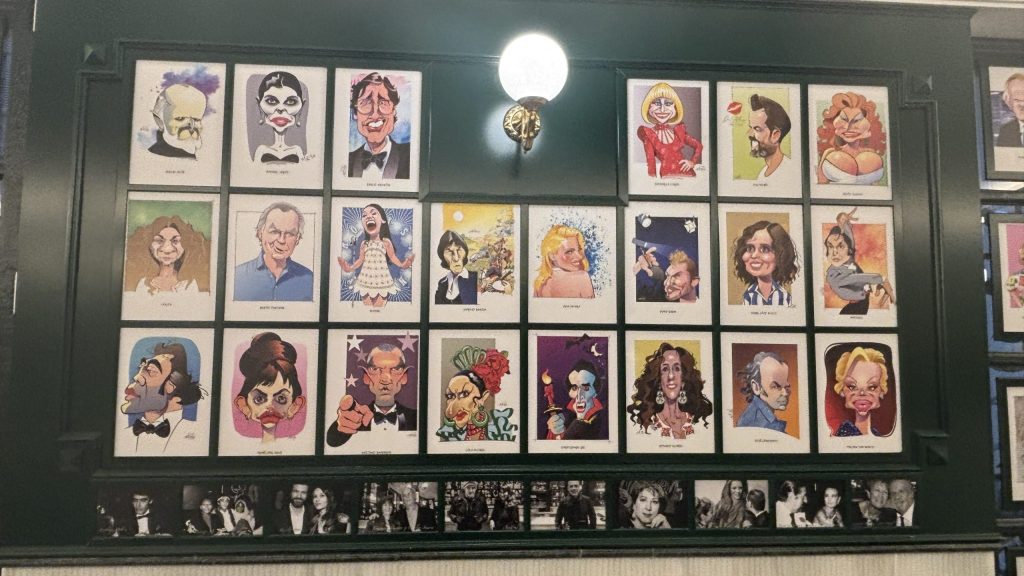
Caricatures of famous people who had visited the Chocloteria before us.
Our first stop was Chocloteria San Gines which is a must stop for all tourists in Madrid for their famous Churros. Even on a relatively quiet day there was a long line to get in. As we were waiting a guy in a chefs outfit with the company logo on it came to us and said there was another place to get in with no line. Taking him at his word we followed him across the street to a branch shop and walked right in. The Churros dipped in chocolate were worth the trouble. In the back room was a large wall of caricatures of famous people who had visited in the past. They told us ours would be up next time we came.
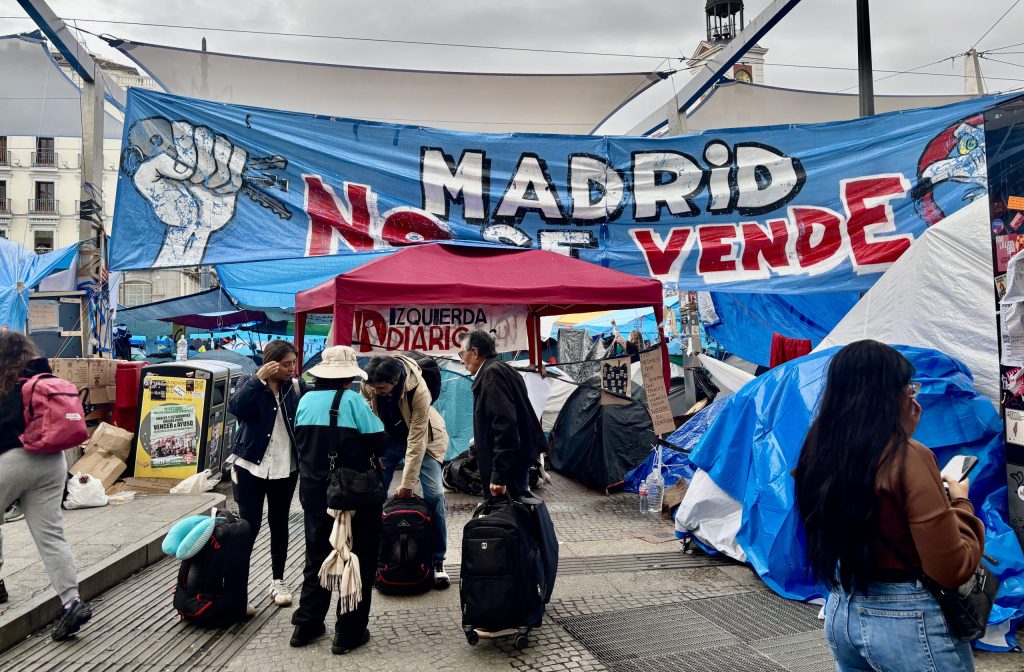
The tent city protesting housing affordability on one of the main squares in Madrid.
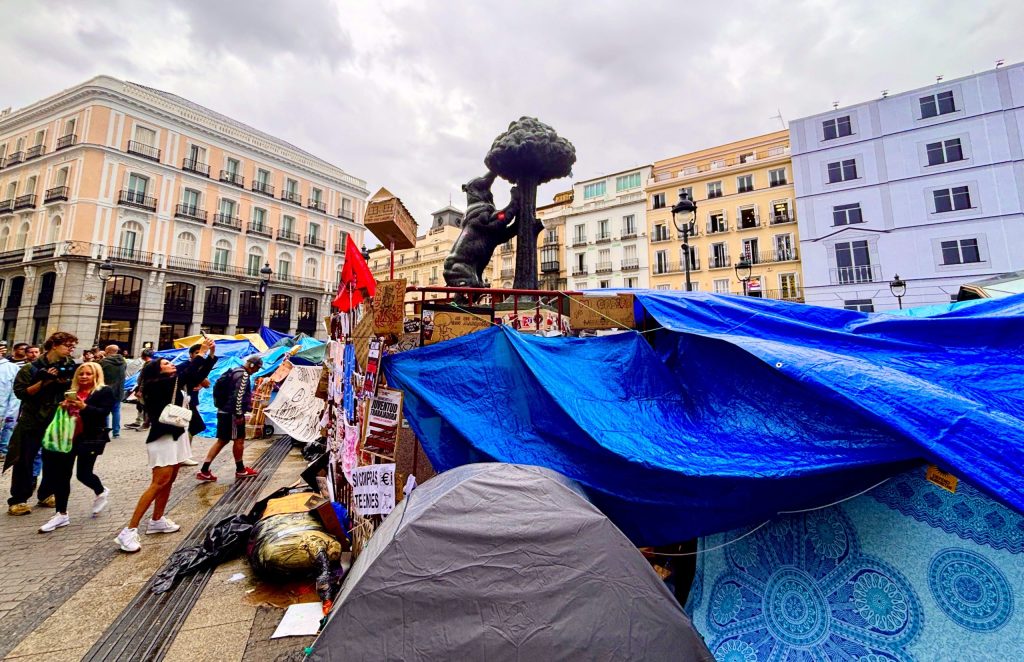
On our way to our next stop we came across a giant tent city on one of the main squares. The tent city was set up to protest the lack of affordable housing in Spain. The protest was started when a 87 year old women was evicted from her apartment she had lived in since 1956 after her rent was increased by 250% following the purchase of her building by a corporation. This story has been on going while we were in Spain and has even led to the Prime Minister calling a snap election after legislature he proposed to address housing costs failed in parliament. It was a big protest but very quiet, it had turned into a bit of a tourist attraction itself which is a little ironic as the protestors cite over tourism as one of the causes of the rise in rents in cities like Madrid, and Barcelona.
This statue of a bear and a tree is one of he symbols of Madrid that is now part of the protest tent city.
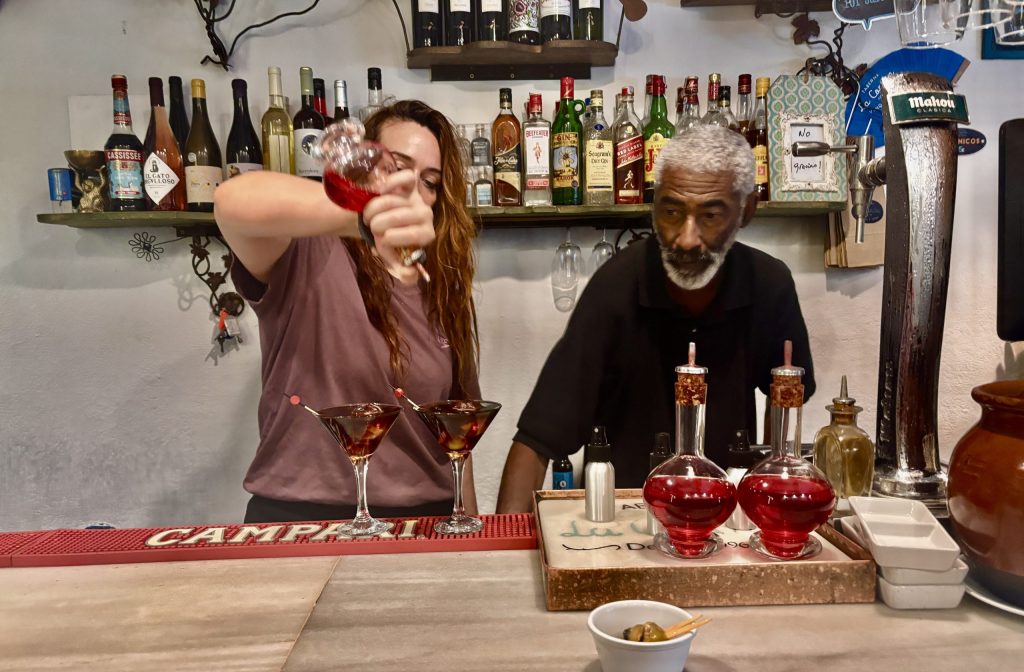
Our next stop was a place famous for their vermouth. Spanish vermouth is one of my favorite things about visiting Spain. The bar we visited had invented a vermouth cocktail called the Manuela. It was vermouth with a splash of Aperol. The vermouth was excellent and the atmosphere in the bar was cool.
Our bartender putting the finishing touches on our Manuela’s.
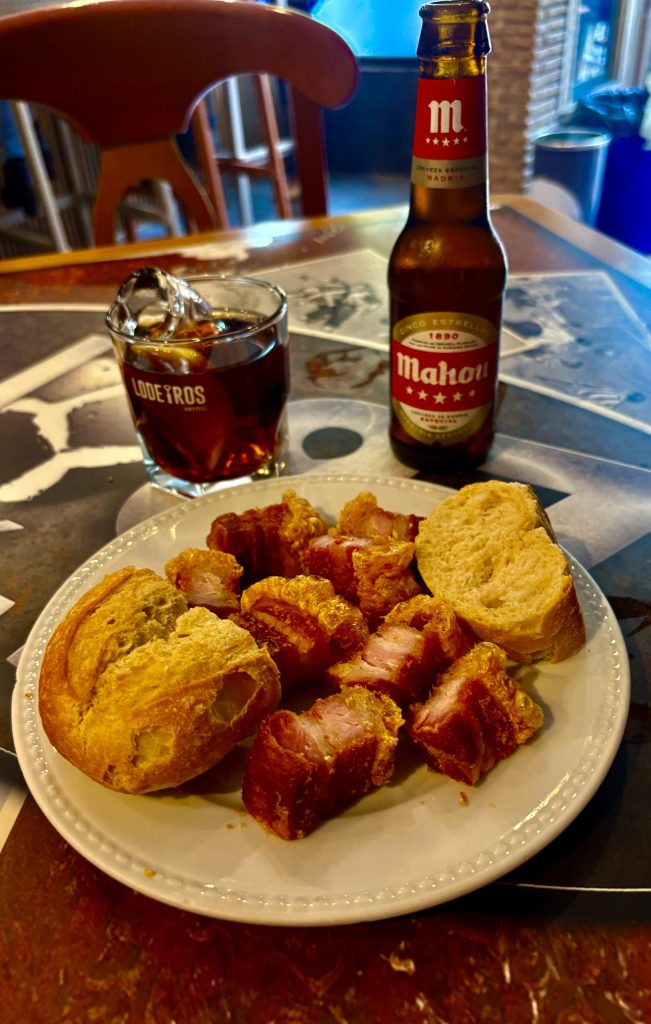
After our vermouth we needed some food. Most of the tapas places were offering Torrenzos de Soria so we decided to see if the Madrid ones matched up to the originals. They were excellent but not up to the standard of Soria which is what we expected.
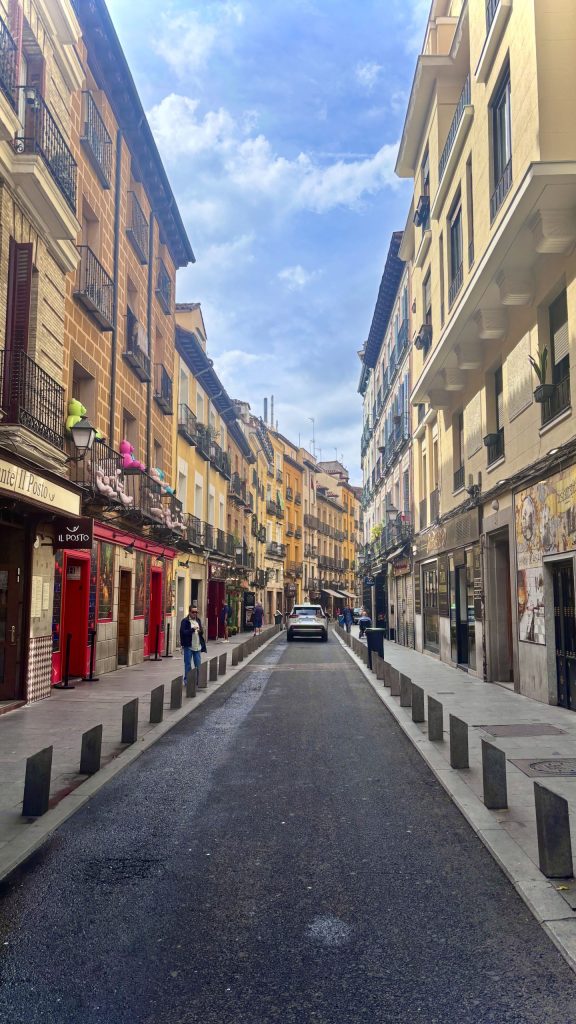
As we walked from place to place we enjoyed views like this.
I like the atmosphere of the streets of Madrid. Paris is romantic, Vienna is elegant, Prague feels like a party, Madrid feels like a place with blue collar roots. There are cool buildings, but there are a lot more dive bars designed for 15 to 20 people to enjoy a beer snack and a chat, than big fancy 5 star restaurants. I think I like that in a city more than the fancy places with Michelin stars.
Our last stop for the day.
Our last stop for the day was one of those small bars. It was in a gentrified neighborhood that was once blue collar. But the gentrification didn’t mean the bars were replaced by fancy restaurants, it meant the beer went from San Miguel to Lagunitas IPA. The bar we went in had two rooms. To get to a seat in the back room you literally crawled through a hole in the bar to get back there. Luckily for us there was a table in the front.
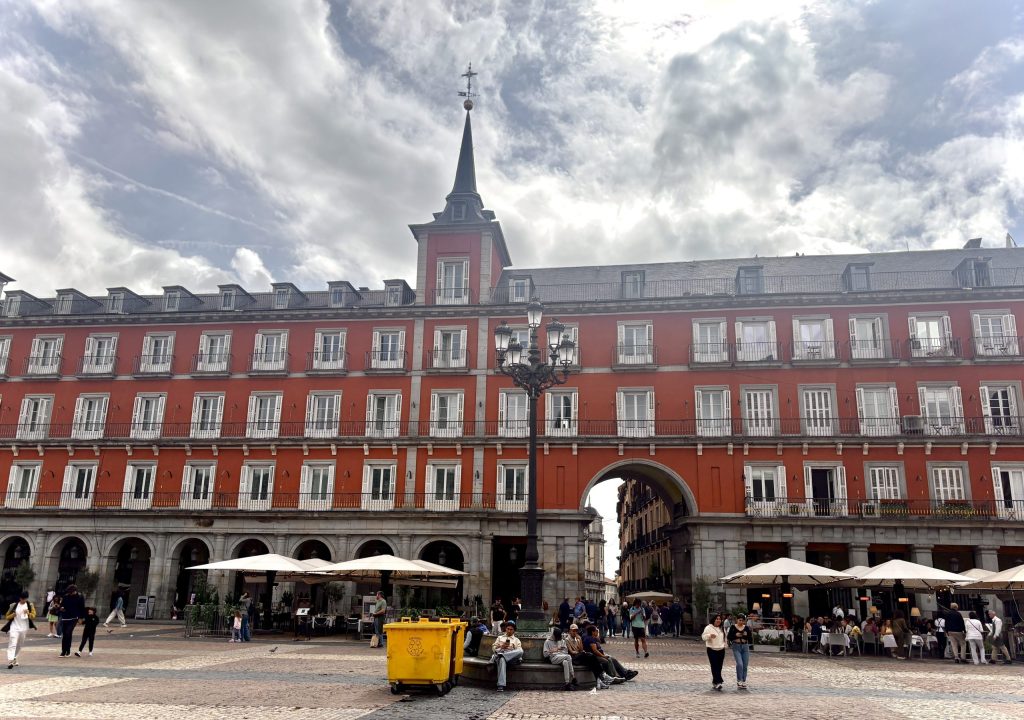
The Plaza Mayor in Madrid.
It was time to head back to the campground as the skies were darkening up. We had about 1 kilometer to walk from the metro to the campground. We almost made it, but for the last 400 meters (yards) we got caught in a downpour and were pretty wet when we reached François.
Madrid was hopping. Ton worked hard to get this shot of a pretty empty street.
There were a series of thunderstorm for the rest of the afternoon, and at the end of the third one the power went out in François. We were laughing that we were going to be banned from Madrid. This time we were lucky, it was only a section of the campground that lost power, and it was restored after about 45 minutes.
I thought we owed Madrid another day after our last trip here was disrupted by a nation wide power outage. We had an easy drive to the only campground in Madrid. After we set up Ton suggested a day of rest and I agreed. The only thing we accomplished in the afternoon was a load of clothes.
We were debating today’s destination last night, and the debate continued into this morning. Do we push to Madrid and spend 4 hours on the road, or do we stop in Soria which was about 90 minutes from Logrono. We finally settled on Soria.
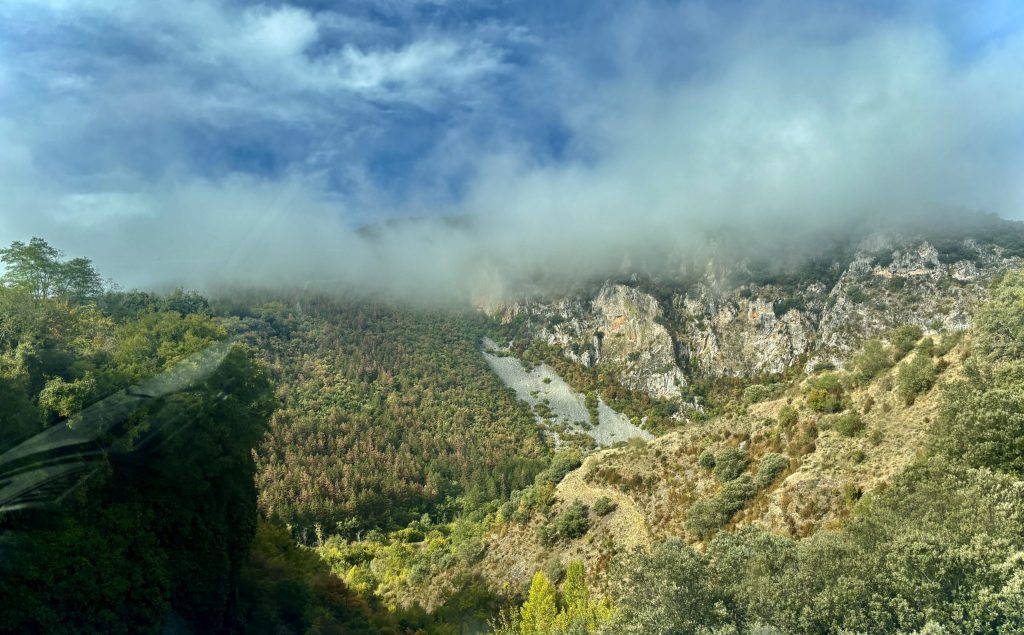
The Sierra de Cebollera Mountains.
About 1 minute after pulling out of the campground we came to a cross road with a local police officer directing traffic. It turns out that today is the Logrono marathon. So we sat at the intersection for about 10 minutes until there was a gap in the runners big enough for him to allow us to cross the road. It runs out that our route out of the city paralleled the route of the race for about 6 kilometers. At first it was cute than eventually it was annoying as we were forced onto side roads that were tight for François.
The Sierra de Cebollera’s were quite beautiful.
Eventually we got untangled from the marathon and started heading to Soria. Of the 100 kilometers to Soria about 80 were in the mountains. The road was a good two lane road and we were the slowest thing on the road so it was not too stressful and the Sierra de Cebollera’s were beautiful.
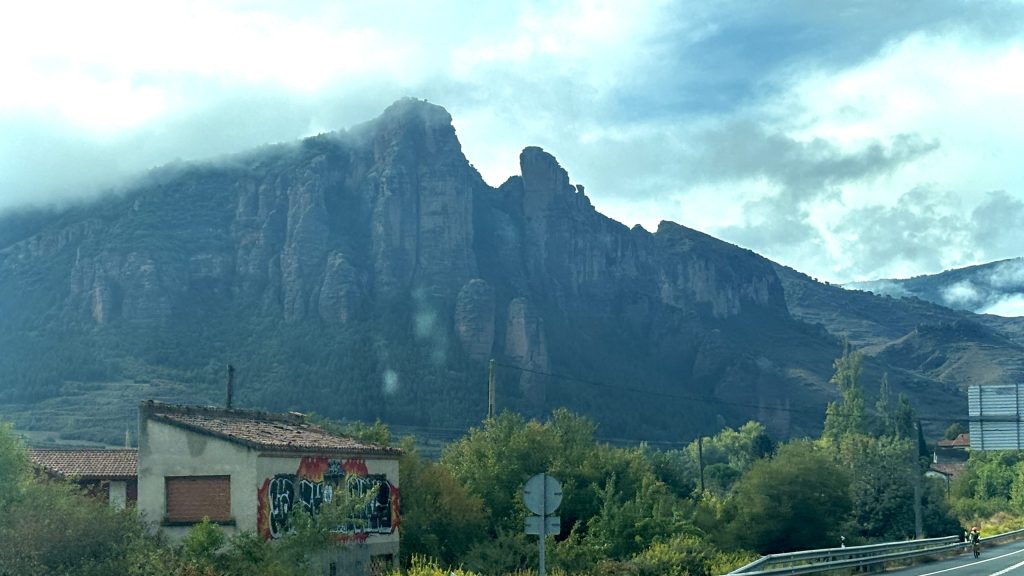
Cool rock formation.
Soria is the capitol of the Soria Province which is the least populated Province in Spain. I know I told you Logrono was the capitol of the least populated Region in Spain yesterday and they are both right. Autonomous Regions are bigger than provinces. Soria is located in the Castile y Leon Region. Anyway enough about population.
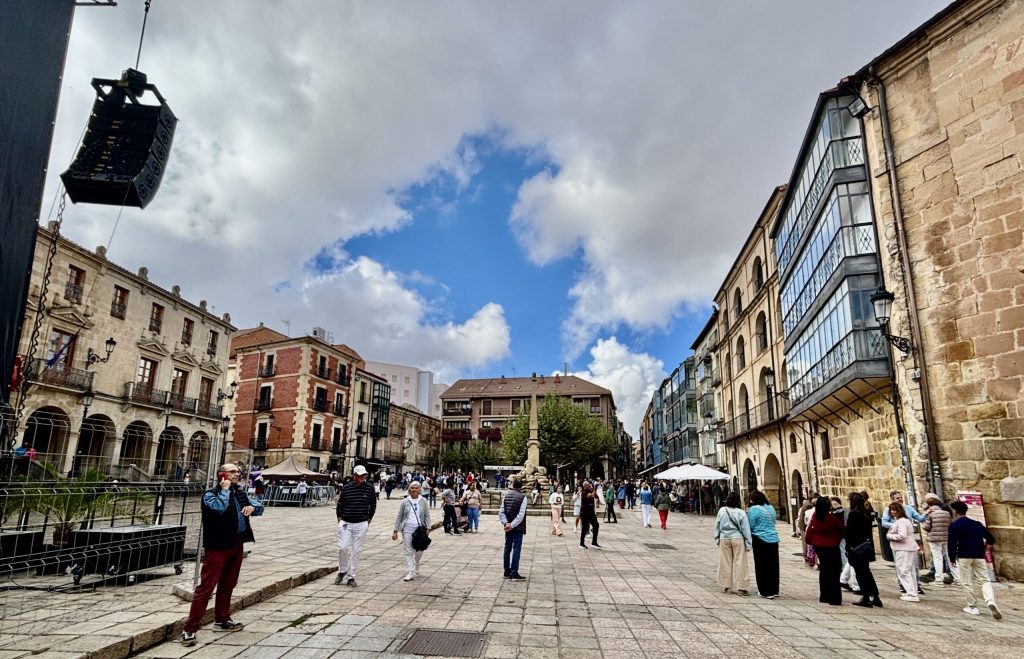
The main square in Soria.
Given it’s lack of population I was not expecting a lot of activity on a Sunday morning. But all the parking lots coming into town were packed. We did quite a lot of driving before we found a place.
The crowd heading towards the fiesta.
Like most medieval cities the center of town is located on top of a big hill. So after we parked we found ourselves climbing up some fairly empty streets before we suddenly popped out on Cervantes Park. The park was full of people and we quickly found that we had arrived during their fall Fiesta.
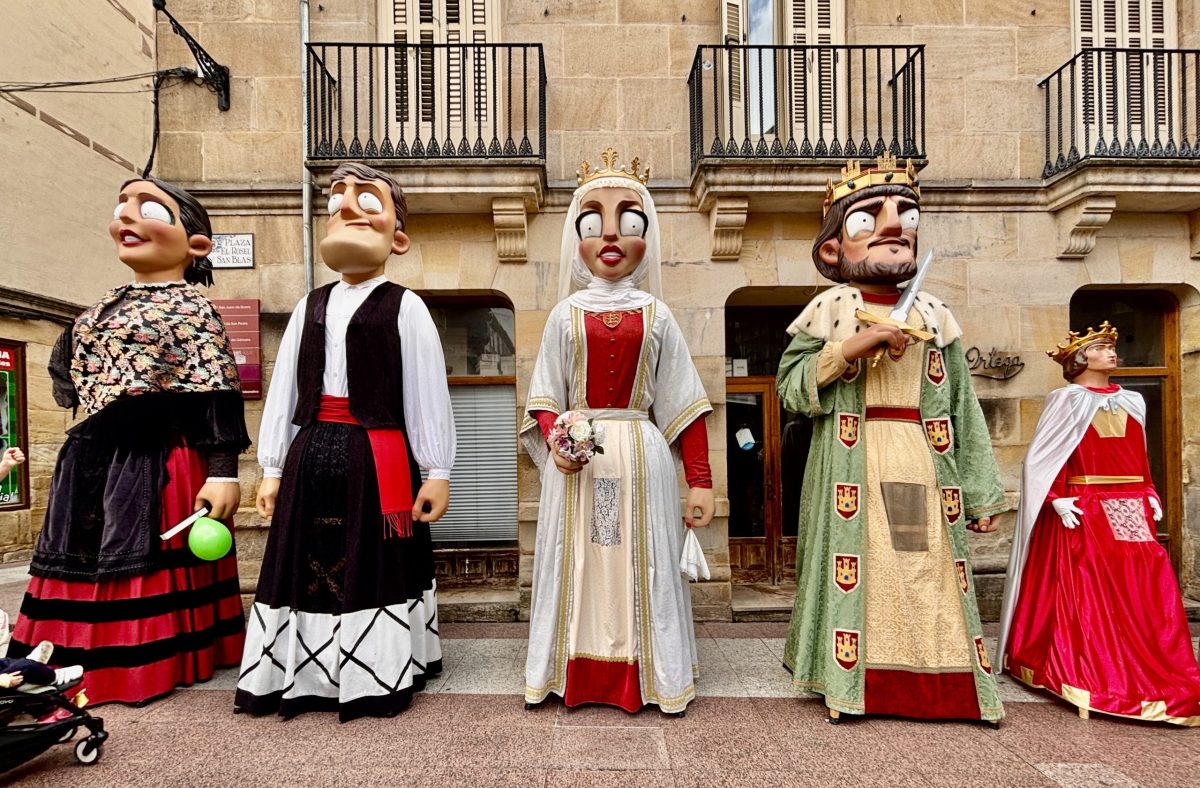
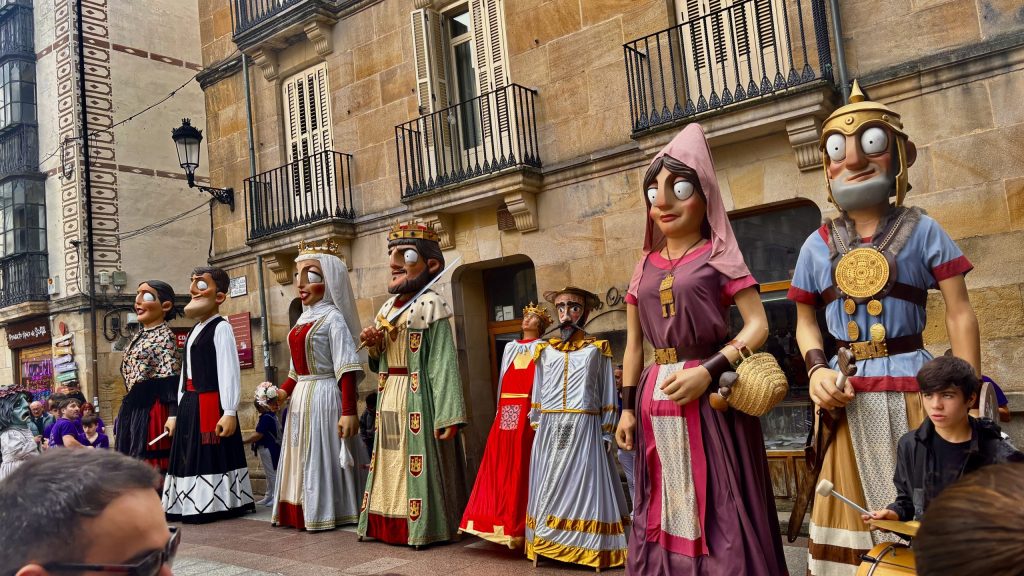
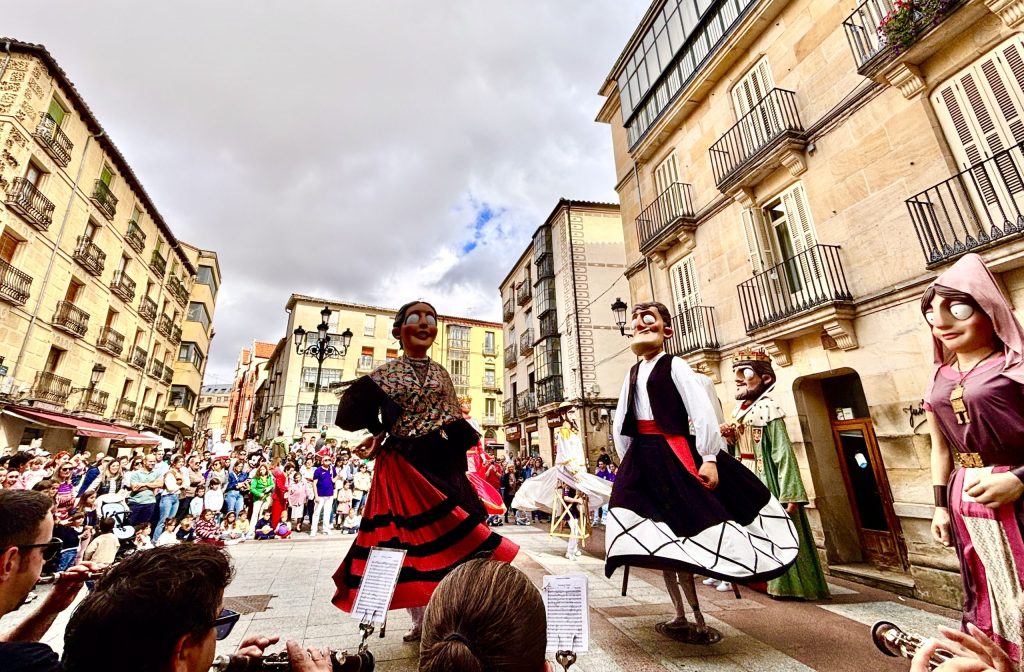
The “Society of Giants and Big Heads” was putting on their annual fiesta today.
In the distance we heard medieval sounding music and saw big figurines moving down the main street of town. So we followed the music and joined the parade as it made its way down the street.
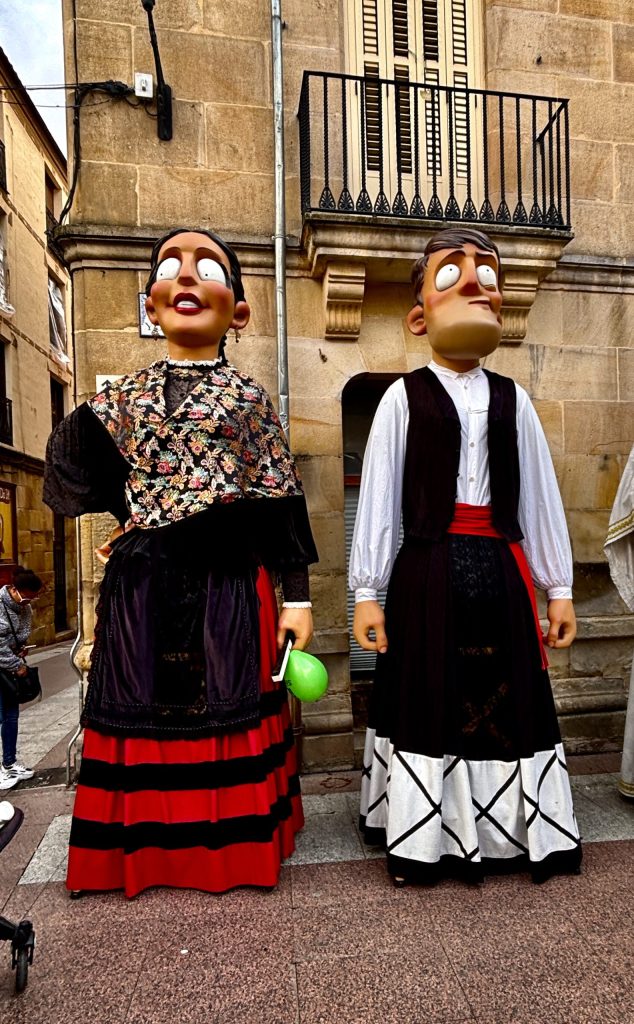
The larger figurines were 10 to 12 feet tall and probably weighed 150 pounds. They were controlled by one person.
Everyone was having a wonderful time and the children were out in force. Ton was in heaven dashing around taking pictures. I was busy trying to keep her in site in the crowd. I didn’t even try to keep up with her.
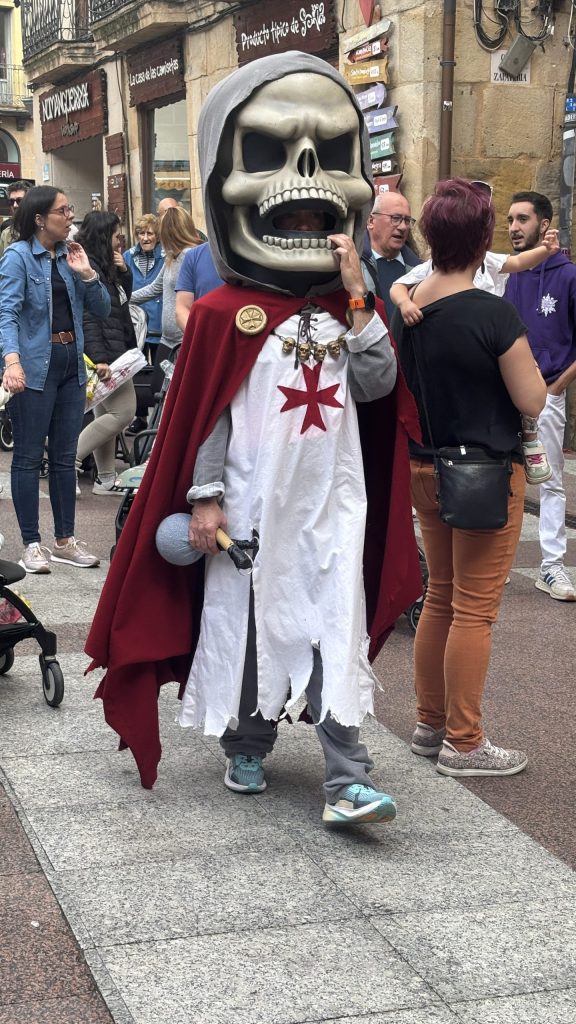
This is a “Big Head”.
Spain has outdone itself the last week. Each day has had a completely unexpected event that has delighted us. We have been incredibly fortunate.
Dancing Giants.
We had one more thing to accomplish which involved food. Soria is famous for a pork dish called Torreznos. It is marinated pork belly fried in a special way. It is very similar to a Thai dish that we both love so after chasing the giants we headed into a bar to get a dish. Ton is famous for tasting a dish and giving this review; its good, but the Thai version is better. For maybe the first time ever her review of Torreznos was that this is better than the Thai version.
Torreznos de Soria, fried pork belly that is better than its Thai counterpart.
By the time we finished our Torreznos the fiesta was starting to break up. We headed back to François and found a campground. In the end we were thrilled that we did not by pass Soria for Madrid.
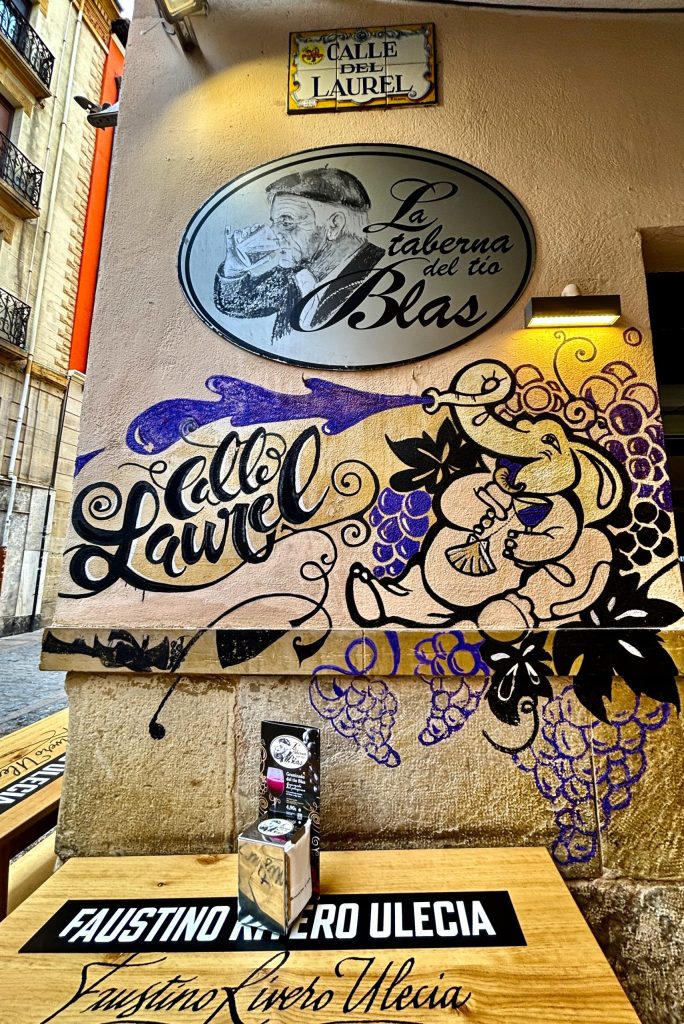
We spent our last day in Rioja enjoying two or our favorite things. Armed with research from Ton and advice from a Scottish/Irish couple we have been sharing campgrounds with we headed into town to do a run on the Tapas and Pinxto bars on Calle Laurel.
Calle del Laurel one of our favorite gastronomic experiences.
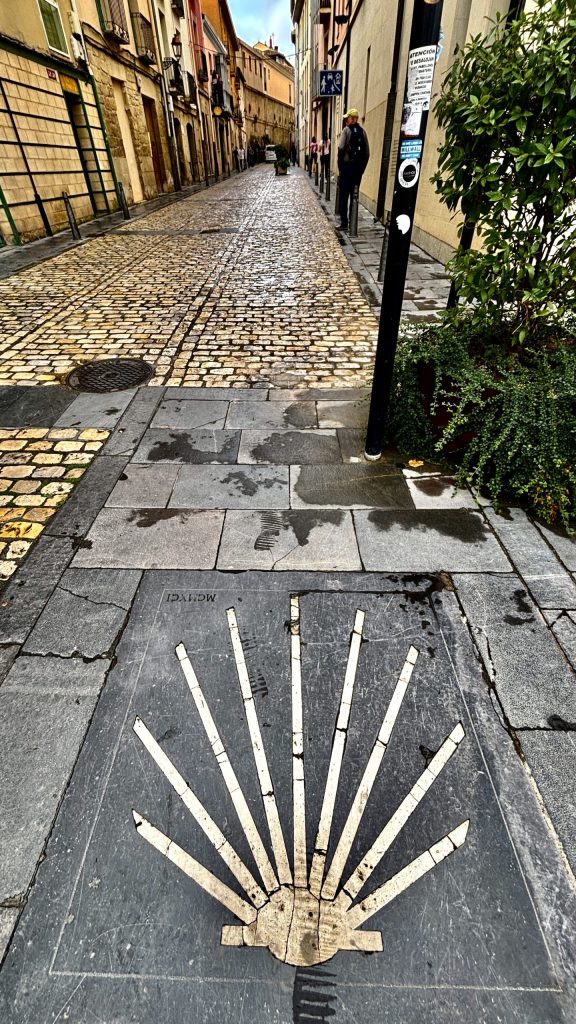
We left François at 11:30, because Ton wanted to check out some of the Santiago Camino infrastructure. All of northern Spain has tremendous infrastructure to support the pilgrims on the way to Santiago de Campostelo. Historically Logrono was one of the main stops on the camino and they have a lot of hostels to cater to the pilgrims.
The shell designating the route for pilgrims is a little more abstract in Logrono. This is the street dedicated to pilgrims.
As we were walking up the street we saw a group of mostly older gentlemen gathered on the street in front of us. They were dressed in capes and berets so we walked up curiously. Ton whispered to me to pretend to look at something so she stealthily take their picture. Before we could execute our plan; one of the gentlemen came over grabbed Ton and called over some of his friends to pose for a group picture. We had a good laugh together and after the picture there was much handshaking and goodbyes. Another time when we wished we could speak Spanish.
Our not so stealthy group photo with the Society of St. Gregory.
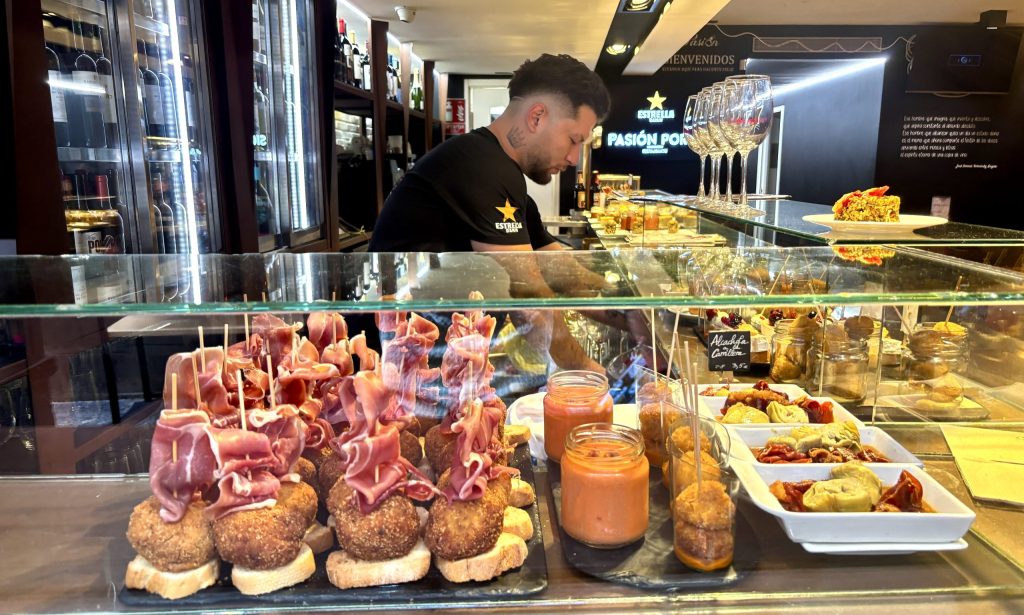
Now it was time for the main part of the day-eating. We had a plan for Calle Laurel , we would only have one dish and one drink in each bar. We would split the dish and the drink and then move on to the next bar. This plan was helped by the fact that several of the bars only offer one dish, but they are very good at it.
Sometimes the hardest thing was selecting the one thing to try.
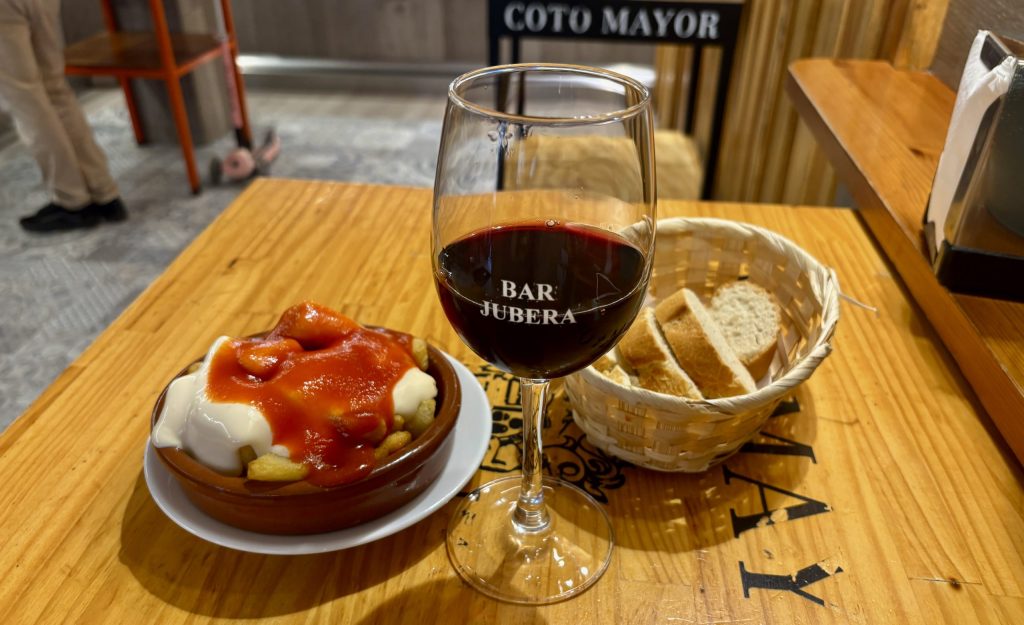
The only place on the list I picked was the first one. The only dish they offered was roasted potatoes. In this place we each got a glass of wine to set a base. Our next stop was about 50 feet up the street and the only dish they offered was roasted mushrooms. This time only one glass of white wine.
My roasted potatoes with pimento and cream sauce.
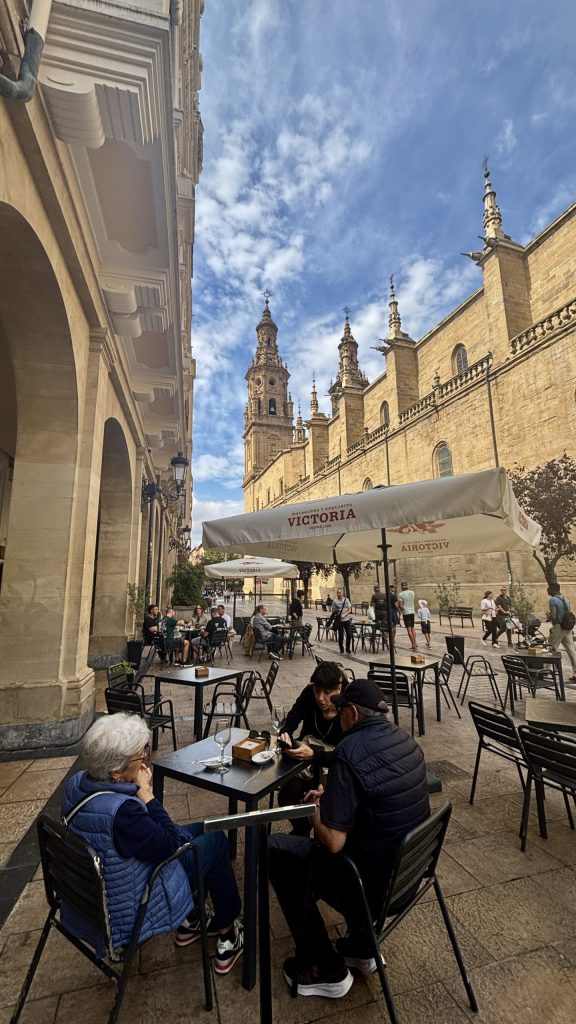
We spent the next hour working our way up Calle Laurel from one place to the next. We weren’t the only one, there were hundreds of other people doing the same thing. You walk in to a bar find a place at a table or a counter, go up to the bar order your tapas and a drink, pay, eat and when you are ready to move on take your glasses and plates back up to the bar. In every place as soon as we cleared our table another couple would step up and grab it and continue the routine.
At 2pm the tapas flurry was winding down and the streets were starting to empty out.
We continued this routine for a total of 6 places. The total spend for 6 plates and 5 drinks was €23. We were full and very happy. The tapas culture here is fantastic. We did not see an unhappy person even though all the places are packed. The Spanish really have something special here.
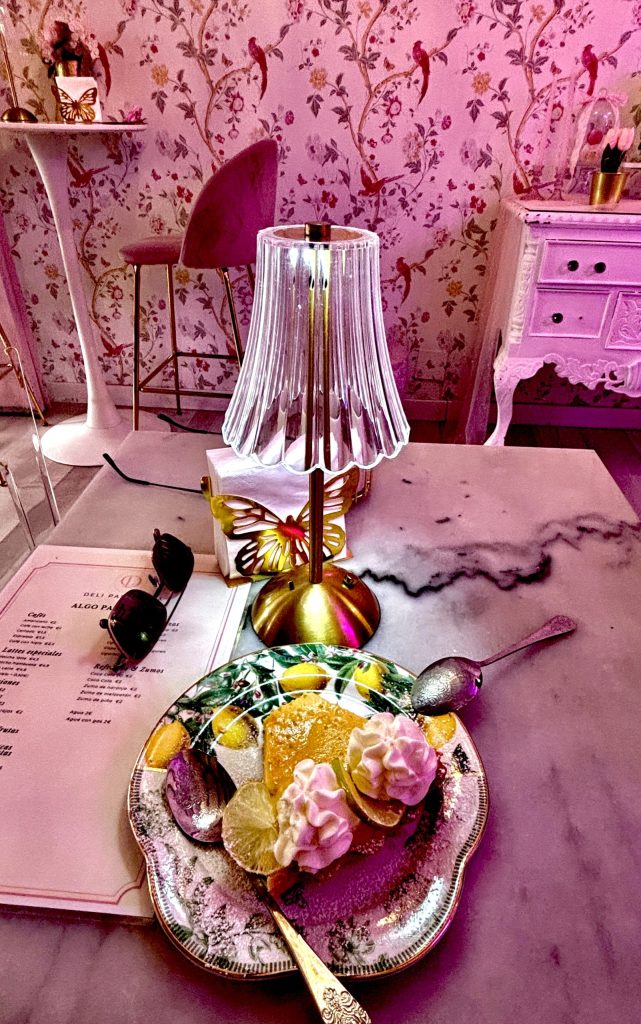
Our last stop was dessert, key lime pie.
After our trek up Calle Laurel, and under the threat of thunderstorms we returned to François for a well earned siesta. The thunderstorms rolled in around sunset, but we were too stuffed to care.
We have arrived in the capitol of Rioja where we are planning to wrap up our visit to Rioja. Rioja is the smallest Autonomous Area (kind of like a state) in Spain in size and population. The population is under one million for the region, and half of that is in Logrono. This region along with Extremadura, and La Mancha are know as the empty region.
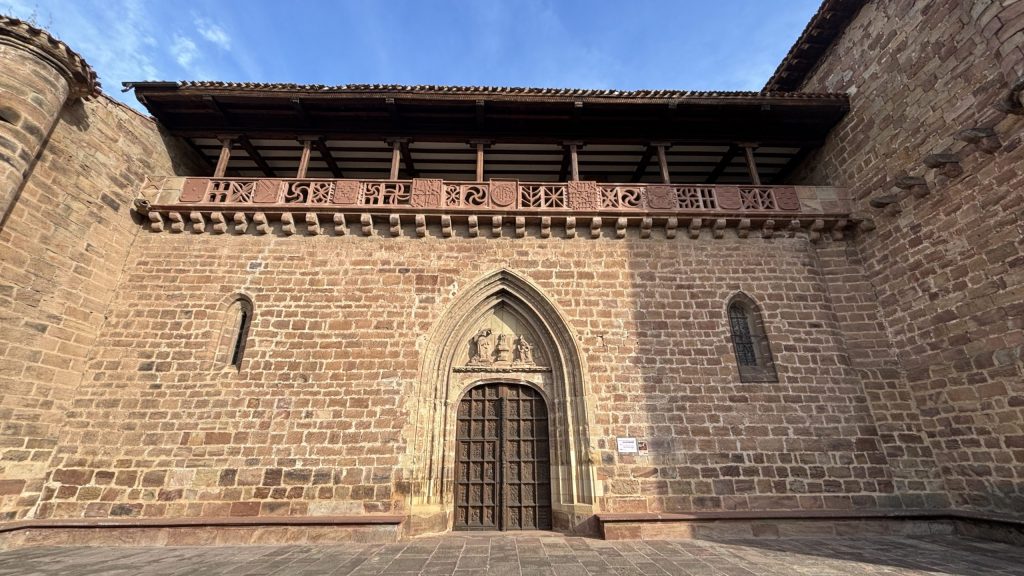
The entrance to the Romanesque Church in Ezcaray.
The population is low and has been falling since the 20th century as the younger population is moving to the cities, or immigrating. For the last two days as we have driven through multiple small villages we did not see one child, and the vast majority of people we did see were our age or older.
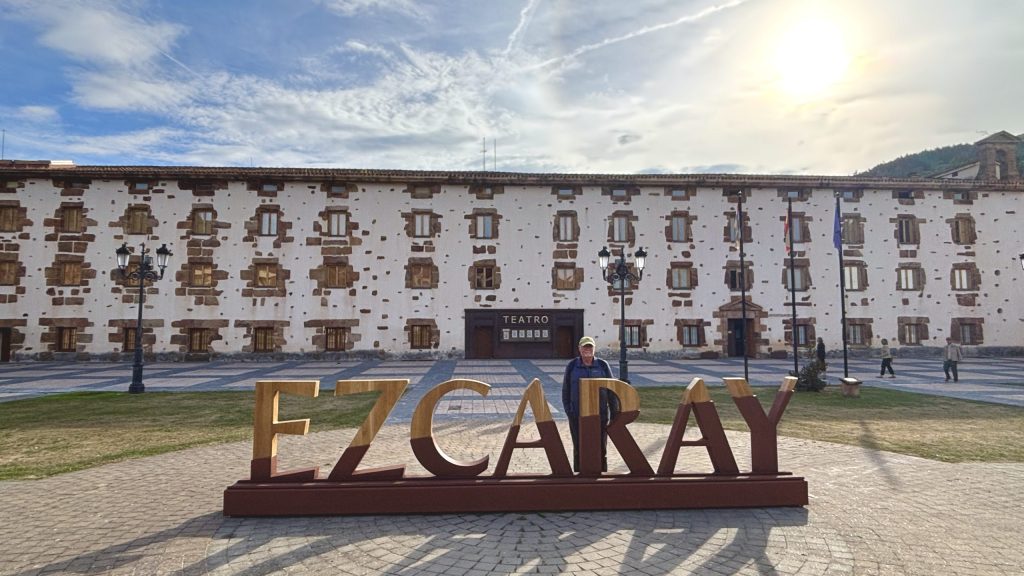
The former Royal Cloth Factory building in Ezcaray.
The villages have an all most ghost town feeling with many of the apartments and homes looking well maintained but closed up. I understand that a lot of Spaniards maintain a home in their ancestral village even have they have moved to one of the cities, but they may only use it for a few weeks per year. Most of the villages have no services outside a bakery and maybe a butcher shop/grocery store.
Ezcaray was the first town we passed through that had a variety of businesses still open.
On our way to Logrono we made a short stop in Ezcaray which was described to us as a resort town with a ski resort. It was larger than most of the towns and villages we passed through and still had banks, grocery stores, and even a few touristy shops. But it was also very quiet and again walking through the streets we saw no children at all, and very few young adults.
Ezcaray is a tourist hub, but we mostly had the place to ourselves.
But Ton and I love Rioja because of the remoteness. The land is beautiful with wide valleys and mountains. The Ebro River and it’s tributaries cut through it and pop up in unexpected places. The land also seems very fertile and as we were driving around today the potato crop was being harvested so there was work in the fields. The people we have met have been open and welcoming and we have really enjoyed them.
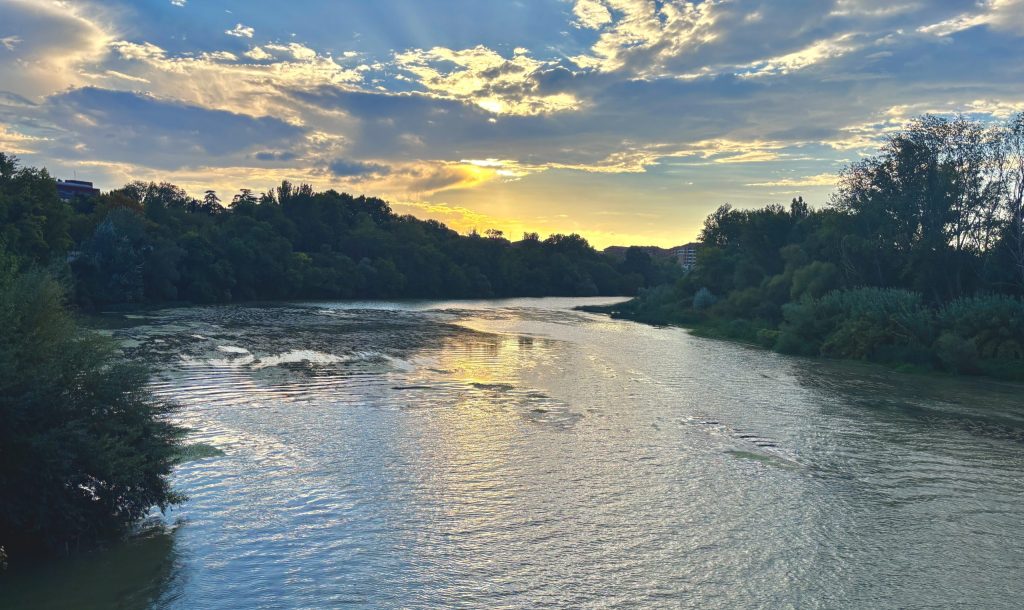
The Ebro River from the bridge near our campground.
We arrived in the only campground in Logrono about noon, it has a great location about 10 minutes from the heart of the city, but the layout is pretty tight and weird. At first I wasn’t sure we were going to get in as they were pretty full. First François was given an inspection by two of the workers, then they had an intense discussion in blistering Spanish about whether he would fit. I was becoming concerned we were going to get turned away when they guy gestured for me to follow him and walked me to a site and said we could park here. It was one of the bigger sites so in the end we did well.
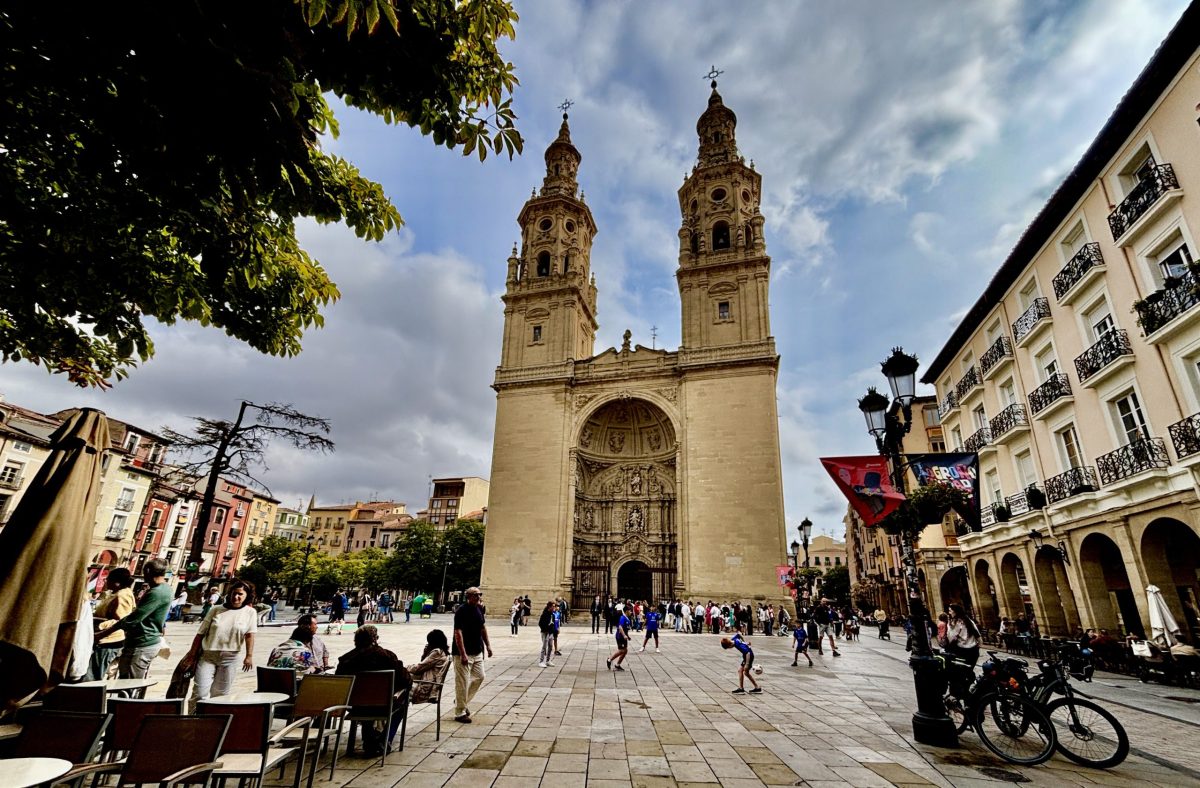
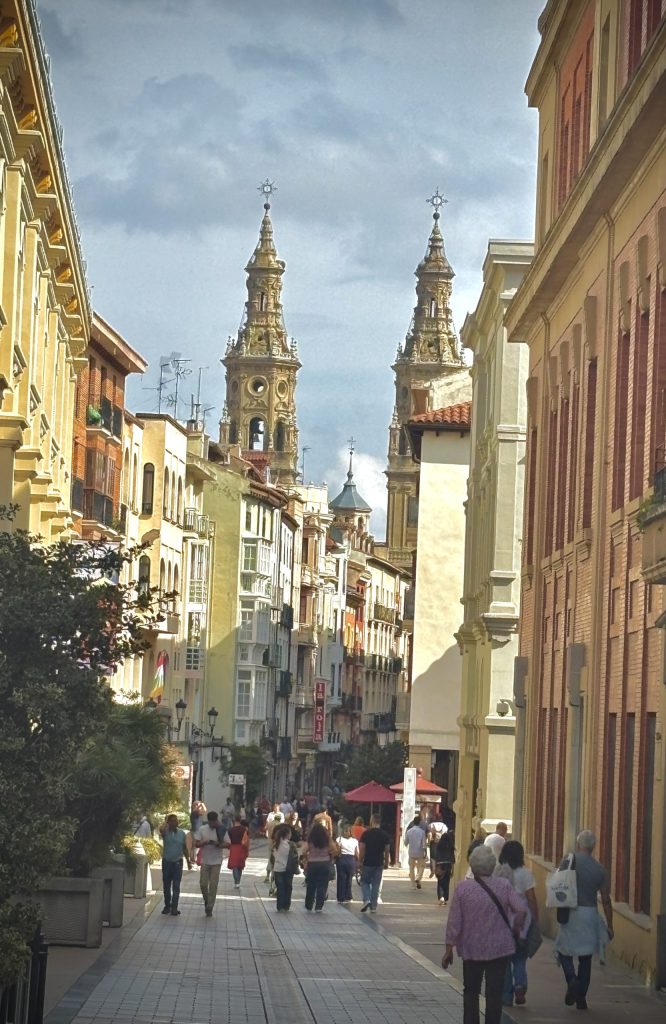
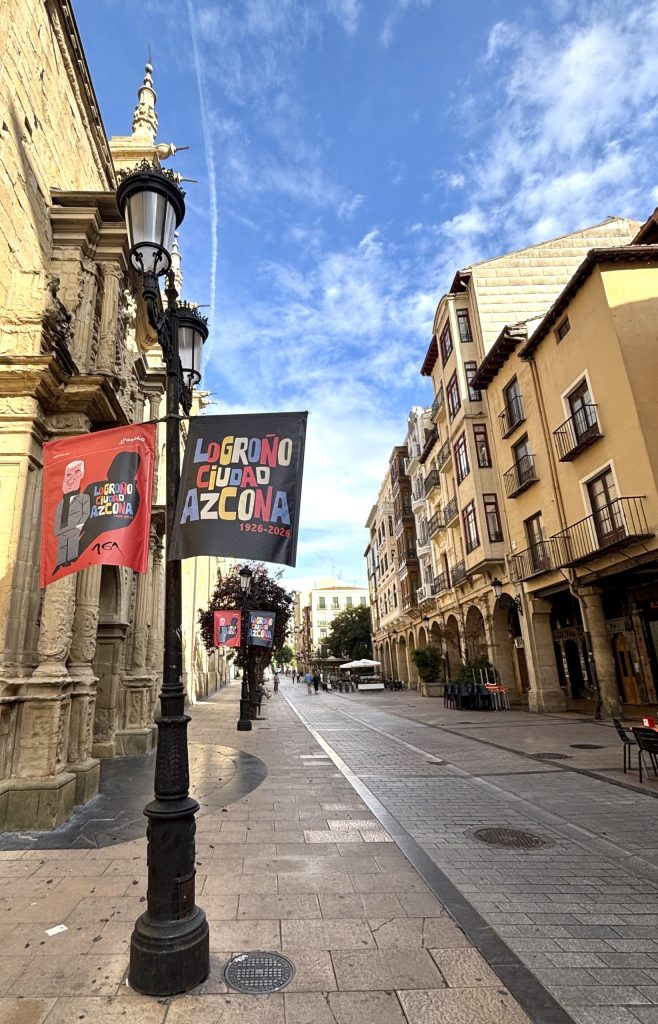
The center of Logrono at 4 pm.
Right after we got François parked another van was trying to squeeze out of a tight spot, and he maneuvered around a tree with about 1/2 inch to spare. It was impressive driving. I gave him a thumbs up and he said I knew I had it in an American accent. Every trip we usually have one encounter with an American in a campground. We had a short conversation as they were departing, they seemed to be enjoying themselves.
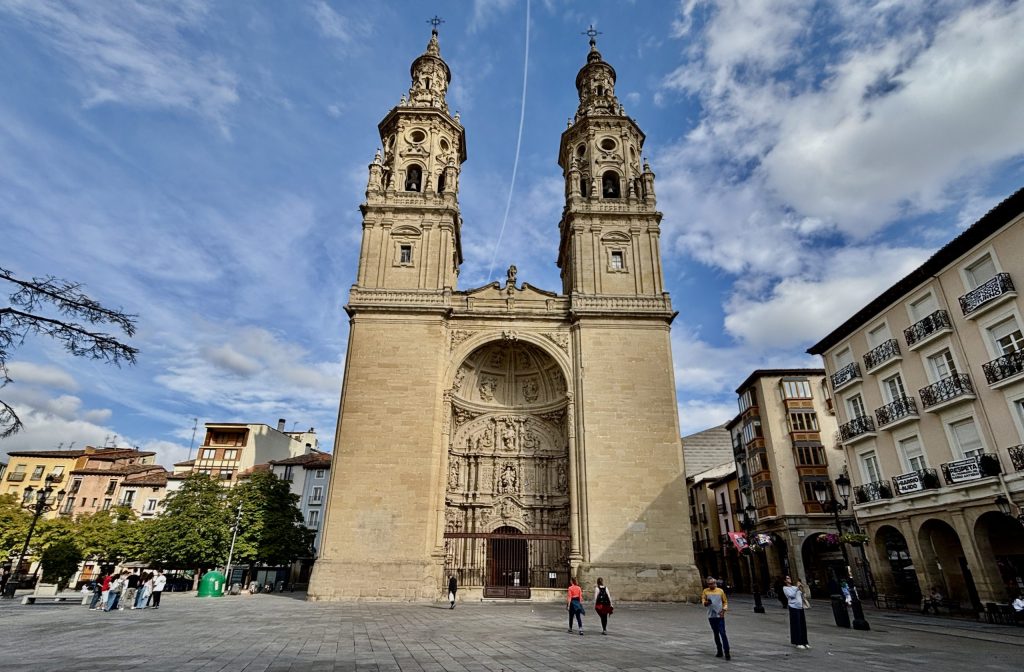
The exterior of the Burgos Cathedral.
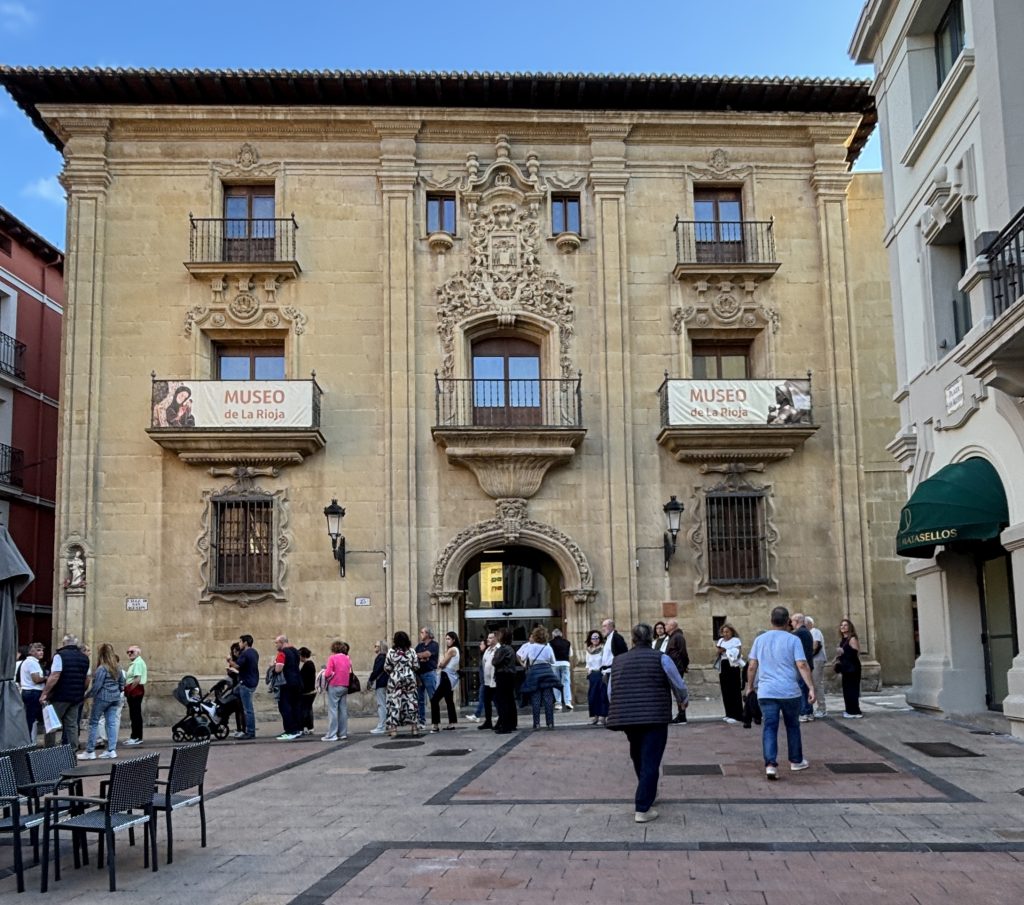
By the time we were settled it was 2pm and well into siesta time. So we had a lunch and I took a nap. We headed into town about 4pm which was still too early as the streets were empty. We found a couple of churches to pop into and visited the Rioja Museum which was excellent.
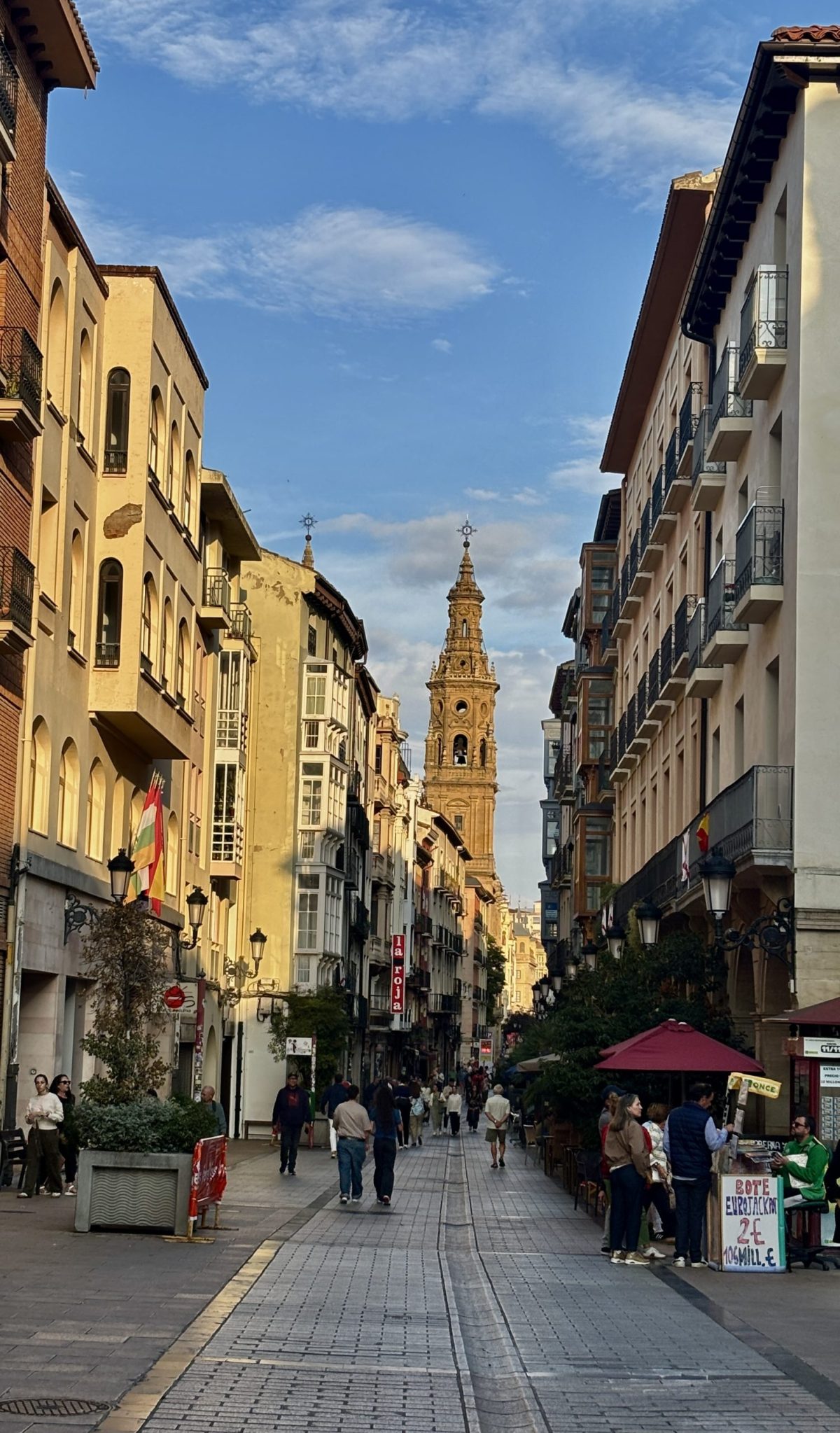
The streets starting to fill up at 6pm.
When we came out of the museum the shops were opening up and the empty streets were beginning to fill. But it was time for us to head back to François for dinner. The Spanish have such an unique internal clock. Most of the restaurants showed that their bar was open at 4pm but the kitchens were not open until 8 pm. We eventually get used to eating lunch at two pm, but we never have mastered the 8 pm dinner.