Venice is one of the most visited cities in the world, and the type of place we sometimes avoid for that reason. This time Ton told me that we really needed to visit as she had very fond memories from a trip with her mother when she was in college. We were lucky to visit during the off season as the crush of tourists you hear about so often was not that bad. One of the days the city was experiencing the Acqua Alta high tides that floods St. Marks Square. Unfortunately the week after we visited Venice experienced catastrophic flooding that inundated 80% of the city.
Today was a maintenance day. Our campsite is less than 100 yards from the main shipping channel for Venice port so we began the day watching the morning parade of different types of commercial ships go by including Container Ships, Car Carriers, long distance Ferries, and tankers. They passed close enough in front of us that we hear the crew talking on the ships, it was a fun start to the day.
Police boat near Venice.
After that we drove less than an hour to a US Army base in Vicenza Italy. François needed a good cleaning, and we decided to take advantage of the big American washing machines there. So the day consisted of washing all of our sheets and blankets, while Ton was working on that I gave François a bath in the rain which worked out since I did not need to rinse.
After that we did some food shopping and relaxed for the rest of the day.
After a wet and windy night we woke up to sunny skies with a touch of fog. The bet we had made on the weather had turned out, so we headed over to Venice for the day.
Our ferry dock was pretty memorable.
As I talked about yesterday I had to decide if we were going to take a gondola ride today. Instead I decided that we would ride on one of the ferries that acts like a bus. Line 1 follows the Grand Canal and it costs considerably less than a gondola, and covers more ground. After a couple of stops we gained the two front seats in the bow of the waterborne bus. This proves (at least to me)that it is possible to have romance without spending a lot of money.
Who needs an expensive gondola when you can take a waterborne bus and get the same views.Passing under the Rialto Bridge on our trip on the Grand Canal.
We also planned to visit the Rialto Bridge which is the most famous bridge in Venice. So we disembarked from our ferry/bus there after about an hour cruising the Grand Canal. The bridge and the market next door did not capture our attention, so we headed over to St. Marks square. The tide was quite a bit lower so the square was not under water today. The places that were flooded yesterday now had fancy outdoor cafes with bands and extremely expensive coffee for sale. It was quite a change from yesterday. While it was a lot prettier it somehow felt less interesting than the square under water.
This is the area of yesterdays picture of St. Marks under two feet of water. Today it is one of the most expensive cafe’s in Venice.
It was much less crowded than yesterday even with the better weather. The long Italian weekend was over, and there was only one cruise ship in town instead of the three that were here yesterday. So when we walked by St. Marks Cathedral we were shocked to see there was no line at all. Ton was in full photography mode so she sent me off to see how much it cost to enter. Another shock, it was free, so we headed in for a walk. St. Marks is the first cathedral we have come to that allows no photography so we do not have any pictures, but it was very beautiful.
Exterior shot of St. Marks Cathedral, as no interior photos are allowed.
By now we were quite hungry so we headed over to the old Jewish quarter of town where we had heard there were lots of restaurants. It was a nice walk and to our surprise the further we got from the tourist part of town the wider the roads got which spread the crowds out, the shops and restaurants were still intriguing, we found a nice garden with several interesting art works, and the people watching was still quite good.
We both really enjoyed this sculpture called “Guardians of Time”.
After our late lunch we decided to head back to the ferry as it was getting towards dark. While waiting we were treated to the cruise ship in town passing by on the canal with three tugs shepherding it along. It was a final giant connection to the city of canals.
As planned we moved to the other side of Venice to a campground that was open for the whole time we are planning to be here. The drive over in light traffic was pretty uneventful except for my inability to follow Greta’s directions. This resulted in us twice unnecessarily being on toll roads for short distances. The first time we ended up paying a toll, the second time when I put the ticket in the machine the barrier went up and the ladies voice on the machine said arrivederci before I could put my credit card in for the toll. She must of felt sorry for the fool who could not follow directions.
We arrived at the new campground early, hooked up and headed over to Venice during a little break in the rain. We had no real plans for the day and thought we would just walk around and take in the sights.
View of Venice from our ferry.
We followed the signs towards St. Marks Cathedral. The crowds were plentiful but not overwhelming, despite the three cruise ships we saw docked. As we walked I contemplated Ton’s offer of whether we take a gondola ride or not. Last night she told me gondola rides were €80 and lasted 30 minutes. She said she had taken one with her mother in 1978, so it was completely up to me whether we took one as she had already done it. We will see tomorrow.
Ton was disappointed that most of the gondoliers did not wear their hats, so she was happy with this guy.
It has been wet and blustery the last couple of days and the tides were pretty high along the water front, the sea was nearly up to the footpath with occasional waves washing over. This looks like it must be becoming more common as many places have temporary bridges stacked so you can walk without getting your feet wet.
Everyone walking on temporary bridges in front of St. Marks Cathedral.
St. Marks square was interesting because when we arrived about 60% of it was underwater. The water depth ranged from 6 inches to a couple of feet. All of the stores and restaurants on one side of the square were closed as they had about 2 feet of water lapping at their doors.
Difficult to have a nice coffee in a foot of water.
We wandered around for another hour or so, mostly people watching. The weather channel was dead on as about 1pm a light rain began. By the time we got back to the ferry station about 2pm it was a steady hard rain and the wind was starting to blow.
Waves breaking over the walkway at the ferry stop.
We spent the rest of the afternoon in François. We have a nice waterfront spot looking across the water at Venice and the cruise ships, it really is a nice view. Ton cooked up a wonderful seafood pasta. We have really enjoyed both the restaurants and the quality of the food in groceries in Italy. We spent some time trying to figure out what food from Italy we should try to bring back home.
The weather today is very Oregon like; steady rain and high temperatures in the 50’s. Our plan was to simply head up to Venice and hunker down for the day and wait out the bad weather by planning our time in Venice.
There are two points to enter Venice conveniently from a camping point of view. One entry is southwest of the city and the other is east of the city and entails going around the city. Even though it is less convenient I chose the east one because it had 6 campgrounds in the vicinity and two of them were listed in my planning app as open year round. When we arrived the first one informed me that they were closing tomorrow at noon. The alternative is closed for two weeks for renovations. So again we were looking for a plan b. After some thought we are staying in the campground we arrived at for one night, and after confirming that the one southwest of the city we passed 65 kilometers ago is indeed open we will head over there tomorrow and carry on with our plan for two days in Venice.
A soggy windshield shot as that is all we saw today.
We are getting nervous about Italy because it looks like a lot of the campgrounds are shutting down after this weekend, so our travels in Northern Italy may get curtailed, and will certainly take more planning.
Rome is only the second capital city we have visited in Europe. We tend to avoid big cities but did not want to miss out. The drive in and moving around were pretty easy, and we were rewarded with a great time, except for the Vatican museum tour which was a real cattle call.
One of Ton’s favorite sites in Rome were the Swiss Guards at the Vatican.
Our second day in Rome was aimed at the Roman ruins and the Colosseum. Again the public transport in Rome worked very well and we arrived early for our tour. This time we were able to get a slot on an earlier tour which was lucky as this tour was pretty small and we had some things we wanted to see after the tour.
We began by visiting Palatine Hill which contains many of the ruins of the old Roman city center. They are still discovering many ruins as Rome like many cities is in layers. We were told that there are seven layers of buildings from the modern we see today to the original remains of the founding of the city. We began the tour by looking over a site that was uncovered when they were extending the metro system. It was the remains of a temple and was quite impressive. The guide says this happens all of the time when new construction is begun in the city.
One of the ancient temples very well preserved because it was converted to a Catholic Church.
The tour of the ruins around the Colosseum was very interesting, and the history is fascinating to hear. The ruins are different than those of Pompeii because Pompeii was destroyed in a flash, the ruins in Rome happened over centuries due to neglect. Originally Rome was built on hills because the areas between the hills were flood plains. Over time as the Romans developed their sewer systems they were able to manage the floods and much of what we saw today was development in what had been the flood plain. As Rome declined the sewers and other flood control measures failed, and things were covered over with mud from floods.
Overview of the Palatine Hill Area of Rome.
After a thorough exploration of Palatine Hill, we headed over to the Colosseum for the big finish of the tour. The Colosseum is an impressive structure. The resemblance to modern stadiums is striking. The building held 50,000 people for events, and they could have the crowds into the building in 30 minutes and could empty the building in 20 minutes. The construction techniques are fascinating to me, and their solutions to structural issues were quite sophisticated. Most of the seating is gone but you can easily visualize the crowds. They even had a method to cover the seats during rain using canvas and ropes.
Interior of the Colosseum.Exterior shot.
Our final two sites for the day were the Trevi Fountain, and the Spanish Steps. They are having a real Indian Summer here so the crowds at these two sites were summer like. For the Trevi Fountain I picked a spot where I could enjoy a view and let Ton dive into the crowd to get some pictures.
Ton braved the crowds to get this shot of the Trevi fountain.
Another very touristy day, but we have no regrets. Sometimes you have to be a tourist and not a traveler.
Today we decided to start our time in Rome by visiting the Vatican. Yesterday after some research we decided to do a guided tour, it was €10 more than the unguided ticket. It was expensive but the other option was waiting in line for an indeterminate amount of time to purchase a ticket as an individual.
Our tour was at 11am but not having tried the public transport in Rome we left about 8:45 to give me some time to get lost. It turns out the trip to the Vatican was a breeze and we were there about 9:30. We used the time until the tour began to wander around St. Peters Square. The square itself is very impressive and we had no trouble killing the time we had until our tour.
St. Peters Basilica from the exterior.
We joined our tour and headed over to the Vatican Museum. The museum was fantastic but the crowds inside were incredible. I am not sure how many people they let in per day, but if today is any indication it is too many. At times you could not stop walking as you were being carried along by the crowds. We saw a lot of beautiful things that we would have liked to stop and admire but were unable to due to the crowds. It also made following the guides talk very complicated as we would frequently be separated from her by a wall of people and were not quite sure what piece of art she was talking about. We later learned that even in shoulder season Mondays and Saturdays are very crowded.
This level of crowd was the norm for the tour.
We eventually made our way thru to the highlight of the trip the Sistine Chapel. Again the place was jammed with people and you were basically herded into the middle of the Chapel and had to stop and stand in one place. There was no moving around to get a better view of a particular part of the chapel. Having complained I know why so many people want to see the chapel as it is absolutely stunning, one of the most beautiful places I have ever seen. In the end it was worth the trouble. Sorry there are no pictures from the Sistine Chapel allowed.
This picture is a Raphael from the Popes Apartments. He depicts Michaelangelo sitting in the lower left center. He is in Renaissance clothing unlike the other characters, and sitting working on a list.
The tour finished up with St. Peters Basilica. We have visited a lot of Cathedrals during our time touring in Europe but this one is special. While the crowds were just as large, St. Peters was more than big enough to handle them. While the place is ornate it struck me as more understated, as if it has nothing to prove. We appreciated this, but the art that is in the cathedral is beautiful, and surprisingly to us from many different eras. It is not frozen in time which is also refreshing.
A Michaelangelo from St. Peters Basilica.
In the end our three hour tour took a little over four hours due to the crowd, and we emerged from St. Peters famished. Ton had picked out a place she wanted to try and following Google maps we arrived at the site, sat down and ordered some pasta, when I looked across the street and saw the name of the restaurant she had picked out, we were in the wrong place. The food was pretty good though.
Not much to talk about today. We woke a little early, prepared François for movement after four days sitting in one place. The drive to Rome was uneventful, the Autostrada was quiet and easy.
The Monastery at Monte Cassino from the Autostrada. This building was completely rebuilt after WWII as it was fought over for several months during the war and completely leveled, before Polish troops fighting for the allies took it.
We arrived at the campground pretty early and got set up for what will be another extended stay. We spent the afternoon researching tours and purchasing tickets for the two big attractions the Vatican, and the Colosseum. So the next two days are already planned. As it was Sunday everything was closed but a grocery store so we headed there for a little recreational shopping. Some days are not very interesting.
Campania includes three of the biggest tourist attractions in Italy, Pompeii, the Amalfi Coast, and Naples. Pompeii and the Amalfi were as expected spectacular. Naples was a pleasant surprise and another place I wish we had spent more time.
We slept in a bit today, and after pottering around the campground a while we headed into Naples. When we got to the train platform here in Pompeii we ran into the French couple we did the Amalfi coast with yesterday. Ginette and Michel were also going into Naples for the day and we ended up joining up for the day.
Romance in the air in Naples. Ton had no idea she caught the couple in the lower left corner in the photo.
We did a couple of driving tours of Naples to get a feel for the city. Naples is an interesting city. It is as chaotic as any city you would find in the world, Ton said the traffic reminds her of Bangkok. The traffic is a free for all, and entertaining to watch. The city itself is grimy but seems full of character. The setting for the city is absolutely beautiful with a large bay with the Amalfi coast in the distance, and Mt. Vesuvius looming over the port. This is a city that no one is going to be neutral on, you are going to love it for its character and in your face attitude, or you are going to hate it for its grime, and lack of discipline. I was a little tempted to extend one more day to spend some time on foot to get a better sense of the city, but Rome is calling.
The fort guarding the harbor in Naples.
We had a nice meal with Ginette and Michel, and really enjoyed our day with them. Despite not having a common language we had a good time and learned about each other. As the day went on Michel tried out his limited English, and Ton even began to dredge up some of her college French. We really enjoyed their company and feel like we made some new friends.
Yesterday was a bucket list item for me, and today was a bucket list item for Ton. Before every trip Ton gives me some places we must see, and we took care of one of them today, visiting the Amalfi Coast.
One of the many stunning views on the Amalfi coast.
The Amalfi Coast is a spectacular 40km stretch of road strung along a peninsula. The road is carved in cliff side, and the views are spectacular. Part of the fun is watching the drivers deal with the hundreds of switchbacks on what is effectively 1 and 3/4 American lanes. RV’s are forbidden which allowed me to enjoy the views and the chaos on the road as a spectator. It was worth every dollar we paid to not be driving.
A relatively straight section of the road, of course we are on the same road looking across at that stretch.
To give an example of Italian driving from today. Our driver did not speak English. At one point we were crossing a bridge and I saw a little village and harbor tucked under the bridge and pointed to get Ton’s attention. Next thing I know the driver pulled over into the on coming lane (there were cars coming), threw the van in reverse, and backed to the middle of the bridge where he parked, turned around and looked at the 5 of us in the back seat and said “Picture”? The five of us looked at each other and said why not? So we got out of the car while cars going in both directions dodged around us and the van. The funny thing is this did not seem to faze any of the Italians in the other cars, vans and busses in the least, they all just shrugged and maneuvered around us like it was perfectly reasonable to stop in the wrong lane of a narrow two lane bridge to snap a few pictures.
The view from the bridge.
Our tour included three towns and a tourist attraction. The first town we saw was Positano which is the jewel of the Amalfi. Steinbeck wrote a short story about it, and it has been featured in several movies. It is a beautiful sea front with the town flowing up the cliffs. Tourism is the main, (possibly only) industry in the town now, but the setting makes it worth dealing with all of the people.
Positano as we are dropping in on the road.The harbor in Positano with ferries and tour boats coming and going.
The next stop was at a tourist attraction called The Grotto. There were six of us on the tour, two other Americans, and a French couple. None of us were quite sure what we were getting into, but it turned out to be a short tour of a pretty underwater cave.
The light for the Grotto comes from an underwater entrance to the cave. It is natural.
We next stopped at the largest city and the namesake of the Amalfi Coast, Amalfi. In many ways it felt a lot like Positano. A small harbor leading to another town carved from cliffs. Amalfi did have a really beautiful cathedral though we decided to pass on the interior as we are getting a little jaded about cathedrals.
The exterior of the cathedral in Amalfi is really spectacular.
The final town for the day was Ravello which was up in the mountains of the Amalfi away from the sea. It was clearly the most prosperous of the towns, and looked like it dealt with a higher end clientele than the other two towns.
Ravello way up in the mountains of the Amalfi coast.
We enjoyed poking around in a ceramic store with the French couple. At the beginning of the day they were pretty quiet as neither one speaks English. But by the end of the day we had a fun time communicating with them using broken English, broken French, broken Italian, sign language and smiles and laughter. They have been traveling extensively and it is a shame we cannot communicate better as Ton and I would love to talk to them about their travels in Morocco and Greece.
This is the high end ceramic shop in Ravello, some of it’s clients include Mark Rufallo (the Hulk), Steven Tyler (from Aerosmith), Mariano Rivera (NY Yankees), and Rod Stewart (the singer).
Since we are parked across from the entrance to Pompeii we decided to visit the site. I have always been interested in Pompeii since I read about it when I was a child, so I was excited for the visit. Pompeii was destroyed and buried when Mt. Vesuvius exploded and the ruins were not discovered until the 1700’s.
The city walls of Pompei.A public fountain, all of the public fountains had faces on them.
But for me it was seeing the more day to day buildings such as bakeries, baths, taverns, public toilets and even brothels. The different houses from the rich, working class, and the poor were on view.
A fresco from a wealthy home in Pompei.
It was very easy to imagine what life was like in this Roman town. You can see very clear similarities between how people live today, and how they lived back then. You can see how very highly developed things were and how some things are very common to today. As an example the ovens used in the bakeries are almost identical to those used today for Pizza in the local restaurants.
An oven in a bakery that is almost identical to the pizza oven in the restaurant next to the campground. We think the large stone on the left is for grinding grain into flour.
Ton read my account of entering Tropea yesterday and said it sounded a little whiny. Ton thought Tropea was a really beautiful city, and felt I should have spent more time talking about how beautiful the town was, about our fun encounter with a young clerk in a food shop and that the water off shore was a beautiful emerald color. So I apologize to Tropea for not giving it it’s due yesterday.
Another picture of Tropea to make up for my whining.
As usual on these trips we start to panic when we realize that there is more to see than we have time for. Today we are two weeks into the trip, and have a lot more to cover. I had hoped to spend more time in the far south, but we both agreed that there was a lot to do around Naples so we made the decision to have a big travel day up to Naples. It helped that it was our first rainy day of the trip so we headed up the excellent and mostly free Autostrada to Pompeii. Tonight we are parked in the Spartacus Campground across the street from the entrance to the Pompeii archeological site.
The A2 Autostrada in Southern Italy is quite an engineering feat, we must have passed thru more than 50 tunnels from 100 to 2500 meters long.
Since there is not a lot to talk about today I am going to tell one of my favorite stories from Sicily. As we were walking around Sicily we kept seeing these flower pots of a male and female head. The male head looked Arabic, and was often black. We finally dug up the story behind these pots.
These flower pots are all around Sicily.
Once upon a time in Palermo there lived a fair maiden who was extremely beautiful, but she was a loner, and was not interested in suitors. One day a Moorish Prince landed in Palermo, and spotted the fair maiden and fell in love. He boldly entered her home and professed his love. The fair maiden was taken by his forwardness and agreed to allow him to become her lover. One day she asked when he planned to marry her, when he confessed that he must return to Africa tomorrow, and that he had a wife and family at home. The maiden said nothing, but that night she murdered him in her bed, cut his head off and turned it into a flower pot so he would be with her forever. How very Sicilian!
I was worried about the day for some reason. I was 90% sure that I had told Greta Garmin the right ferry terminal, but there are three in Messina, and I did not want to be playing Ferry Terminal roulette in an old Italian city. It turns out I had nothing to worry about as I had put in the right terminal. I think the other reason I was uncomfortable is I have a feeling we did not give Sicily all of the time it deserves. We have not had a bad day on Sicily.
They have an interesting system for selling tickets for the ferry, there is an island in the road with two ticket booths in the middle, everyone just drives up to the vicinity of the ticket booths, stops their car, jumps out and heads over to the ticket booth, once they have their ticket they wind their way thru all of the other randomly “parked” cars, and head on down to the ferry. Initially we sat at the end of the “line” of cars trying to figure out the system, which confused the Italians behind us who scurried around us looking annoyed. Eventually we figured out the system and joined in the fun.
It was a short ferry ride over to the boot of Italy. We pulled off the ferry and on to a really nice freeway for the next 60km’s on our way to the resort town of Tropea. We picked it as it seemed like a pretty easy drive if anything went wrong with the ferry. We were also intrigued with some of the pictures of the town in one of our tour books.
Arrivederci Sicily.
The drive was going along pretty uneventfully until we dropped down into Tropea. The road down from the mountains above town was pretty twisty, but we are getting used to that by now. The real problem was once we entered town we were immediately in typical small city roads which are challenging in a RV, then the real problem started. In Italy they have areas called limited traffic zones (ZTL) where cars are forbidden to enter without special passes. The fine for violating these zones is around €100, and they are enforced by cameras. The problem is if you accidentally blunder into one you may pass several cameras before you work your way out of the area, and you get fined each time.
The road we turned down to reach the campground, the sign on top means no campers or trucks. I missed that sign as I was trying to work out how to get out of the center of town.
While I was trying to follow Greta and thread my way down the narrow streets I saw a Limited Traffic Zone sign in front of me. I made a left turn to avoid entering the zone, and hoped it would trigger Greta to find another route that avoided the dreaded zone. She led us out of town on even narrower roads to punish me for not following her original route. We finally emerged on a nice wide highway and I thought problem solved, but suddenly she wanted me to make a right turn onto a road that was on her map. The problem was the road was in a gorge about 50 feet below us, so now we were heading back into town, and sure enough there was another no traffic zone sign, but I had a place to pull over and sort thru things. As I was looking at the map, I happened to notice that the no traffic sign had a green sign under it that was flashing a message in Italian, and then a miracle, in English the same sign said Free Access. I took this to mean it was ok to enter the limited traffic zone and did. We were not out of the woods as Greta than told us to turn down the narrowest road yet, a motorcycle behind me honked a warning and I new that I might be heading into trouble. The road was narrow and the switchbacks were hairpin. Luckily François is short, and most importantly we did not meet anyone coming up. So after quite an adventure we made it to our seaside campground. So I guess my unease was right I just did not realize it would be on the end of the trip.
After I had a beer and did some research on how to avoid ZTL’s we walked into Tropea and it is beautiful.
Our campground is just to the left of this 6th century monastery.Sunset from our campground.
My only regret about our visit to Italy was we rushed the time in the South a bit. If I could go back I would have spent several more days in the south, particularly Sicily. There is so much about the place that I liked. The rugged mountains that run down to the sea are beautiful. The interesting stories that come up when you dig into the history. It may look a little “lived in”, but it is incredibly charming.
To make up for rushing Sicily in 2020 we revisited it in 2023 for a more extended stay. Our fond memories of our short visit in 2020 were confirmed on this trip. Italy is a wonderful country and there is not a part of it we have not enjoyed, but Sicily is my favorite part of Italy. Italian food is great, but Sicilian food takes it to another level in my opinion. There are some foods that we saw but didn’t get to try that I think would make another trip to Sicily worthwhile.
Taormina was on Ton’s must see list today. I made a scouting run down to the terminal to discover the best way to Taormina. Option 1 was a hop on hop off bus that gave us use of the tourist bus and the regular bus for €14 each or take a regular bus for €3. We were torn about what to do, and still had not made up our mind when we got to the terminal. We finally chose the regular bus, but after we bought the ticket the cashier who must have heard our debate, asked the Hop on Hop off bus driver to let us ride to Taormina, so we ended up with the best of both worlds. This good samaritan was the same guy who had rebuffed my earlier attempt to ask him about the bus to Taormina in halting Italian, with a gruff “What do you want?” in English.
Taormina is the town between the two high points of land.
Taormina has been a town since the ancient Greeks, and it is really a spectacular site on a large bluff overlooking the harbor at Giardini-Naxos. We were dropped off at a nondescript bus terminal, but as soon as we began hiking up the road to the town the views were spectacular. As we got closer to the town center we both became more charmed. Despite the fact that Taormina is definitely on the tourist trail, complete with all of the brand name stores lining its main street, it still had a spirit that we both really enjoyed.
The main road in Taormina lined with big brand shops, but still beautiful.
The town meanders up and down hill. The main road is wide and flat, but all of the roads off of it are either up or down and quite narrow, which adds to the atmosphere. Off of the main road the shops were run by locals who were very friendly without being pushy. Ton had picked out two potential restaurants for lunch, but one had gone out of business, and the other was not open. Just down the street was a cheese store that advertised lunch and we were both drawn to it. We went inside to take a look and saw a restaurant in the back. We asked the lady at the counter if they served lunch and she said yes in an hour, would we like a reservation. Something I have learned is that in romance languages my short name “Ron” is perplexing, so when she acted confused about my name I switched it to Ronaldo, she immediately connected the dots and had a good laugh with one of the customers.
Typical side “road” in Taormina.
Having an hour to kill we decided to head up to the Greek Theater which is the big attraction in town. When we got there it was €10 to get in, and since we have seen a lot of antiquity sites on this trip decided to pass. We still had time to kill so we went to the municipal park and sat down on a park bench to enjoy the views.
The view from our park bench in Taormina.
The lunch at the cheese shop was superb. We opted for a Sicilian food and wine tasting. It consisted of three wines, and a plate of cheeses, meats, and grilled vegetables. We have had a lot of good meals on our trips in Europe, but we both agreed that so far this is the best. The food and wine while simple was fresh and delicious. The service of the husband and wife was great and they enjoyed explaining the food and wine to us. They were clearly proud of their Sicilian heritage and happy to share it with us. At the end neither of us could bring ourselves to leave so we stalled with a coffee, and an aperitif. Ton was tempted to return for dinner, but they were full, though we could tell if we pushed and had some flexibility they would have found a way to accommodate us. We rarely mention places by name but if you are ever in town do not miss La Bottega Del Formaggio.
I really enjoyed this meal much more than my expression shows!
Today was a maintenance day mostly. We woke early as we wanted to drive to the US Navy base at Sigonella to take care of laundry and shopping. We covered about 150km’s to the base, and the traffic was Sunday light. Large sections of the freeway we traveled on were under construction or heavy maintenance, and we got a little turned around for awhile, but recovered without too much trouble.
Arriving at the Navy Base we were not sure what the procedure would be to gain access. In Spain it was pretty complicated, in Germany it was as easy as the US, and here it was easy also. In Germany and Spain there were limits on what facilities we could use, but here in Italy we could use everything. All of the chores were taken care of mid-afternoon. Our original plan was to stay somewhere close to the Navy base, but the pickings were slim.
As we were driving down the coast we realized Mount Etna, was having a minor eruption. It turns out it has been putting out ash clouds now for a few days, and it was strong enough on Wednesday that they had to close the main airport for Sicily.
Mt. Etna is having a small eruption, it is venting in two places.
Our plan for tomorrow is to visit a town called Taormina, so as it was early I decided we would head there. It was a short hop up the coast on the freeway, which for the last 20km’s turned into a tollway. I was a little distracted as we came to our exit and blew right by it, so we had to go up one extra exit. At the exit as we pulled into the toll booth I noticed everyone was paying with cash. We panicked as our smallest bill was a €20. The machine coughed up €18 in change with no problems.
Greta Garmin sent us up a national road, but it turned into a driving test as the road was a beautiful seaside road but quite twisty, and with cars parked fairly randomly in one or sometimes both lanes it was a tight squeeze at a couple of points. The good news though was we realized that the Sosta (Italian for Aire) we are using tonight is located quite close to the ocean. If we had taken the right exit we would never have known that.
This is the road you end up on when you miss your exit on the freeway.
After an early dinner Ton proposed we walk on into the town. Giardini-Naxos is a postcard beautiful Mediterranean fishing port town, with incredible views. There was a cruise ship in port, and as the sun set the harvest full moon was rising over the ocean. The walk around the port was pretty romantic. It was a fantastic end to a day that we had low expectations for, and all because I missed an exit on the freeway.
The harbor of Giardini-Naxos with Mt. Etna in the background.This view is the reward for missing the exit and squeezing thru town.Ton loves fishing ports, because the views are pretty, and the food is great.
We finally have a plan for Sicily and it was time to move on from Marsala. It was a short drive to Agrigento for our first stop.
We spent the last two days trying to figure out what these little tubs were for. We finally asked and they are for washing your feet, of course!
We had heard a lot about the poor quality of Italian roads and particularly those on Sicily. The road today was on the whole good, the only problem was I spent the whole trip more or less not knowing what the speed limit was. The road was controlled access most of the way and while it was only two lanes there was very little cross traffic. But the speed limit was a total mystery, sometimes really good stretches were posted at 50kmh, some other stretches were posted at 70, and once in a while we would see a short stretch of 90. Near the end just to add some variety there was an 8 or 10 km stretch posted at 60. The problem was there was either no rhyme or reason to the speeds, and the Italians around here are pretty stingy with signs. The Garmin was no help as it seemed to have a different opinion than me and was also frequently different than the signs. You cannot judge by the local drivers as they bomb along at any speed they feel comfortable with, but they know where the speed cameras are. I think it will be a miracle if I do not end up with a ticket somewhere along the line, if I did not get one today even though I was one of the slowest cars on the road.
The view of the Sicilian countryside from our trip today.
The purpose of todays trip was to visit the Valley of the Temples near Agrigento. The area around here has been an urban site since the Greeks and there is a large area with different versions of mostly Greek temples, with an area of Roman development thrown into the mix. Ton and I counted 8 different temple sites, but we may have missed a couple. The entire Valley is about one and a half miles, and is one of the most extensive archeological sites I have seen.
Part of the remains of the Temple to Hercules.
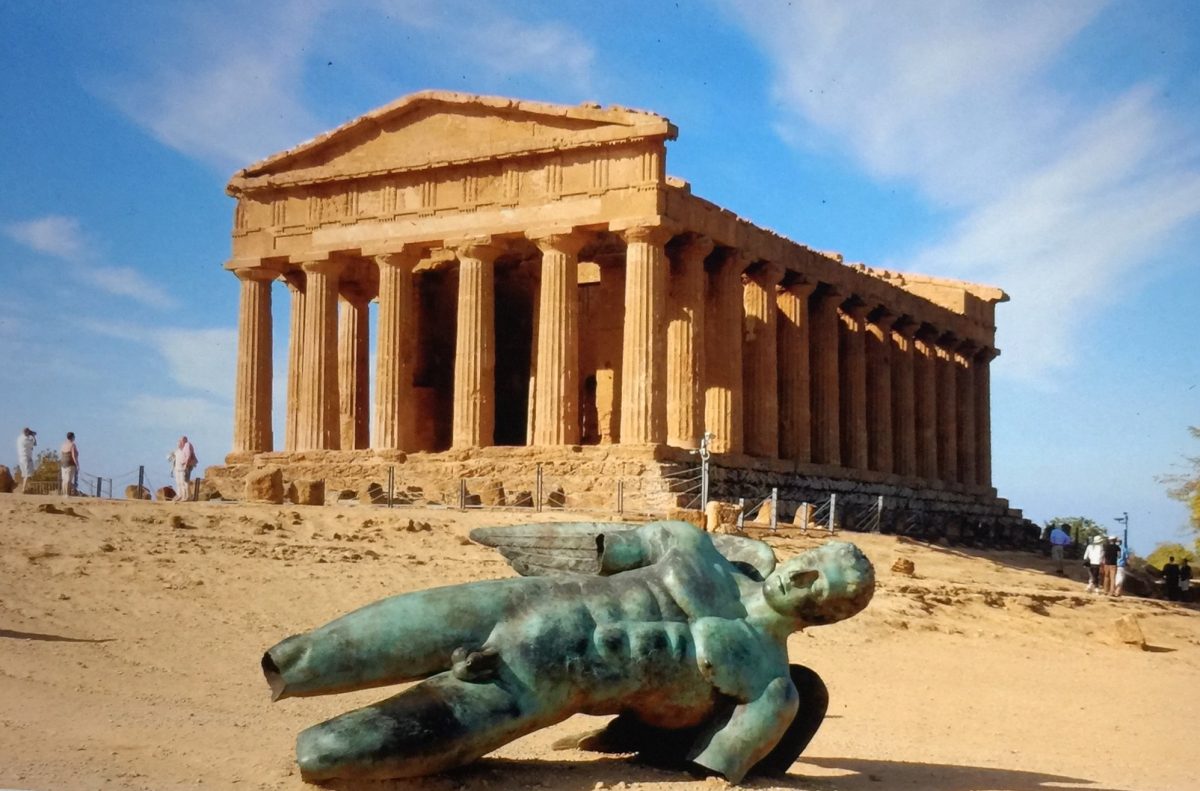
The highlight of the valley is the Parthenon like Temple of Concorde which dominates the valley. Originally built by the Greeks 2500 years ago it has been repurposed over time as Carthaginian, Roman, and Christian Temples/Churches which is why it has survived in such good shape. Many people say it is in better shape than the Parthenon in Athens.
The Temple of Concordia.Another view of the Temple of Concordia, with a broken statue of Icarus in front.
The Valley of Temples is one of the most impressive World Heritage Sites we have visited. For me it was pretty awe inspiring.